Why St. Louis Is a Two-Speed Housing Market in 2026
Sep 23, 2026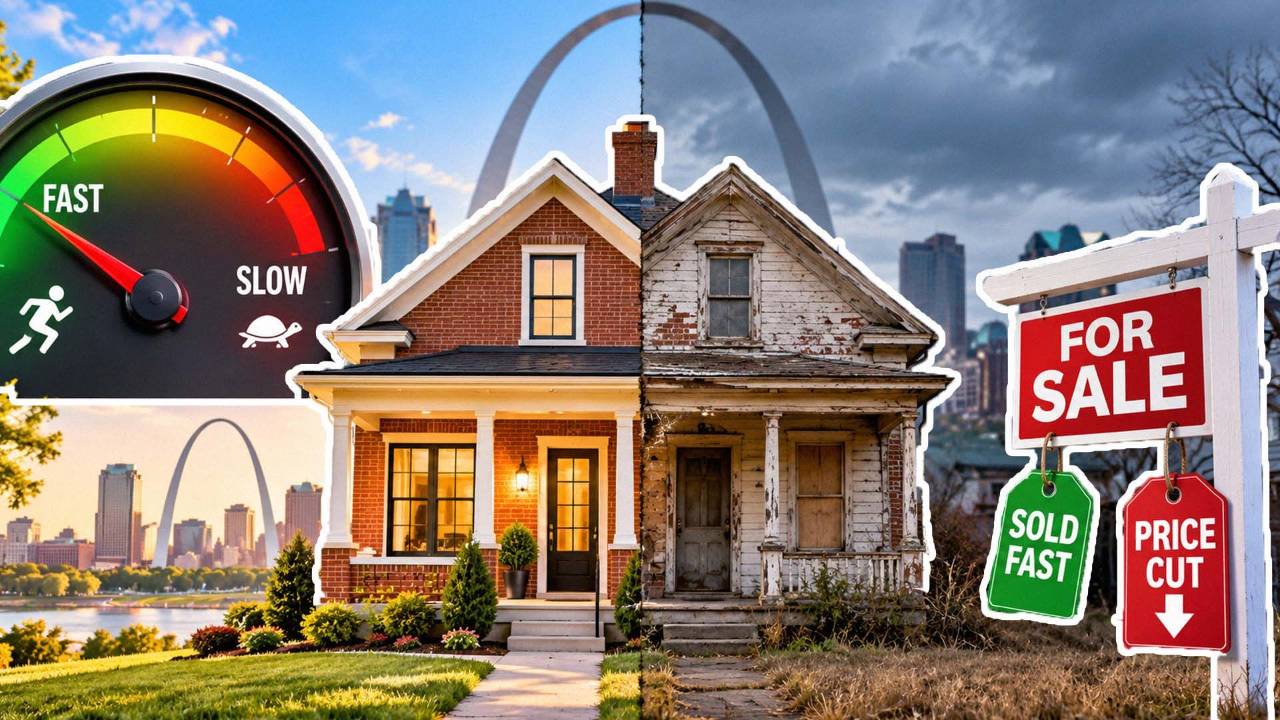
Written by David Dodge
More homes are for sale, prices are still climbing, and mortgage rates are knocking on 7%. Here's what that mix actually means if you're buying or selling in the St. Louis area this fall.
If you've been watching the St. Louis housing market for the last few years, you probably remember what it felt like in 2021 and 2022. Listings disappeared over a weekend. Buyers waived inspections. Sellers picked from a stack of offers and sometimes didn't even bother with showings past the first Saturday. That era shaped how a lot of people still think about buying and selling here.
But September 2026 is not that market anymore, and it's not a crash market either. It's something more interesting. Local analysts describe the region as having moved past the sharp price swings and tight inventory of the 2021 to 2024 cycle into a more layered, split market. I've been calling it a "two-speed" market, because that's honestly the easiest way to picture it. Think of I-64 at rush hour. One lane is moving at a good clip. The lane next to it is crawling. Same highway, same day, completely different experience depending on where you're sitting. That's St. Louis real estate right now. Some homes are going under contract in less than a week. Others are sitting for a month and a half, collecting price cuts and "still available?" messages that never turn into offers. In this update, I'll walk through the latest numbers, explain why the market split this way, look at what's pushing it (spoiler: it's mostly mortgage rates), and then get practical about what to do depending on whether you're buying or selling. I'll keep it grounded in St. Louis City, St. Louis County, and the surrounding metro, because national headlines rarely match what's happening on your street in Kirkwood, Florissant, South City, or St. Charles. Let's start with inventory, because that's the biggest change from a year ago. Across the St. Louis metro, total homes listed for sale hit 9,864, which is up 13.9% from the same point in 2025, according to Homes.com data cited in a September 2026 outlook. That's a real jump. For buyers who spent 2022 and 2023 fighting over a handful of listings, having close to 10,000 homes to look at is a genuinely different experience. Other trackers show the same trend. St. Louis REALTORS® and MARIS figures published in early September put active regional inventory at 5,850 homes, a 15.2% increase over last year. The counts differ because each source defines the region and the listing types a little differently, but the story lines up: supply is rising at a double-digit pace. Now here's the part that surprises people. You'd expect all that extra inventory to push prices down. It hasn't. Redfin reports that over the three months ending August 2026, the median sale price in St. Louis was about $260,000, up 4.8% from the same stretch last year. The same data shows 1,362 homes sold in August, nearly identical to the 1,358 sold a year earlier. Zoom out to the broader metro and the numbers are higher, because you're pulling in more suburban and higher-priced areas. The combined City and County single-family median sold price climbed 5.9% year over year to $350,000, while the metro-wide median sale price rose 3.7% to $310,000. Sales volume is holding up too. Through the end of August 2026, 23,643 homes had sold in the St. Louis metro, about 4% more than the 22,718 sold over the same period in 2025. So people are still buying. They're just buying more carefully. And then there's time on market, which is where the "two speeds" really start to show up. Homes that did sell in St. Louis went under contract in around 21 days on average, compared with 19 days a year earlier. That's still pretty quick. But averages hide a lot. Across the metro, the median listing spent 44 days on the market in June, roughly 10% longer than the year before. In other words, the homes that sell are selling fast, and the homes that don't are dragging the listing-side numbers way up. One more figure worth knowing because it explains why St. Louis hasn't cracked the way some metros have: Redfin estimates the St. Louis median sale price is about 37% below the national figure, and the overall cost of living is around 10% lower than the U.S. average. Even with rates up, the monthly math here is gentler than in most big metros. Metric Latest figure Change vs. last year Source Homes listed for sale (metro) 9,864 +13.9% Active inventory (REALTORS®/MARIS) 5,850 +15.2% Median sale price, St. Louis (3 mo. ending Aug.) ~$260,000 +4.8% Median sale price, metro $310,000 +3.7% Avg. days to sell (homes that sold) ~21 days Up from 19 Homes sold year to date (through Aug.) 23,643 +4.07% 30-year fixed rate (national, Sept. 17) 6.95% +0.69 pts Different sources measure different geographies (city, county, or full metro) and different things (active listings vs. closed sales), so treat these as a picture of direction rather than numbers to add together. So how do you get rising inventory and rising prices at the same time? The answer is that the market isn't one market anymore. It's two, running side by side. Well-kept, move-in-ready homes in high-demand areas and strong school districts are still drawing steady interest and often going under contract within four to seven days. If you've got an updated three-bed in Kirkwood, Webster Groves, Clayton, Ladue, or a good pocket of Chesterfield or Wildwood, and it's priced where it should be, you're probably still getting a busy first weekend. These homes check the boxes buyers care most about right now. They don't need a new roof. The HVAC isn't original. The kitchen doesn't need to be gutted. And that matters more than ever, because a buyer paying close to 7% on a mortgage doesn't have a lot of extra room left over for a $40,000 renovation. Every dollar of the budget is already spoken for by the monthly payment, so a house that just works is worth a premium. That's also why the price medians keep going up. The homes that are actually closing skew toward the nicer, updated, well-located ones. When the "good" homes make up a bigger share of sales, the median rises even if plenty of other listings are stuck. On the other side of the road, things look very different. Homes with outdated layouts, big deferred repairs, or asking prices set too high are lingering for 44 days or longer and often need formal price reductions and seller concessions to land a buyer. You can see this clearly in the listing data. Active listing prices across St. Louis County dropped 13.76% year over year in late August, even though closed sale prices held steady. That gap tells you exactly what's going on. Sellers list high, hoping for a 2023-style result, don't get the traffic they expected, and then cut. The listing price falls, but the price homes actually sell for stays put. June's metro numbers pointed the same way. The median metro listing price was $290,000 in June, down 3.3% from a year earlier, while active listings rose about 10%. Asking prices are coming back to earth. Closed prices aren't really falling. That's the two-speed market in one sentence. The split even shows up at the ZIP code level. An August 2026 TopHap report rated the 63146 ZIP in west St. Louis County as a balanced market with a median sale price around $390,000. Meanwhile, the same service scored 63121 in North County as a strong buyer's market, with a median sale price near $114,000 and a much older housing stock. Two ZIP codes, a short drive apart, live in completely different markets. Inside the City of St. Louis, you see the same pattern on a smaller scale. A rehabbed brick two-story in Tower Grove South, Lafayette Square, or the Central West End with new mechanicals and a finished kitchen can draw a crowd on the first weekend. A few blocks away, a similar-looking house with original windows, an old boiler, and a basement that takes on water may sit for weeks while buyers walk through, do some quick math in their heads, and move on. The difference usually isn't the neighborhood. It's the list of what the next owner has to fix. That's why I'd push back a little on anyone who says "the St. Louis market is slow" or "the St. Louis market is hot" right now. Both are true, and both are wrong. What you really need to know is which lane a specific home is in. Fast lane Slow lane Typical home Updated, move-in ready, systems in good shape Dated finishes, older roof or HVAC, visible repairs needed Location Sought-after school districts and walkable inner-ring suburbs Areas with less demand, or homes priced above their neighborhood Time to contract Often 4 to 7 days 44+ days is common Pricing Near or at list, sometimes competing offers Price cuts and seller credits are the norm Who's buying Owner-occupants stretching for the right home Bargain-minded buyers, investors, and rehabbers Summary based on the September 2026 St. Louis outlook from HouseSoldEasy and local listing trends. If you want one reason the market divided like this, it's the cost of borrowing. Rates have been creeping up all summer, and in September they took a bigger step. Here's how the last several weeks played out nationally. Freddie Mac's weekly survey had the 30-year fixed at 6.71% on September 3, up from 6.66% the week before. A week later it was 6.76%, compared with 6.35% at the same point in 2025. Then came the jump. By September 17, the average 30-year rate reached 6.95%, a 19-month high. Weekly Primary Mortgage Market Survey averages. Aug. 27 is omitted. Sources: Mortgage News Daily's Freddie Mac tracker, Freddie Mac (Sept. 3), Freddie Mac (Sept. 10), The Washington Post (Sept. 17). Keep in mind that Freddie Mac's number is a national average for borrowers with excellent credit and 20% down. What most people are actually quoted is higher. Mortgage News Daily's daily index showed the 30-year fixed at 7.20% on September 18. Locally, St. Louis Real Estate News reported the 30-year fixed for St. Louis borrowers climbing to 7.24% this month, with the 15-year at 6.84% and jumbo loans at 7.40%. So when buyers here say "rates are over 7," they're not exaggerating. That's what's landing on their loan estimates. Why the rise? Mortgage rates follow the 10-year Treasury yield more than the Fed's overnight rate, and the Mortgage Bankers Association's chief economist has tied the recent climb to investor worries about inflation and the federal deficit. That's important, because it means rates may not drop quickly just because the Fed holds steady. Here's the chain reaction in plain terms. Freddie Mac's survey had the 30-year rate at 6.71% in early September, up 66 basis points from 6.05% in February, and that increase has squeezed affordability across eastern Missouri. At current levels, a $300,000 loan costs roughly $200 more per month than it would have a year ago. When a monthly payment jumps like that, a few things happen at once: Casual buyers step back. The "let's just see what's out there" crowd stops booking showings. Nationally, purchase applications are close to their weakest level since spring 2025, which economists read as rate-driven hesitation. Serious buyers get picky. The people still shopping have usually run the numbers, gotten pre-approved, and know exactly what they can afford. They're not going to spend it on a house that needs work. Repair budgets disappear. A buyer who could have handled a $25,000 kitchen refresh at 5% rates can't do it at 7%. So condition becomes a dealbreaker instead of a negotiating point. Sellers stay put. Plenty of owners locked in rates in the 3% range years ago. Unless they have to move, trading that for a 7% loan doesn't feel great, which keeps some of the best homes off the market and keeps competition alive for the good ones that do list. That last point is exactly why this isn't a crash. Serious buyers are still very much in the game. In July, the president of the St. Louis Association of Realtors said younger buyers in particular have accepted today's rates, and that the hard part is finding the right house without landing in a bidding war. That same report showed new listings up 8% and pending sales up 3.6% over the prior year. Demand hasn't vanished. It's just gotten much more focused. And the rental side isn't giving buyers an easy escape hatch either. CoStar found St. Louis apartment asking rents held flat in August at about $1.51 per square foot, still up around 1.6% from a year earlier. Rent isn't spiking, but it isn't getting cheaper, so people who want to own are still motivated to find a way. The short version: higher rates didn't kill demand in St. Louis. They filtered it. The buyers left are qualified, focused, and allergic to surprises. Homes that give them certainty sell fast. Homes that hand them a project are waiting. This is the part that actually matters, so let me get specific. Your strategy depends a lot on which side of the deal you're on and which lane your home (or your target home) sits in. A few things will shape how the fall plays out here. Local market watchers are keeping an eye on Federal Reserve decisions, whether the usual post-Labor Day wave of listings outpaces new contracts, and the ripple effects of property tax reassessments. If rates settle back into the mid-6s, some of that slow-lane inventory could start moving again. If they push higher, expect the gap between the two lanes to get even wider. Either way, I don't expect St. Louis to swing to extremes. A big part of why the region has held steady despite higher borrowing costs is its lasting affordability compared with coastal and Sun Belt metros. People who move here from bigger, pricier cities still see a lot of house for the money, and that keeps a steady floor under demand. St. Louis in September 2026 isn't a buyer's market or a seller's market. It's both, depending on the house. Inventory is up by double digits. Prices are still rising. Mortgage rates are sitting right around 7%. Put those together, and you get a market that rewards homes that are ready and punishes homes that aren't. If you're selling, your pricing and prep matter more than they have in years. If you're buying, you have more choices and more leverage than you've had in a long time, especially if you're open to a home that needs a little love. And for everyone, the old rule applies more than ever: the averages in the headlines won't tell you what's happening with your specific home, on your specific street. Not sure which lane your home is in? Every neighborhood in St. Louis is moving at its own pace right now, and a general market report can only tell you so much. If you're thinking about selling, we can look at recent sales and active competition around your address and tell you honestly whether you're in the fast lane or the slow one, and what it would take to move over. If you're buying, we'll help you figure out where the real opportunities are for your budget, from turnkey homes worth competing for to slower listings where you have room to negotiate.The numbers: more homes, higher prices, and a longer wait for some
St. Louis housing snapshot, late summer 2026
Why it's a "two-speed" market
The fast lane: move-in-ready homes in the neighborhoods everyone wants
The slow lane: dated homes, deferred maintenance, and optimistic pricing
The two speeds, side by side
What's driving the split: rates are back near 7%
30-year fixed mortgage rate, weekly average (Freddie Mac)
How that turns into a split market
What this means for you
If you're selling in St. Louis this fall
If you're buying in St. Louis this fall
A quick word on what to watch the rest of the year
The bottom line
Ready to Buy or Sell in St. Louis? House Sold Easy Has You Covered!
Whether you're thinking about listing your home or exploring a cash offer, it's worth understanding all of your options before making a decision. The right choice depends on your timeline, your property's condition, and your goals. Contact House Sold Easy to discuss your situation and see what makes the most sense for you.Our St. Louis experts know every corner of this city and will make buying your dream home or selling your high-end property a breeze. Don’t miss out on the hottest market in the U.S.! Contact House Sold Easy today and let’s make your real estate goals happen!