Finding "The One" in STL: 3 Signs a Home Is Turn-Key
May 06, 2026
Written by David Dodge
3 signs a St. Louis house is ready for the spring rush — and how to spot a high-value, turn-key property before the competition does.e, March 2026
52
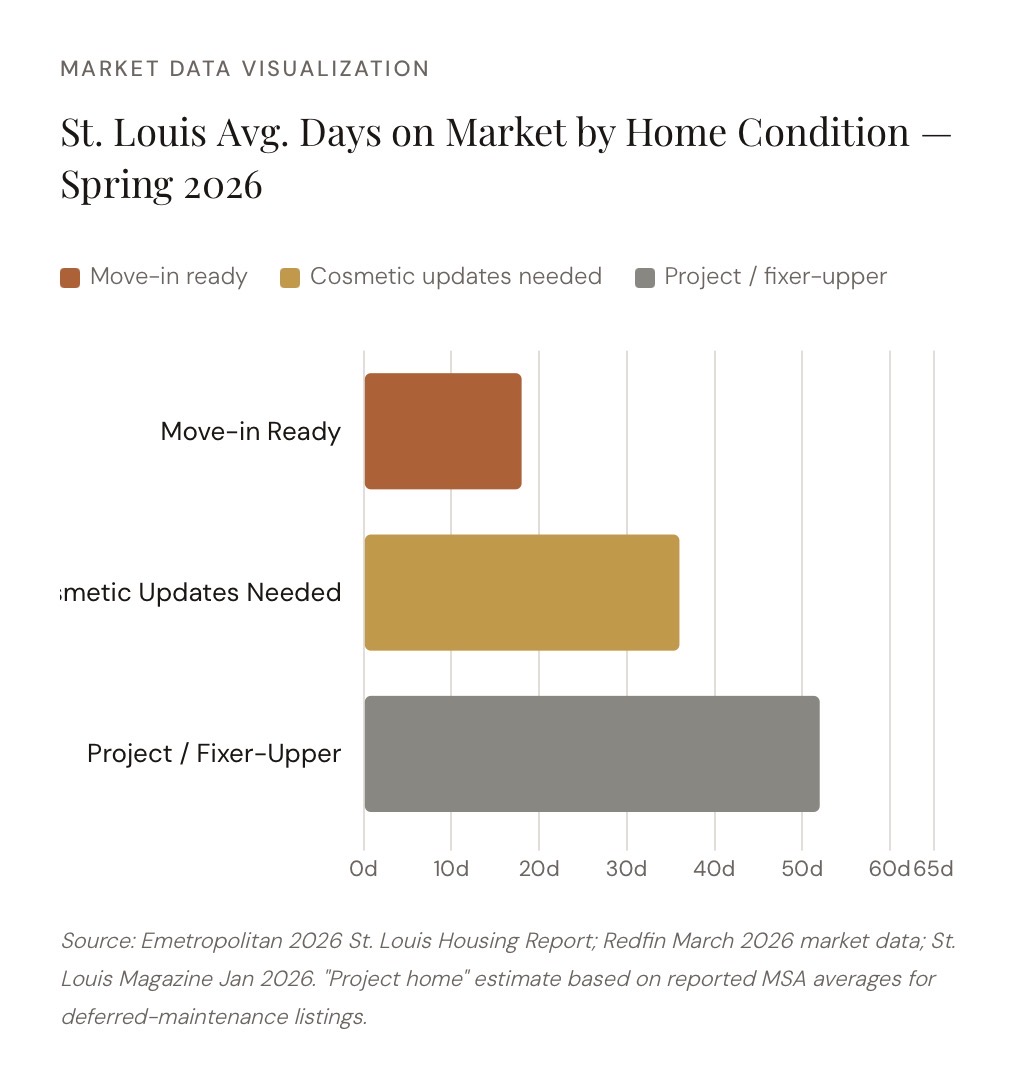
Avg. Days on Market — Project Homes
4.2%
Year-Over-Year Price Growth, St. Louis
$250K
Median Home Sale Price, March 2026
Spring in St. Louis arrives with the scent of magnolias — and the unmistakable sound of open house signs being hammered into front lawns across Tower Grove South, Kirkwood, and Soulard. Every year, thousands of buyers descend on the Gateway City with big dreams and carefully assembled pre-approval letters, ready to make a move. And every spring, many of them make the same costly mistake: falling in love with potential rather than reality.
The 2026 St. Louis market is, by almost every measure, a fascinating place to buy. According to Redfin's March 2026 data, the median home sale price in St. Louis reached $250,000 — up 4.2% year-over-year — while average homes sell after about 31 days on the market. But beneath those city-wide averages lies a story of extreme contrast: some homes are flying off the market in under a week, while others sit, and sit, and sit.
The dividing line? Move-in readiness.
This guide will tell you exactly what separates the homes that are about to get multiple offers from those that are becoming involuntary long-stay residents of Zillow. We'll walk you through the three most important signs that a St. Louis home is primed for the spring rush, give you a buyer's checklist you can actually use, and explain why walkability in neighborhoods like Soulard and the Central West End is commanding a measurable price premium right now. By the time you finish reading, you'll know how to find "The One" — before everyone else does.
The "Project Home" Problem: Why Fixer-Uppers Are Sitting
Let's start with the data that's reshaping how buyers approach this spring. Across the St. Louis metro, residential listings are averaging roughly 52 days on the market — a figure that climbs significantly for homes that need substantial work. Emetropolitan's 2026 St. Louis housing report confirms this trend, noting that homes are spending longer on the market as the market normalizes, with the MSA averaging 52 days for residential listings. That's up 28% from the year prior for single-family homes.
The shift is fundamental. During the frenzied seller's market of 2021 and 2022, buyers were so desperate that they'd waive inspections, overlook obvious deferred maintenance, and compete for homes with rotting decks and ancient electrical panels. That era is over. Today's buyers — armed with more inventory and a little more breathing room — are becoming genuinely selective. St. Louis Magazine's January 2026 market report put it plainly: fixer-uppers, once snapped up instantly, are now lingering for several weeks — a window that simply didn't exist in 2021 “Fixer-uppers, once snapped up instantly, are now lingering for several weeks — a window that simply didn't exist in 2021 or 2022
“Fixer-uppers, once snapped up instantly, are now lingering for several weeks — a window that didn't exist in 2021 or 2022.”
— St. Louis Magazine, January 2026
This isn't just about aesthetics. Buyers doing the math on renovation costs in 2026 are confronting a harsh reality: contractor labor in the St. Louis metro has remained elevated, supply chain improvements have been uneven, and the cost of kitchen remodels, roof replacements, and HVAC upgrades has not meaningfully declined from pandemic-era highs. A home listed at $215,000 with $60,000 in deferred maintenance isn't a bargain — it's a liability wearing a reasonable price tag.
Meanwhile, turn-key homes in desirable school districts and walkable neighborhoods continue to see multiple offers. Local agents quoted in St. Louis Magazine predict that move-in-ready homes above $750,000 will remain "quite competitive" through 2026, with no slowdown expected. The same competitive dynamic filters down through lower price points when the home checks all the right boxes.
The lesson for spring 2026 buyers is clear: if you are not specifically hunting for a renovation project with a defined budget and timeline, you want to be hunting for move-in-ready homes. And knowing how to identify them — quickly, before an offer deadline appears — is the skill that separates successful buyers from frustrated ones.
Sign #1: The Systems Are Updated — Not Just the Surfaces
The single most reliable indicator of a genuinely turn-key home is one that far too many buyers overlook in favor of shiny countertops and freshly painted walls: updated major systems. Roof, HVAC, electrical panel, and plumbing are the four pillars that determine whether a home is truly ready to live in — or whether it's a cosmetic renovation sitting on a ticking clock.
In St. Louis, where the housing stock skews older (a significant portion of homes in neighborhoods like Tower Grove South, Soulard, and Benton Park date to the early-to-mid 20th century), this matters enormously. A 1920s brick bungalow with stunning original hardwood floors and a recently updated kitchen is still a problem home if the electrical panel runs on fuses, the knob-and-tube wiring hasn't been touched since 1952, and the furnace was installed during the Clinton administration.
What you should be looking for, and what you should be asking your agent to verify before you even fall in love with a listing, includes: a roof with more than 8 years of remaining useful life (or documentation of a recent replacement), a furnace and central air system no older than 15 years, a 200-amp electrical panel, and water heater and plumbing updates within the last decade. Sellers who have invested in these upgrades will have documentation, and they will lead with it. If a listing's marketing copy focuses exclusively on the beautiful renovated master bath but says nothing about the roof or HVAC, that silence is telling you something.
The Redfin listings for Tower Grove South offer a useful illustration of this principle in action. Homes that are commanding top-dollar attention and moving quickly are consistently the ones that explicitly highlight capital improvements: new flat roofs, new HVAC systems including furnaces, A-coils, and condensers, and updated electrical panels. These are the homes that pass inspection without drama. They are the homes that close.
Sign #2: The Neighborhood Commands a Walkability Premium
Here is a fact that should fundamentally change how you think about location in St. Louis: walkability is not just a lifestyle preference. It is a measurable financial premium embedded in home prices, and in 2026, buyers are paying for it explicitly.
Redfin's landmark walkability analysis found that walkable homes sell for a premium over car-dependent ones across U.S. markets, with the premium accelerating as Walk Scores approach 100. Research cited by property investment analysts shows that moving from a Walk Score of 79 to 80 can add over $7,000 to a home's value on average — and premiums accelerate from there as walkability improves further.
In St. Louis, this dynamic is playing out visibly in specific neighborhoods. According to neighborhood data compiled for St. Louis move-up buyers, Soulard and Tower Grove East both carry Walk Scores of 85, Benton Park registers 84, Lafayette Square sits at 82, the Central West End at 78, and Tower Grove South at 75 — all well above the threshold where walkability meaningfully lifts property values.
Walk Score: 85
Historic brick rowhouses, Soulard Market, and a dense restaurant scene. One of St. Louis’ strongest walkability premiums.
Walk Score: 78
Forest Park access, the Euclid Ave corridor, and hospital proximity continue driving demand. Median sale prices remain well above the city average.
Walk Score: 75
17.9% year-over-year price appreciation with strong demand for Victorian and craftsman homes. Especially attractive to young professionals.
Strong School District
Multiple-offer situations remain common. Highly rated schools continue commanding a premium, with steady interest from out-of-state buyers.
Tower Grove South has seen a 17.9% year-over-year rise in home prices, driven in part by its walkable blend of urban and suburban living that continues to draw buyers who want proximity to coffee shops, parks, and the Morganford business corridor without paying Central West End prices. Soulard, with its iconic farmers market (one of the oldest west of the Mississippi, operating since 1779), its dense bar and restaurant scene, and its Walk Score of 85, remains one of the city's most compelling propositions for buyers prioritizing daily-errand walkability. For buyers evaluating spring listings, this means something specific: when you are comparing two homes of similar size and price, the one in the more walkable neighborhood is almost certainly the better long-term investment. Walk Score is not just about your daily convenience — it is a proxy for how much future buyers will want to live there, which is ultimately what determines your resale value.
Sign #3: The Listing Is Priced for the Market, Not for a Fantasy
The third sign of a home that is ready to transact — and that represents real value — is deceptively simple: it is priced correctly for where the market actually is, not where the seller wishes it were.
The St. Louis spring 2026 market is what real estate professionals politely call a "selective market." House Sold Easy's comprehensive 2026 St. Louis market analysis describes it well: while inventory is rising, turn-key homes in desirable school districts continue to see multiple offers. The keyword there is "turnkey." The competitive bidding environment has not disappeared — it has concentrated around a specific type of home.
As House Sold Easy's deep-dive on the St. Louis seller's market dynamic noted, well-priced, well-presented homes are selling in under 30 days and often 3-8% above list price with clean inspection resolutions. The operative phrase is "well-priced." An overpriced home — even a move-in-ready one — will sit. An accurately priced home with updated systems in a walkable neighborhood will generate offers within days.
For buyers, a correctly priced listing signals a motivated seller who has done their homework. They know the comps. They have accounted for the condition of their home. They are not testing the market — they are selling. These listings reward serious, prepared buyers who move quickly. They are also, not coincidentally, the listings most likely to produce a smooth closing rather than a protracted negotiation followed by an inspection surprise.
Compass St. Louis & Beyond's Katie Dooley Curran, one of the city's most respected agents, puts the buyer mindset clearly: "If you find a home you love, buy it; waiting is never a winning strategy. Home prices consistently trend upward, not down, making real estate one of the most reliable investments." The implication for spring shoppers is that a correctly priced, move-in-ready listing in a desirable STL neighborhood should not be treated as an opportunity to negotiate — it should be treated as an opportunity to move.
✅ TURN-KEY PROPERTY VERIFICATION CHECKLIST
Roof age documented & under 10 years
Ask for the permit or installer receipt. A roof over 12–15 years in Missouri's climate is a negotiating point at best, a deal-breaker risk at worst.
HVAC system under 15 years old
In St. Louis, humidity, a failing AC is a crisis. Look for service stickers and verify the manufacture date on the data plate.
200-amp electrical panel (no fuse box)
Older South City homes commonly have outdated panels. Upgrade costs often run between $3,000–$6,000.
Water heater under 10 years old
Check the serial number for the manufacture date. Replacement costs can range from $1,200–$2,500.
Walk Score of 70 or above
Walkable areas like Soulard, Tower Grove South, and Central West End often carry stronger resale premiums.
No permit red flags or open violations
Review permit history through city or county portals before making an offer. Unpermitted work can create financing issues.
Priced within 5% of neighborhood comps
Compare against sold homes from the last 90 days within a 0.5-mile radius before moving forward.
Listed under 21 days without a price reduction
Strong listings in walkable neighborhoods tend to move quickly. If not, investigate why carefully.
Windows updated within the last 20 years
Modern double-pane windows improve comfort, efficiency, and often signal better overall maintenance.
No active foundation issues or water intrusion evidence
Watch for diagonal cracks, sticking doors, or basement water stains — common warning signs in Missouri homes.
Why Spring Timing Changes Everything in St. Louis
The St. Louis spring market does not begin in April — it begins, for serious buyers, in late January or early February. This is not conventional wisdom; it is specific to how the local market operates. Compass St. Louis agent Katie Dooley Curran identifies January 7th as the true start of the spring market — the moment when motivated buyers re-enter after the holiday slowdown while inventory is still at its leanest point of the year.
By April, the competition is fully in swing. Data shows that homes listed in April sell about 6 days faster and command nearly 1% higher prices than other months, with early May offering a 3.1% boost in sale price. But by late May, that advantage compresses to 1.2%, and by early June, prices trend back toward list. Spring is a window, not a season.
For buyers targeting neighborhoods like Tower Grove South or Kirkwood in 2026, this creates a specific strategic reality. Emetropolitan's 2026 analysis notes that buyer demand is expected to accelerate into the peak spring season as mortgage rates ease toward the 6% mark. More demand, tightening supply in the most desirable areas, and the usual spring listing flush combine to make the late April through May window the most competitive — and, for well-positioned buyers, the most rewarding — period of the year.
The buyers who succeed in this window share several characteristics: they are pre-approved, not merely pre-qualified; they have a clear sense of which neighborhoods they will buy in; they have done the system-check homework so they are not second-guessing themselves at the showing; and they are willing to move on a good listing within 24 to 48 hours of seeing it. In Kirkwood, a well-priced move-in-ready home can still draw multiple offers within its first weekend on the market. That is not a warning — it is an invitation to be prepared.
The Walkability Premium in Dollars and Cents
Let's talk specifically about what walkability is worth in St. Louis — because the numbers are larger than most buyers realize, and they compound over time.
Research consistently shows that each incremental point of Walk Score carries real financial weight. Analysis cited in property investment research shows that moving from a Walk Score of 79 to 80 adds over $7,000 to a home's average value, and the premiums accelerate further as scores approach 100 — driven by the high demand and limited supply of truly walkable urban addresses. A one-point Walk Score increase in highly walkable areas can add up to $3,000 or more per point.
In the St. Louis context, this means that a home in Soulard (Walk Score 85) carries a measurable, embedded premium over a structurally similar home in a neighborhood scoring 55 or 60. That premium is not arbitrary — it reflects what the next buyer will be willing to pay, which is ultimately what resale value is. Soulard ranks as the 3rd most walkable neighborhood in St. Louis, with approximately 76 restaurants, bars, and coffee shops in the area — amenities that are within walking distance and that make car-free daily errands genuinely possible.
The Central West End, anchored by Forest Park and the Euclid Avenue commercial corridor, similarly commands a premium. Neighborhood data confirms that the Central West End's centrally located position with access to Forest Park, Barnes-Jewish Hospital, and Washington University School of Medicine keeps it among the city's most consistently desirable addresses — with prices to match. For buyers who want to own in a neighborhood where walkability is a daily reality rather than an aspiration, CWE and Soulard are the benchmark.
This does not mean that less walkable neighborhoods are bad investments. Kirkwood, for example, achieves its premium through school district quality rather than urban walkability — and that premium is equally real and equally durable. The point is to understand which premium you are buying, to verify that it exists, and to confirm that the listing price reflects fair value within that premium tier rather than a seller hoping you have not done your research.
What This All Means for Your Spring Strategy
Buying in St. Louis this spring means navigating a market that rewards preparation and punishes hesitation in the best neighborhoods — while simultaneously offering surprising negotiating room in overpriced or project-heavy listings. The gap between these two experiences is wider in 2026 than it has been in years. That gap is your opportunity.
The most important thing you can do before the spring rush is to be decision-ready before a listing appears. Know your target neighborhoods. Understand which Walk Scores correspond to which price premiums in those areas. Have your system-check criteria memorized so you can identify a genuine turn-key home in 20 minutes of walking through a property. Be pre-approved with a local lender who can move fast.
And when a home checks all the boxes — systems updated, walkability premium verified, price aligned with comps, listed fresh — move with confidence. The buyers who succeed in spring 2026 will not be the ones who waited for certainty. They will be the ones who were prepared enough to recognize "The One" when it appeared, and decisive enough to act.
St. Louis has an extraordinary housing stock. The brick architecture, the tree-lined streets, the neighborhood character that took 100 years to build — these are not being replicated anywhere in the Sun Belt. The buyers who understand how to evaluate what they are looking at, and who can distinguish the genuine gems from the projects dressed in fresh paint, will find tremendous value here. That is what this guide is for.
Ready to Buy or Sell in St. Louis? House Sold Easy Has You Covered!
Navigating St. Louis’ red-hot luxury market doesn’t have to be a headache. With House Sold Easy, it’s all about less hassle—we’ve got you covered from start to finish. Our St. Louis experts know every corner of this city and will make buying your dream home or selling your high-end property a breeze. Don’t miss out on the hottest market in the U.S.! Contact House Sold Easy today and let’s make your real estate goals happen!