St. Louis Real Estate & Housing Market 2026: Trends & Tips
Mar 27, 2026
Written by David Dodge
$250K
Median Sold Price — St. Louis County, Feb 2026
+8.2%
YOY Price Growth — St. Louis City
47 days
Avg. Days on Market — Up from 42 last year
48%
Below National Median — St. Louis affordability edge
St. Louis has always played the "affordable alternative" card quietly. But in spring 2026, the Gateway City's housing market is making noise — prices are up, inventory is finally rising, and buyers have their best shot at a deal since the pandemic froze everything in place.
Where Prices Stand Right Now
The most current snapshot comes from St. Louis Real Estate News, which reported this month that the St. Louis County median sold price hit $250,001 in February 2026 — a 3.79% jump from $240,875 in February 2025. Sales volume dipped slightly, with 768 homes closing compared to 777 the year before, a 1.16% decline that signals buyers are being more deliberate rather than panicked.
Redfin's February 2026 data paints an even sharper picture for the city proper: home prices up 8.2% year-over-year, with a median sale price of $224,000. Homes sat on the market an average of 47 days, up from 42 days the year prior — a sign the frenzied pace of the past few years has cooled, giving buyers real time to think.
Nationally, St. Louis continues to punch well above its weight on affordability. Its median sale price sits 48% below the national average, and the overall cost of living runs about 11% cheaper than the U.S. norm. For buyers priced out of Chicago, Austin, or Nashville, that spread is increasingly hard to ignore.
A Market Finally Coming Into Balance
The defining story of spring 2026 in St. Louis is the shift from a pure seller's market to something more measured. Metropolitan Mortgage's February 2026 analysis describes it as a "Selective Market" — inventory is up, sellers have tempered their expectations (the median list price in St. Louis County actually dropped 14.29% to $240,000 from $280,000 last February), and buyers with pre-approval letters are finally getting first offers accepted in neighborhoods that were bidding-war battlegrounds just two years ago.
St. Louis Magazine's January 2026 market report found that local agents were uniformly optimistic heading into spring — particularly for move-in-ready homes above $750,000, which remain "quite competitive," and for value-seekers in neighborhoods like Affton and Overland, where buyers can often land a first offer without a bidding war. Fixer-uppers, once snapped up instantly, are now lingering for several weeks — a window that didn't exist in 2021 or 2022.
That said, don't mistake balance for weakness. The same St. Louis REALTORS® data cited by St. Louis Magazine showed home prices up 9.1% in December 2025 compared to the year before, extending years of steady appreciation. The bungalow in St. Louis Hills that went for $180,000 a decade ago now commands $325,000.
Neighborhood-by-Neighborhood Snapshot
The St. Louis metro is deeply hyper-local. Here's where the action is in 2026:
What's Driving Prices Up — And Who's Moving Here
St. Louis's diverse economy — anchored by healthcare giants BJC HealthCare and Centene Corporation, plus a growing tech sector — is attracting what Metropolitan Mortgage calls "equity migrants": buyers relocating from high-cost metros like Chicago, Denver, and the coasts with cash proceeds from prior home sales. These buyers can often outbid local first-timers, which is reshaping competition at the $300K–$600K tier.
On the rental side, St. Louis remains a top-15 metro for rent growth nationally — rents rose 3.6% year-over-year, maintaining strong investment floors. The metro-area median rent is rising, with O'Fallon and Wentzville topping out above $2,200/month according to Faster House's 2026 Missouri market analysis.
New construction in St. Charles County is offering mortgage rate buydowns and seller concessions — a direct acknowledgment by builders that higher borrowing costs still sting first-time buyers. Missouri's state-level MHDC first-time buyer programs also offer below-market interest rates and down payment assistance, though slots fill quickly in competitive spring markets.
The Mortgage Rate Picture in March 2026
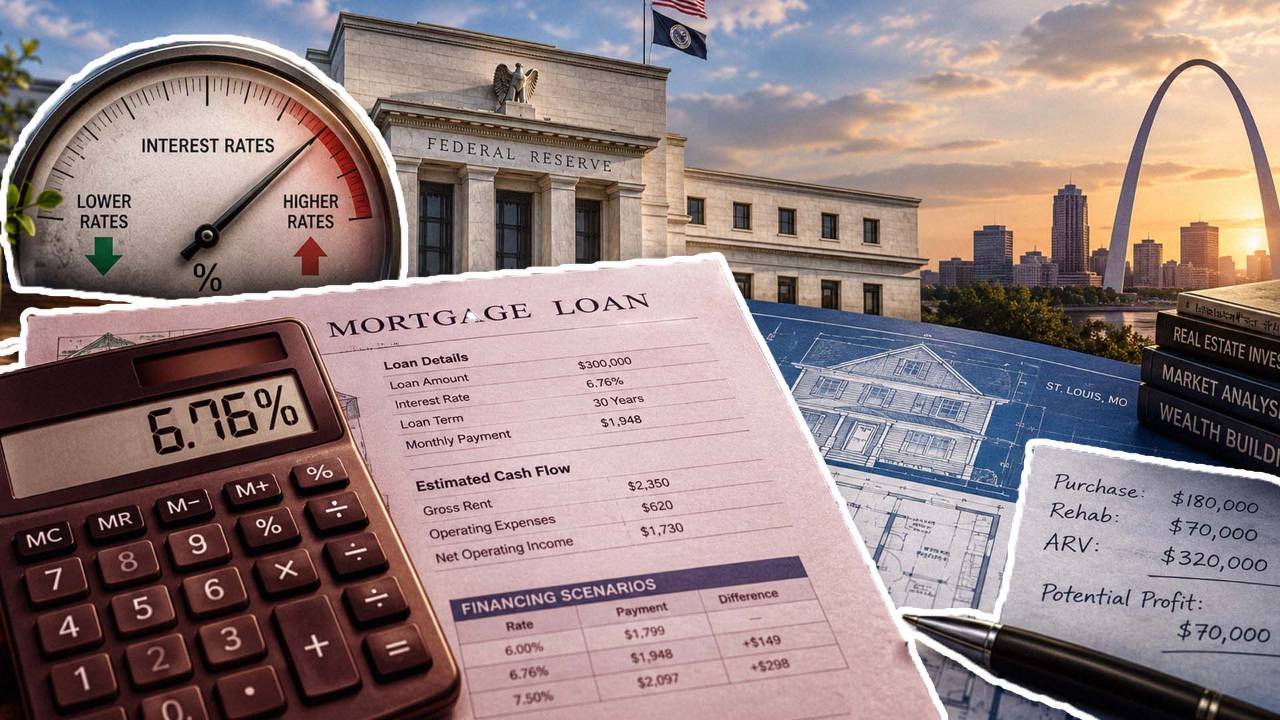
Norada Real Estate's 2026 St. Louis forecast tracked 30-year fixed mortgage rates falling to around 5.95% in early February — a meaningful drop from the 7%+ peaks of 2023. Rates stabilizing in the 6% range has been the single biggest factor unlocking buyer demand that sat on the sidelines for two years. Analysts from Norada project 2–4% price appreciation through the remainder of 2026 for the St. Louis metro, with the possibility of a gentle nudge higher if rates continue to ease.
For reference: on a $250,000 home with 10% down and a 30-year fixed at 6%, your monthly principal and interest lands around $1,349. Compared to renting a three-bedroom in the suburbs at $2,200+, that math is increasingly convincing buyers who were waiting.
The First-Time Buyer Struggle — and Where the Real Openings Are
First-time buyers in St. Louis face a genuinely mixed picture in spring 2026. On one hand, prices are up and mortgage rates — while improved — are still meaningfully higher than the historic lows of 2020 and 2021. On the other hand, St. Louis remains one of the most accessible major metros in the country for working-class and middle-income households trying to plant roots.
The challenge is concentrated in the entry-level tier. Homes priced under $200,000 — once plentiful across South City, North County, and the inner suburbs — have been rapidly absorbed. St. Louis Real Estate News noted that the most competitive segment right now is the $175,000–$275,000 range, where buyers frequently compete against investors purchasing for rental conversion alongside traditional owner-occupants. When a clean, move-in-ready three-bedroom in Lemay or Brentwood hits Zillow under $220,000, it often draws five to ten showings in the first 48 hours and multiple offers by the weekend.
The good news? Missouri's Missouri Housing Development Commission (MHDC) runs two programs that can make a tangible difference: the First Place Loan and the Next Step Loan. The First Place program offers below-market interest rates specifically for first-time buyers who haven't owned a primary residence in the past three years. The Next Step program is open to all buyers regardless of first-time status. Both come with optional down payment assistance of up to 4% of the loan amount — that's up to $10,000 on a $250,000 purchase. Income limits apply, but the caps are generous enough to cover most households in the St. Louis metro area.
Local credit unions — including First Community Credit Union and Together Credit Union — also offer portfolio loan products with more flexible underwriting than major banks, which can be a lifeline for buyers with non-traditional income, self-employment history, or credit scores in the 620–680 range. Getting a relationship with one of these institutions before you start touring homes can meaningfully expand your purchasing power and speed up the process when the right property appears.
The zip codes where first-time buyers are still winning without bidding wars in March 2026: 63123 (Affton), 63135 (Ferguson/Jennings), 63074 (St. Ann), 63021 (Ballwin outskirts), and 63303 (St. Charles). These aren't consolation prizes — they're livable, well-connected neighborhoods where your dollar still goes meaningfully further than anywhere on either coast. Commute times to downtown Clayton or the medical corridor on Forest Park Parkway are manageable, school districts are improving, and community investment is trending in the right direction.
Investment Real Estate in St. Louis: Cashflow Is Back on the Table
For real estate investors, St. Louis has quietly become one of the most compelling secondary markets in the country. The math that makes the city challenging for first-time buyers — rising rents, relatively low purchase prices compared to national averages — is exactly what makes it attractive for landlords and BRRRR-strategy investors who want real monthly cashflow rather than speculative appreciation alone.
Faster House's 2026 Missouri market analysis tracked metro-wide rent growth at 3.6% year-over-year. The strongest rent markets within the metro are in suburban corridors where remote workers have relocated: O'Fallon, Wentzville, and Chesterfield all show median rents above $2,000/month for a three-bedroom single-family home. In those markets, a home purchased at $280,000–$320,000 with 20% down can generate gross yields of 7–9% — numbers that were nearly impossible to achieve in 2021 and 2022 when purchase prices surged faster than rents.
In St. Louis City proper, the investment calculus is different but still compelling. The city's 10-year tax abatement program for renovated properties remains one of the most generous incentives in any major Midwest city. Investors who purchase distressed properties in designated reinvestment zones and complete qualifying renovations can lock in near-zero property tax obligations for a decade — dramatically improving cash flow on what would otherwise be marginal deals. Neighborhoods like Baden, Bevo Mill, and Old North St. Louis still have properties priced well below replacement cost, with rents rising alongside steady reinvestment from neighbors and small businesses moving into the area.
Short-term rental (STR) investors should be aware that St. Louis implemented updated STR regulations in late 2025, requiring registration, insurance minimums, and owner-occupancy in certain zones. The Central West End, Soulard, and Lafayette Square remain the strongest Airbnb markets in the city, with occupancy rates that local operators report averaging 68–75% annually. Demand spikes significantly around Cardinals home games, St. Louis Blues playoff runs, and major events at America's Center convention complex — a venue that has been steadily expanding its convention calendar through 2026.
For investors watching a longer arc, the ongoing development of the National Geospatial-Intelligence Agency (NGA) campus in North St. Louis is creating significant demand for workforce housing within a reasonable commute. The NGA campus is expected to bring thousands of high-income federal jobs online in the coming years, and residential demand in adjacent neighborhoods like St. Louis Place and JeffVanderLou is already beginning to stir as a result. Those who recognize this early have an edge that later buyers won't.
If You're Selling in 2026: Pricing Strategy Has Never Mattered More
For homeowners considering listing this spring, the opportunity is real — but the playbook has changed. The era of throwing any home on the market at an aspirational price and waiting for a bidding war to bail you out is over in most St. Louis zip codes. Sellers who are succeeding right now are the ones who understand that this is a conditional seller's market, not an unconditional one.
The most important number to understand before you list is your neighborhood's sale-to-list price ratio. In Crestwood, homes are still closing at 103% of asking price — meaning sellers there have genuine room to price aggressively and expect competition. But across the broader metro, the average has settled at 98%, meaning the typical home sells for about 2% below list price. Overpricing by 5–10% and waiting for a reduction puts you in a dangerous zone where days on market accumulate, buyer skepticism grows, and you end up accepting a lower final price than if you had priced correctly from day one.
Presentation matters enormously in a market where buyers have more time and more options. In the competitive years of 2021–2022, buyers were waiving inspections, skipping walkthroughs, and overlooking deferred maintenance. Today, buyers are inspecting everything and using condition issues as negotiating leverage. Pre-listing inspections — where you hire an inspector before putting your home on the market, identify issues, and either fix them or disclose and price accordingly — have become one of the most effective tools a St. Louis seller can use to prevent deals from falling apart after offer acceptance.
On the subject of timing: Norada Real Estate's seasonal analysis confirms what local agents have long known — St. Louis's peak listing season runs from late March through early June. Homes listed in this window sell faster and closer to the asking price than at any other point in the calendar year. If you're considering listing and haven't yet, the next six weeks represent your optimal window. By July, buyer traffic drops noticeably and days on market extend, often forcing price reductions that eat into net proceeds.
One more note for sellers with homes in the $400,000–$700,000 range: this is the tier where out-of-state equity migrants are most active. If your home is in a desirable school district — Kirkwood, Webster Groves, Ladue, Rockwood — or within reasonable commuting distance of major employment centers in Clayton and Creve Coeur, make sure your listing photographs, virtual tour, and marketing copy are polished enough to convert remote viewers. That buyer may be making a dedicated trip from Chicago or Minneapolis specifically to see your home. They are motivated, financially qualified, and often have flexibility on closing timelines that local buyers simply don't.
What the Rest of 2026 Looks Like for St. Louis Real Estate
Looking ahead through the end of 2026, the consensus among analysts who cover this market is cautiously optimistic. Norada Real Estate projects 2–4% appreciation for the full year — modest by the standards of the past five years, but meaningful when layered on top of the cumulative gains since 2020. A home that was worth $200,000 in early 2020 is now worth roughly $280,000–$300,000. Another 3% appreciation by December 2026 adds another $8,000–$9,000 in equity on that same home without a single renovation dollar spent.
The biggest wildcard is mortgage rates. The Federal Reserve's trajectory through 2026 remains the most closely watched variable in residential real estate nationally. If the 30-year fixed rate dips from its current mid-6% range toward the 5.5% threshold — a level many economists consider the psychological trigger for a new surge in buyer demand — St. Louis could see a meaningful acceleration in sales volume and renewed multi-offer competition in more neighborhoods. Conversely, if persistent inflation data forces the Fed to pause or reverse its easing cycle, rates could stabilize or tick back up, keeping some buyer demand suppressed through the fall and winter.
One structural tailwind that is unlikely to reverse: St. Louis's affordability advantage relative to other major metros is becoming a larger, more intentional part of its identity. The city's growing reputation as a tech and life sciences hub — anchored by Washington University's research ecosystem, the Cortex Innovation Community in Midtown, and a string of venture-backed startups in the biotech and agtech sectors — is quietly attracting a higher-income professional demographic that bodes well for sustained demand in the $300,000–$600,000 price tier. This is exactly the income group that drives neighborhood revitalization in metros like Pittsburgh and Columbus, and St. Louis is tracking a similar curve.
For most buyers and sellers, the practical message heading into the second half of 2026 is straightforward: this is a market that rewards preparation, realistic pricing, and localized knowledge. The broad strokes — rising prices, more inventory than a year ago, mortgage rates that are still elevated but improving — set the context. But the deals, the wins, and the costly mistakes all happen at the neighborhood and street level. The difference between a buyer who gets their offer accepted on the first attempt and one who loses five in a row often comes down to knowing which zip codes are still negotiable and which ones remain full contact.
That hyper-local intelligence — knowing that a home in Shrewsbury will draw a weekend bidding war while a comparable house in Overland sits for three weeks — is the edge that separates successful buyers and sellers from frustrated ones. Partner with agents who run their own market stats. Pull the actual sale-to-list data for the specific streets you're considering. And remember that every broad headline about the "St. Louis housing market" is really a composite of fifty different micro-markets, each with its own rhythm and its own rules.
Seven Moves to Make in the St. Louis Market This Spring
- Get pre-approved before you tour. Sellers in hot zip codes — CWE, Webster Groves, Crestwood — won't entertain offers without a lender letter. Have it in hand before your first showing. Metropolitan Mortgage and local credit unions can turn approvals around in 24–48 hours.
- Look at Affton, Overland, and South County for first offers. These are the neighborhoods where buyers are winning without escalation clauses right now. Strong fundamentals, comparative discounts, and sellers who've adjusted expectations from peak pricing.
- Watch the sale-to-list ratio, not just list price. The metro average has dipped to 98%, meaning you can negotiate on most homes. But Crestwood is still at 103%, so adjust the strategy by neighborhood. Your agent should pull this data before you write any offer.
- Budget 2–5% of the purchase price for closing costs. On a $250K home, that's $5,000–$12,500 needed at the table beyond your down payment. First-timers who overlook this figure get blindsided at closing. Ask your lender for a detailed Loan Estimate early in the process.
- Ask builders in St. Charles County about rate buydowns. New construction incentives are very real right now — builders are motivated to move inventory. A 1-point rate buydown on a $300K loan saves roughly $180/month for the first two years. That's real money.
- Sellers: get a pre-listing inspection. Buyers are back to inspecting everything and using findings as negotiating leverage. Know your home's condition before they do. Fix what you can; disclose and price what you can't. It prevents deals from dying after ratification — one of the most costly scenarios a seller can face.
- Check MHDC eligibility before ruling out homeownership. Missouri's First Place and Next Step loan programs offer below-market rates and up to 4% in down payment assistance. Many St. Louis households qualify and don't know it. The income limits are broader than most people expect — worth a 15-minute call with a participating lender.
The Bottom Line
St. Louis's housing market in spring 2026 is the story of a city finally getting the recognition it quietly deserved all along. Prices are up — meaningfully so — but the market is no longer the chaotic, waive-everything feeding frenzy of 2021. More inventory, longer days on market, and sellers willing to negotiate mean that patient, prepared buyers have real options. First-time buyers still face headwinds from price appreciation and borrowing costs, but the tools exist — MHDC programs, local credit unions, value neighborhoods — to overcome them with the right groundwork laid in advance.
House Sold Easy put it plainly in their March 2026 buyer's guide: St. Louis home prices remain 48% below the national average, inventory is higher than it's been in years, sellers are working with buyers rather than against them, and mortgage rates are lower than they were 12 months ago. That combination of factors makes this one of the most compelling entry points the St. Louis market has offered in recent memory.
For sellers, the window of historically elevated prices is still wide open — but pricing realism matters more than it has in years. Overpriced listings are sitting. Condition issues that went unnoticed in 2021 are deal-killers in 2026. The market rewards preparation, honesty, and strategic pricing from the outset. Come in right, and you'll move fast at a strong number. Come in overpriced, and you'll chase the market down.
And for the investors and long-term thinkers watching from the sidelines: the NGA campus, the Cortex innovation district, the steady stream of equity migrants from more expensive cities — these are the signals that St. Louis's trajectory is upward, even if the pace in 2026 is measured rather than explosive. The Gateway City is opening wider, and the people who recognized the opportunity clearly are the ones who'll look back on this moment as an obvious one.
Ready to Buy or Sell in St. Louis? House Sold Easy Has You Covered!
Navigating St. Louis’ red-hot luxury market doesn’t have to be a headache. With House Sold Easy, it’s all about less hassle—we’ve got you covered from start to finish. Our St. Louis experts know every corner of this city and will make buying your dream home or selling your high-end property a breeze. Don’t miss out on the hottest market in the U.S.! Contact House Sold Easy today and let’s make your real estate goals happen!