St. Louis Sellers: Why May 2026 Is Your Sweet Spot
May 05, 2026
Written by David Dodge
Mortgage rates have finally stabilized. Buyers are coming off the sidelines. And St. Louis inventory is up 11% — a rare alignment that won't last long.
There's a moment in every housing cycle where the stars align — where rates cool just enough, inventory opens just enough, and buyer psychology shifts from hesitation to action. For St. Louis home sellers, that moment is right now, in May 2026.
For the better part of two years, the St. Louis housing market existed in a kind of tense equilibrium. Sellers sat tight, reluctant to give up pandemic-era mortgage rates locked at 2–3%. Buyers watched rates hover above 7% and did the math — then quietly closed their Zillow tabs. The market didn't crash. It just... froze.
Now, the thaw is here. And if you own a home in the St. Louis metro and have been wondering whether the timing is finally right to sell, the data makes a compelling case for: yes — and soon.
The Psychological Unlock: What 6.1% Actually Means
Numbers don't exist in a vacuum. They carry weight — emotional, psychological, behavioral. And when it comes to mortgage rates, few numbers carry more weight than the divide between 6% and 7%.
For most of 2023 and into 2025, 30-year fixed mortgage rates sat stubbornly above 7%. That wasn't just mathematically expensive — it was psychologically paralyzing. Buyers who had watched rates dip to 2.65% in early 2021 couldn't reconcile themselves to monthly payments that were $800 to $1,200 higher on the same home. So they waited.
Then came the shift. On February 26, 2026, the average 30-year fixed mortgage rate briefly touched 5.98% — its first dip below 6% since 2022, according to Freddie Mac. The headline alone moved markets. As Kara Ng, senior economist at Zillow Home Loans, put it: "Mortgage rates below 6% could be an important psychological threshold. Round numbers matter, and that headline alone could prompt many sidelined buyers to take another peek at the housing market."
Since then, rates have stabilized in the 6.1% to 6.3% range — slightly above that magic sub-6% threshold, but meaningfully lower than the prior two Aprils (7.17% in April 2024 and 6.81% in April 2025). For buyers who have been waiting two years, this is real affordability relief. According to Realtor.com data, mortgage purchase applications rebounded in April after slipping in March, a sign that buyers are actively re-engaging.
"Mortgage rates below 6% could be an important psychological threshold. Round numbers matter, and that headline alone could prompt many sidelined buyers to take another peek at the housing market."— Kara Ng, Senior Economist, Zillow Home Loans
In Missouri specifically, 30-year fixed rates have settled near 6.125% as of mid-April 2026, down from the 7%+ peaks of prior years. That drop translates into hundreds of dollars per month in savings for the average buyer — a difference that, for many households, pushes homeownership from aspirational to achievable.
For sellers, this matters enormously. A buyer who can afford a more expensive house is a buyer who can meet your asking price — or come close enough to make a deal happen.
The St. Louis Difference: Why This Market Isn't Like the National Story
Before diving deeper into the local numbers, it's worth acknowledging the national backdrop. Much of the country's spring 2026 housing market has been complicated by geopolitical tensions, rising oil prices, and a brief spike in borrowing costs that put some buyers back on the sidelines. Nationally, existing home sales fell to a nine-month low in April, according to CNN Business, which reported on NAR data.
But St. Louis is not a national headline. It is a city with its own gravitational pull — driven by its extraordinary affordability, a diversified economy anchored in healthcare and education, and a housing market that moves to its own rhythm.
Consider the numbers: St. Louis home prices in March 2026 were up 4.2% year-over-year, with a median sale price of $250,000, according to Redfin. That median sits roughly 41% below the national average. In other words, what costs $425,000 in a comparable Midwestern city might run you $250,000 here — with the same school quality, commute times, and neighborhood character.
This affordability has made St. Louis a magnet for what market analysts call "equity migrants" — buyers relocating from higher-cost metros like Chicago, Denver, or the coasts, cashing out substantial equity, and arriving in St. Louis with significant purchasing power. When rates ease even slightly, these buyers move decisively.
Current 30-yr fixed rate in Missouri (April 2026)
Year-over-year increase in St. Louis metro active listings
Median home sale price — 41% below the national average
Months of supply — still technically a seller's market
The 11% Inventory Rise: A Window, Not a Warning
Here's the number that might make sellers nervous at first glance: active listings across the St. Louis MSA have increased nearly 11% year-over-year, with approximately 4 months of housing supply in the metro. After years of being conditioned to celebrate the tight, sub-2-month markets of the pandemic boom, seeing inventory expand can feel threatening.
But context is everything. Four months of supply is still, by every technical definition, a seller's market. The threshold between buyer and seller advantage sits at 6 months. At 4 months, sellers still hold meaningful leverage — especially in sought-after school districts and move-in ready conditions.
More importantly, this inventory growth is actually unlocking buyer activity. One of the biggest friction points in recent years wasn't just affordability — it was inventory. Buyers who qualified financially couldn't find anything worth buying. With inventory up 11% year-over-year, it's a rare "balanced" window where there are actually houses to look at, but rates are manageable.
The St. Louis metro now sits at approximately 10,300–10,400 active listings, up about 10.8% year-over-year. Some pockets in the city and county are seeing even stronger inventory gains, near 14%. What this means in practice: buyers have enough choices to get serious about their search, which generates more transactions, which benefits sellers across the board.
Think of it this way. In a market with only 1,200 homes for sale, a buyer with specific needs — 3 bedrooms, good school district, finished basement — might find two options. If neither fits, they don't buy. In today's market, that same buyer finds eight or ten options. They get specific. They find the right home. They close.
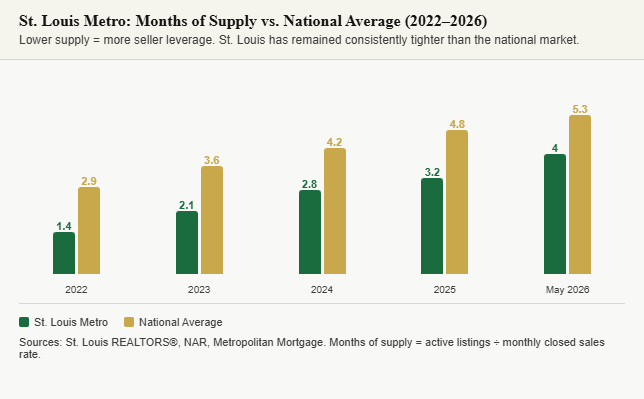
The chart above tells an instructive story. Even as inventory has grown in 2025 and 2026, the St. Louis market remains substantially tighter than the national average — meaning sellers here face less competition and more buyer urgency than their counterparts in, say, Phoenix or Austin, where overbuilding has genuinely shifted power to buyers.
The "Comeback Buyer" Phenomenon
One of the most compelling dynamics of spring 2026 is what Coldwell Banker Research has labeled the "comeback buyer." These are homebuyers who walked away from their search — sometimes for months, sometimes for more than a year — and are now re-entering the market with renewed urgency.
According to Coldwell Banker's 2026 Home Shopping Season Report, which surveyed more than 700 real estate agents nationwide, roughly 20% of current active buyers are people who previously paused their search in the last two years before re-entering the market this spring. Agents describe these buyers as cautious but motivated, with many maintaining budgets similar to when they originally started searching.
For St. Louis sellers, this population of comeback buyers represents opportunity. These are not impulsive shoppers — they have done their research, know what they want, have often been pre-approved for financing, and are emotionally ready to commit. When they find the right home at the right price, they move quickly.
What's bringing them back? Primarily the rate stabilization, but also a growing recognition that waiting for rates to fall dramatically — to 5%, or even the mid-5s — may be a losing strategy. As NAR's chief economist noted in the organization's 2026 Housing Outlook, home sales are expected to increase by approximately 14% nationwide in 2026, driven in part by the disappearing "lock-in effect" as life events compel more owners to sell.
Every month a buyer waits, they risk rates moving higher, home prices appreciating further, or the best-value inventory being picked off by less hesitant shoppers. The comeback buyers understand this calculus. They're done waiting.
Seller Insight
Comeback buyers have already done significant research. They know comparable prices, school ratings, and commute times cold. Your listing photos, staging quality, and pricing precision matter more than ever — this audience will see through lazy presentations instantly.
Why May Specifically? The Spring Timing Advantage
Real estate has always been seasonal, and spring has always been the prime selling season. But May 2026 holds specific advantages beyond simple seasonality.
First, families operate on school-year calendars. A buyer who closes in May or June can move over summer break — the ideal scenario for any household with children. This creates urgency. Buyers who haven't found a home by July face the prospect of another school year in the wrong district, which pushes many toward decisive action in the April–May window.
Second, the inventory timing is favorable. New listings climbed 1.1% year-over-year in April, while active inventory continued growing despite the pace of growth moderating — a divergence that Realtor.com economists describe as "fresher inventory cycling through the market." For sellers, fresher inventory cycling through means motivated buyers with purchase intent, not idle browsers.
Third, rate volatility itself creates buying pressure. After peaking at 6.46% on April 2nd, mortgage rates fell for three consecutive weeks, finishing April below 6.30%, according to Realtor.com data. This kind of volatility — where rates dip and then threaten to rise — pushes buyers who have been deliberating to commit. The fear of missing the window is a powerful motivator.
Finally, 43% of real estate agents nationwide reported a busier home shopping season than last year in spring 2026, according to Coldwell Banker's survey. In the Midwest specifically — the region where St. Louis competes — that number skews higher, as Midwest markets have historically maintained stronger fundamentals through the current rate environment.
What the Numbers Say About Timing
St. Louis residential listings are averaging approximately 52 days on market across the broader MSA in 2026, though in hyper-competitive pockets or for move-in ready homes, properties can still go pending in as little as 15 to 24 days. That gap — between 52-day averages and 15-day elite properties — tells you exactly where sellers need to focus their energy.
The homes selling fastest are those that check three boxes: priced accurately against current comps, professionally staged and photographed, and located in neighborhoods with demonstrated demand. This isn't guesswork — it's a strategy that separates the quick closings from the listings that linger.
Neighborhood-Level Dynamics: Where Sellers Hold the Most Leverage
The St. Louis metro is not one market — it's dozens of micro-markets that behave differently based on school district quality, commute access, and neighborhood character. Understanding where your home sits in this landscape is essential to setting the right expectations and strategy.
- West County and St. Charles County
- These suburbs have long been the primary destinations for relocating families. Strong school districts, newer housing stock, and easy highway access make them perennially competitive. The market has transitioned from the "intense" seller's dynamic of pandemic years into a more balanced environment where negotiation is returning, particularly in St. Charles and West County. However, turnkey homes in top school districts are still generating multiple offers, often within days of listing.
- South City and Benton Park
- The south side of St. Louis City, including neighborhoods like Benton Park, Tower Grove, and Dutchtown, has seen sustained appreciation driven by younger buyers priced out of the suburbs. Walkability, character architecture, and a vibrant food and arts scene continue to attract a demographic that is particularly rate-sensitive — and therefore particularly motivated by today's 6.1% environment vs. the 7.1% they faced 18 months ago.
- Webster Groves and Kirkwood
- Buyers and investors are prioritizing what analysts call "lifestyle density" — areas like Webster Groves and Chesterfield that offer walkability, community identity, and strong school districts simultaneously. These neighborhoods command premium pricing and see some of the lowest days-on-market figures in the metro.
What This Means If You're Thinking About Selling
The data paints a clear picture. Mortgage rates have stabilized at levels that unlock a large pool of motivated, qualified buyers. St. Louis inventory has grown enough to bring those buyers off the sidelines, but not so much as to swing negotiating power sharply in their favor. Median prices continue to appreciate — St. Louis residential median sale prices have increased 10.7% year-over-year to $320,500, according to the St. Louis REALTORS® Monthly Housing Report. And the seasonal forces of spring align buyer urgency with listing activity in ways that benefit sellers who are ready to move.
The strategic window, however, has a close date. These kinds of relatively balanced periods don't last forever — rates can shift with economic data, and inventory dynamics can tighten again if sellers pull back. Waiting for a "perfect" market risks missing the best of what's available right now.
Here is what high-performing sellers are doing right in this environment:
- Pricing with precision. The era of listing 10–15% above comparable sales and hoping a bidding war arrives is over. Buyers in 2026 are informed and cautious. Overpricing triggers extended days-on-market, which triggers price reductions, which triggers buyer skepticism about what's wrong with the property. The first 14 days on market are the most valuable — arrive priced correctly.
- Investing in presentation. Professional staging and photography have moved from "nice to have" to table stakes. For sellers, professional staging and accurate pricing are now mandatory to compete with rising inventory. Homes that photograph beautifully get significantly more showing requests, full stop.
- Being strategic about concessions. The sale-to-list ratio across the broader metro has stabilized near 95–98%, meaning well-prepared buyers can successfully request concessions in neighborhoods with higher inventory. Know where your neighborhood sits on that spectrum and build your negotiation strategy accordingly.
- Acting before summer. The spring selling season is not a suggestion — it's a deadline. Buyer activity peaks in the April–June window and softens meaningfully through July and August. A home listed in mid-May still benefits from peak buyer activity. A home listed in July is fighting headwinds.
The Bottom Line for Sellers
St. Louis median home prices are up over 10% year-over-year. Rates have dropped more than a full percentage point from their peak. Buyer activity is rising. If you've been waiting for the right moment to sell, the data says: this is it. Don’t wait for perfect. Sell into a strong.
The Forecast: What Comes Next
For sellers wondering about the durability of current conditions, the outlook remains favorable but not indefinite. Experts predict 2–4% price growth for the St. Louis metro through the remainder of 2026, with markets like Jefferson City and Springfield expected to see slightly higher appreciation. This is healthy, sustainable growth — not the speculative acceleration of 2021, and not the stagnation of a softening market.
The "lock-in effect" — the phenomenon that kept potential sellers frozen in their sub-3% mortgages — is gradually unwinding. According to the Coldwell Banker survey, approximately one in three home sellers nationwide are now giving up mortgage rates below 5%, with 36% of agents reporting their clients are listing due to personal life circumstances. Life doesn't wait for perfect rate environments. Divorces, new jobs, growing families, and empty nests — these forces bring supply to market regardless of macro conditions.
As that supply comes online through summer and fall, buyer leverage increases incrementally. The competitive advantage sellers hold today is real, but it is not permanent.
The window is open. The question is whether you'll step through it.
Ready to Buy or Sell in St. Louis? House Sold Easy Has You Covered!
Navigating St. Louis’ red-hot luxury market doesn’t have to be a headache. With House Sold Easy, it’s all about less hassle—we’ve got you covered from start to finish. Our St. Louis experts know every corner of this city and will make buying your dream home or selling your high-end property a breeze. Don’t miss out on the hottest market in the U.S.! Contact House Sold Easy today and let’s make your real estate goals happen!