Zillow Ghost: Spotting Fake Rental Listings Fast
May 01, 2026
Written by David Dodge
Tower Grove, CWE, the Grove — scammers know exactly which St. Louis neighborhoods have renters desperate enough to wire a deposit before they've ever touched a doorknob. Here's how to stop them cold.
It starts the same way every time. You've been grinding Zillow for six weeks. The market is brutal — one-bedrooms in the Central West End are running close to $1,600 a month, and anything worth living in gets multiple applications within 48 hours. Then you find it: a gorgeous two-bedroom in Tower Grove South, hardwood floors, updated kitchen, in-unit laundry, and the rent is $925. The listing went up this morning. The "landlord" responds within minutes and says there are three other people already interested. All he needs is the first month and a $750 deposit wired over today to hold it.
You already know where this is going. But every week in St. Louis, people who absolutely should know better still lose that money. This isn't about being gullible — it's about what happens when a genuine housing shortage collides with sophisticated, industrialized fraud. And right now, those two things are colliding hard in our city.
St. Louis's Rental Market Set the Table for Scammers
Before you can understand why ghost listings are thriving in St. Louis, you need to understand what's happening to the actual rental market. And the picture is not simple — it depends entirely on which neighborhood you're looking in.
According to MMG Real Estate Advisors, St. Louis has consistently ranked within the top 15 metro areas for rent growth over the past two years, driven by shrinking supply and rising demand — particularly along the I-64 corridor that runs through the Central West End. New construction multifamily starts dropped nearly 50% in the recent cycle, meaning the units just aren't getting built to keep up with demand.
The neighborhoods that matter most for this conversation — CWE, Tower Grove, The Grove — are precisely where the squeeze is tightest. RentCafe data puts average rents in Central West End at around $1,595/month, with 72% of households in that neighborhood being renters, which tells you there's a massive, continuously churning pool of people looking for units. Tower Grove runs closer to $1,200, making it one of the most sought-after "affordable but still desirable" pockets in the city.
Scammers aren't dumb. They read the market. They know exactly which neighborhoods attract renters who are stressed, moving fast, and occasionally willing to bend the rules of common sense to lock down a good deal.
Central West End
Avg. rent, all sizes
$1,595/mo
Tower Grove
2BR avg. estimate
$1,200/mo
That Listing You Found
“Price too good to pass up.”
$850/mo
STL Citywide
Avg.1BR, mid-2025
$1,124/mo
The Scale of the Problem Is Bigger Than You Think
Let's put some numbers on this, because the headlines have been genuinely alarming. The FTC doesn't play politics with fraud data — when they publish something, it's underreported if anything, since most victims never file a complaint.
Rental scams reported to the FTC since 2020
Total reported losses to rental fraud since 2020
Of scam victims found the fraudulent listing on Facebook
The FTC's December 2025 data spotlight found that since 2020, consumers reported nearly 65,000 rental scams, with the median reported loss sitting at $1,000 per victim. That's a thousand dollars gone — often wired or sent via payment app — with essentially zero recourse. A 2024 survey by Rently found that 93% of renters believe rental scams are common and 90% worry about falling victim themselves. That's not paranoia — that's people reading the room correctly.
Young renters get hit hardest. The FTC data shows people ages 18 to 29 were three times more likely than other adults to report losing money to a rental scam. That tracks perfectly with the Tower Grove and CWE renter profile — recent college grads, young professionals new to St. Louis, people who learned apartment hunting from an app and never encountered a pre-internet world where you had to meet someone in person to hand over money.
“Before discovering that they were scammed, 70% of victims had already paid their security deposit, and 59% had paid their application fee. The money was gone before they ever knew something was wrong.”
What a Ghost Listing Actually Looks Like in STL
The Better Business Bureau actually documented a St. Louis-specific version of this scam years ago, and the playbook hasn't changed much. A woman named Adele was relocating to St. Louis and found an apartment on Craigslist at a solid price for the area. She got a long, warm reply from someone calling themselves "Reverand Margaret Finney," who claimed to be out of the country doing missionary work and couldn't show the apartment in person. This framing is almost universal in ghost listings: the "landlord" is always somewhere unreachable, and always has a story that explains why you can't meet them.
The modern version is slicker. Scammers pull real photos and listing details from legitimate Zillow, Realtor.com, or MLS listings for properties that are actually for sale — not for rent. They strip out the agent's contact information and replace it with their own. The BBB's rental scam study documented a Texas real estate agent whose property appeared as a fraudulent rental on Facebook Marketplace within days of going on the market — and despite her efforts to get it taken down, the fake listing stayed live for at least two weeks while scammers collected deposits.
That's the "Zillow Ghost" in its most common form: a real address, real photos, a fake landlord, and a price designed to make your rational brain lose a fight with your desperate-renter brain.
The STL-Specific Version
In St. Louis, the scam often targets properties in Tower Grove South and CWE specifically because those neighborhoods have a combination of desirable older architecture (the listings look legitimate and beautiful), a high renter turnover rate, and a population of young professionals who are comfortable transacting online. The listings get posted to Facebook Marketplace — often in St. Louis-specific renter groups — and sometimes to Craigslist. They go up on Thursday evening when people are thinking about weekend apartment tours, they get dozens of messages overnight, and the scammer collects as many "deposits" as possible before the listing gets flagged, usually 10–20 hours later.
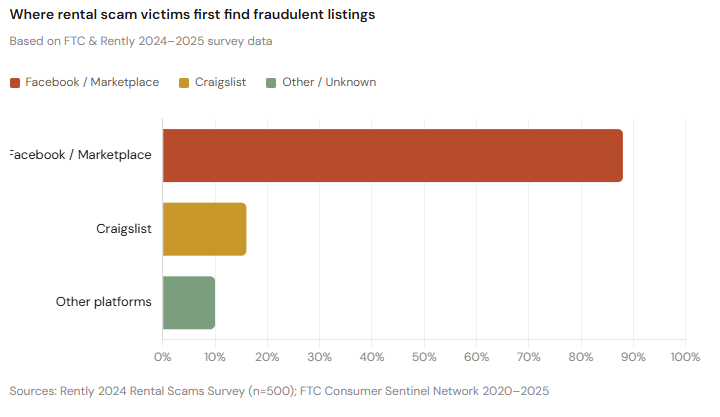
The FTC notes that about half of all reported rental scams in the 12 months ending June 2025 started with a fake ad on Facebook, with another 16% originating on Craigslist. If you're finding St. Louis rentals primarily through Facebook groups, you are operating in the highest-fraud-density environment that exists.
How the Scam Actually Works, Step by Step
It helps to understand the mechanics because once you see the pattern, you can't unsee it. These aren't sophisticated hackers — they're running a playbook that's been working consistently because housing stress makes people do things they'd never otherwise do.
- Step one is the hook. The listing goes up on Facebook Marketplace, Craigslist, or sometimes even copied to Zillow. The price is set 20-30% below market — enough to be obviously attractive, not so low that it triggers immediate alarm. Photos are stolen from the real listing using the actual address, so a reverse image search initially comes back clean (the images are real — they just belong to a for-sale property, not a rental).
- Step two is urgency. Zillow's fraud guidance is direct on this point: scammers rely on a heightened sense of urgency, opportunities that seem too good to be true, and caution about select details and specifics. The "landlord" will tell you there are three other applicants, and the first one to send a deposit locks it in. This manufactured urgency is designed specifically to short-circuit the verification steps you'd otherwise take.
- Step three is the ask. Wire transfer, Zelle, Venmo, Cash App, sometimes cryptocurrency, sometimes gift cards. Never a check. Never a credit card. Equifax's consumer guidance on rental fraud is blunt: wiring money is like sending cash — once it's out of your account, there is no getting it back, and the scammer can disappear completely. There is no dispute process, no chargeback, and no bank investigation that will recover wired funds sent to a stranger.
- Step four is the vanish. Sometimes it happens immediately after payment. Sometimes the scammer strings you along for days — asking for additional documents, sending fake "lease agreements," even scheduling a fake move-in date — before going silent. The longer version is more elaborate but also more damaging, because by then you may have given notice at your current place.
The Identity Theft Add-On
There's an uglier version of this scam that doesn't stop at taking your deposit. The application process itself becomes a data collection operation. The FTC flagged this pattern explicitly: scammers collect personal information, including Social Security numbers, driver's licenses, and pay stubs — all under the guise of a standard tenant screening process. By the time you realize the listing was fake, someone else has your full financial identity package. At that point, you have two problems instead of one.
Never provide your SSN, bank account information, or copies of your driver's license to any landlord before you have physically toured the property and verified independently that they own or manage it.
How to Verify a St. Louis Rental Listing (A Real Checklist)
This isn't theoretical advice — these are the specific steps that will tell you within about 15 minutes whether a listing is legitimate. Do all of them before you respond to anything or agree to anything.
What "Too Good to Be True" Actually Looks Like in Numbers
Let's be concrete, because vague warnings don't help anyone. Here's how you can quickly sanity-check a St. Louis listing price using publicly available data.
Reporting on St. Louis's 2025 real estate landscape describes Central West End, Midtown, and The Grove as having low rental vacancies and steady rent increases due to their proximity to jobs and hospital and university districts. These aren't depressed markets where landlords are desperate to fill units — they're competitive markets where legitimate landlords have their pick of applicants.
A two-bedroom in the CWE that's legitimately priced runs $1,500 and up. A one-bedroom in Tower Grove South goes for $1,100-$1,350, depending on condition and building. If you see a listing that's significantly under those numbers, with photos that look professionally shot and amenities that seem outsized for the price, the math simply doesn't work. Landlords in high-demand St. Louis neighborhoods don't need to undercut their neighbors to find tenants — they're getting applications within 48 hours at market rate.
Quick rule of thumb: If a CWE listing is under $1,200 for a one-bedroom, or a Tower Grove two-bedroom is under $1,000, verify the property ownership through public records before you respond.
Don’t even start the conversation until you’ve confirmed someone actually owns that building and that it’s legitimately available for rent.
What to Do If You Think You've Been Scammed
If you sent money and you're now realizing it was a scam, act fast — though be honest with yourself that wire transfers and Zelle payments are rarely recovered.
First, contact your bank or payment app immediately. While recovery is unlikely for wire transfers, some banks will make a fraud inquiry, and if the money hasn't yet settled, there's a slim chance of a recall. For Zelle, contact your bank's fraud department and file a claim. Results are inconsistent, but it costs you nothing.
Second, file a report. The FTC's ReportFraud.ftc.gov takes complaints and adds them to the Consumer Sentinel Network, which law enforcement agencies use to build cases. File with the Missouri Attorney General's consumer protection division as well. Report the listing to whatever platform it was on — Facebook, Craigslist, Zillow — so it gets taken down and flagged faster.
Third, if you gave out personal information (SSN, license, pay stubs), immediately place a fraud alert or credit freeze with all three credit bureaus — Equifax, Experian, and TransUnion. This is free and prevents scammers from opening new accounts in your name. You can do it in about 20 minutes online.
Finally, consider filing a police report with St. Louis Metropolitan Police or St. Louis County PD, even if they tell you recovery is unlikely. A police report creates a paper trail and may be required by your bank for a fraud claim.
The Platforms Aren't Fixing This Quickly Enough
Here's the uncomfortable truth that nobody in Silicon Valley wants to say out loud: Facebook Marketplace and Craigslist have a structural fraud problem that benefits them more than it costs them. Both platforms drive massive engagement from rental listings. Fraudulent listings generate the same ad revenue as real ones until they get flagged.
BBB research found that Craigslist caught only 47% of fake listings that researchers determined to be fraudulent, and that for clone listings — the most common scam type where a legitimate posting gets copied with different contact info — 40% of fake ads remained active and unflagged for 20 hours after posting. Twenty hours is more than enough time to collect deposits from dozens of people, especially on a Thursday night when the post targets weekend apartment hunters.
Facebook's record isn't better. The same BBB documentation showed fake listings staying active for weeks despite victims actively reporting them and contacting the company. The volume of content is part of the excuse — but it's also part of the business model. Don't count on the platforms to protect you. Count on yourself.
A Note on the "Missionary Landlord" and Other Classic Story Lines
There are patterns in the fake backstories that scammers use, and recognizing them helps. The "missionary abroad" is a classic — it explains unavailability, creates sympathy, and establishes a reason why keys need to be mailed rather than handed over in person. The "recently deployed military" version does the same thing. The "moving across country for work and the property is sitting empty" variant covers a different demographic.
All of these stories have one thing in common: they explain why the "landlord" cannot meet you. As LeaseRunner's rental fraud guide notes, scammers copy photos and descriptions from real listings and repost them with different contact information. They don't actually have access to the property. The story about being abroad isn't just sympathy-building — it's a logistical necessity. They can't show you the apartment because they have never been inside it.
Any landlord who cannot arrange a tour — in person, or at a minimum a live video call where they're physically in the property — should be removed from your list immediately. This is true even for high-end listings, even for properties you really want, even when they say you'll lose it to someone else if you insist on a tour. Legitimate landlords in St. Louis's tight rental market still show their properties. That's the basic contract.
The Bottom Line for St. Louis Renters
The rental market in St. Louis is genuinely tight right now, especially in the neighborhoods that attract younger renters and transplants. That tightness creates the conditions scammers rely on: stress, urgency, and a willingness to move faster than normal caution allows. Understanding that this is a designed trap — not a personal failing — is step one.
Step two is treating every online listing you can't immediately verify as unverified. Not fake necessarily, but not real either, until you've checked property ownership, reverse image searched the photos, confirmed the company or individual exists, and either toured the unit or sent someone you trust to tour it for you.
The tools to verify a St. Louis rental listing exist, and they're mostly free. The St. Louis County Assessor's database is public. Google Maps Street View is free. TinEye and Google Lens are free. Apartments.com rent comparison is free. None of these steps takes more than 20 minutes combined, and any one of them can save you $1,000 and weeks of chaos.
The Zillow Ghost is real. But it's also remarkably easy to spot once you know what you're looking at. The rent isn't that good. It never was.
Ready to Buy or Sell in St. Louis? House Sold Easy Has You Covered!
Navigating St. Louis’ red-hot luxury market doesn’t have to be a headache. With House Sold Easy, it’s all about less hassle—we’ve got you covered from start to finish. Our St. Louis experts know every corner of this city and will make buying your dream home or selling your high-end property a breeze. Don’t miss out on the hottest market in the U.S.! Contact House Sold Easy today and let’s make your real estate goals happen!