St. Louis Home Sales Falling Through Inspection (2026)
May 25, 2026
Written by David Dodge
Sellers are watching "Pending" signs flip back to "Active." Buyers are panicking over repair estimates they can't afford. Here's what's really happening — and what both sides can do about it.
Let me set a scene that's become painfully familiar for a lot of people in this market right now. You've had your house on the market for three weeks. You finally get an offer, sign the contract, put the "Pending" rider on the yard sign, and allow yourself to exhale. You've already mentally moved out. You're budgeting the next chapter. And then your phone rings.
The buyers are backing out. The inspection turned up something — maybe a crack in the basement wall, maybe an aging HVAC system — and with mortgage rates still hovering in the mid-6% range, they just don't have the financial cushion to absorb even a moderate repair bill. That "Pending" sign is coming down. You're relisting. And you're devastated.
This isn't a one-off bad luck story. This is happening all across St. Louis right now, and it's happening with a frequency that should have every buyer and seller re-thinking how they approach the inspection phase.
12–15%
of accepted STL contracts fall through before closing
15.1%
of U.S. purchase agreements canceled in Aug 2025 — a record high
70%
of cancellations cite inspection or repair issues as the top cause
The Numbers Don't Lie
According to St. Louis Realtors®, roughly 12–15% of accepted contracts in our market are falling apart before they ever reach closing. That means one out of every seven or eight sellers who thought they had a done deal ends up relisting — after weeks of stress, lost momentum, and in many cases real out-of-pocket costs for inspections they had done on their next home.
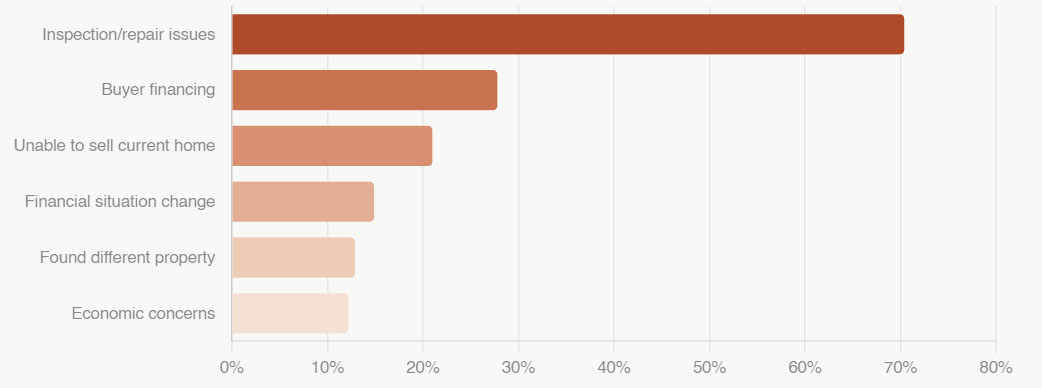
Nationally, things aren't much better. Redfin reported that roughly 56,000 U.S. home-purchase agreements were canceled in August 2025 alone — equal to 15.1% of homes that went under contract, the highest August cancellation rate since tracking began in 2017. And of the 443 Redfin agents surveyed who dealt with these cancellations, a full 70% pointed to home inspection or repair issues as the primary reason deals fell apart.
What's driving it? In a word: margin. Or rather, the complete lack of it.
Why deals fall through — agent survey
% of agents citing each reason (Redfin survey of 443 agents, 2025)
Source: Redfin, October 2025
Why Buyers Are So Spooked Right Now
Here's the thing that I think sellers sometimes forget: buyers in this market are stretched incredibly thin before they even walk into an inspection. Mortgage rates in St. Louis have been bouncing between 6.38% and 7.08% throughout the past year, according to Redfin data compiled by FasterHouse. On a $280,000 home — which is right around the St. Louis median — the difference between a 4% rate and a 6.5% rate is nearly $400 a month. Every month. Forever.
So a buyer sitting at a kitchen table looking at an inspection report that lists a $12,000 HVAC replacement, $6,000 in electrical panel work, and some suspicious-looking cracks in the basement wall isn't just thinking about those repair costs. They're calculating those costs on top of a mortgage payment that's already consuming 35–40% of their take-home pay. There's no cushion. Even a $5,000 repair credit can feel inadequate when you've already depleted your savings to cover the down payment and closing costs.
"Buyers are very knowledgeable when they're looking at a property. They know what they can and cannot afford — and right now, almost none of them can afford surprises."
— Megan Toll, Real Estate Agent, as quoted in industry research
Add to that the fact that there are simply more homes on the market now than during the pandemic frenzy, and buyers feel emboldened to walk. Fortune reported that sellers are outnumbering buyers nationally by about 500,000 at any given time, which gives buyers the psychological permission to say, "There's another house. We'll move on."
For Sellers: Stop Getting Blindsided
I know it stings to hear your deal fell apart. But most of the time, inspection cold feet is a preventable problem. The sellers who protect their deals are the ones who do the work before the buyer's inspector shows up — not after.
Get a pre-listing inspection. Yes, really.
I cannot stress this enough. A pre-listing inspection — where you hire an inspector before you list — typically costs between $300 and $500, which is nothing compared to the cost of losing a deal and relisting. It gives you the roadmap. You find out about the HVAC issue, the slow drip under the sink, and the section of the roof that's borderline. Then you have choices: fix it, price accordingly, or disclose it upfront with a repair credit already baked into the deal terms. What you eliminate is surprise — and surprise is what kills contracts.
Sellers who disclose known issues upfront and price accordingly almost always have smoother closings than sellers who "hope the inspector doesn't find it." They always find it.
Consider offering credits instead of doing the work yourself.
One of the smartest moves a seller can make in a market like this is to proactively offer a repair credit. Rather than waiting for the buyer to come back with a list of demands after their inspection, you can offer a flat credit at closing — say, $3,000–$5,000 — that buyers can use toward repairs of their choosing. This signals good faith, keeps the buyer in the deal, and often costs you less than actually completing the repairs would.
Seller checklist — before you list
- Hire a licensed inspector for a pre-listing walkthrough ($300–$500)
- Address any obvious deferred maintenance items: leaky faucets, GFCI outlets, and missing smoke detectors
- Have your HVAC serviced and document the service records
- If your home is older (pre-1980), consider having the electrical panel reviewed
- Price the home to reflect the condition honestly — overpricing a dated home in this market is a deal-killer
- Offer a proactive repair credit if there are known issues you're not repairing yourself
For Buyers: Learn to Tell the Difference
Now let's talk to buyers — because not every scary-looking inspection report is actually a reason to walk.
There is a critical distinction in any inspection between issues that are structural red flags and issues that are cosmetic or routine maintenance. Conflating the two is how buyers end up walking away from perfectly good homes — or worse, accepting risky ones because they didn't know what they were actually looking at.
Real red flags: things you should take seriously
In St. Louis specifically, where a significant portion of the housing stock in neighborhoods like South City, Soulard, and Bevo Mill was built between the 1910s and 1950s, foundation issues are genuinely common. Stratum Structural Systems — a local foundation repair company that works extensively in St. Louis County — notes that the city's combination of clay-rich soils and fluctuating moisture levels creates ongoing pressure on foundation walls over time.
A bowing basement wall in an older South City home is not the same thing as cosmetic cracks in drywall. A wall that curves or leans inward, has horizontal cracks running across the blocks, or shows significant displacement at the mortar joints is a structural issue that warrants either a significant repair credit, a seller-funded fix, or in some cases, a legitimate reason to walk. Repair costs on a bowing wall can range from $8,000 to $25,000+, depending on the extent of the damage and the method required to correct it.
Other structural red flags: active water intrusion into a basement (not just old staining — active moisture), a compromised roof deck (not just aging shingles), knob-and-tube wiring that hasn't been updated, and evidence of significant pest damage to framing members.
Not red flags: things buyers panic about unnecessarily
Here's the flip side. The inspection report is going to be long. It always is. Inspectors are legally and professionally obligated to note everything — including things like a missing cover plate on an outlet, a dryer duct that's three inches shorter than recommended, or a weatherstripping gap on a door. These are not reasons to blow up a deal.
Hairline vertical cracks in poured concrete walls? Usually just normal concrete shrinkage. Dated but functional appliances? That's a pricing conversation, not an inspection conversation. Original single-pane windows in a 1940s Dogtown bungalow? Expected. The buyer who cancels over these things is often the buyer who panics — not the buyer who's making a rational financial decision.
Buyer's framework — real vs. routine
-
Structural (take seriously): Bowing or horizontally cracked foundation walls, active water intrusion, compromised roof structure, significant pest damage to framing
-
Major mechanical (negotiate on): HVAC systems near the end of life, electrical panels that need updating, failing water heater, aged roof with limited life remaining
-
Cosmetic/routine (don't panic): Cosmetic wall cracks, aged fixtures, dated finishes, minor plumbing drips, missing cover plates, and older appliances that still function
- When in doubt, get a second opinion from a structural engineer — not just the general inspector — before walking away from a home you otherwise love
The Emotional Reality for Sellers
I want to take a moment and just acknowledge how genuinely awful it is to see a "Pending" sign go back to "Active."
There's a specific kind of grief that comes with a fallen-through deal. You've already started picturing yourself gone. You've maybe told your employer you're relocating, or started calling moving companies, or mentally redecorated the next place. And then it evaporates. And now you're back to square one, with the psychological burden of knowing that potential buyers who visit from here on out will wonder: what did the inspection find?
That stigma is real. Homes that go back to active after a pending status do tend to sit longer and often need to be repriced. Which is exactly why doing the work on the front end — the pre-listing inspection, the honest pricing, the proactive credit — is so much better than hoping you get through without turbulence.
The Bigger Picture
The inspection-phase collapse epidemic isn't specific to St. Louis, but our market has some qualities that make it particularly acute. We have a large inventory of older homes with genuine deferred maintenance. We have buyers who came into 2025 and 2026, stretched by rates that were supposed to have come down by now. And we have a market that shifted from frenzied seller's market conditions — where buyers waived inspections entirely — to a more normalized environment where buyers are exercising every protection available to them.
That normalization is actually healthy. The inspection contingency exists for a reason: to protect buyers from buying someone else's problem without knowing the full picture. The sellers who understand that — and who prepare accordingly — are the ones closing deals. The ones who price high and hope the inspection goes away are the ones relisting.
Whatever side of the transaction you're on, the single best thing you can do right now is go into the inspection phase with eyes open, realistic expectations, and a willingness to problem-solve rather than panic. Most deals that die in the inspection phase didn't have to die. They died because both sides ran out of goodwill before they ran out of options.
Ready to Buy or Sell in St. Louis? House Sold Easy Has You Covered!
Navigating St. Louis’ red-hot luxury market doesn’t have to be a headache. With House Sold Easy, it’s all about less hassle—we’ve got you covered from start to finish. Our St. Louis experts know every corner of this city and will make buying your dream home or selling your high-end property a breeze. Don’t miss out on the hottest market in the U.S.! Contact House Sold Easy today and let’s make your real estate goals happen!