St. Louis Housing Market: What a $285K Home Budget Buys
May 24, 2026
Written by David Dodge
Prices are up. Headlines are loud. Here's a neighborhood-by-neighborhood reality check for buyers who want honest numbers before calling an agent.
$285K
Metro Median Price
↑ 3.6% year-over-year
1.9mo
Homes in Supply
Seller's market territory
47 days
Avg. Days on Market
Up slightly from 42 last year
Let me be straightforward with you: the St. Louis housing market is genuinely hard to read right now — not because it's falling apart, but because it's moved fast enough that the gap between what people think $285,000 buys and what it actually buys has gotten pretty wide, depending on where you're looking. Walk into Central West End with that budget and you're in condo territory. Drive 20 minutes southwest to Kirkwood, and you might be priced out entirely without a strong offer. Head to South City or a pocket of West County, though, and $285k can still feel like a real opportunity.
That's the story I want to tell here — not market doom, not cheerleading, just a practical look
at purchasing power across four distinctly different parts of greater St. Louis. Whether you're a first-timer who just started browsing Zillow late at night or someone who's been waiting out rates and wondering if now's the moment, this breakdown should give you a grounded sense of what to expect.
The macro picture, first
According to the most recent data from St. Louis REALTORS®, the metro's residential median sales price has risen to around $285,000 — roughly 3.6% higher than where we were this time last year. That's not a bubble number. It's steady, grinding appreciation driven largely by one stubborn fact: inventory is thin. As of early 2025, single-family homes had just 1.9 months of supply in the market. Anything under 3 months is considered a seller's market, and we've been camping here for the better part of three years.
The national picture is slightly different. Redfin data puts St. Louis's median sale price roughly 43% below the national average — which means if you're relocating from a coastal market, this city probably still looks like a relative bargain. For locals, the calculus is more personal. Wages haven't kept pace the same way prices have, and mortgage rates hovering near 6.5% make monthly payments feel heavier than the sticker price suggests.
Still, compared to Chicago, Nashville, or Denver? St. Louis is holding its own as one of the genuinely affordable major metros in the country. That's nothing.
Let me be straightforward with you: the St. Louis housing market is genuinely hard to read right now — not because it's falling apart, but because it's moved fast enough that the gap between what people think $285,000 buys and what it actually buys has gotten pretty wide, depending on where you're looking. Walk into Central West End with that budget, and you're in condo territory. Drive 20 minutes southwest to Kirkwood, and you might be priced out entirely without a strong offer. Head to South City or a pocket of West County, though, and $285k can still feel like a real opportunity. That's the story I want to tell here — not market doom, not cheerleading, just a practical look at purchasing power across four distinctly different parts of greater St. Louis. Whether you're a first-timer who just started browsing Zillow late at night or someone who's been waiting out rates and wondering if now's the moment, this breakdown should give you a grounded sense of what to expect.
The macro picture, first
According to the most recent data from St. Louis REALTORS®, the metro's residential median sales price has risen to around $285,000 — roughly 3.6% higher than where we were this time last year. That's not a bubble number. It's steady, grinding appreciation driven largely by one stubborn fact: inventory is thin. As of early 2025, single-family homes had just 1.9 months of supply in the market. Anything under 3 months is considered a seller's market, and we've been camping here for the better part of three years.
The national picture is slightly different. Redfin data puts St. Louis's median sale price roughly 43% below the national average — which means if you're relocating from a coastal market, this city probably still looks like a relative bargain. For locals, the calculus is more personal. Wages haven't kept pace the same way prices have, and mortgage rates hovering near 6.5% make monthly payments feel heavier than the sticker price suggests.
Still, compared to Chicago, Nashville, or Denver? St. Louis is holding its own as one of the genuinely affordable major metros in the country. That's not nothing.
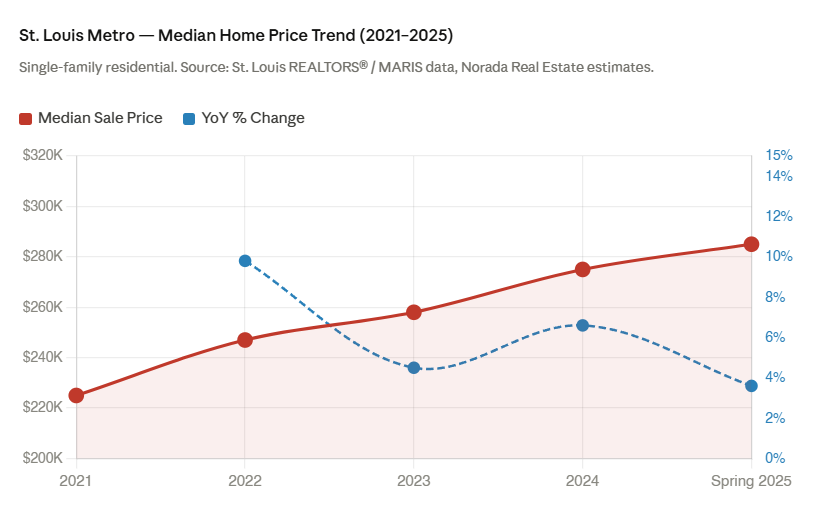
One thing worth flagging: new listings actually dropped 7.3% over the past year, according to Norada Real Estate's market analysis. Fewer homes hitting the market while buyer demand holds steady is what keeps prices from softening even as mortgage rates stay elevated. It's a supply squeeze more than it is a demand surge — and that's an important distinction for buyers. It means you're not necessarily competing with a flood of eager buyers; you're competing in a pool that just doesn't have many options.
What $285,000 looks like across four neighborhoods
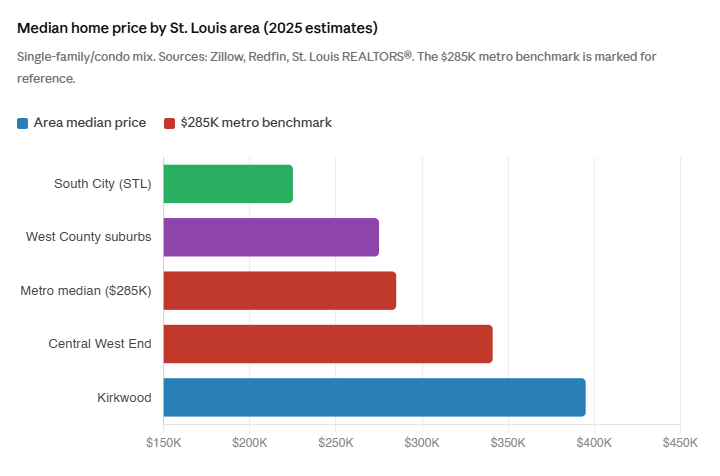
This is the part that actually matters for most people doing research. The metro-wide median is a useful anchor, but St. Louis is a city of micro-markets. What your $285,000 can buy in the Central West End is fundamentally different from what it buys in South City or West County. Here's an honest, neighborhood-by-neighborhood breakdown.
Central West End
~$285K–$350K avg.
At $285K in the CWE, you're shopping for a condo, not a house. Expect 800–1,100 sq ft, walkability, Forest Park access, and one of STL’s best dining scenes. Parking is often extra.
Condo market at $285K
Kirkwood
~$350K–$450K avg.
Kirkwood remains highly competitive. A $285K budget may land a smaller starter home, but buyers need to move quickly and submit strong offers.
Stretching budget here
South City (STL)
~$190K–$300K avg.
Tower Grove South, Bevo Mill, and Dutchtown offer brick bungalows, updated homes, yards, basements, and classic STL character.
Best value in the city
West County (suburbs)
~$250K–$325K avg.
At $285K, buyers can often find a solid 3BR/2BA ranch or two-story home in areas like Ballwin or Ellisville with strong school access.
Good value, school access
Neighborhood median prices at a glance
Inventory, days on market, and what that means for your offer
The days-on-market number is one I'd watch closely right now. The metro average is sitting at 47 days, which sounds relaxed — but that's a blended number that masks a lot of variation. A well-priced, updated home in South City or a move-in-ready ranch in Ballwin can go pending in under two weeks. Properties that need work or are priced aggressively high are the ones dragging that average up.
What this means practically: if you see something in the sub-$300k range that's been sitting for more than 30 days, there's usually a reason. It might be cosmetic (an outdated kitchen that scares buyers), it might be something more serious (foundation, roof, sewer), or it might just be overpriced for the condition. Each of those scenarios is a different kind of negotiating opportunity — but you need eyes on the property to know which one you're dealing with.
Buyer Tip:
In this market, pre-approval isn't just a checkbox — sellers will not take you seriously without it. With inventory sitting at under 2 months of supply, the sellers who are listing have options. Show up with your financing in order, know your absolute ceiling, and don't make an offer you're not ready to stand behind.
The percent-of-list-price-received metric also tells you something useful: for residential homes, it's sitting right around 100.6%, meaning homes are on average still selling very close to asking, slightly above, in fact. That said, STL Home Search's market data notes that the spread has crept slightly, giving buyers a bit more room than they had in 2022 or 2023. It's not a buyer's market, but it's not 2021 either.
Should you buy now — or wait?
I'm not going to give you a definitive answer on this because it genuinely depends on your situation — but I can give you the honest version of the conversation you should be having with yourself.
If you're renting and plan to stay in St. Louis for at least 5 years, the math increasingly favors buying. Forecasts from the Norada Real Estate project continued appreciation of around 2% through the end of 2026 — modest, but steady. Waiting for prices to drop meaningfully in this market is a speculative bet. The supply problem that's driving prices isn't going to resolve itself quickly, and rate cuts that make buying more accessible also tend to bring more buyers off the sidelines, keeping competition elevated.
If you're eyeing a stretch-budget neighborhood — say, Kirkwood or Webster Groves — it's worth being honest about whether you're ready to compete in that price range or whether a neighboring market (Maplewood, Shrewsbury, South County) gives you more home for the same money.
And if you're a seller? You're still in a solid position. Low inventory means your well-presented home will get attention. But the days of pricing 10% above market and watching a bidding war unfold are largely behind us for most price points. Price it right from day one.
The bottom line
The $285,000 median is a real number — but it's more of a compass than a destination. In South City, it puts a move-in-ready brick home within reach. In the Central West End, it's a condo with character and a great walkable lifestyle. In Kirkwood, it's a starting point for a conversation about what you can realistically compete for. In West County, it lands you squarely in the suburban sweet spot with good schools and room to park two cars.
St. Louis remains one of the more affordable large metros in the country, and that's not changing anytime soon. What is changing is the pace of that appreciation and the shrinking window you have to act when something good hits the market. The buyers who do well here right now are the ones who've done the homework — who know their neighborhoods, know their numbers, and have a team ready to move when the right property comes up.
If this breakdown raises more questions than it answers, that's actually a good sign. It means you're getting into the specifics, which is exactly where this decision needs to live.
Ready to Buy or Sell in St. Louis? House Sold Easy Has You Covered!
Navigating St. Louis’ red-hot luxury market doesn’t have to be a headache. With House Sold Easy, it’s all about less hassle—we’ve got you covered from start to finish. Our St. Louis experts know every corner of this city and will make buying your dream home or selling your high-end property a breeze. Don’t miss out on the hottest market in the U.S.! Contact House Sold Easy today and let’s make your real estate goals happen!