Why Community Culture Drives St. Louis Home Values in 2026
Jul 03, 2026
Written by David Dodge
As dusk falls across eastern Missouri tonight, the sky is lighting up with more than just early mid-summer displays. From the historic brick-lined streets of the city center to the wide, oak-canopied avenues of the historic inner-ring suburbs, holiday weekend block parties and local community fireworks displays are kicking off tonight across the entire St. Louis metropolitan landscape. Smells of slow-smoked barbecue drift over freshly painted front porches; sparklers cut bright paths through the twilight; and neighbors drag lawn chairs out past their property lines onto sidewalks to catch up, share food, and celebrate together.
But beneath this idyllic scene lies a powerful shift in the regional economy. In 2026, home buyers across the United States—and specifically within the competitive, resilient St. Louis metropolitan statistical area (MSA)—are no longer evaluating real estate purely through the traditional, cold metrics of square footage, bedroom counts, or generic asset appreciation. Instead, buyers are shopping for community culture.
The traditional calculation of home valuation has broken open. While physical structures degrade and interior finishes shift out of style, the intangible social architecture of a block—its "neighborhood spirit," its walkability, its collective civic investment, and its literal front-porch-heavy layout—has emerged as one of the most reliable wealth-preservation engines in modern real estate. This love letter to St. Louis’s historic and tightly knit communities breaks down the concrete financial value of community character, exploring why hyper-engaged pockets are keeping regional home values highly insulated from wider national housing market slowdowns.
The Shift to "Community Character" in 2026
For decades, real estate agents and residential appraisers evaluated real estate value based primarily on a hard, mathematical baseline: location, structure size, lot dimensions, and macro-level municipal tax brackets. However, as the 2026 housing market balances itself against a shifting national economic landscape and stabilizing interest rates, a premium is being placed on the experiential value of a home's immediate surroundings.
This transformation is driven by a deep human desire for connection in an increasingly digital world, but it is supported by hard, observable economic data. According to a comprehensive national development impact study by
When neighbors know one another by name, when they organize independent neighborhood watches, and when they host collective block parties, the market notices. Buyers are willing to accept a premium, paying significantly more per square foot for the privilege of embedded civic engagement. This premium manifests as real insulation against market corrections. While a standard subdivision with identical facades and unutilized common grounds may see listing velocity drop during high-interest-rate cycles, historical front-porch communities experience sustained bidding pressure.
The reason is simple: you can remodel a master bathroom or expand a kitchen island, but you cannot construct a century-old neighborhood culture from a blueprint. Community character is a finite resource, and in 2026, finite resources command premium pricing.
Navigating the 2026 St. Louis Macro Housing Market
To understand how community engagement drives micro-market outperformance, one must first look at the broader St. Louis real estate framework. The regional market in mid-2026 is defined by its resilience and relative affordability, with housing costs in the area sitting approximately 39% below the national average.
According to the comprehensive
ST. LOUIS MSA MARKET SUMMARY (MID-2026)
MEDIAN SALE PRICE
$309,900
▲ 4.63% vs 2025
INVENTORY SUPPLY
3.72 Months
Stabilizing
REGIONAL AFFORDABILITY
39%
Below National Average
MARKET OUTLOOK
Steady
Community-driven demand
However, looking purely at macro averages obscures the sharp contrasts defining different pockets of the region. While the overall St. Louis metropolitan area holds a stabilizing 3.72-month supply of active housing inventory, suburban hubs like St.
Conversely, the
Yet, within these very same geographical boundaries, hyper-localized historic pockets completely defy broader city-wide baseline trends. Pockets with massive neighborly engagement and distinct architectural identities bypass broader city-wide market corrections entirely. Let us analyze three prime examples where front-porch culture and community vibes create bulletproof real estate premiums.
Spotlight on Three Iconic St. Louis Micro-Communities
1. Webster Groves: The Suburban Front-Porch Archetype
Located in the inner-ring suburban fabric of southwest St. Louis County, Webster Groves is an economic case study in how deep civic involvement can insulate property values. Known for its rolling hills, centuries-old historic oak canopies, and iconic century-old Victorian, Craftsman, and Colonial Revival homes, Webster Groves is built entirely around human interaction.
According to early-2026 home valuation research published by
The physical layout of Webster Groves is engineered for socialization. The homes feature wide, deep covered front porches positioned close to sidewalks, explicitly inviting casual conversation with passing neighbors. Tonight, Webster Groves is not just watching fireworks; it is hosting long-standing, street-by-street block associations where generational residents mix with young families who bought into the community for its renowned public school systems and walkable old-town commercial centers.
When a home hits the market on tree-lined streets like South Elm Avenue, buyers are not just looking at the updated custom kitchens or newly laid cedar porches. They are looking at the neighborhood kid selling lemonade down the block, the active garden clubs, and the annual community festivals like the Webster-Kirkwood Turkey Day game or the local Fourth of July community parade. This high level of neighborly investment creates an environment where homeowners take meticulous care of their properties, creating a self-reinforcing loop that protects property values against broader market swings.
2. Lafayette Square: Architectural Majesty Matched by Intimate Civic Bonds
Closer to the urban core, standing directly south of downtown St. Louis, lies Lafayette Square. Centered around the oldest public park west of the Mississippi River, this historic district is famous for its stunning, meticulously restored "Painted Ladies"—grand, multi-story Second Empire Victorian townhomes that boast soaring mansard roofs, ornate wrought-iron fences, and vibrant, multi-colored facades.
The
MEDIAN NEIGHBORHOOD VALUATION COMPARISON (MID-2026)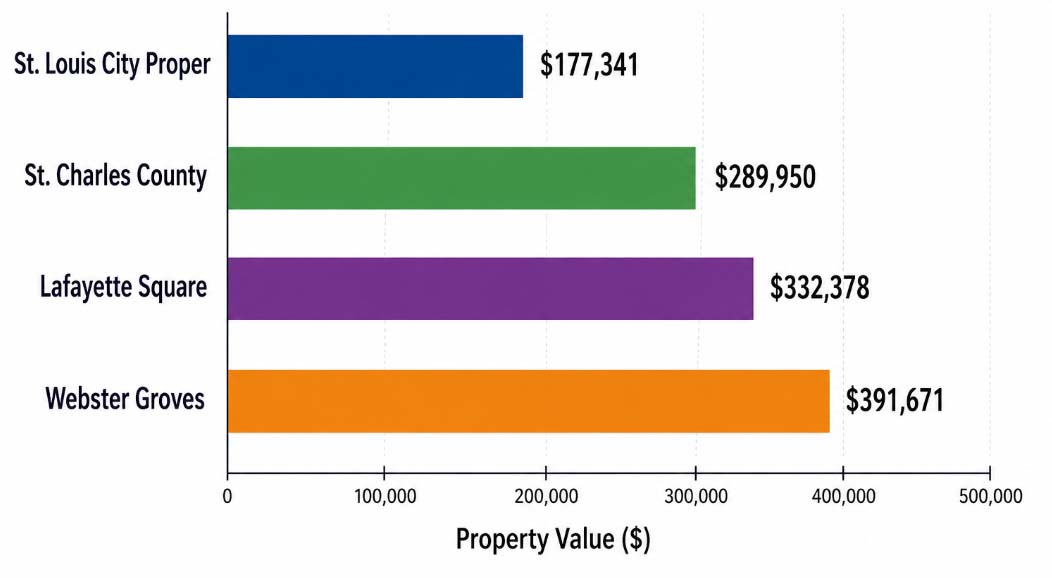
But the architectural majesty of Lafayette Square would mean very little without its famously fierce community backbone. The Lafayette Square Restoration Committee (LSRC) operates as a powerful civic engine, organizing neighborhood safety patrols, coordinating neighborhood park cleanups, funding historical preservation initiatives, and hosting renowned seasonal home tours and summer concert series in Lafayette Park.
On a holiday evening like tonight, the park acts as a massive outdoor living room. Neighbors pack picnic baskets, pour glasses of wine on their front stoops, and watch children play around the historic bandstand. In Lafayette Square, buying a home means gaining an immediate, highly active social calendar. The community culture is so palpable that it acts as an economic buffer: even when broader urban real estate metrics experience minor pricing volatility, the sheer demand for a lifestyle anchored around Lafayette Park keeps inventory remarkably low and prices rock-solid.
3. St. Charles: Historic Riverfront Identity Meets Contemporary Demand
Crossing the Missouri River into St. Charles County brings you to historic St. Charles, a community that masterfully bridges the gap between historical riverfront identity and modern suburban growth. Boasting a baseline median home value of $289,950, St.
The crown jewel of this community is South Main Street—a beautifully preserved, gas-lit brick thoroughfare lined with 19th-century buildings that now house local coffee shops, artisan boutiques, and family-owned restaurants. The residential neighborhoods flanking the historic commercial core are heavily weighted toward walkability, featuring closely spaced historic homes, small community parks, and deep front porches that overlook the brick streets.
Tonight, the community spirit of St. Charles is on full display as thousands gather along the banks of the Missouri River for the city’s massive annual fireworks celebration. For a homebuyer looking at real estate here, the financial calculus extends beyond the walls of the property. The value is driven by the ability to walk out of your front door, wave to your neighbor, and stroll down to the riverfront for a community festival without ever getting into a car.
This high level of connectivity and shared community pride transforms St. Charles from a mere commuter suburb into a deeply rooted destination market. It ensures a steady influx of eager home buyers who intentionally seek out areas with a clear, palpable sense of place, keeping home values insulated even when nearby contemporary subdivisions experience market stagnation.
| Location | Median Home Value | Market Characteristics |
|---|---|---|
| St. Louis City Proper | $177,341 | High buyer leverage with a median of approximately 21 days on market, giving buyers more opportunities to negotiate. |
| St. Charles County | $289,950 | Ultra-competitive suburban market with limited inventory, quick sales, and strong buyer demand. |
| Lafayette Square | $332,378 | One of St. Louis' fastest-appreciating historic neighborhoods, known for premium homes and exceptional walkability. |
| Webster Groves | $391,671 | Highly desirable inner-ring suburb featuring excellent schools, mature neighborhoods, and consistently strong buyer demand. |
The Hard Financial Math of Neighborhood Spirit
How exactly does "community vibe" translate into actual dollars and cents on a home appraisal or a closing statement? There are several direct, concrete mechanisms through which hyper-local neighborhood spirit actively shields and enhances property values:
-
Lower Structural Turnover and High Retention: Pockets with high neighborly engagement exhibit much longer average residential tenure. When people love their neighbors, they stay in their homes for decades rather than moving every few years. This low structural turnover minimizes active inventory. In a classic supply-and-demand framework, when the supply of homes for sale in a highly desirable school district or historic neighborhood remains perpetually low, values naturally climb.
-
The "Front-Porch" Appraisal Premium: Walkable neighborhoods with vibrant front-porch cultures naturally experience higher rates of home maintenance. Because properties are highly visible to neighbors during daily foot traffic, peer accountability ensures yards are landscaped, paint is fresh, and historic architectural features are preserved. This minimizes neighborhood blight and guarantees that comparable sales (comps) within the immediate district remain strong.
-
Organic Commercial Vitality: Strong community spirit naturally births strong local business support. Walkable neighborhoods like Webster Groves, Lafayette Square, and historic St. Charles feature highly successful, locally owned commercial corridors. When homeowners intentionally spend their dollars at neighborhood bistros, local coffee shops, and independent bookstores, they create a thriving local economy that makes the surrounding residential real estate infinitely more attractive to incoming buyers.
-
Enhanced Collective Security and Civic Advocacy: Engaged neighborhoods naturally establish tight-knit community watches, block-by-block communication channels, and active neighborhood associations.
Visualizing the 2026 St. Louis Property Value Premium
To clearly demonstrate how community-first, front-porch-heavy neighborhoods outperform broader regional averages, the data graph below illustrates the clear premium that buyers are willing to pay for neighborhoods defined by high neighborly engagement and distinct community character.
The chart contrasts the baseline St. Louis City Proper Zillow Home Value Index with the median values commanding the historic, community-centric real estate corridors of Lafayette Square, St. Charles, and Webster Groves as of mid-2026.
Figure 1: 2026 St. Louis Neighborhood Value Premium Breakdown
As visually represented above, the financial premium attached to community-rich neighborhoods is substantial. Lafayette Square commands nearly double the median property value of the broader city-proper index, while Webster Groves sits at the top of the localized index, driven by its powerful combination of inner-ring walkability, civic infrastructure, and front-porch architecture. This visualization makes one reality undeniable: when you invest in a home with an embedded neighborhood spirit, you are paying for an economic moat that protects your residential investment from broader macro market downturns.
Ready to Buy or Sell in St. Louis? House Sold Easy Has You Covered!
Whether you're thinking about listing your home or exploring a cash offer, it's worth understanding all of your options before making a decision. The right choice depends on your timeline, your property's condition, and your goals. Contact House Sold Easy to discuss your situation and see what makes the most sense for you.Our St. Louis experts know every corner of this city and will make buying your dream home or selling your high-end property a breeze. Don’t miss out on the hottest market in the U.S.! Contact House Sold Easy today and let’s make your real estate goals happen!