Expert St. Louis Real Estate Tips for 2026 Sellers
Aug 13, 2026
Written by House Sold Easy Team
If you bought a house between 2021 and 2024, you probably heard the phrase "waiving inspections" on a loop. It was a stressful, sometimes ruinous tactic buyers used to win bidding wars in a hyper-competitive, historically tight market. For the better part of the last half-decade, buyers felt as though they were participating in a marathon where the finish line kept moving. A home would hit the market on a Thursday, and by Friday evening, it would have a dozen offers, most of them well over asking, with contingencies completely waived. Buyers were exhausted, experiencing a phenomenon known as "buyer fatigue," where the emotional toll of constantly losing out on properties forced many to pause their searches entirely.
During that time, purchasing a home without a thorough inspection was normalized. People were buying properties entirely sight unseen, relying on low-resolution FaceTime walk-throughs and the sheer hope that the roof wouldn't cave in. The systemic pressure to waive a fundamental consumer protection—the right to know exactly what you are purchasing—created an environment of extreme anxiety. Homeownership, historically a cornerstone of the American Dream, suddenly felt akin to high-stakes gambling.
But as we move through August 2026, a healthy, long-overdue real estate staple has returned to St. Louis: the inspection contingency. The market is cyclically normalizing, shedding the unhealthy volatility of the post-pandemic boom. The fever pitch of the past few years could not sustain itself forever, and the landscape is shifting back to a balanced state. Buyers are no longer willing to risk their financial futures by purchasing potential money pits blindly.
The Relatable Problem: The End of "Waiving Inspections
If you bought a house between 2021 and 2024, you probably heard the phrase "waiving inspections" on a loop. It was a stressful, sometimes ruinous tactic buyers used to win bidding wars in a hyper-competitive, historically tight market. For the better part of the last half-decade, buyers felt as though they were participating in a marathon where the finish line kept moving. A home would hit the market on a Thursday, and by Friday evening, it would have a dozen offers, most of them well over asking, with contingencies completely waived. Buyers were exhausted, experiencing a phenomenon known as "buyer fatigue," where the emotional toll of constantly losing out on properties forced many to pause their searches entirely.
During that era, purchasing a home without a thorough inspection was normalized to a terrifying degree. People were buying properties relying on hasty walk-throughs and the sheer hope that the roof wouldn't cave in. The systemic pressure to waive a fundamental consumer protection—the right to know exactly what you are purchasing—created an environment of extreme anxiety. Homeownership suddenly felt akin to high-stakes gambling. The aftermath of this period has left many pandemic-era buyers burdened with homes requiring catastrophic repairs they were wholly unprepared to finance.
But as we move through August 2026, a healthy, long-overdue real estate staple has returned to St. Louis: the inspection contingency. The market is cyclically normalizing, shedding the unhealthy volatility of the post-pandemic boom. The fever pitch of the past few years could not sustain itself forever, and the landscape is shifting back to a balanced state. Buyers are no longer willing to risk their financial futures by purchasing potential money pits blindly.
This return to normalcy means that due diligence is no longer a luxury—it is an expectation. The power dynamic between buyers and sellers has stabilized, meaning that requesting an inspection is no longer viewed as a competitive disadvantage, but rather as a standard component of a legally sound transaction. It marks a return to a marketplace where informed consent, rather than sheer desperation, dictates how a home is bought and sold.
Understanding the Data: The Summer 2026 Market Shift
To fully grasp why contingencies are back, we must look at the data driving the 2026 St. Louis housing market. The most critical metric driving this newfound market balance is housing inventory. According to local real estate market data, active listings in the metro have jumped roughly 10.3% year-over-year. This influx of new inventory gives buyers breathing room. Instead of competing against twenty other offers on a single property, buyers might now only be competing against two or three—and in many cases, none at all if the property has been sitting on the market for a few weeks.
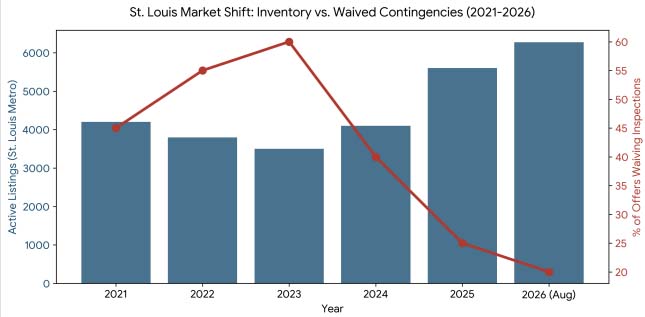
Fig 1. The inverse relationship between rising active listings in St. Louis and the declining percentage of waived buyer contingencies from 2021 to 2026.
With more homes to choose from, buyers have reclaimed their negotiating power. They are taking their time, scheduling second showings, and demanding robust inspection periods. The frantic pressure to make an offer within hours of a listing going live has largely dissipated. Furthermore, as we look at national trends surrounding interest rates and affordability, the context becomes even clearer. In the current market environment of late 2025 and heading into 2026, mortgage rates have been hovering around 6.7%. Higher borrowing costs mean buyers are stretched thinner on their monthly payments, leaving them with absolutely zero appetite for unexpected, massive repair bills post-closing.
The stabilization of the market has also shifted the types of contracts being written. According to comprehensive industry surveys tracking buyer behavior, 81% of purchase contracts contain at least one contingency, and roughly 20% of buyers waive inspection or appraisal protections. While that 20% might still seem high, it represents a massive decline from the peak frenzy of 2022 when well over half of all winning bids featured waived inspections. The 81% of contracts containing contingencies now represent the new normal for 2026.
Why This Matters for St. Louis Buyers: An Architectural Deep Dive
St. Louis is famous for its rich, historic architecture. The city's housing stock is incredibly diverse and notably old compared to many Sun Belt cities. Whether you are looking at a century-old brick bungalow in South City, a stately Victorian in Lafayette Square, or a sprawling mid-century ranch in Chesterfield, older homes come with distinct, unavoidable quirks. They require a specialized level of scrutiny that simply cannot be achieved during a fifteen-minute open house.
When you buy an older home in St. Louis, you aren't just buying a floor plan; you are buying decades of maintenance history. You are inheriting the craftsmanship of the 1920s, the plumbing updates of the 1970s, and the electrical DIY projects of the 1990s. The inspection contingency is your only defense against inheriting someone else's neglected maintenance. In a city where brick masonry and plaster walls define the aesthetic, the cost of repairing structural hidden damage is astronomically high. Knowing exactly what lies behind the walls and beneath the floorboards is crucial.
The return of the inspection contingency gives St. Louis buyers the necessary time to bring in specialists. A general home inspector is excellent for identifying surface-level issues and pointing out red flags, but historical St. Louis homes often require experts: structural engineers, specialized roofers familiar with slate or architectural shingles, and masonry experts who understand tuckpointing. The standard ten-day inspection window provides the runway needed to coordinate these specialized evaluations without the fear of the seller terminating the contract.
Furthermore, older homes were not built to modern energy codes. In the brutal heat of a St. Louis August or the freezing temperatures of January, poor insulation and outdated HVAC systems can lead to unmanageable utility bills. Inspections allow buyers to evaluate the thermal envelope of the house, check for asbestos in older insulation materials, and assess the true lifespan remaining on major mechanical systems. This isn't just about safety; it's about accurate financial planning for the first five years of homeownership.
The Silent Threat: Sewer Laterals in St. Louis
One of the most critical, yet often overlooked, aspects of buying a home in St. Louis is the sewer lateral line. This is the pipe that connects your home's plumbing system to the main municipal sewer line running under the street. In many St. Louis municipalities, the homeowner is entirely responsible for the maintenance and repair of this lateral line, right up to the connection point at the main.
In South City and many of the older inner-ring suburbs, these sewer laterals are constructed of vitrified clay, cast iron, or Orangeburg pipe—materials that have long surpassed their intended lifespans. Clay pipes, in particular, are highly susceptible to root intrusion. Over decades, tree roots seek out the moisture inside the sewer lines, infiltrating through tiny joints and cracks, eventually causing massive blockages or total structural collapse of the pipe.
Replacing a collapsed sewer lateral in St. Louis can easily cost between $8,000 and $15,000, as it often involves excavating the yard, breaking through sidewalks, and sometimes even tearing up the street itself. During the years when buyers were waiving inspections, thousands of homes traded hands with ticking time bombs buried beneath the front lawns. Now that contingencies have returned, you finally have the time to get a proper camera inspection of the sewer lines.
A specialized plumber can snake a high-definition camera down the lateral line to check for root intrusions, bellies (sags in the pipe where water pools), and structural cracks. This $200 inspection is arguably the highest ROI investment a buyer can make during the due diligence period. If severe issues are found, the buyer can utilize their contingency to require the seller to perform the repairs or offer a substantial credit at closing. Furthermore, St. Louis buyers should always investigate whether their specific municipality offers a Sewer Lateral Program, which can offset some of the repair costs, though these programs have limitations and waitlists that buyers need to be fully aware of before closing.
Foundation Checks: Missouri's Shifting Clay Soil
If there is one thing that defines the subterranean landscape of Missouri, it is clay soil. The expansive clay soil prevalent throughout the Greater St. Louis area is notorious for its dramatic expansion and contraction cycles based on moisture levels. During the wet spring months, the soil absorbs water and expands, exerting immense hydrostatic pressure against the foundation walls of homes. During the hot, dry late-summer months—like August 2026—the soil dries out, shrinks, and pulls away from the foundation, removing necessary support.
This endless cycle of expanding and shrinking wreaks havoc on concrete and block foundations. Standard protection clauses are back on the table to protect you from unexpected $15,000 to $30,000 repair bills associated with foundation failure. Common symptoms of this soil-induced stress include stair-step cracks in the mortar joints of block foundations, horizontal cracks that indicate a wall is bowing inward, and vertical shearing that suggests differential settlement.
In older St. Louis homes, particularly those with rubble stone foundations common in the late 19th and early 20th centuries, water intrusion is a constant battle. The mortar holding the stones together deteriorates over time, leading to damp basements, efflorescence (white, chalky mineral deposits on walls), and eventually, structural instability. Without an inspection contingency, a buyer taking on a home with foundation issues assumes a liability that can rapidly drain their savings.
The 2026 real estate market gives buyers the ability to bring in a structural engineer during the inspection period. If a wall is bowing, the engineer can determine whether it requires simple carbon fiber strapping, the installation of steel I-beams, or, in extreme cases, total wall excavation and replacement. This level of clarity allows the buyer to make an educated decision: negotiate the cost of the repair, or walk away from the property with their earnest money intact.
Financial and Mortgage Contingencies in 2026
While the physical inspection contingency is paramount in St. Louis due to the housing stock, it is equally important to highlight the return of the financing and appraisal contingencies. The volatile interest rate environment of the past few years has proven that financing is never guaranteed until the final underwriting approval is issued.
A mortgage contingency ensures that if a buyer's financing falls through due to factors beyond their control—such as a sudden job loss, a shift in lender guidelines, or an unexpected change in credit profile—they can exit the contract without penalty. In 2026, lenders are scrutinizing debt-to-income ratios more strictly than they were during the peak frenzy. Having this safeguard in place provides peace of mind that a buyer won't be forced into defaulting on a contract and losing thousands of dollars in earnest money deposits.
Similarly, the appraisal contingency protects the buyer from overpaying. In a rapidly appreciating market, buyers often waive this contingency and promise to cover any "appraisal gap" in cash. Today, as price appreciation normalizes, buyers are less willing—and often less able—to bring an extra $20,000 in cash to the closing table just because an appraiser disagreed with the purchase price. The appraisal contingency ensures that the home must appraise for at least the purchase price, or the buyer has the right to renegotiate or walk away.
"A home inspection isn't a weapon; it's a manual for your new home. For the first time in years, St. Louis buyers can finally read the manual before buying the house."
What This Means for Sellers: The Transition to a Turnkey Market
The resurgence of buyer contingencies dramatically shifts the strategy for sellers in the St. Louis market. For years, sellers enjoyed the luxury of selling homes "as-is," knowing that desperate buyers would overlook deferred maintenance, aging roofs, and outdated HVAC systems just to secure a property. Those days are definitively over. As we navigate the latter half of 2026, buyers are looking for turnkey properties.
With mortgage rates remaining elevated compared to the pandemic lows, buyers are pouring the majority of their liquid capital into down payments and closing costs. They simply do not have the cash reserves left over to immediately replace a failing air conditioning unit or patch a leaking roof. Therefore, homes that are well-maintained, updated, and genuinely move-in ready are the ones commanding top dollar and selling quickly.
If you are a seller in St. Louis, and you know your HVAC system is on its last legs or your roof has missing shingles, fix them before you list. Addressing these issues upfront prevents them from becoming major negotiating weapons for the buyer later on. When a buyer discovers a major defect during their inspection, they typically overestimate the cost of the repair, requesting a price reduction or credit that far exceeds what the seller would have paid to fix it beforehand.
Many savvy St. Louis sellers in 2026 are investing in "pre-listing inspections." By hiring their own inspector before putting the house on the market, sellers can identify hidden issues—like a small roof leak, a cracked sewer lateral, or an outdated electrical panel—and address them proactively. This transparency builds trust with prospective buyers. When a seller can provide a clean pre-listing inspection report, along with receipts for the recent repairs, it drastically reduces the likelihood of the buyer's own inspection derailing the transaction.
Furthermore, sellers must pay attention to cosmetic maintenance. Power washing the driveway, adding fresh mulch, painting the front door, and deep-cleaning the carpets are low-cost, high-impact tasks that signal to buyers that the home has been cared for. In a market with 10.3% more inventory, standing out requires flawless presentation and undeniable structural integrity.
Negotiating Post-Inspection: How to Proceed in 2026
The return of the inspection contingency naturally brings back the art of post-inspection negotiation. When the inspection report comes back—and it will always be dozens of pages long, regardless of the home's condition—both buyers and sellers need to approach the negotiation with pragmatism and realistic expectations.
Buyers must remember that an inspection is not a tool to demand a flawless house. It is unreasonable to ask a seller to address every minor defect, such as a loose doorknob, a squeaky floorboard, or a small crack in the driveway. The purpose of the inspection contingency is to uncover major, unforeseen defects that materially affect the value, safety, or structural integrity of the home. Health and safety hazards (like exposed wiring or mold), structural failures, and major mechanical end-of-life discoveries are the appropriate grounds for negotiation.
Sellers, on the other hand, must realize that brushing off legitimate buyer concerns will likely result in a terminated contract. If a buyer uncovers a cracked heat exchanger in the furnace, the seller cannot simply say "no" and expect the buyer to proceed. In 2026, buyers have options. If the seller refuses to negotiate on major defects, the buyer will walk away, and the seller will be forced to put the home back on the market. In St. Louis, returning to the market with a stigmatized listing often results in a significantly lower final sale price than if the seller had simply negotiated the repair with the initial buyer.
The most successful transactions in 2026 are those where both parties collaborate. Often, the best solution is a financial credit at closing rather than requiring the seller to perform the repairs. A credit allows the buyer to hire their own preferred contractors post-closing, ensuring the work is done to their standards, while relieving the seller of the stress of managing contractors while trying to pack and move.
The Takeaway: Embracing the "Manual" of Your Home
The real estate market of 2026 is undoubtedly healthier and more sustainable than the frenzied years that preceded it. For St. Louis residents, this stabilization is a massive victory for consumer protection and long-term financial security. The frenzy of waiving inspections was a symptom of a distressed market, and its departure should be celebrated by anyone who values sound investments.
Ultimately, a home inspection isn't a weapon; it's a manual for your new home. It teaches you where the water shut-off valves are located, how to properly maintain the HVAC filters, and what preventative maintenance will be required over the next decade. It provides an unfiltered, objective look at the intricate systems that make up the shelter you are about to purchase.
For the first time in years, St. Louis buyers can finally read the manual before buying the house. By embracing the inspection contingency, utilizing specialized local experts to evaluate historical quirks, and negotiating fairly, both buyers and sellers can navigate the 2026 St. Louis real estate market with confidence and peace of mind.
Ready to Buy or Sell in St. Louis? House Sold Easy Has You Covered!
Whether you're thinking about listing your home or exploring a cash offer, it's worth understanding all of your options before making a decision. The right choice depends on your timeline, your property's condition, and your goals. Contact House Sold Easy to discuss your situation and see what makes the most sense for you.Our St. Louis experts know every corner of this city and will make buying your dream home or selling your high-end property a breeze. Don’t miss out on the hottest market in the U.S.! Contact House Sold Easy today and let’s make your real estate goals happen!