STL 4th of July Real Estate Secret: Skip the Fireworks
Jul 04, 2026
Written by House Sold Easy Team
Half the metro is downtown for Celebrate 250 or already at the Lake. The buyers still touring homes on Saturday and Sunday aren't casual — and that changes how this weekend should be played, whether you're listing a house or writing an offer.
Every agent who has worked a July 4th weekend in St. Louis knows the feeling. The office goes quiet. The phone stops buzzing with the usual "just looking" requests. And then, without fail, a small handful of showings still get booked — for Friday afternoon, for Saturday morning, for right in the middle of a holiday that most of the region has already mentally checked out of. This year, that pattern isn't just a quirk. It's a strategy, and it's worth understanding before the weekend is over.
Most years, the effect is mild. This year, it's pronounced, because this particular 4th of July weekend happens to line up with a citywide event unlike anything St. Louis has staged in recent memory, a national housing market that's quietly shifting underneath everyone's feet, and a school-year deadline that's creeping closer by the day for families in the region's most in-demand districts. Stack all three on top of each other, and you get a weekend that behaves nothing like a typical summer Saturday, even though the calendar makes it look like one.
A two-night party that the whole region is planning around
This isn't a normal 4th of July in St. Louis. The city is hosting Celebrate 250, its marquee event for America's 250th birthday, and it is genuinely massive. Two full nights on the Gateway Arch grounds, running Friday, July 3, with gates at 4 p.m. and Saturday, July 4, with gates at 2 p.m., headlined by Zedd and Ludacris on night one and Miranda Lambert, Kenny Loggins, Stephen Marley, and Rebirth Brass Band on night two. Add in the 142nd America's Birthday Parade down Market Street, an antique car show, an "Innovation Village" exhibit, and a 1,500-drone show paired with fireworks over the Mississippi both nights, and you have what organizers are calling the biggest Independence Day gathering the region has staged in years.
St. Louis Public Radio's coverage of the lineup announcement makes clear this event was built to pull people downtown from every corner of the metro — Kirkwood, St. Charles, the Metro East, Jefferson County, all of it. And for the households who aren't headed to the riverfront, the other default plan for the 4th in St. Louis is just as predictable: pack the cooler, load the boat, and get down to the Lake of the Ozarks before Friday traffic on I-44 turns into a parking lot. Between the two, this weekend pulls an unusually large share of the metro's population out of their normal Saturday routine of grabbing a coffee and wandering into three open houses because a sign caught their eye.
Anyone who's lived here long enough remembers what a normal, non-anniversary 4th of July already does to weekend plans in this region. Add America's 250th birthday to the mix, and the pull downtown is stronger than usual, not weaker. Free admission, no ticket required, headliners announced weeks in advance and promoted heavily across local radio, television, and social feeds — the event was designed to be the default plan for the weekend, and by most measures it's succeeding. That's good news for the parade, the drone show, and the fireworks over the Mississippi. It also happens to be useful information for anyone trying to read the local real estate market correctly for the next 72 hours.
“If someone is touring a home instead of watching the drone show or hauling a boat to the lake, they are not a ‘just looking’ buyer. They are a motivated one.”
The zero-competition window, explained
Here's the theory, and it holds up better than it sounds at first. Real estate has a well-documented rhythm to it. Agents already plan around the fact that house hunters cluster their touring around predictable windows — most buyers do their serious weekend planning by Wednesday or Thursday, block out Saturday morning, and hit a run of open houses back to back. Redfin's research on listing timing is built entirely around this pattern, noting that agents time new listings to land in front of buyers who are actively mapping out their weekend showings.
A holiday weekend like this one scrambles that rhythm in a useful way. The casual browsers — the neighbors curious what a house down the street sold for, the "someday" shoppers who are eighteen months out from actually buying, the people who treat Sunday open houses as a form of free entertainment — those people are not going to skip a 1,500-drone show and a Miranda Lambert set to walk through a colonial on Big Bend Boulevard. They're downtown, or they're at the Lake, or they're at a backyard cookout. That leaves a smaller, more concentrated pool of people still touring homes, and that pool skews heavily toward buyers who have a reason that outweighs the holiday.
This matters because foot traffic quality, not just foot traffic volume, is what actually produces offers. An open house with twelve visitors and no letters of intent is a worse outcome for a seller than an open house with three visitors and one serious conversation about financing. Holiday weekends compress the second group and mostly remove the first.
Think about it from the buyer's side for a second. Touring homes on a holiday weekend requires giving something up. Maybe it's skipping the drone show with the kids, maybe it's telling extended family you'll catch the back half of the cookout, maybe it's driving past a road closure downtown to get to a showing in Webster Groves. Nobody makes that trade-off idly. The people willing to make it are the ones already deep into a decision — comparing two or three finalist homes, waiting on a pre-approval letter that just came through, or racing a deadline that has nothing to do with real estate and everything to do with a school calendar. A casual browser has no reason to make that trade. A motivated one barely notices they're making it.
There's also a quieter effect worth naming: agents themselves tend to treat holiday-weekend showings differently. A buyer's agent who requests a Saturday-afternoon-of-the-4th showing is signaling something to the listing agent before anyone even opens the front door — that their client is serious enough to ask for it. That signal alone can shift how a listing agent frames the conversation, prices expectations for an offer, or decides how much room there is to negotiate on closing costs or a home warranty.
What the broader market data says about this moment
It's worth stepping back from the holiday-specific theory for a second, because the national numbers happen to reinforce it. The housing market heading into this summer has been unusually favorable to buyers who are actually ready to act. Redfin's April 2026 market analysis found sellers still outnumbering buyers nationally, though that gap has been narrowing for months — down to roughly 46.5% more sellers than buyers in April, from a high near 48.9% back in December 2025. Translation: buyers who show up with financing in hand and a clear sense of what they want are still negotiating from a position of real leverage, but that leverage is not going to keep expanding forever.
At the same time, activity has been picking up. The National Association of Realtors' existing-home sales report for May 2026 showed sales up 3.2% both month-over-month and year-over-year, with the Midwest posting gains on both measures. NAR's chief economist described it as more Americans getting off the sidelines and back into motion. Put those two data points together and you get a market that is still workable for buyers, but is quietly firming up underneath them — which is exactly the kind of environment where being early and decisive pays off, rather than waiting for a "better" moment that may not come.
Data check
Buyers still have leverage — but the gap is closing
Share of U.S. markets with more sellers than buyers, monthly, per Redfin's supply-demand tracking
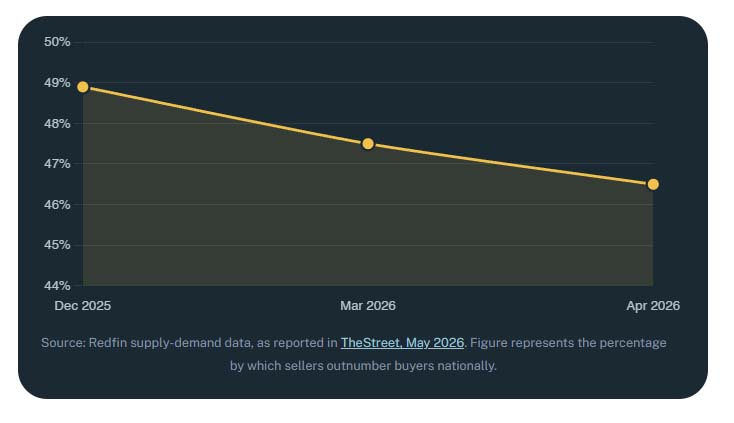
None of this means the market has flipped to favor sellers. It hasn't. It means the window where a prepared buyer can move with minimal competition and real negotiating room is still open, but it's the kind of window that tends to close gradually and then all at once. A holiday weekend with unusually thin foot traffic is, in a small but real way, a local, temporary intensification of that same national trend.
It also helps to understand why that national gap has been narrowing instead of holding steady. Part of it is simple math: as more buyers re-enter the market, each one has fewer competing listings to choose from relative to a few months ago, which slowly tightens the field even without prices moving dramatically. Part of it is seasonal — early summer typically brings out families who specifically need to close before a school year starts, which is a buyer motivation that doesn't show up nearly as strongly in the January or February numbers. And part of it, frankly, is confidence. When NAR's chief economist frames rising sales as evidence that "more Americans are on the move," that's also a signal to sellers who have been sitting on the fence that now might be a reasonable time to list, which in turn gives the buyers who are ready to act more real choices to consider — St. Louis stock in Kirkwood, Webster Groves, Ballwin, and Wildwood included.
For a local buyer watching this from the ground, the practical takeaway is straightforward: the national data doesn't say "wait." It says "the advantage buyers have enjoyed for the better part of a year is real, but it is not permanent, and it rewards people who use it rather than bank it." A holiday weekend with almost no competing showings is about as concrete a version of "using it" as this market currently offers.
The real deadline nobody says out loud
Talk to enough parents in Kirkwood, Lindbergh, or Rockwood in early July, and a pattern emerges that has nothing to do with fireworks. They are quietly doing math about school. The Kirkwood School District's 2026–27 calendar has students back in classrooms on August 25, and Rockwood's calendar page shows the district has followed a similar mid-to-late-August start in recent years. Lindbergh runs on a comparable timeline. For a family trying to land in a specific attendance zone, that late-August date isn't just a mark on a calendar — it's the finish line of a chain of deadlines that has to start now.
Work backward from an August move-in, and the timeline gets tight fast. A typical financed purchase takes somewhere in the range of 30 to 45 days to close once a contract is signed, which means a family hoping to be unpacked, registered, and settled before the first bell needs to be under contract by the middle of July at the latest — and that's before accounting for inspection periods, appraisal scheduling, or a home that needs even minor work before move-in. Every week that passes without an accepted offer is a week that gets subtracted directly from that runway.
That's what makes this particular holiday weekend so pointed for school-district-driven buyers. It sits right at the edge of that mid-July deadline, which means anyone touring a home this weekend with a Kirkwood, Lindbergh, or Rockwood address in mind isn't casually exploring options. They're running out of calendar, and they know it.
The three districts pull from slightly different playbooks, which is worth knowing if you're the one showing a house this weekend. Kirkwood families are often trading up within a tight, walkable footprint near downtown Kirkwood and are frequently comparing two or three specific streets rather than entire subdivisions, which means they've usually already done their homework and are touring with a short list instead of casting a wide net. Lindbergh's draw tends to be families relocating from other parts of the metro specifically for the district's reputation, so the timeline pressure is often compounded by a job relocation or a lease that's ending on its own schedule. Rockwood, covering a much larger footprint from Ballwin and Wildwood out to Eureka, tends to see the widest range of buyers, from first-time families stretching for a specific elementary boundary to move-up buyers chasing a bigger lot, which also means Rockwood-area showings this weekend are likely to be the most varied in terms of what buyers are actually looking for.
In every case, the psychology is the same. Nobody wants their child starting a new school mid-week, three days into a semester everyone else has already settled into. Parents will tell you, almost apologetically, that they know it's "just a house" in the grand scheme of things, but the emotional stakes of getting a kid started on time, in the right building, with the right teacher assignment, make this deadline feel a lot more binding than a typical real estate timeline. That's not a bad thing for anyone involved in a transaction this week. It's simply useful context for understanding why someone touring a home on a holiday afternoon might move faster than the calendar would otherwise suggest.
If you're selling this weekend, lean into the holiday
For sellers with a showing on the calendar for the 3rd, 4th, or 5th, the instinct might be to apologize for the timing or worry that a holiday weekend is a bad time to have people through the house. The opposite is closer to true — but only if the house actually shows like a St. Louis summer, not like a house that happens to have a backyard.
- Turn on every string light before the first showing. A deck lit for evening use signals "this is livable and enjoyable," not just "this is for sale." If a showing falls in daylight, leave them on anyway — buyers picture the space at night regardless of when they see it.
- Stage the patio like it's mid-cookout. A grill positioned with intent, a pitcher and glasses on the outdoor table, cushions that don't look brand new in the box — these small cues do more work than a fresh coat of interior paint in a home with real backyard space.
- Show off the BBQ-and-backyard-games layout specifically. St. Louis buyers know exactly what a good summer backyard looks like: room for a cornhole board, a clear sightline from the kitchen to the yard so nobody's isolated at the grill, and enough flat space for a folding table without it feeling cramped.
- Don't hide the fact that it's the 4th. A tasteful flag, a bowl of fresh fruit on the counter, windows open if the weather allows — these read as "someone lives an actual life here," which matters more during a holiday showing than a sterile, staged-for-Instagram look.
The buyers walking through this weekend are already picturing themselves hosting their own version of this holiday next summer. A house that makes that picture easy to complete has a real edge over one that makes them do the imaginative work themselves.
There's a practical scheduling piece here too. If your listing agent is weighing whether to hold an open house on the 4th itself versus the 5th or the following weekend, it's worth having a direct conversation about foot traffic trade-offs rather than assuming one is automatically better. A holiday-day open house will likely draw fewer total visitors, but as this whole piece argues, the ones who show up are disproportionately likely to be serious. A same-week follow-up open house, once the parade routes have cleared and downtown traffic has normalized, can catch a second wave of buyers who spent the holiday itself with family but start their search again as soon as the long weekend ends. Doing both, rather than picking one, often outperforms either approach alone.
It's also worth double-checking the basics that get overlooked during a hectic holiday week: confirm the air conditioning is working well before a showing (a St. Louis July afternoon with a warm house is one of the fastest ways to lose a buyer's attention), make sure any sprinkler or irrigation system isn't running mid-showing, and if fireworks are visible from the neighborhood, consider mentioning it. A backyard with a partial view of a neighborhood fireworks display is a genuine selling point for a family that just spent the evening watching one from a lawn chair.
If you're buying this weekend, here's the move
For buyers, the strategy is less about staging and more about recognizing the moment for what it is. If financing is already in place and the search has narrowed to a short list, this weekend is a legitimate opportunity to see homes without elbowing past a crowd, ask an agent unhurried questions on a showing, and potentially write an offer into a market with fewer competing bids than a normal July Saturday.
That doesn't mean rushing into a purchase that doesn't fit. It means treating the reduced competition as real information, not a coincidence, and using it. A seller whose only other showings that week were casual lookie-loos who no-showed is often more receptive to a clean offer with reasonable terms than a seller who just fielded four competing bids the weekend before. Come with pre-approval in hand, be ready to move on scheduling an inspection quickly, and don't assume the quiet weekend means there's no urgency — the family two towns over doing the exact same school-district math might be touring the same house on Sunday.
Two mistakes to avoid this weekend
The first mistake is assuming a quiet open house means a weak seller. Some sellers list specifically because they, too, are working against a timeline — a job relocation, a closing on their next home already scheduled, a life change that doesn't pause for a holiday. A seller in that position may actually have more urgency than a typical July listing, not less, and a lowball offer built on the assumption of desperation can backfire just as easily this weekend as any other. Read the situation, don't assume it.
The second mistake is treating the school-district deadline as more flexible than it actually is. It's tempting, in the middle of a relaxed holiday weekend, to think "we have a few more weeks" and let a promising showing slide into next week's to-do list. But every closing has its own chain of dependencies — inspection scheduling, appraisal turnaround, loan underwriting — and each of those steps has its own capacity constraints that don't stretch just because a family needs them to. The buyers who are actually going to be unpacked by August 25 are, in large part, the ones who treated this weekend's showing as the start of a clock, not a preview.
Bottom Line
The 4th of July doesn't pause the St. Louis housing market—it filters it. Casual buyers disappear for the holiday weekend, while motivated buyers remain active. That makes the weekend surprisingly valuable, whether you're hosting an open house or touring homes between fireworks shows.
Whichever side of the transaction you're on this weekend, the underlying fact holds: a market this quiet on the surface is rarely quiet beneath the surface. The people still out there looking at houses on the 4th of July have already made a decision most of the metro hasn't — that this weekend matters more for their next chapter than it does for a night under the Arch.
Is this just a nice story, or does it actually hold up?
It's a fair question. Every real estate market has its share of seasonal folklore — Wednesday listings sell for more, never list during a Super Bowl, buyers vanish in the two weeks around Christmas — and not all of it survives scrutiny. But this particular pattern rests on something simpler and harder to argue with than folklore: opportunity cost. Celebrate 250 and the Lake of the Ozarks aren't hypothetical draws this weekend; they're confirmed, heavily promoted, once-in-a-generation-scale events competing directly for the same Saturday and Sunday hours that house hunting normally occupies. Anyone who chooses a showing over the drone show has revealed something about their priorities that a normal weekend simply doesn't force them to reveal.
Layer the national buyer-leverage data and the local school calendar on top of that, and the story stops being a cute holiday angle and starts looking like a fairly ordinary application of a well-known real estate principle: reduced competition plus a hard deadline plus a still-favorable market produces better outcomes for whoever moves first. St. Louis just happens to have all three lined up on the same weekend this year, which is worth noticing whether you're the one showing a house on Big Bend Boulevard or the one touring it.
Ready to Buy or Sell in St. Louis? House Sold Easy Has You Covered!
Whether you're thinking about listing your home or exploring a cash offer, it's worth understanding all of your options before making a decision. The right choice depends on your timeline, your property's condition, and your goals. Contact House Sold Easy to discuss your situation and see what makes the most sense for you.Our St. Louis experts know every corner of this city and will make buying your dream home or selling your high-end property a breeze. Don’t miss out on the hottest market in the U.S.! Contact House Sold Easy today and let’s make your real estate goals happen!