St. Louis Real Estate 2026: What the Summit Revealed
May 11, 2026
Written by David Dodge
The shift from big-box sprawl to smarter industrial development is already happening — and it's telling homeowners exactly where to look.
$1.8B
Boeing's expansion in
North St. Louis County
500+
New direct jobs expected
at the Boeing campus
2.37M
Sq ft of industrial leasing,
Q1 2026 (CBRE)
$320K
Median single-family
home price, mid-2025
6.8%
Industrial vacancy rate,
St. Louis Q1 2026
I sat through a lot of panels at this year's Commercial Summit. Some were the kind of thing you nod along to and forget by lunch. But something felt different on April 22nd at the Charles F. Knight Executive Conference Center at Washington University. The room had a current running through it — real estate brokers, economic development folks, and policy people actually sounding like they were talking about the same city for once.
The headline that came out of the day was this: St. Louis is at an inflection point for growth. That's not just chamber-of-commerce optimism. There were numbers behind it, honest conversations about perception versus reality on crime, and a genuine sense of alignment between capital, policy, and regional ambition that hasn't always been there.
What caught my attention the most, though, was what wasn't said on a panel — the subtext running under everything. The city's industrial landscape is quietly reshaping itself in a way that has massive implications for homeowners who aren't paying attention to the commercial side. And most aren't.
The Big-Box Era Is Winding Down
For about two decades, industrial development in the St. Louis metro was largely defined by what you'd expect: massive distribution warehouses, big-footprint logistics centers, sprawling fulfillment hubs on cheap suburban land. It made sense at the time. Land was available, labor was available, and the build-it-big mentality matched the era's economic logic.
That model is running out of runway. Not collapsing — just maturing past its peak. The Q1 2026 industrial report from CBRE paints a clear picture of where the market actually stands: 2.37 million square feet of industrial leasing activity with an average lease rate of $5.49 NNN per square foot, and a total of 3.6 million square feet actively under construction. The two biggest individual projects — Boeing's F/A-47 factory at 979,000 square feet and an Amazon distribution facility at Gateway Tradeport at 933,000 square feet — are outliers. The concentration of construction activity in a handful of mega-projects masks a deeper and more interesting trend.
Talk to anyone who's been brokering industrial deals in this market over the past few years, and they'll tell you the same thing: the demand for smaller, more flexible industrial space — buildings in the 15,000 to 40,000 square foot range — has been quietly outpacing supply. These aren't your grandfather's warehouses. We're talking about last-mile logistics nodes, advanced manufacturing flex space, tech-light manufacturing facilities, and specialty distribution hubs that serve hyper-local needs.
"St. Louis has the land, the demand, and the momentum. Turning that into real progress will come down to alignment — ensuring policy, capital, and collaboration are all moving in the same direction."
The Summit speakers kept returning to the theme of collaboration — and specifically, the importance of commercial brokers actually entering their properties into data platforms like CoStar. That sounds mundane, but it tells you something important: we're in a market where information asymmetry is still a real problem, and a lot of smaller industrial deals are happening quietly, away from the headline announcements.
Boeing Is the Headline. The Story Around It Is the Real News.
The Boeing expansion has become the symbol of North County's turnaround potential, and for good reason. Jason Archer of the St. Louis Economic Development Partnership pointed to the collaboration behind the project as a model for what regional development can look like when public and private entities actually get out of each other's way. The deal — a $1.8 billion investment in advanced manufacturing space near Lambert International Airport, paired with at least 500 new direct jobs — was cited at the Summit as proof of concept.
Councilwoman Rita Heard Days, who sponsored the tax incentive legislation, put it directly: "We are trying to elevate north county, which is seen as the stepchild of St. Louis County." That's a frank acknowledgment of a long-standing perception problem — and a signal that serious political will is now backing the economic case for North County development.
But here's the thing about Boeing: a single mega-employer is not, by itself, a neighborhood transformation story. What turns a manufacturing anchor into a genuine residential value catalyst is the ecosystem that forms around it. The suppliers, the professional services firms, the lunch spots, the childcare facilities — the dense web of smaller businesses and services that follow employment concentration. And increasingly, those businesses are looking for exactly the kind of smaller, sub-40,000 square foot industrial and flex space that the market hasn't been building fast enough.

Chouteau's Landing: The Wildcard Nobody's Pricing In Yet
If North County is the established storyline, Chouteau's Landing is the subplot that hasn't fully been written yet — and that's exactly why it matters to homeowners.
Situated just south of downtown St. Louis along the riverfront, Chouteau's Landing is one of those areas that real estate people have been talking about for years without much happening. The bones are there: historic industrial buildings, rail access, proximity to downtown, and a geography that is genuinely interesting. What it lacks is density of committed investment and a clear narrative.
That narrative may now be forming. The pattern that has played out in cities like Nashville's Wedgewood-Houston, Kansas City's West Bottoms, and Pittsburgh's Strip District is one that planners and developers are well aware of: a historically industrial riverfront or rail corridor attracts smaller creative and tech-light manufacturers first, then the hospitality and retail layer follows, and residential demand in the surrounding commuter ring catches fire — often before most buyers realize what's happening.
The critical threshold in that pattern is usually the arrival of tech-adjacent firms — software companies that need affordable, flexible space with character, or light manufacturing operations that have upgraded their image. When those tenants start signing leases in a formerly neglected industrial corridor, it tends to be a leading indicator, not a lagging one.
What to Watch
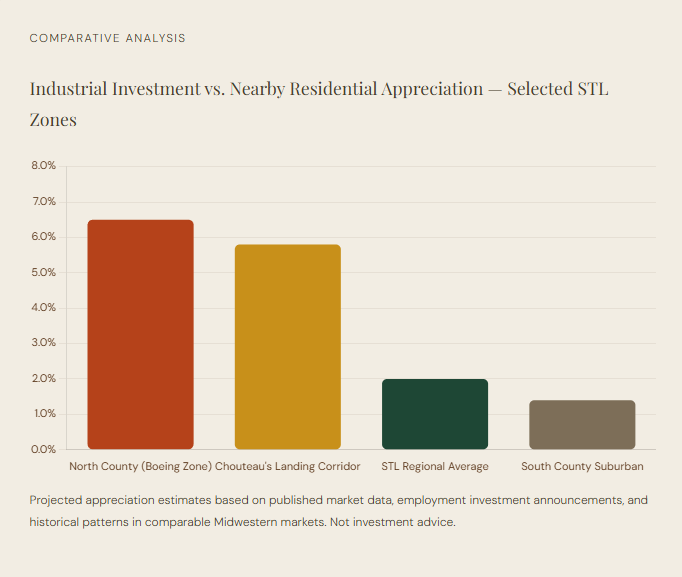
Industrial lease signings in sub-40,000 sq ft buildings are the canary in the coal mine. When tech-light manufacturers, last-mile logistics firms, or specialty distributors start clustering in areas like Chouteau's Landing or North County, residential demand in the surrounding 3–7 mile commuter ring historically follows within 18 to 36 months. You want to buy before that lag closes.
The Commuter Ring Effect: Why Industrial Moves Matter for Homeowners
Let me explain the mechanism here, because it's not just vibes — there's a real transmission channel between industrial development and residential home values in surrounding neighborhoods.
It starts with employment density. When a cluster of industrial and tech employers builds up in an area, it creates a worker population that needs to live within a reasonable commuting distance. In a metro like St. Louis — where driving is still the dominant mode, and most people don't want to commute more than 25–30 minutes — that creates a demand pressure in a meaningful geographic ring around the employment hub.
Research on commercial development and residential values consistently shows that well-managed, smaller-scale commercial and industrial activity within a neighborhood tends to have a net-positive effect on home prices, particularly when the development brings employment and reduces vacancy on formerly blighted properties. A 2011 study published via ResearchGate examining the impact of industrial sites on residential values found the relationship is highly context-dependent — legacy heavy industrial with pollution concerns can suppress values, but clean, modern light industrial is a different animal entirely.
The St. Louis housing market data support the broader optimism. Current market forecasts project home values in the St. Louis MSA rising approximately 2% by the end of 2026, which is steady and unremarkable on its face. But aggregate MSA figures mask enormous variation at the neighborhood level. The areas closest to active employment investment — particularly in North County and transitional corridors near downtown — are where that 2% average is likely to be significantly exceeded.
What the Summit Actually Said About Infrastructure and Policy
One thing that stood out from the 2026 Commercial Summit coverage was how much time was devoted to the policy and financing environment, which matters more than people realize for the residential market downstream.
Evan Liddiard, director of tax policy for the National Association of REALTORS®, connected federal legislation to on-the-ground deal-making in directly relevant ways. The 20% Qualified Business Income deduction remains a significant incentive for real estate investment. Opportunity Zones — which have been evolving since their introduction — bring both complexity and genuine capital to underinvested areas. The ongoing SALT cap debate has real implications for how attractive St. Louis looks to professional households relocating from higher-cost states.
The land bank legislation being pushed at the state level for North St. Louis County is particularly important. Addressing vacancy and bringing underutilized properties back into productive use isn't just a development story — it directly affects neighborhood desirability and, by extension, home values for people who already own in those areas.
And then there's the public safety conversation. The Summit opened with a candid exchange between St. Louis County Prosecuting Attorney Melissa Price Smith and SLMPD Chief Robert Tracy on crime and perception. The honest acknowledgment that violent crime is down — especially in St. Louis City — but that perception hasn't kept pace with reality is directly relevant to any homeowner or prospective buyer evaluating transitional neighborhoods. Perception gaps are where opportunity lives.
The Practical Calculus for Homeowners and Buyers
So what does all of this actually mean if you own a home in the St. Louis metro, or if you're thinking about buying?
If you own in North County — particularly in the Hazelwood, Berkeley, or Bridgeton corridor that sits in Boeing's extended economic shadow — you're in a better position than headline narratives might suggest. The Q1 2026 CBRE data shows 3.6 million square feet of industrial construction actively underway in the St. Louis market. Employment investment at that scale doesn't stay contained to the construction site. It moves outward through supply chains, service industries, and workforce housing demand. Holding in a North County commuter ring right now is a reasonable bet.
If you're looking to buy, the transitional corridors — Chouteau's Landing, the near-south riverfront, and the eastern portions of North County that haven't yet been caught in Boeing's rising tide — are worth serious attention. These are the areas where industrial lease activity is likely to precede residential demand by 18 to 36 months, based on comparable market patterns.
The St. Louis market in early 2026 shows a median sale price of around $320,000 for single-family homes, with the market still tilted toward sellers despite some easing. Inventory at 1.9 months of supply for houses keeps pressure on prices upward. But the more important number may be the longer trend: from 2020 to mid-2025, St. Louis median home prices rose roughly 73%, from approximately $185,000 to $320,000. That's not a bubble story — that's a market that was genuinely undervalued relative to comparable Midwestern metros and is gradually repricing to reflect its fundamentals.
"The areas closest to active employment investment are where that 2% regional average is likely to be significantly exceeded. Perception gaps are where opportunity lives."
The Smarter Industrial Thesis — And Why It Changes the Map
The shift from big-box sprawl to smarter, smaller industrial — the sub-40,000 square foot flex spaces, the last-mile nodes, the light manufacturing hubs — isn't just an industrial real estate story. It's a neighborhood geography story.
Large-format logistics centers tend to locate where land is cheapest, which is typically far from established residential areas. Their workforce is often drawn from across the metro and doesn't necessarily create concentrated demand in any particular residential market. They're economic in aggregate, but their neighborhood-level impact is diluted.
Smaller, smarter industrial operations tend to cluster differently. They seek out areas with character — good bones, interesting buildings, proximity to urban amenities — precisely because they're competing for a more skilled, more mobile workforce. Those workers want to live near where they work. And when they start concentrating in a neighborhood, the residential market follows.
This is the pattern to watch in Chouteau's Landing and in the transitional zones of North County that sit between Boeing's campus and the established residential areas of communities like Normandy, Overland, and University City. The industrial canary sings first. The residential market catches up. The window between those two events is where opportunity exists — for buyers who are paying attention to both sides of the market.
The Bottom Line
The 2026 Commercial Summit was not a pep rally. It was a working session with real data, honest conversations about obstacles, and a level of cross-sector coordination that the St. Louis market hasn't always managed to produce. The through-line from Boeing's north county investment, to Opportunity Zone financing, to smaller-format industrial demand, to the land bank legislation — it's all connected. And it all points in the same direction for residential real estate in the transitional zones surrounding the city's industrial core.
You don't have to be a commercial real estate professional to read these signals. You just have to be willing to look at both sides of the market simultaneously. When industrial and tech firms move into areas like Chouteau's Landing or North County, home values in the surrounding commuter rings historically follow. That signal is flashing right now. The question is whether you're buying ahead of it or reading about it after.
Ready to Buy or Sell in St. Louis? House Sold Easy Has You Covered!
Navigating St. Louis’ red-hot luxury market doesn’t have to be a headache. With House Sold Easy, it’s all about less hassle—we’ve got you covered from start to finish. Our St. Louis experts know every corner of this city and will make buying your dream home or selling your high-end property a breeze. Don’t miss out on the hottest market in the U.S.! Contact House Sold Easy today and let’s make your real estate goals happen!

F1 in 3