St. Louis Land Tax Sale #236: What It Means for You
May 12, 2026
The Sheriff's auction is more than a courthouse spectacle — it's a real-time diagnostic for where this city's housing market actually stands.
Written by David Dodge
Sale #236 Details
Date: May 12, 2026
Time: 9:00 AM sharp
Location: 11th Street side, Civil Courts Building, 10 N. Tucker Blvd, St. Louis
Payment: Cashier's check/money order only. Full payment by 2:00 PM the same day.
Note: Pre-registration required. Closes 10 days before each sale.
This morning, at exactly 9:00 a.m. on the 11th Street side of the Civil Courts Building at 10 N. Tucker Blvd, a crowd of registered bidders gathered in the open air. Some came with cashier's checks. Some brought attorneys. A few were first-timers clutching printed property lists they downloaded from the city's website two weeks ago. All of them were there for Land Tax Sale #236 — the St. Louis Sheriff's Office's latest auction of properties whose owners stopped paying property taxes.
If you didn't know this was happening, you're not alone. Most people in this city go about their day completely unaware that the Sheriff quietly holds these sales several times a year, quietly recycling some of the most distressed real estate in St. Louis back into private hands — or, failing that, into the city's land bank. But if you're serious about understanding this market — as a buyer, investor, or just a curious homeowner — Land Tax Sale #236 is worth paying attention to.
Here's why it matters, what it actually tells us about the city right now, and what you should do with that information if you're in the market for a home.
What a Land Tax Sale Actually Is
The St. Louis land tax sale process isn't something that happens overnight. It starts the moment a property owner stops paying their property taxes — and it plays out over years before a property ever hits the auction block.
Here's the basic chain of events, according to the City's Collector of Revenue office:
- 1Taxes go unpaid. The Collector of Revenue tracks delinquent payments. Under Missouri law, St. Louis City can begin foreclosure proceedings after taxes have been delinquent for two years — though in practice, it usually takes closer to three.
- 2A lawsuit gets filed. Once a parcel becomes delinquent, the Collector files a suit to foreclose on the tax lien. This is the moment it becomes a judicial matter, not just an administrative one.
- 3The tax sale is scheduled. The auction happens approximately one year after the suit is filed. The Sheriff's Office takes over from here and manages all the post-sale processes.
- 4The auction opens. Properties are auctioned starting at the amount of taxes owed. That's the floor — not market value, not assessed value. Just the debt.
What makes St. Louis unusual compared to most Missouri counties is that it follows a judicial process under the Municipal Land Reutilization Law (MLRL, RSMo 92.700), rather than a simpler administrative sale. And critically, once the court confirms a sale in St. Louis City, the original owner has no redemption period. It's final. In surrounding counties, owners typically get a full year to buy their property back. Here, the gavel falls, and it stays fallen.
2026 Update
As of this year's land tax season, the city has made a notable procedural change: cash is no longer accepted as payment at land tax sales. Cashier's checks and money orders only. It's a small detail that signals a maturing, more formalized process — the city is tightening up, not loosening.
To even bid, you have to pre-register online at least 10 days before the sale. The city checks whether you have any delinquent property taxes yourself, any housing code violations, or any past sales you failed to pay for. In other words, they vet you. This isn't a free-for-all — it's a regulated, courthouse proceeding with real legal consequences.
After a winning bid, you have until 2:00 p.m. that same day to pay. Then comes a confirmation hearing, an appraisal, notices to interested parties, and a recorded Sheriff's Deed. The entire post-sale process involves the courts, multiple government offices, and — as the city strongly recommends — an attorney. None of this is simple.
Why It's a Barometer for the City
Here's what most people miss about land tax sales: the properties on that list don't appear randomly. They're the result of years of decisions — or failures to make them — by property owners across the city. Every parcel that ends up at auction is a story of financial distress, abandonment, speculation gone wrong, or estate entanglement. And when you look at those stories in aggregate, you start to see the city's health in a way that median sale prices and days-on-market numbers simply don't capture.
~25,000
Vacant parcels in St. Louis City
9,000
Vacant buildings
$21M+
In unpaid fees tied to vacant properties (2024 city estimate)
According to a 2024–2025 impact report from the City's Community Development Administration, St. Louis has roughly 24,000 vacant parcels, including about 9,000 vacant buildings. Of those, the Land Reutilization Authority (LRA) — the city's land bank, established in 1971 as the first of its kind in the country — owns approximately 8,500 parcels and 1,167 buildings. When a property doesn't sell at a land tax auction, it passes automatically to the LRA by default. That's the "owner of last resort."
The city's own 2024 data estimated that 14,000 properties had racked up $21 million in fees and finance charges related to vacancy, and owed another $2.7 million in back taxes on top of that. These aren't abstract numbers — they represent real drains on neighborhood stability, school funding, and city services.
"These properties are not only not generating resources for our schools, our libraries, our basic city services, but are actually draining resources. If you fail to mow your lawn for a vacant property, the city goes in and uses tax dollars to do that."
That quote is from reporting by St. Louis Public Radio on the city's ongoing fight against vacancy. It captures something important: every property that ends up at a land tax sale represents a failure of private ownership — and a cost that gets socialized across every taxpaying household in the city.
So when Sale #236 lists dozens of properties for auction, it's telling you something about which parts of the city are under the most financial stress. Where are the owners who couldn't make it work? Where are the speculators who bought cheap and walked away? Where are the inherited properties that families couldn't manage? The auction list is a map of those answers.
And when you cross-reference that map with the broader market — where home prices are rising 4.2% year-over-year (per Redfin's March 2026 data), and where turnkey homes in desirable neighborhoods are still drawing multiple offers — you start to understand the split personality of St. Louis real estate. The market at 35,000 feet looks healthy. On the ground, block by block, it's far more complicated.
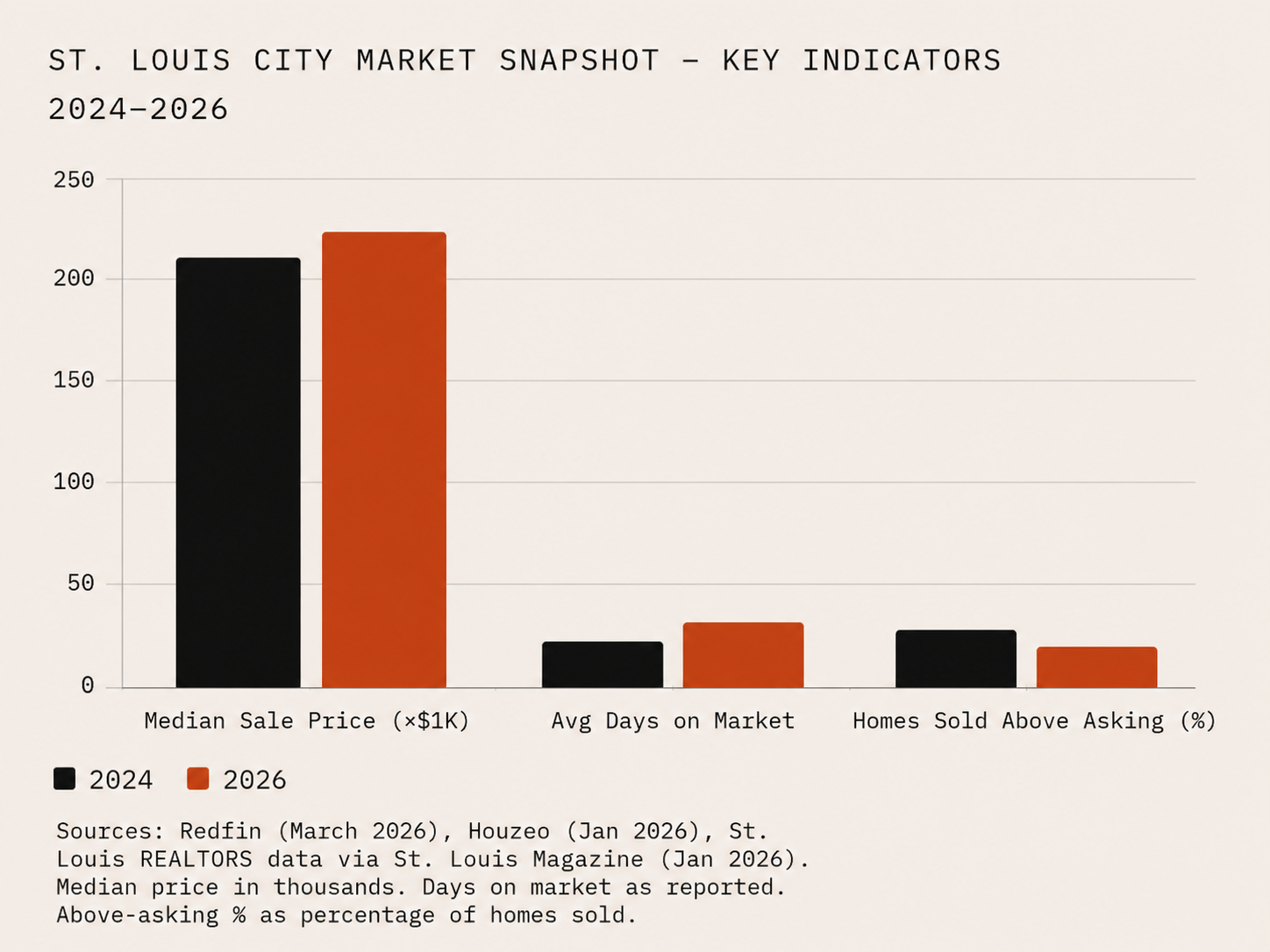
That chart is telling two stories at once. Prices are up — that's the headline. But homes are taking longer to sell, and fewer are drawing above-asking offers. The market is cooling at the margins, even as it holds at the core. That's exactly the kind of environment where a land tax sale feels tempting to a first-time investor: prices are high enough that a big "discount" looks attractive, but the underlying risk profile of distressed properties hasn't changed one bit.
The "Deal" That Isn't Always a Deal
I've talked to enough people who've gone to these auctions — or thought about it — to know the appeal. You're standing outside a courthouse, bidding on a property starting at whatever taxes are owed. Sometimes that's a few thousand dollars. The house might be worth $80,000 on paper. The math looks obvious.
Except it rarely is.
Here's what the math doesn't tell you: what condition is the property in? Has it been vacant for three years, or eight? Has it been used for storage, or scavenged for copper pipe? Is the roof intact? Is there a basement drainage problem that's been slowly destroying the foundation? Are there environmental issues from decades of use that nobody's disclosed because nobody has to? Has the property been cited for code violations that the new owner will now be responsible for clearing?
Per the city's own land tax sale guidelines, you have 10 days after the confirmation hearing to apply for an occupancy permit. That triggers a housing conservation inspection. And if the city finds what it usually finds in a property that's been through the tax sale pipeline — and it almost always finds something — you're on the hook. You can't flip the switch to "investor mode" and just hold it. The city will cite you, fine you, and keep fining you until you fix it or demolish it.
The Rehab Reality Check
Properties that make it to a land tax sale have typically been delinquent for three or more years. That's years of deferred maintenance, possible vandalism, possible squatting, and zero upkeep investment. In practice, most of these properties require a full gut rehab — new electrical, new plumbing, new HVAC, new roof, and structural repairs.
We're talking about 9 to 18 months of active renovation work, minimum, and often $60,000 to $120,000+ in renovation costs depending on the property size and condition. If your timeline or capital doesn't support that, the "deal" is actually a trap.
The Center for Community Progress, a national nonprofit that studies exactly these systems, has documented the pattern across dozens of cities: the properties with the best structural condition and highest resale values almost always get picked up by private buyers at the tax sale. What's left — what the land bank inherits — tends to be the hardest cases. By the time a property reaches auction, the easy money is rarely on the table.
That's not a reason to never buy at a land tax sale. Experienced investors with construction crews, deep pockets, and long-term horizons do very well with them. But if you're a first-time buyer, or someone who's seen HGTV and thinks a renovation project sounds fun, this is not your vehicle. Not without serious due diligence, legal counsel, and a realistic construction budget sitting in a bank account before you ever set foot in the courthouse.
The Alternative: South City Turn-Key at 6.44%
Here's the practical counterpoint to the land tax sale appeal: right now, there are legitimate deals available in St. Louis that don't require a 12-month construction project, a confirmation hearing, or a lawyer on retainer.
The St. Louis housing market, as of spring 2026, is what I'd call selectively soft. St. Louis Magazine's January 2026 market analysis put it plainly: move-in-ready homes in desirable areas are competitive, while fixer-uppers and properties that need cosmetic work are sitting on the market for multiple weeks. That's a reversal from the frenzied 2021-2023 window when everything sold fast regardless of condition.
South City is the perfect example of where this plays out. Neighborhoods like Bevo Mill, Dutchtown, Tower Grove South, and Marine Villa have historically been among the most affordable entry points in the city for a legitimate, livable home. These are areas with actual bones — brick construction, established lot sizes, and walkable commercial strips. And right now, with inventory loosening slightly and days on market ticking up, motivated sellers exist.
The mortgage rate environment matters here. Current 30-year fixed rates in Missouri have come down considerably from the 7%+ peaks of 2023 and 2024. As of mid-2026, rates have settled near the 6.44% range. That's still meaningfully higher than the sub-3% era that many buyers are anchored to psychologically — but it's workable, and the math on a South City turn-key home often pencils out in a way that a land tax purchase doesn't, once you factor in rehab costs, holding time, and financing gaps.
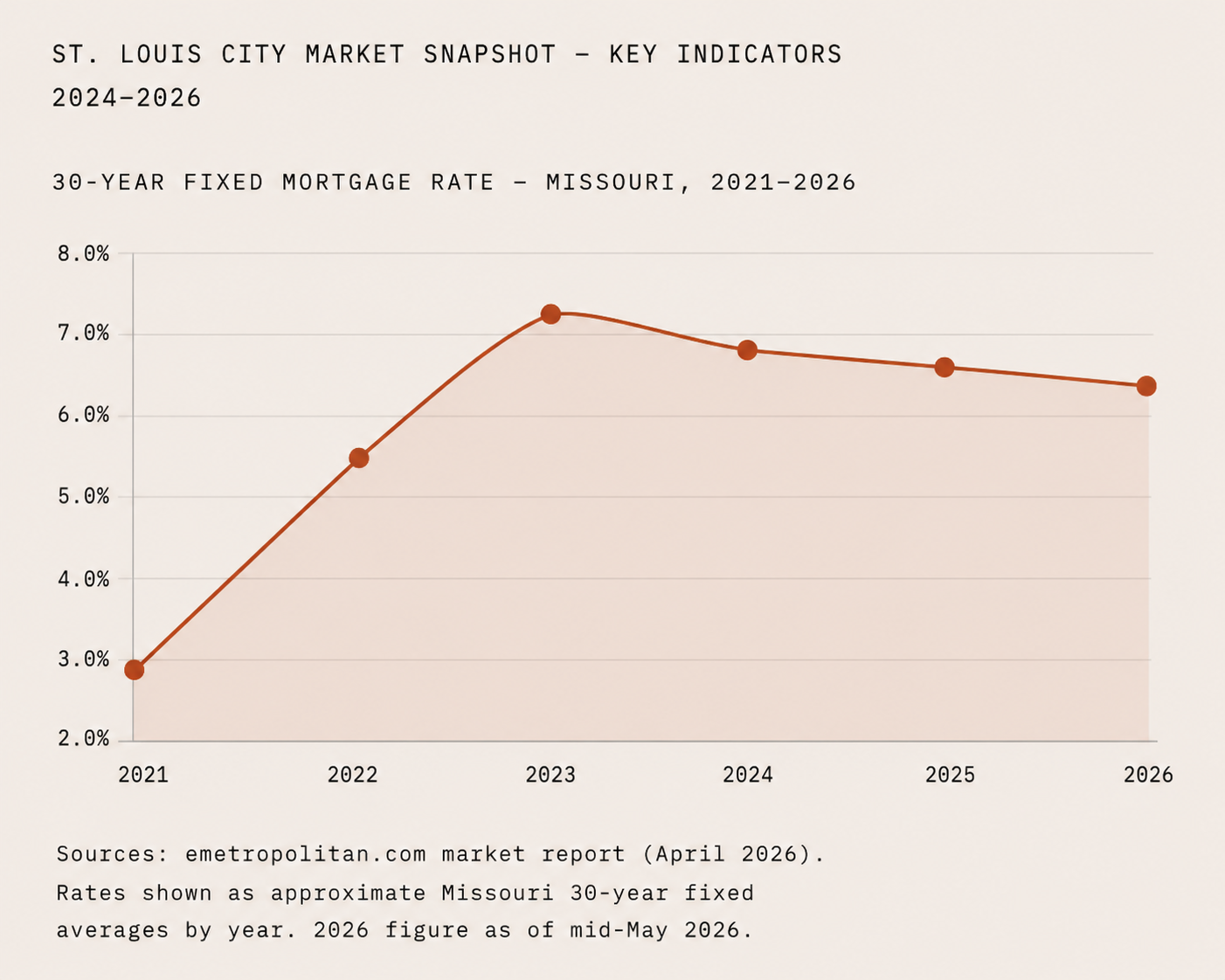
Consider a $185,000 turn-key home in Bevo Mill at 6.44% on a 30-year fixed — a realistic scenario in today's South City market. Your monthly principal and interest is roughly $1,160. You have a working furnace, a roof that isn't your first problem, and you can be in within 30 to 45 days of closing. Compare that to a land tax purchase at $15,000, plus $90,000 in estimated renovation, plus holding costs, plus interest on a hard money loan during construction — and suddenly the "deal" starts to look a lot more expensive than the asking price on a clean South City home.
The city-wide median for St. Louis City was $224,000 as of early 2026, with the Central West End and Botanical Heights commanding premiums. South City neighborhoods tend to track below that median — meaning there is still room to buy well without a courthouse drama.
"The real deal isn't always the lowest price. It's the lowest total cost — purchase price, renovation, time, and opportunity — relative to what you actually get."
What Sale #236 Is Really Saying
Every land tax sale in this city says the same few things simultaneously. It says: these properties have been stuck. It says: the private market failed to hold onto them. It says: people are willing to take on that failure, for a price. And it says: the city needs buyers brave enough to step in, because if nobody does, these properties go to a land bank that's already overwhelmed.
But Sale #236 also says something specific to this moment in 2026: the St. Louis housing market is at an interesting inflection point. Prices have risen enough that even the courthouse floor prices for distressed properties look like money. Rates have come down enough that conventional financing is viable again. And inventory in the broader market has loosened enough that buyers have real alternatives.
That combination means you have options — which is exactly when you need to be most intentional about which option you choose.
If you are an experienced investor with a reliable contractor, a solid capital reserve, and a 12-to-18-month project runway, a land tax sale property could absolutely make sense. Go to the list, do your due diligence, drive the properties, pull the city's code violation records, talk to a real estate attorney, and bid with your eyes open.
If you are a first-time buyer, a move-up buyer, or anyone whose primary goal is to live in the property in the near term, look south. Look at Bevo, Dutchtown, Tower Grove, and Marine Villa. Find a house that needs paint, not a foundation. Get a conventional mortgage at 6.44%, get a home inspection, and buy something you can actually move into. The courthouse auction is exciting. The closing table on a real house is better.
The Bottom Line
Land tax sales are a legitimate tool in the right hands — but they are not a shortcut. They're a complex judicial process that comes with real renovation requirements, legal post-sale obligations, and a cash or certified-funds-only payment structure.
If you're not ready for a 12-month rehab project and the uncertainty that comes with it, the smarter play right now is a turn-key property in South City at current 6.44% rates — where the deal is real, and the timeline is actually yours to control.
Land Tax Sale #236 is a feature of St. Louis life most residents never see. But it is, in its own way, one of the most honest windows into what this city actually is: a place still reckoning with decades of population loss and property abandonment, while simultaneously producing a housing market that can hold its own against any mid-tier American city. Both things are true. The auction happening this morning is proof of both.
Watch it if you can. Learn from it even if you don't bid. And the next time someone tells you St. Louis real estate is all distressed properties and lost causes — point them to the data. The median price in March 2026 was $250,000. The market is up 4.2% year-over-year. And people are standing outside a courthouse right now, in the spring sunshine, bidding real money on the belief that this city is worth investing in.
They're right. They just need to make sure they know what they're getting into.
Ready to Buy or Sell in St. Louis? House Sold Easy Has You Covered!
Navigating St. Louis’ red-hot luxury market doesn’t have to be a headache. With House Sold Easy, it’s all about less hassle—we’ve got you covered from start to finish. Our St. Louis experts know every corner of this city and will make buying your dream home or selling your high-end property a breeze. Don’t miss out on the hottest market in the U.S.! Contact House Sold Easy today and let’s make your real estate goals happen!