Selling a House As-Is in St. Louis: What It Really Means
Jun 11, 2026
Written by David Dodge
If your home has a leaky limestone basement in South City, a kitchen that hasn't been touched since the Ford administration, or the kind of structural settling that's just part of life in a pre-1950 St. Louis brick, the idea of prepping it for a traditional MLS listing can feel paralyzing. You've probably seen the signs stapled to telephone poles on Gravois or Hampton: "We Buy Houses As-Is — Any Condition." But what does that actually mean for your bottom line, your timeline, and your stress levels?
Let's cut through the noise. This is a full breakdown of what "as-is" really means in the Missouri real estate context, the trade-offs between a traditional MLS listing and a direct cash sale, and why older St. Louis homes, specifically the ones that built this city's neighborhoods, often make the strongest case for bypassing the conventional market entirely.
STL City (2026)
Up from 42 days
No bank underwriting
Up 8.2% YoY
First: what "as-is" means in Missouri law
In Missouri, selling a property "as-is" doesn't mean you get to hide known problems. Under state disclosure requirements, sellers are still required to disclose known material defects — things like a leaking foundation, active water intrusion, or a roof that's actively failing. What "as-is" actually means is this: you're telling the buyer upfront that you won't be making repairs or offering concessions after inspection. The buyer accepts the property in its current condition.
This is a totally legitimate way to sell. It's also the default structure for most cash investor transactions. The buyer prices their offer based on what they expect to spend in repairs, you accept or decline, and the transaction moves forward without the weeks of negotiation over a home inspection repair list that can kill a traditional deal.
Key Distinction
Selling "as-is" on the MLS is not the same as selling as-is to a cash investor.
On the MLS, you'll still need to disclose known defects, prepare the property for showings, and navigate inspection-related negotiations that can lead to repair requests or price reductions.
With a direct cash buyer, the process is typically much simpler: one offer, one inspection (sometimes waived), and one closing.
The St. Louis housing stock problem nobody talks about
Here's the thing about St. Louis that makes this conversation different from selling a house in, say, suburban Dallas: a massive percentage of the housing stock in this city is genuinely old. South City neighborhoods like Tower Grove South, Dutchtown, Bevo Mill, and Carondelet are loaded with brick homes built between 1910 and 1950. Those homes have character, they have bones, and — if you own one — they probably also have at least one of the following:
- Clay sewer lateral lines that have cracked, shifted, or been infiltrated by tree roots
- Knob-and-tube wiring that predates modern safety standards and is either uninsurable or requires a full rewire before a lender will approve financing
- Bowing basement walls are caused by the clay-rich soils and fluctuating moisture levels that are simply part of living in this region
- Active water intrusion in a limestone or concrete block basement — not old staining, but actual moisture moving through the wall
- Cast-iron drain lines that are decades past their useful life
- Outdated 60- or 100-amp electrical panels that can't support modern appliances
None of these issues makes a home unsellable. But they make selling it the traditional way a project. A structural engineer for the bowing wall. An electrician's quote for the rewire. A plumber scoping the sewer lateral. Before you've even listed the home, you're potentially looking at $15,000 to $50,000 in repairs just to get the house to a condition where a mortgage lender will finance it — and where a buyer's home inspection won't blow up the deal.
That quote is from a home inspector's perspective — aimed at buyers. For sellers, those same items represent a repair budget you may not have, or may not want to spend on a home you're leaving. That's where the cash buyer conversation gets genuinely interesting.
The STL as-is showdown: traditional MLS vs. cash investor
Let's put this side by side. This isn't a case for one approach over the other — it's a factual breakdown so you can make the decision that fits your situation.
| Feature | Traditional MLS (MARIS) | Direct Cash Buyer (As-Is) |
|---|---|---|
|
Pre-Listing Repairs |
Required to stay competitive and satisfy buyer inspections. Older STL homes often need $15K–$50K+ in updates before listing. |
None. Cash buyers purchase properties in their current condition, including clutter, damage, and deferred maintenance. |
|
Municipal Occupancy Inspection |
Many STL municipalities require occupancy permits or point-of-sale inspections. Sellers are typically responsible for correcting violations. |
Bypassed. The investor generally assumes responsibility for municipal code violations. |
|
Closing Timeline |
30–45+ days minimum. Bank underwriting alone often averages 41 days after offer acceptance. |
Typically 7–14 days. No appraisal, financing contingency, or lender delays. |
|
Agent Commissions & Fees |
5–6% in commissions plus seller closing costs. On a $224K home, that's roughly $11,200–$13,440 before other expenses. |
No agent commissions. Many reputable cash buyers also cover standard closing costs. |
|
Sale Price |
Potentially near full market value if the home shows well and passes inspections. |
Typically 70–85% of ARV (after-repair value). The convenience discount is real. |
|
Deal Fall-Through Risk |
Higher. Financing issues, appraisal gaps, and inspections can derail the transaction. |
Very low. Cash offers without financing contingencies rarely collapse. |
|
Showings & Preparation |
Multiple showings, open houses, photos, staging, and ongoing home preparation. |
Usually one walk-through. No staging, deep cleaning, or weekend showings required. |
The data: where St. Louis sellers stand in 2026
The St. Louis market in 2026 is not the frantic seller's market of 2021 and 2022. It's stabilizing — and for homes with condition issues, that stabilization matters. When inventory was thin and buyers were waiving everything, even a problem house could get multiple offers. That dynamic has cooled.
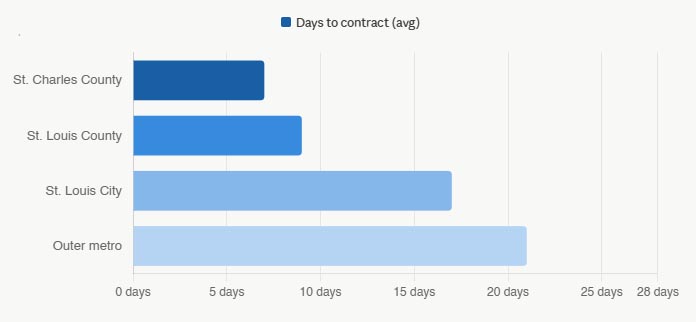
Sale timeline comparison: Traditional MLS vs. Cash buyer (days)
Based on 2026 St. Louis market data — HomeLight, Houzeo, and STL Realtors reports
Estimated net proceeds on a $224,000 St. Louis home
Scenario: Older home needing ~$20,000 in pre-listing repairs. Cash offer at 78% of ARV after repairs.
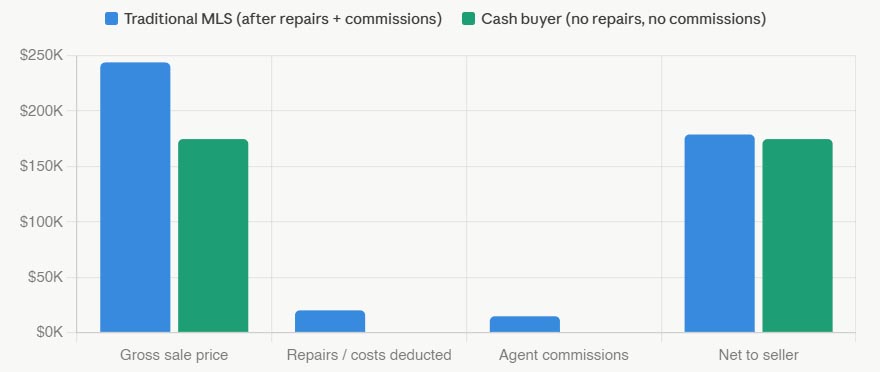
Note: Traditional scenario assumes $20K repair spend + 6% commission ($13.4K) + $3K closing costs, applied to post-repair ARV of $244K. Cash scenario assumes offer at 78% of $224K current value ($174,720), closing costs covered by buyer. Numbers are illustrative — actual offers vary.
That net proceeds comparison is the number that usually surprises people. After repairs and commissions, the gap between a traditional sale and a cash as-is offer is often smaller than sellers expect — and for homes with significant defect exposure, the traditional path can actually come out behind once you account for deal fall-throughs, extended carrying costs, and repair overruns.
The municipal inspection factor: a real St. Louis wrinkle
Here's something that catches a lot of sellers off guard, especially in St. Louis City and many of the older inner-ring suburbs: Missouri's point-of-sale municipal inspection requirements. Unlike a standard buyer's home inspection (which is hired by the buyer and is advisory), certain St. Louis municipalities require a city or county occupancy inspection before a property can be transferred. The seller is typically responsible for bringing the home into code compliance as a condition of closing.
For an older South City home with knob-and-tube wiring, clay sewer pipes, or a foundation issue, this is not a theoretical problem. It's a real one. Failing a municipal inspection can mean thousands of dollars in mandatory repairs with no wiggle room to negotiate — you either fix it or you don't close.
Most cash investors and institutional buyers in the St. Louis market purchase properties subject to existing municipal code violations and handle the inspection and compliance process themselves after closing.
Why it matters: Sellers can often avoid the time, expense, and uncertainty of correcting violations before listing, making the transaction faster and significantly less stressful.
This is one of the most overlooked advantages of a direct as-is sale in the St. Louis market.
When a cash-as-is sale actually makes sense for you
This isn't a pitch for cash buyers across the board. If your home is in good condition and you have the time to list, the MLS will almost certainly get you a higher gross sale price. But there are specific situations where the math and the logistics genuinely favor the as-is route:
- Inherited property: Settling an estate in Missouri can drag out for months. If the home sat vacant for years, there may be deferred maintenance, code violations, and condition issues that make a traditional listing a project rather than a sale. Cash buyers who understand Missouri probate can work alongside estate attorneys to close at the right time.
- Pre-foreclosure: Missouri's foreclosure process can move faster than sellers expect. If you're behind on payments, the 30–45 day MLS timeline plus the financing risk of a traditional buyer is a gamble you can't afford. A cash buyer who can close in 10 days is a different calculation entirely.
- Divorce: When both parties need to convert shared real estate to cash quickly and cleanly, avoiding the months of open houses, contractor negotiations, and agent coordination is often worth the equity trade-off.
- Relocation under a deadline: Corporate moves don't wait for the market. If you have 30 days to be in another city, a traditional listing is a liability.
- Homes with known structural or system issues: If you already know the basement walls are bowing, the wiring is knob-and-tube, or the sewer lateral has never been scoped — and you don't have the cash or inclination to fix it — the as-is path is the honest, logical choice.
How to not get taken advantage of in an as-is sale
The "we buy houses" market has legitimate operators, and it has predatory ones. Here's what separates them and how to protect yourself:
Always get multiple offers
Never accept the first cash offer you receive. The difference between competing offers on a distressed St. Louis property can easily be $10,000–$25,000. Platforms and services that aggregate multiple cash buyers let you compare side-by-side without doing all the legwork yourself. Per the data, sellers who compare multiple offers consistently get better prices than those who take the first call.
Watch for bait-and-switch tactics
A common tactic is a high initial offer followed by a significant price reduction after an "inspection" — sometimes well into the escrow period when the seller feels locked in. Any reputable buyer will disclose their offer methodology upfront and honor their offer absent genuinely new information. If an offer drops more than a few percent after inspection without a clear and documented reason, walk away.
Understand what "closing costs covered" actually means
Some cash buyers advertise zero fees and then quietly build those costs into the offer price. Ask explicitly: are title fees, transfer taxes, and escrow costs included in your offer, or deducted from it? Get it in writing before you sign anything.
Know that Missouri allows you to negotiate
A cash offer is not automatically take-it-or-leave-it. If you've received two or more competing offers, use them as leverage. Even a 2–3% improvement on a $220,000 offer is $4,400–$6,600 back in your pocket. Don't let the convenience narrative pressure you into accepting less than you should.
The bottom line for St. Louis sellers in 2026
The St. Louis market in 2026 is sitting at a median price of $224,000 in the city, homes averaging 47 days on market — up from 42 the prior year — and sellers getting about 95.5% of asking price when everything goes right. When everything goes right. For a home with real condition issues, that "everything goes right" scenario requires a significant upfront investment in repairs, patience for a longer timeline, and a tolerance for deal uncertainty that not every seller has.
Selling as-is to a direct cash buyer isn't giving up. For the right home and the right situation, it's the most sensible exit available in this market. The key is knowing exactly what you're trading — a portion of equity — and exactly what you're getting in return: certainty, speed, and freedom from a process that can grind on for months.
If you own an older South City brick, an inherited North County ranch, or any home in the St. Louis metro that needs work you're not positioned to do, the as-is conversation is worth having. Just go into it with both eyes open and multiple offers in hand.
Ready to Buy or Sell in St. Louis? House Sold Easy Has You Covered!
Navigating St. Louis’ red-hot luxury market doesn’t have to be a headache. With House Sold Easy, it’s all about less hassle—we’ve got you covered from start to finish. Our St. Louis experts know every corner of this city and will make buying your dream home or selling your high-end property a breeze. Don’t miss out on the hottest market in the U.S.! Contact House Sold Easy today and let’s make your real estate goals happen!