St. Louis Housing Market 2026: Renting, Buying & Selling
Jul 24, 2026
Written by David Dodge
The days of throwing a massive price tag on your house and watching the offers roll in are over. If you want to cash out your equity this summer without your listing growing stale, pricing precision is your single greatest weapon.
Let’s be honest about what selling a house felt like just three or four years ago. You could stick a slightly crooked “For Sale” sign in the front yard on a Thursday afternoon, skip vacuuming the living room, throw a number at the wall that was $50,000 over your neighbor’s highest sale price, and go away for the weekend. By Sunday night, your inbox would be overflowing with fifteen competing offers, most of them waiving inspections, offering cash gaps, and promising to name their firstborn child after you just to secure the keys.
It was an absolute gold rush for property owners. But if you are stepping into the summer 2026 real estate market expecting that same frenzied, unconditional surrender from buyers, you are setting yourself up for a brutal reality check.
The real estate landscape has fundamentally transformed. The fever pitch of the early 2020s has cooled into an analytical, price-sensitive, and inventory-rich environment. Today’s buyers are exhausted by years of inflation, hyper-aware of their monthly mortgage outlays, and far more discerning about property condition. They are no longer operating out of FOMO (Fear Of Missing Out); they are operating out of FOOP (Fear Of Overpaying).
If you are looking to sell your St. Louis home this summer—whether you own a classic charming Tudor in Webster Groves, a historic brick walk-up in Soulard, a mid-century ranch in Creve Coeur, or a spacious modern build-out in Chesterfield—you need to pay close attention to a crucial shifting metric: Days on Market (DOM). Currently, the median time a home spends on the market across the St. Louis metro area has crept up to 44 days, and in some specific pricing tiers and historic city neighborhoods, it is pushing past 47 days.
Furthermore, local buyers now have over 6,200 active listings to choose from across the broader regional market. That is a massive surge in available housing inventory compared to the bone-dry shelves we experienced a few summers ago. When buyers have choices, they gain leverage. When they have leverage, sloppy pricing and mediocre presentation get punished.
Here is the comprehensive, data-backed 2026 playbook for how everyday sellers can stand out, protect their hard-earned equity, and successfully cross the closing table this summer.
The 2026 St. Louis Market Reality Check: By the Numbers
To understand why strategic pricing is your best friend right now, we have to look under the hood of the current housing data. Real estate is intensely hyper-local, but local trends are always shaped by macroeconomic tides.
Throughout the summer of 2026, the national housing market has entered what economists call a "rebalancing phase." According to the
Here in the Greater St. Louis area, that shift is distinctly palpable. Let’s look at the hard data defining our local market this summer:
-
Active Inventory Surge: Across the St. Louis Metropolitan Statistical Area (MSA), inventory has expanded significantly. Looking at macroeconomic tracking from the
Federal Reserve Bank of St. Louis (FRED) economic inventory data -
The 44-Day Clock: Why is the median Days on Market (DOM) sitting around 44 days such a critical warning light for sellers? Because in real estate, time is the ultimate enemy of value. When a property sits on the market past the 30-day mark in St. Louis, a psychological shift occurs in the buyer pool. A listing that has been active for 45 or 60 days develops a stigma. Buyers stop asking, "How high do we need to bid to beat the competition?" and start asking, "What is wrong with this house that nobody else bought it?"
-
Price Resilience vs. List Price Reality: Interestingly, home values in St. Louis have not collapsed. According to recent
St. Louis City real estate market data from MORE, REALTORS® Redfin St. Louis County housing market report
Why Are Buyers So Sensitive This Summer?
You cannot blame today’s buyers for being cautious. Consider the math they are dealing with. With 30-year fixed mortgage rates hovering around 6.75%, the monthly principal and interest payment on a typical St. Louis home is substantially higher than it was for someone buying the same house in 2021.
A buyer taking out a $300,000 mortgage at 6.75% is committing to a principal and interest payment of roughly $1,945 per month—before factoring in rising property taxes and property insurance premiums. That buyer does not have a spare $15,000 in cash lying around after closing to replace an aging HVAC system, tuck-point deteriorating brickwork, or remodel a dated 1990s kitchen. They are financially stretched to their comfort limit just making the down payment and securing the loan. Therefore, when they look at your listing, they are viewing it through a hyper-critical, protective lens.
Data Visualization: The Overpricing Penalty in St. Louis
To visualize exactly how pricing strategy impacts your final bottom line in the summer 2026 market, examine the data relationships below. The longer a home sits unsold due to initial overpricing, the deeper the ultimate discount required to secure a binding contract.
The St. Louis Summer 2026 Market Dynamics
| Market Metric | Summer 2024 Seller's Market |
Summer 2025 Transitional |
Summer 2026 Current Balanced Market |
What This Means for Today's Seller |
|---|---|---|---|---|
|
Active Listings (St. Louis Metro) |
~3,800 Homes |
~4,900 Homes |
6,200+ Homes |
Buyers have 63% more inventory choices than two years ago, so standing out is mandatory. |
|
Median Days on Market (DOM) |
18 Days |
31 Days |
44 Days City: 47 Days |
Prepare for a measured marketing cycle. Do not panic if your home does not sell during the first weekend. |
|
List-to-Sale Price Ratio |
102.4% Over Asking |
99.1% |
97.8% With Concessions |
Expect negotiation. Homes are closing slightly below their initial list price on average. |
|
Homes Requiring a Price Drop |
14.2% |
26.8% |
38.4% of Active Listings |
More than 1 in 3 sellers are pricing too high and paying the penalty through market stigma. |
|
Seller Concessions Offered |
Less Than 10% of Transactions |
~25% of Transactions |
42% of Transactions |
Closing-cost assistance and repair credits are now standard tools for getting deals closed. |
Data synthesized from regional MLS records, FRED economic inventory tracking, and local municipal sales reports for Q2/Q3 2026.
The Overpricing Penalty Curve: How Days on Market Destroy Equity
When sellers ask their agent to "just try a higher price for the first couple of weeks to see if we get a bite," they misunderstand real estate buyer algorithms and human psychology. Below is a graphical representation of what actually happens to your final net proceeds when you overprice in a balanced 2026 market:
FINAL SALE PRICE RELATIVE TO TRUE MARKET VALUE (%)
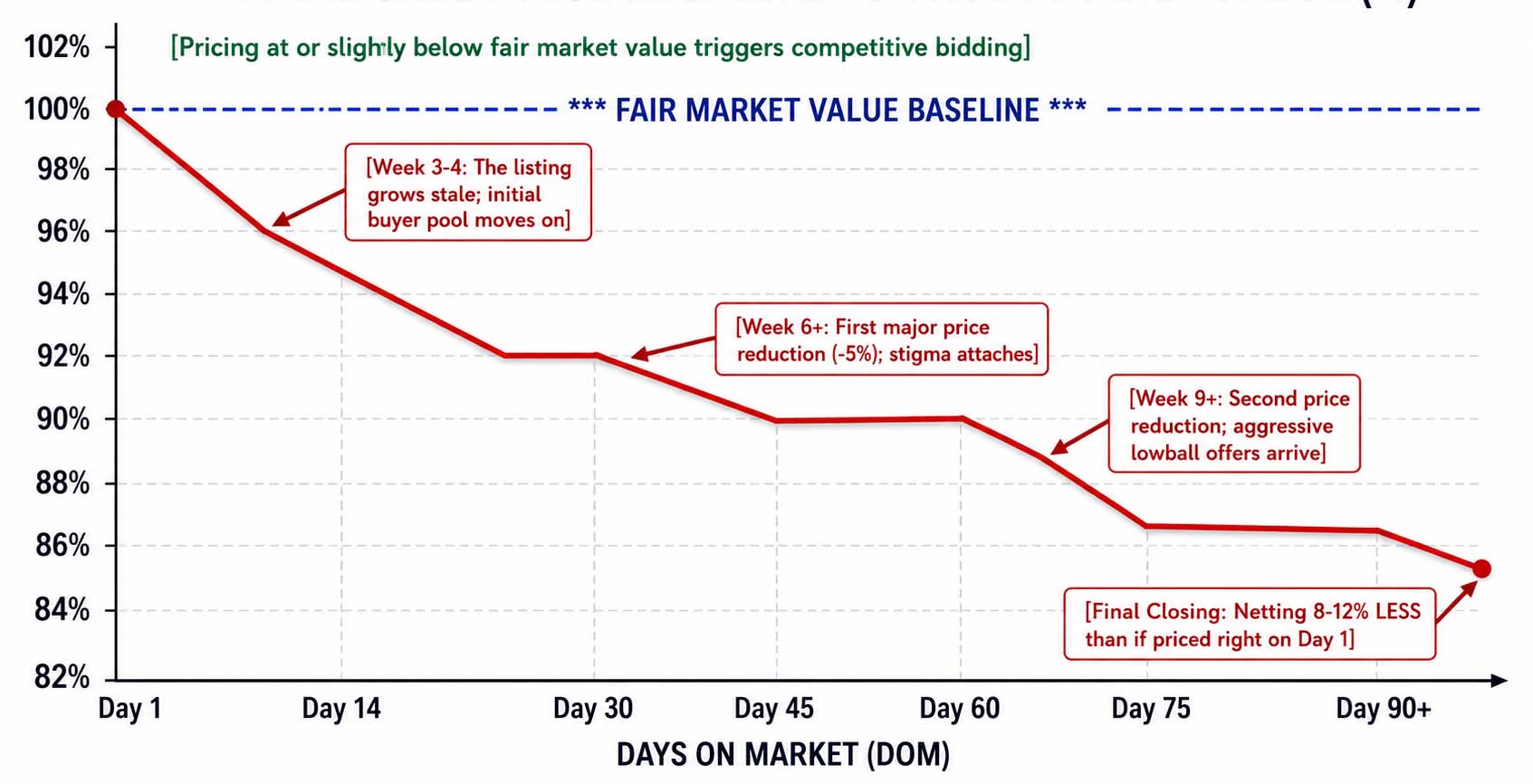
As the curve illustrates, the "aspirational pricing" strategy backfires. By pricing 5% above fair market value on Day 1, you miss the initial wave of active, qualified buyers. By Day 45, when you finally drop the price to where it should have been originally, those initial buyers have already purchased other properties. You are left dealing with bargain-hunters who see a 45-day DOM badge on Zillow and assume you are desperate, resulting in a final sale price that is often thousands of dollars below what you would have netted with a sharp, realistic Day 1 price tag.
Pillar 1: Price It Right from Day One (The Strategy & The Math)
If there is a golden rule for selling real estate in the summer of 2026, it is this: Your listing is like a fresh loaf of bread—it is never more appealing, more desirable, or more valuable than it is the moment it hits the market.
In St. Louis, the first 14 days of your listing life cycle represent your window of maximum leverage. When your home first appears on the local MLS, it triggers instant email alerts to hundreds of motivated buyers who have saved search criteria matching your neighborhood and bedroom count. Local real estate agents actively review new open-house tours for their eager clients. This initial pop of attention is your golden opportunity.
If your home is priced accurately—meaning it sits squarely in line with what comparable properties have actually closed for over the last 60 to 90 days—you will capture this built-in audience immediately. You generate strong foot traffic, create a sense of urgency among buyers who know a good deal when they see one, and potentially spark a multi-offer dynamic that drives your final price upward.
However, if you overprice your home out of the gate, here is exactly what happens in the modern 2026 digital marketplace:
1. The Search Bracket Trap
Today’s home shoppers do not flip through newspaper classifieds; they search on property portals using rigid numerical brackets. When a buyer sets their search filter on a real estate app, they choose increment caps: "$250,000 to $300,000" or "$400,000 to $450,000."
Let’s say your St. Louis home has a true fair market value of $298,000 based on recent neighborhood comps. If you decide to list at $305,000 just to "leave room for negotiation," you instantly vanish from the screens of every single buyer whose search filter maxes out at $300,000. You have artificially hidden your property from the exact demographic most likely to buy it. Meanwhile, the buyers searching in the $300,000 to $350,000 bracket will see your home, but they will compare it against larger homes with superior finishes that truly belong in that price tier—and your listing will lose every single time.
2. How to Run a Bulletproof 2026 CMA
To price accurately this summer, you must work collaboratively with a seasoned local real estate agent to conduct a rigorous Comparative Market Analysis (CMA). But beware: a 2026 CMA cannot rely on data from a year ago. Real estate moves fast, and last summer's numbers are ancient history.
Here is how a strategic seller evaluates comps in today's market:
-
Look at Pending Sales, Not Just Closed Sales: Closed sales tell you what the market was doing 45 to 60 days ago when those contracts were written. Pending sales (homes under contract right now) tell you what buyers are actively willing to pay this very week.
-
Weight Radius and Style Heavily: In St. Louis, neighborhood block-by-block dynamics matter immensely. You cannot compare a two-story brick colonial in University City with a split-level home in Overland just because they have the same square footage. A valid comp must share similar architectural style, age, structural condition, and sit within a tight half-mile to one-mile radius whenever possible.
-
Adjust for the "2026 Interest Rate Reality": When reviewing comps, verify if the sellers of those comparable properties had to provide closing cost credits or interest rate buydowns to achieve their recorded sale price. If a neighbor sold for $320,000 but gave the buyer a $10,000 seller concession at closing, their true comp value is $310,000. Do not let unadjusted gross sale prices inflate your expectations.
As highlighted in the
Pillar 2: Focus on First Impressions & The Summer Curb Appeal Playbook
Because today's buyers are not operating out of desperation, their standards have skyrocketed. When inventory was scarce, buyers would gladly overlook peeling paint, overgrown landscaping, dated carpet, and lingering pet odors just to secure a roof over their heads. In the summer of 2026, those same imperfections will cause a buyer to walk right out your front door without a second thought—or make an insulting lowball offer that deducts three times the actual cost of the repairs.
When buyers have over 6,200 active listings to choose from across the metro, your home cannot afford to look like a weekend project. You must deliver a turnkey, emotionally captivating first impression from the moment they pull up to the curb.
Here is your St. Louis summer staging and preparation playbook, specifically tailored to handle our intense Midwestern summer climate and maximize your Return on Investment (ROI):
1. Conquer the St. Louis Summer Weather Factors
Let’s talk about St. Louis in July and August: it is hot, and the humidity can be relentless. When a buyer steps out of their air-conditioned car to tour your open house, their physical comfort dictates their emotional perception of the property.
-
The HVAC Is Your Best Salesman: Do not turn the thermostat up to 78 degrees to save a few dollars on your utility bill while your house is listed. Keep your home aggressively cool—around 70 to 72 degrees. When a sweating buyer walks into a crisp, cool foyer, it immediately creates a subconscious feeling of relief, sanctuary, and luxury. Furthermore, change your furnace filters immediately before listing. A dirty, dust-clogged intake grate signals to buyers that the home’s mechanical systems have been neglected.
-
Eliminate Summer Odors: High humidity amplifies ambient odors. If you have dogs, cats, or smoke inside the home, you may be "nose-blind" to smells that will instantly hit a prospective buyer. Have carpets professionally hot-water extracted or replaced entirely. Wash pet bedding, clean out drains, and avoid using heavy, artificial chemical plug-in air fresheners (which make buyers suspicious that you are masking mold or urine). Instead, aim for a clean, neutral, or subtle citrus/vanilla scent.
-
Manage the Solar Gain: If your home has windows facing west or south that catch the brutal afternoon sun, adjust your blinds and curtains strategically. You want to let in abundant natural light—which makes rooms feel larger and cleaner—without turning the living room into a greenhouse during a 4:00 PM showing.
2. The $1,500 High-ROI Prep Checklist
You do not need to drop $40,000 on a complete kitchen gut-remodel right before selling; in fact, major structural renovations rarely yield a 100% dollar-for-dollar return at closing. Instead, deploy your capital into high-impact, low-cost cosmetic refinements that remove buyer objections before they can even form:
-
Aggressive Decluttering (The 50% Rule): Go through your home and remove 50% of the contents from every closet, cabinet, and surface. Pack away out-of-season clothes, family portraits, knick-knacks, and countertop kitchen appliances. Buyers need to envision their lives in the space, which is impossible if the home is overflowing with your personal history. Storage space is a huge selling point; half-empty closets make storage look cavernous.
-
Power Washing & Brick Care: In St. Louis, brick is king. Over winter and spring, masonry, concrete driveways, and limestone front steps accumulate soot, algae, and grime. A $300 professional power washing session can make a 75-year-old exterior look vibrant, well-maintained, and historically charming.
-
Fresh Landscaping & Mulch: The front yard is the first photo on your digital listing and the first thing buyers see in person. Trim overgrown bushes away from windows to let light in, edge the lawn cleanly, weed flowerbeds, and lay down a fresh layer of dark brown or black mulch. Plant a few hardy summer annuals (like geraniums or marigolds) in pots by the front door to add a pop of welcoming color.
-
Strategic Paint Touches: Walk through your home with a critical eye. Scuffed baseboards, chipped doorways, and bold, personalized accent walls (like a dark purple bedroom or lime-green bathroom) must go. A few gallons of a universally flattering, modern neutral paint—such as a warm greige or crisp off-white—can instantly modernize a dated room and make the entire layout feel cohesive and bright.
As confirmed by recent
Pillar 3: Be Prepared to Negotiate (Concessions Over Cuts)
In a heated seller's market, negotiation is a one-way street: the seller dictates terms, and the buyer either complies or gets stepped on by the next person in line. In the balanced summer 2026 market, negotiation has returned to what it was always meant to be: a professional, collaborative compromise between two parties trying to solve a mutual problem.
When you list your home this summer, you must enter the process with a flexible, deal-making mindset. This does not mean you need to slash your price out of the gate or roll over at the first lowball offer. It means understanding what today’s buyers actually need to get across the finish line—and using targeted concessions to solve their financial pain points while preserving your bottom-line equity.
1. Why Concessions Are Your Secret Weapon
Let’s examine the psychology and economics of a buyer in 2026. As documented in
Imagine you list your home for $310,000. A buyer loves the house but hesitates because the 6.75% interest rate stretches their monthly budget, and they are worried about needing $4,000 for upcoming roof repairs within the next two years. They submit an offer of $295,000—a $15,000 price cut.
If you react emotionally and reject them, your house sits for another three weeks, accumulating DOM stigma. Instead, how should a savvy 2026 seller counter-offer? Offer concessions instead of price slashes.
You could counter at a purchase price of $308,000, but agree to provide a $6,000 Seller Concession at closing toward the buyer's closing costs or an interest rate buydown. Look at why this is a win-win:
-
For the Buyer: That $6,000 credit allows their lender to execute a "2-1 Rate Buydown" or permanently buy down their mortgage interest rate by a full percentage point. This lowers their monthly payment significantly—often saving them $150 to $200 per month—and keeps cash in their pocket for moving day. To a cash-strapped buyer, $6,000 in upfront closing assistance is worth far more than a $6,000 drop in the purchase price (which only lowers their mortgage payment by about $38 a month).
-
For You (The Seller): You secure a contract at a gross price of $308,000. After deducting the $6,000 credit, your net proceeds are $302,000—which is $7,000 more than if you had accepted their initial lowball $295,000 price cut!
By mastering the art of closing cost credits and rate buydowns, you can protect your equity while making the buyer feel like they won the negotiation.
2. Navigating the Inspection Phase Without Losing Your Cool
In 2021, home inspections were routinely waived. In 2026, the home inspection is where deals live or die. Buyers are using inspections not just to check for structural catastrophes, but as a secondary negotiation arena to seek price reductions for routine deferred maintenance.
Here is how to handle the inspection repair request:
-
Pre-Inspect if Your Home is Older: If you own a historic home in St. Louis City or an older brick property in the inner-ring suburbs, consider hiring an inspector to do a pre-listing inspection for $400 before you put the house on the market. Discovering a cracked sewer lateral, a double-tapped electrical panel, or a slow plumbing leak before listing allows you to fix it on your own terms and timeline, at wholesale contractor pricing—rather than dealing with a panicked buyer demanding a $10,000 credit three days before closing.
-
Categorize Objections: When the buyer's inspection notice arrives, separate requests into three buckets: Life/Safety Hazards (electrical faults, active gas leaks, mold, structural movement), Functional Defects (broken AC, plumbing leaks, dead appliances), and Cosmetic/Age Upgrades (older but functioning roof, dated windows, minor brick tuck-pointing).
-
Fund Minor Repairs via Closing Credits: Always agree to fix genuine safety hazards and active plumbing/mechanical failures. However, for minor nuisance repairs or requests to replace aging-but-functional systems, avoid hiring contractors yourself during the escrow period. It is stressful, and buyers often complain about the quality of the repair work anyway. Instead, offer a clean, fixed financial credit at closing (e.g., "Seller to provide $1,500 credit instead of repairs to exterior gutter drainage and window caulking"). This caps your financial exposure and lets the buyer manage the repairs to their own satisfaction after taking possession.
The 30-Day St. Louis Summer Seller’s Playbook & Timeline
To help you put these principles into immediate execution, here is a structured, week-by-week roadmap for prepping, pricing, and launching your St. Louis home onto the summer 2026 market.
Week 4 (30 Days Out from Listing): Strategy & Triage
-
Interview Local Agents: Meet with at least two full-time St. Louis real estate professionals. Ask for their specific marketing plan, their average Days on Market for 2026 listings, and a detailed CMA showing both closed and active comps.
-
Execute the 50% Decluttering Rule: Rent a storage unit or begin staging donations. Clear out basements, attics, and garages so square footage is fully visible.
-
Order a Pre-Listing Inspection (Optional but Recommended): Especially critical for homes built before 1980. Check your sewer lateral line—a notorious sticking point in St. Louis real estate transactions.
Week 3 (21 Days Out): The Cosmetic Blitz
-
Bring in the Handyman: Tackle all lingering nuisance repairs: leaky faucets, loose door handles, burned-out lightbulbs (replace all bulbs with matching 3000K warm-white LEDs), and sticking windows.
-
Neutralize the Palette: Paint over bold colors, touch up baseboards, and fill any drywall anchor holes from hanging art or TVs.
-
Service the HVAC: Have a licensed technician clean and service your cooling system. Tape the service receipt directly to the furnace—it builds instant trust with buyers touring the utility room.
Week 2 (14 Days Out): Curb Appeal & Deep Cleaning
-
Exterior Power Wash: Clean masonry, driveways, front walk, and back patios.
-
Landscaping Overhaul: Trim overgrowth, edge lawns, apply fresh black or brown mulch to flowerbeds, and clean out all gutters and downspouts.
-
Professional Interior Clean: Hire a professional cleaning crew to execute a deep clean—including window interiors and exteriors, baseboards, oven interiors, and bathroom grout lines.
-
Carpet Cleaning/Flooring Prep: Professionally shampoo carpets or buff hardwood floors to restore luster.
Week 1 (7 Days Out): Media Capture & Pricing Lock
-
Professional Photography & 3D Tour: Your agent’s professional photographer captures wide-angle, HDR photos, drone aerials of the lot/neighborhood, and an interactive Matterport 3D walkthrough. Never allow cell phone photos on your MLS listing.
-
Final Pricing Strategy Meeting: Sit down with your agent and review any brand-new comps or pending sales that occurred over the last three weeks. Lock in your exact, strategic Day 1 list price based on current competition.
-
Stage Stage Stage: Remove pet gear, bowls, and litter boxes from sight. Put out fresh, plush white towels in bathrooms and clear off 90% of kitchen countertops.
Launch Weekend (Day 0 to Day 3): The Open House Blitz
-
Go Live on Thursday: Launch your listing on the MLS on Thursday morning. This captures weekend tour planners and allows automated property alerts to hit buyer inboxes before Friday.
-
Disappear for the Weekend: Plan a weekend getaway or stay with family. Allow your agent to host unrestricted private showings on Friday and Saturday, culminating in a highly publicized public Open House on Saturday or Sunday afternoon.
-
Review Offers Objectively: When offers arrive, evaluate them holistically. Look beyond just the top-line price: scrutinize the financing type (conventional vs. FHA/VA vs. cash), down payment amount, inspection contingencies, closing date flexibility, and requested seller concessions.
Conclusion: Take Control of Your Summer Sale
Selling your home in St. Louis during the summer of 2026 does not have to be a stressful, unpredictable gamble. While the market has undeniably transitioned away from the chaotic buyer frenzies of years past, properties that are prepared with care and priced with precision are still selling rapidly and netting exceptional returns for their owners.
The data is unequivocal: buyers have over 6,200 active listings to choose from across the metro, and they are taking an average of 44 days to make their decisions. You cannot bully today’s buyers with inflated price tags or sloppy presentation. By checking your ego at the door, embracing realistic analytical pricing from Day One, investing in high-impact curb appeal and staging, and utilizing smart concessions to bridge financial gaps during negotiation, you transform market realities into your competitive advantage.
You have built substantial equity in your home over the years. Treat the sale of that asset with the strategic professionalism it deserves, work alongside an experienced local real estate advisor who understands the nuances of the 2026 economic landscape, and you will navigate this summer market with confidence and financial success.
Key Takeaways for Summer 2026 Sellers
-
Respect the Clock: A home’s highest probability of selling at top dollar occurs within the first 14 days of listing. Overpricing leads to extended Days on Market (44+ median in St. Louis), which breeds buyer suspicion and forces painful price cuts.
-
Mind the Search Brackets: Price your home just under major digital search thresholds (e.g., $299,900 instead of $305,000) to ensure maximum visibility on real estate portals like Zillow and Redfin.
-
Invest in Presentation: In a market with 6,200+ active listings, curb appeal, professional photography, clean landscaping, and cool, odor-free interior staging are mandatory to survive buyer scrutiny.
-
Use Concessions strategically: Instead of slashing your purchase price when negotiating, offer closing cost credits or interest rate buydowns. These provide massive upfront value to rate-sensitive buyers while protecting your net equity proceeds.
Ready to Buy or Sell in St. Louis? House Sold Easy Has You Covered!
Whether you're thinking about listing your home or exploring a cash offer, it's worth understanding all of your options before making a decision. The right choice depends on your timeline, your property's condition, and your goals. Contact House Sold Easy to discuss your situation and see what makes the most sense for you.Our St. Louis experts know every corner of this city and will make buying your dream home or selling your high-end property a breeze. Don’t miss out on the hottest market in the U.S.! Contact House Sold Easy today and let’s make your real estate goals happen!