Inherited a House in St. Louis? Your 3 Best Options
Sep 03, 2026
Written by House Sold Easy Team
Inheriting a residential property in the St. Louis metropolitan area represents an intersection of emotional reflection, practical responsibility, and legal complexity. For most families across eastern Missouri, acquiring real estate through an estate occurs during a period of profound personal loss. However, the realities of real property ownership begin immediately upon the passing of a homeowner. Real estate taxes continue to accrue, municipal building code standards remain active, utility providers require ongoing baseline payments, and insurance policies must be restructured. Whether the property is a classic brick gingerbread bungalow in South St. Louis City, a 1960s suburban ranch in Florissant, a mid-century home in Affton, or a two-story traditional residence in Chesterfield, estate executors and surviving beneficiaries face an urgent question: What is the most effective, legally sound, and financially prudent strategy for handling this inherited home?
The broader St. Louis real estate environment highlights why structured, proactive property management is vital. Across the region, managing distressed, vacant, or transitional real estate requires careful legal and financial execution. A notable regional example occurred when a 127-unit apartment building at the Lofts at OPO exited judicial receivership following a Fannie Mae foreclosure, as reported by the St. Louis Business Journal. In addition, nine other commercial properties across the urban core have remained under court-appointed receivership, navigating what local real estate analysts describe as an extended journey toward operational stabilization. While commercial receiverships involve institutional financing and large tenant rolls, the underlying principle applies directly to residential estate properties: leaving a residential asset in legal, physical, or administrative limbo inevitably leads to accumulating liabilities, deferred maintenance, code violations, and financial losses.
When tasked with administering an inherited residential property in St. Louis City, St. Louis County, or adjacent communities in St. Charles and Jefferson Counties, heirs and estate personal representatives generally have three primary paths. The first option is selling the home during active probate administration under the statutory authority of the Missouri Probate Code. The second option involves listing the property on the retail open market through the local Multiple Listing Service (MLS) with a licensed real estate agent. The third option is selling the home directly in its as-is condition to an established, professional local cash home buyer. Each approach carries distinct legal prerequisites, financial outcomes, timeline dynamics, and operational requirements. Choosing the correct path requires a thorough understanding of current St. Louis housing market trends, local municipal requirements, state probate statutes, and specific family dynamics.
Current St. Louis Market Context
The late summer housing landscape across the Greater St. Louis metropolitan area has entered a period of market normalization. Following several years characterized by historic inventory shortages, intense bidding wars, and rapid price escalations, the market conditions facing buyers and estate sellers in late August and early September 2026 feature higher listing volumes, extended marketing timelines for properties requiring repairs, and clear performance differences based on overall home condition.
According to verified market statistics published by St. Louis REALTORS® and MARIS, single-family active residential inventory across St. Louis City and St. Louis County climbed to 3,563 homes, representing an increase of 15.2% compared to the 3,093 active listings recorded during the same period in 2025. This double-digit expansion in active housing stock provides retail purchasers with significantly more choices than they had in previous seasons. Concurrently, regional single-family median sales prices increased by 5.9% year-over-year to $350,000, demonstrating that qualified buyers remain willing to pay market rates, but only for properties that meet modern standards regarding mechanical reliability, architectural condition, and cosmetic finish.
ACTIVE SINGLE-FAMILY INVENTORY (ST. LOUIS CITY & COUNTY)
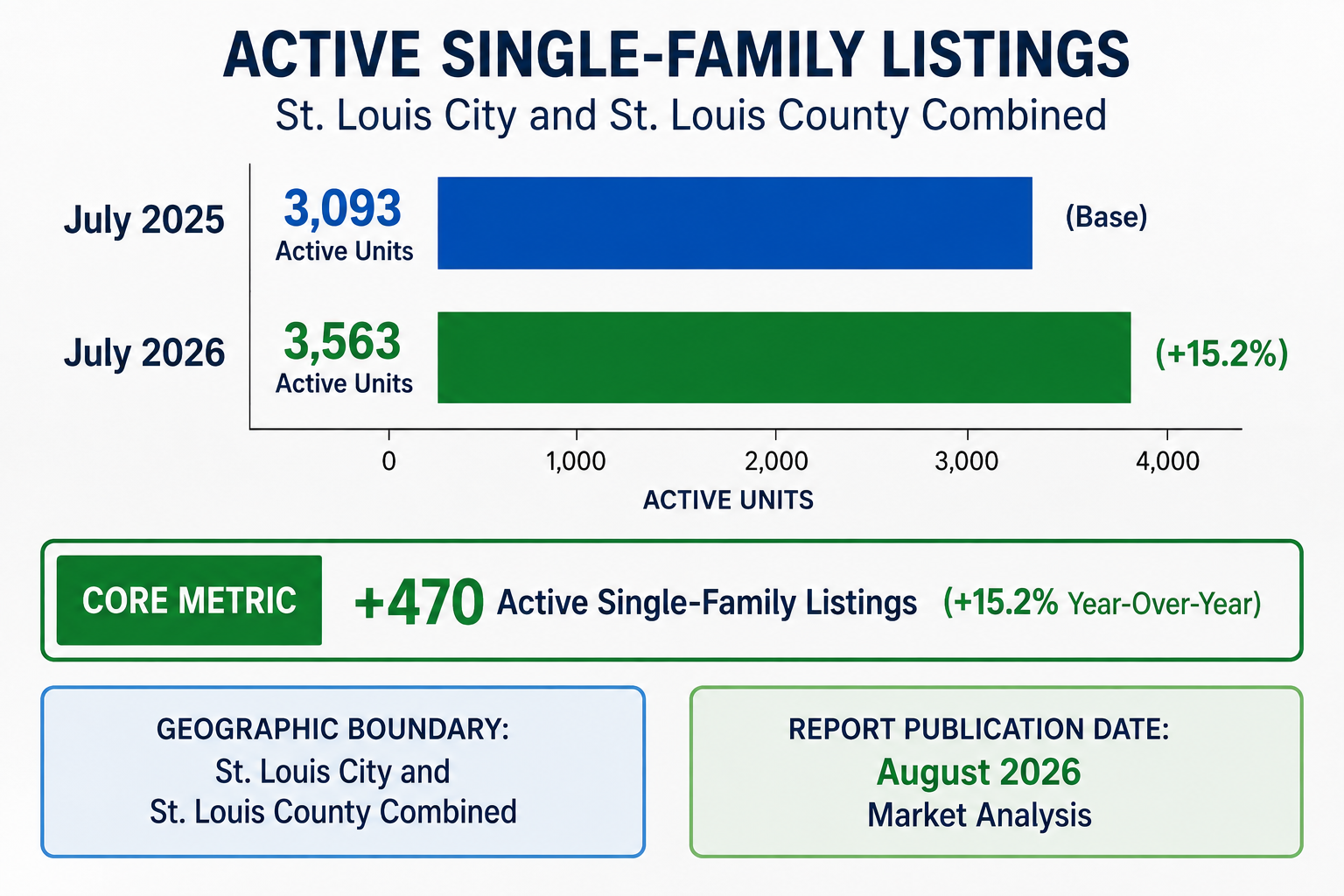
Data Source: St. Louis REALTORS® / MARIS (July 2025 vs. July 2026)
The graph illustrates the 15.2% expansion of active residential single-family listings across the combined jurisdictions of St. Louis City and St. Louis County, growing from 3,093 properties in July 2025 to 3,563 properties in July 2026. This data, compiled directly by MARIS and detailed in late-August market releases, provides critical context for estate executors evaluating market timing. The inventory surge means that the St. Louis housing market is no longer operating under the extreme scarcity that previously masked significant property flaws.
When active inventory expands by double digits, retail home buyers become more selective. Rather than competing aggressively for properties that require immediate repairs, retail buyers focus their attention on move-in-ready homes. For heirs inheriting a home that has not received major structural, mechanical, or aesthetic updates in twenty to thirty years, this inventory expansion represents a clear operational shift. An estate property listed on the open retail market today faces direct competition from updated properties. Consequently, estate executors must recognize that buyers will not overlook dated kitchens, obsolete electrical panels, or aging roofs unless the listing price is discounted significantly to account for required capital expenditures and contractor management time.
Latest Market Data and Seller Dynamics
The expansion of regional housing inventory has directly influenced the speed at which homes sell, creating a stark contrast based on property condition. Regional market tracking published by housesoldeasy.com shows that the overall median days on market across the St. Louis metropolitan area settled at 23 days. However, analyzing that single median figure obscures an important market division.
Turnkey, fully modernized properties located in high-demand submarkets—such as Kirkwood, Webster Groves, Clayton, Glendale, and sought-after pockets of St. Louis City like Tower Grove South, Shaw, and St. Louis Hills—often secure ratified purchase contracts within 4 to 7 days, regularly generating multiple offers. In contrast, homes burdened by substantial deferred maintenance, structural questions, outdated plumbing, or unaddressed estate clearing are remaining on the market for an average of 48 days or longer.
DAYS ON MARKET BY PROPERTY CONDITION (GREATER ST. LOUIS)
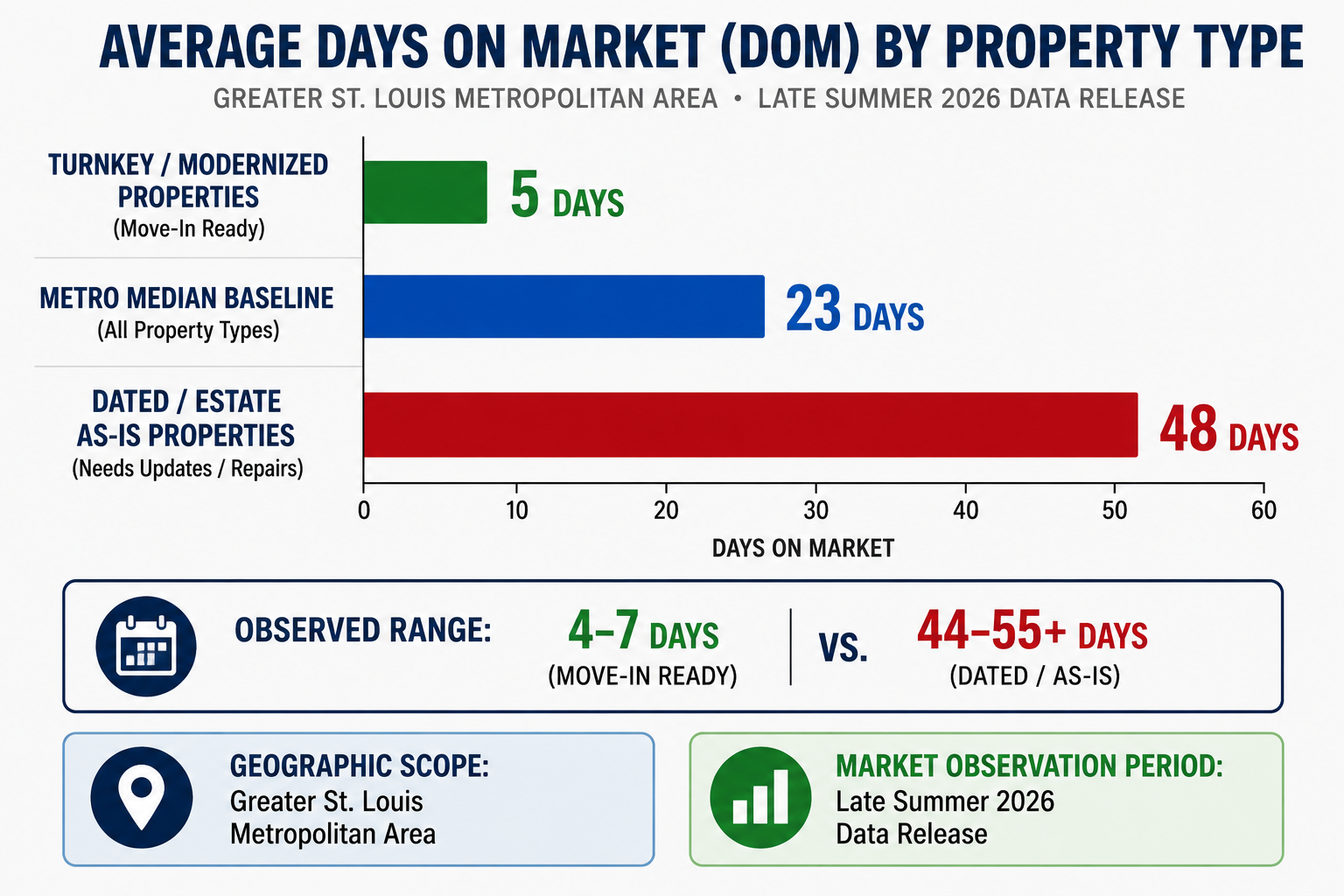
Data Source: MARIS / housesoldeasy.com Market Reports (Late August 2026)
Graph outlines the condition-based timeline divergence in the Greater St. Louis housing market. While the regional median marketing period sits at 23 days, actual sales velocity depends heavily on whether a home is move-in ready or in original estate condition. Move-in-ready properties in desirable school districts and central corridors average just 5 days on market. Conversely, inherited residences with aging mechanicals, worn flooring, vintage wallpaper, or exterior deferred maintenance average 48 days before securing an acceptable contract.
Additionally, data from late August 2026 shows that approximately 17.9% of all active residential listings across the St. Louis metropolitan area underwent at least one formal price reduction. This represents a 1.1 percentage point increase compared to the prior year. When an inherited property sits on the retail MLS beyond 30 days, prospective retail buyers frequently assume the property possesses hidden defects, which can lead to lowball offers and difficult post-inspection repair negotiations. For estate administrators, an extended listing timeline results in ongoing monthly expenditures for real estate taxes, insurance coverage, utility services, and yard maintenance, which steadily erode the final net proceeds available for distribution to heirs.
Key Local Market Statistics
To make an informed decision regarding the disposition of an estate home, executors and beneficiaries must examine the performance metrics across distinct submarkets within the region.
ST. LOUIS REGIONAL HOUSING MARKET SNAPSHOT
| Market Indicator | St. Louis City | St. Louis County | Combined Metro Baseline |
|---|---|---|---|
|
Single-Family Active Units |
1,042 Listings |
2,521 Listings |
3,563 Total Units (+15.2% YoY) |
|
Single-Family Median Price |
$235,000 (+4.4% YoY) |
$390,000 (+6.1% YoY) |
$350,000 (+5.9% YoY) |
|
Median Days on Market |
28 Days |
21 Days |
23 Days (48 Days for As-Is) |
|
Active Price Reductions |
19.4% of Listings |
17.2% of Listings |
17.9% of Active Inventory |
|
Months of Housing Supply |
3.1 Months |
2.6 Months |
2.8 Months |
Table provides a direct comparative overview of market conditions in St. Louis City and St. Louis County. While both jurisdictions experienced positive year-over-year median price growth, their operational baselines reflect distinct dynamics. St. Louis County maintains a higher median sales price of $390,000, supported by steady suburban demand in areas such as Chesterfield, Creve Coeur, Ballwin, and Kirkwood, along with a lower supply level of 2.6 months and a median marketing period of 21 days.
In contrast, St. Louis City presents a lower median price point of $235,000, a higher inventory level of 3.1 months of supply, and a higher rate of price reductions at 19.4%. Inherited properties in the City frequently consist of century-old historic brick masonry homes that involve unique municipal requirements, such as occupancy inspections, lead-safe paint compliance certifications, historic district preservation guidelines, and aging underground sewer lateral connections. These structural characteristics can present unexpected hurdles for an estate attempting a traditional retail sale without significant liquid repair capital.
Option 1: Sell During Probate (Court-Supervised Administration)
Missouri Probate Mechanics and Statutory Framework
When a St. Louis homeowner passes away holding real property solely in their individual name without a designated non-probate transfer instrument—such as a recorded Missouri Beneficiary Deed, a revocable living trust, or joint tenancy with rights of survivorship—the asset becomes part of the decedent’s probate estate. Estate administration in Missouri is governed by the Missouri Probate Code (Title XXXI, Chapter 473 of the Missouri Revised Statutes) and is supervised by the Probate Division of the Circuit Court in the jurisdiction where the decedent resided (the 22nd Judicial Circuit in St. Louis City or the 21st Judicial Circuit in St. Louis County).
Probate serves several legal purposes: validating the decedent’s last will, appointing a personal representative (an executor if designated in a will, or an administrator if the decedent died intestate without a will), establishing an inventory of assets, notifying creditors, settling valid debts and taxes, and distributing remaining assets to beneficiaries.
A frequent misconception among heirs is that an inherited house cannot be sold until the entire probate process reaches its final settlement and formal closure. Under Missouri law, real estate can be sold while probate remains open, provided the personal representative possesses the proper legal authority and title insurance underwriters approve the transaction documentation.
Independent vs. Supervised Administration
The specific legal procedures required to complete a real estate sale during probate depend heavily on whether the estate is administered independently or under supervised administration:
-
Independent Administration (Sections 473.730 to 473.767 RSMo): When a decedent’s will authorizes independent administration or when all known heirs formally consent in writing, the probate court issues Letters Testamentary or Letters of Administration specifying independent authority. Under independent administration, the personal representative generally has the full statutory power to sell, convey, mortgage, or lease real estate without filing advance petitions with the court, without holding formal valuation hearings, and without requiring judicial confirmation of the final sale price, unless the will explicitly restricts those powers. This structure streamlines the closing process, allowing the estate to accept offers and execute sales agreements like a standard residential transaction.
-
Supervised Administration: In cases where independent administration is not granted, where the will requires court oversight, or where disputes arise among heirs, the estate operates under supervised administration. To sell real estate under supervised administration, the personal representative must file a formal Petition for Order of Sale of Real Property pursuant to Section 473.493 RSMo. The court requires evidence establishing that the sale is necessary to pay debts, taxes, or administration expenses, or that the sale is in the best interest of the estate beneficiaries. The court may require an independent appraisal, formal public notice, and a judicial hearing. Once a purchase contract is secured, the personal representative must submit a Report of Sale to the probate division. The court must then issue an Order of Confirmation of Sale before legal deed conveyance and closing can occur.
Step-by-Step Procedure for a Missouri Probate Real Estate Sale
To execute a property sale during active probate administration in St. Louis, personal representatives should follow this sequential workflow:
-
File Initial Probate Pleadings and Secure Letters: Retain a Missouri probate attorney to file the application for letters of administration, establish the estate docket in the local circuit court, and obtain formal Letters Testamentary or Letters of Administration.
-
Order a Comprehensive Title Commitment: Engage a local title agency to run an immediate title examination. This search identifies existing mortgages, home equity lines of credit (HELOCs), unpaid property taxes owed to the St. Louis City Collector of Revenue or St. Louis County Department of Revenue, municipal assessment liens, mechanic's liens, and potential Missouri Department of Social Services MO HealthNet (Medicaid estate recovery) liens.
-
Calculate Ongoing Carrying Expenses: Determine the monthly budget required to maintain the property during estate administration, including hazard insurance premiums (which must be converted to a vacant property policy), utility services to prevent pipe failure or mold growth, lawn maintenance, and real estate taxes.
-
Execute the Purchase Agreement: The personal representative executes the purchase contract in their official fiduciary capacity (for example: "Jane Doe, Personal Representative of the Estate of John Doe, Deceased").
-
Obtain Court Approvals (If Supervised): If operating under supervised administration, complete the required petition, waiting period, and confirmation order with the assigned circuit court judge.
-
Disburse Funds into the Dedicated Estate Account: Upon closing, all net sale proceeds must be wired directly into an official, segregated estate escrow checking account. These funds remain within the estate account until statutory creditor claim periods expire (typically six months from the date of first publication of notice of letters in Missouri under Section 473.360 RSMo) and final distribution is approved.
Advantages of Selling During Active Probate
-
Halting Asset Depletion: Holding costs compound rapidly on vacant properties. In St. Louis City and County, vacant property insurance surcharges, property taxes, baseline utility charges, and exterior maintenance often total $800 to $1,500 per month. Selling during probate preserves liquid funds for the estate's heirs.
-
Mitigating Property Damage Risks: Vacant homes face significant risks from Midwest seasonal weather, including winter freeze-thaw pipe bursts, summer humidity and mold proliferation, basement water intrusion from clay soil movement, and vandalism. Liquidating the property converts a vulnerable physical asset into secure cash.
-
Eliminating Co-Ownership Conflicts: Liquid cash held in an estate account is divisible to the penny according to the decedent's will or Missouri intestate succession laws, avoiding long-term co-ownership disputes among family members.
Challenges and Limitations
-
Court Scheduling Timelines: If supervised administration is required, judicial review and statutory notice windows can add 30 to 60 days to the closing timeline.
-
Creditor Protections: Under Missouri law, sale proceeds must remain within the estate to satisfy valid statutory creditor claims before any distributions can be made to individual beneficiaries.
-
Title Underwriting Requirements: Missouri title insurance underwriters apply strict scrutiny to probate transactions, requiring specific court orders, certified death certificates, and formal waivers of claims before issuing a clear title policy.
Option 2: List Traditionally with a Real Estate Agent
When the Traditional Retail Path Is Appropriate
Listing an inherited property on the open market through the MARIS Multiple Listing Service with a licensed real estate agent is an effective method for maximizing the gross sales price, provided the property meets specific condition and market criteria.
The traditional open market path is best suited for situations where:
-
The property has been consistently maintained, features updated mechanical systems (such as a modern HVAC system, an architectural shingle roof, copper or PEX plumbing, and a 100+ amp electrical panel), and presents modern interior finishes.
-
The estate or its heirs have sufficient liquid capital to fund pre-listing cosmetic updates, professional staging, required municipal occupancy inspection repairs, and ongoing carrying costs for three to six months.
-
All legal heirs agree on the listing price strategy, negotiation boundaries, and closing terms.
-
The property is located in a high-demand suburban or prime urban neighborhood where retail buyer activity is strong.
The Realities of Retail Marketing in the St. Louis Market
While an open-market sale can achieve a high gross transaction price, heirs must evaluate the net financial yield after accounting for the costs associated with preparing and selling a home on the retail market. In the St. Louis area, preparing an estate home for the retail market typically involves several key stages:
-
Estate Liquidation and Property Cleanout: Years of accumulated personal belongings, furniture, tools, and household items must be sorted and removed. Professional estate sale liquidation companies or full-service cleanout services in the St. Louis area typically charge between $2,000 and $6,000, depending on the volume of items.
-
Municipal Occupancy and Code Inspections: Many municipalities across St. Louis County (such as Florissant, University City, Kirkwood, and Ferguson) as well as the City of St. Louis require pre-sale occupancy inspections or building code compliance reviews. Municipal building inspectors examine items including handrails, smoke and carbon monoxide detector placement, ground fault circuit interrupter (GFCI) outlets, sidewalk trip hazards, exterior paint condition, brick tuckpointing integrity, and sewer lateral function. Correcting municipal inspection deficiencies before listing typically requires $1,500 to $5,000 in minor repairs.
-
Capital Improvements vs. Market Return: Retail buyers using conventional, FHA, or VA financing often expect updated kitchens, modern bathrooms, neutral interior paint, and clean flooring. Spending $25,000 to $50,000 on renovations may increase the ultimate sales price, but heirs must evaluate whether the time required, contractor management responsibilities, and risk of cost overruns justify the potential incremental gain.
-
Transaction Fees and Commissions: A traditional transaction includes professional real estate brokerage commissions (typically 5% to 6% of the gross sales price), title closing fees, transfer documentation expenses, and often 1% to 3% in negotiated buyer closing cost credits or post-inspection repair allowances.
St. Louis Submarket Variations for Retail Listings
Market performance for traditional listings varies across different parts of the St. Louis area:
-
Central and West St. Louis County (e.g., Clayton, Ladue, Town and Country, Chesterfield, Kirkwood, Webster Groves): These established submarkets experience steady buyer demand. Turnkey or partially updated estate homes priced under $600,000 frequently generate multiple offers within the first week of listing. If an inherited home in Kirkwood or Webster Groves possesses solid structural fundamentals and a functional layout, making focused cosmetic updates and listing traditionally on the open market often produces strong financial returns.
-
North St. Louis County (e.g., Florissant, Hazelwood, Spanish Lake): These suburban neighborhoods feature a large concentration of 1950s and 1960s ranch-style homes. While median sale prices remain accessible for entry-level buyers (ranging from $160,000 to $225,000), buyers in this segment often utilize FHA or VA loan programs that enforce strict property condition guidelines. If an inherited home in Florissant requires a new roof, has peeling exterior paint, or features an outdated electrical service panel, an FHA appraiser may issue mandatory repair requirements before loan approval, creating obstacles for an estate that lacks liquid repair funds.
-
St. Louis City Historic Neighborhoods (e.g., Soulard, Lafayette Square, Tower Grove South, Shaw, Benton Park): Historic brick homes in the City possess significant architectural character but frequently present maintenance challenges. Aging flat roofs, deteriorating brick tuckpointing, limestone foundation movement, lead water service lines, and cast-iron plumbing stacks can require substantial investments to remediate. Retail buyers in these neighborhoods are selective; they will pay premium prices for fully restored properties, but will discount unrenovated estate homes heavily during inspection negotiations.
Option 3: Accept a Direct Cash Offer from an As-Is Buyer
How a Direct Cash Sale Operates
For many estate executors and heirs, managing a multi-month renovation, navigating municipal occupancy inspections, paying ongoing carrying costs, and mediating family disagreements is impractical. In these circumstances, selling the property directly to an established, professional real estate investment firm or as-is cash buyer offers an alternative solution.
A direct cash transaction removes traditional financing contingencies, appraisal requirements, and retail marketing timelines. The purchasing company acquires the property in its current, as-is physical condition, assuming full responsibility for all deferred maintenance, structural repairs, municipal code compliance, debris clearance, and remaining personal belongings.
Financial Mechanics: Gross Sale Price vs. Net Liquid Proceeds
The primary factor to evaluate when considering a direct cash offer is the distinction between gross contract price and the net liquid cash realized by the estate. While a direct cash offer is generally lower than the projected top-of-market retail valuation, the net financial difference narrows once the expenses of a traditional retail transaction are considered.
Consider an inherited single-family home in an established St. Louis County suburb (such as Affton or Overland) with an estimated fully renovated retail value of $260,000, but carrying 25 years of deferred maintenance:
FINANCIAL NET PROCEEDS COMPARISON MODEL
| Traditional Retail Sale Path (Estimated) | Amount |
|---|---|
|
Gross Retail Sale Price |
$260,000 |
|
Required Repairs / Systems Modernization |
-$35,000 |
|
Professional Cleanout & Staging Services |
-$3,500 |
|
Real Estate Brokerage Commissions (5.5%) |
-$14,300 |
|
Seller-Paid Closing Fees & Title Costs (1.5%) |
-$3,900 |
|
Buyer Inspection Resolution Concessions (2.0%) |
-$5,200 |
|
3 Months Property Carrying Costs |
-$3,600 |
| ESTIMATED NET CASH TO ESTATE | $194,500 |
| Requires 90–120 days of project management, risk, and labor | |
DIRECT AS-IS CASH SALE PATH (ESTIMATED):
| Direct As-Is Cash Sale Path (Estimated) | Amount |
|---|---|
|
Gross Cash Purchase Offer |
$195,000 |
|
Required Repairs / Updates |
$0 |
|
Cleanout / Debris Removal |
$0 |
|
Brokerage Commissions |
$0 |
|
Buyer-Covered Standard Closing Costs |
$0 |
|
Carrying Costs (Closed in 10 Days) |
-$350 |
| ESTIMATED NET CASH TO ESTATE | $194,650 |
| Completed in 10 business days with zero physical labor | |
As this comparison illustrates, when an inherited property requires significant capital investments to compete on the open retail market, the net cash proceeds realized by the estate through an as-is sale can be comparable to a retail listing. At the same time, the cash sale eliminates months of holding risk, contractor management responsibilities, municipal compliance delays, and financing uncertainties.
When the As-Is Cash Path Is the Optimal Strategy
-
Major Structural or Mechanical Issues: Homes requiring foundation stabilization, comprehensive mold remediation, replacement of knob-and-tube electrical wiring, replacement of deteriorated cast-iron plumbing stacks, or complete roof replacements.
-
Significant Personal Property Accumulation: Estates where the decedent accumulated decades of belongings, household goods, or heavy clutter that family members lack the physical ability, time, or emotional capacity to clear.
-
Out-of-Town Personal Representatives: Executors who reside in other states or outside the St. Louis area and cannot travel regularly to oversee contractors, meet municipal building inspectors, and manage retail showings.
-
Disagreements Among Multiple Beneficiaries: Situations where multiple heirs have competing priorities (for example, one sibling seeking an immediate distribution while another refuses to contribute personal funds toward renovations). A rapid cash closing converts the real estate into liquid funds that can be divided cleanly.
-
Imminent Financial or Legal Timelines: Instances where the property faces pending tax sale forfeiture from the St. Louis City or County Sheriff, active mortgage foreclosure, or mounting estate administration debts that require immediate capital.
Special Legal, Tax, and Structural Considerations for Missouri Heirs
Step-Up in Basis Tax Rules
One of the most important tax rules available to heirs of real estate is the federal and Missouri statutory provision known as the step-up in basis under Internal Revenue Code Section 1014.
When an individual purchases real estate, their cost basis is generally the original purchase price plus the cost of capital improvements. If a home was purchased in St. Louis in 1978 for $45,000 and appreciated to $320,000 by 2026, selling the home during the owner's lifetime would result in capital gains taxes on the $275,000 gain.
However, upon the owner's death, the cost basis of the real estate automatically adjusts ("steps up") to the fair market value (FMV) of the property as of the date of death.
-
Immediate Sale Advantage: If the estate or beneficiaries sell the inherited property within a reasonable timeframe following the date of death for approximately its appraised date-of-death fair market value, the taxable capital gain is generally zero or minimal.
-
Holding Period Considerations: If heirs retain the property for several years as a rental or allow it to sit vacant while market values rise, any appreciation occurring after the date of death is subject to standard capital gains taxes upon sale.
-
Documentation Best Practices: Heirs should obtain a formal date-of-death real estate appraisal or a detailed comparative market analysis from an experienced local professional to document the stepped-up basis for IRS and Missouri Department of Revenue records.
Municipal Occupancy Inspections and Code Compliance
The St. Louis metropolitan area includes more than 80 distinct municipalities in St. Louis County, in addition to the independent City of St. Louis. Many of these municipalities enforce mandatory exterior and interior occupancy inspection programs before a change of ownership or residency can occur.
In St. Louis City, properties require an occupancy inspection to verify safety compliance, and older residential units must adhere to local lead-safe standards and sewer downspout disconnection regulations. In North St. Louis County municipalities such as Florissant, Ferguson, and Bellefontaine, municipal inspectors evaluate structural elements, exterior paint, concrete flatwork, and electrical grounding. In Central and West St. Louis County communities like Kirkwood, University City, and Webster Groves, local building departments enforce strict building and property maintenance codes, often requiring sewer lateral testing and sidewalk maintenance.
When listing traditionally on the open market, the seller is typically responsible for addressing these municipal inspection requirements or negotiating an escrow credit with the buyer. Conversely, professional local cash buyers regularly purchase properties with open code violations or under municipal inspection waivers, assuming full legal responsibility for securing required permits and completing necessary renovations after closing.
Sewer Lateral and Environmental Infrastructure
In older neighborhoods throughout St. Louis City and inner-ring County suburbs, underground sewer lines represent a frequent hidden expense. Many homes built prior to 1970 utilize clay pipe sewer lateral lines running from the foundation to the Metropolitan St. Louis Sewer District (MSD) public main. Over time, tree root intrusion and soil settling can cause clay pipes to crack or collapse, leading to basement backups.
Both St. Louis County and St. Louis City operate municipal Sewer Lateral Repair Programs funded by local property taxes, which provide partial financial assistance for repairing collapsed residential lateral lines. However, these programs involve application review periods, required video camera inspections, program deductibles, and maximum coverage limits (often $3,000 to $5,000), leaving the homeowner responsible for any remaining excavation or interior plumbing costs. For an estate with limited liquid reserves, an unexpected sewer line repair can disrupt an open-market retail transaction during buyer inspection negotiations.
What This Means for Estate Stakeholders
Practical Guidance for Sole Heirs and Independent Executors
A sole beneficiary serving as executor with independent administration authority possesses maximum strategic flexibility. In this position, you can select the disposition strategy that best aligns with your timeline, financial resources, and personal bandwidth:
-
Evaluate Personal Time and Capacity: If you live near the property, have access to reliable contractors, and can comfortably cover monthly property taxes, insurance, and utilities for several months, investing in cosmetic improvements and listing traditionally on the MLS will generally achieve the highest gross sales price.
-
Consider Time and Convenience: If managing cleanouts, contractors, and municipal inspections conflicts with your professional responsibilities or family commitments, accepting an as-is cash offer allows you to complete the estate sale, pay outstanding debts, and settle the estate within two weeks without ongoing obligations.
Practical Guidance for Multiple Co-Heirs and Dispersed Families
When an inherited property is owned jointly by multiple siblings or extended family members, differing financial situations and personal priorities can lead to disagreements:
-
Maintain Clear Communication: Early in the administration process, hold a family meeting to review property carrying costs, real estate tax obligations, and physical inspection findings. Ensure all beneficiaries understand that an unsold vacant home requires continuous financial support.
-
Rely on Objective Market Data: Family members sometimes base their expectations on sentimental attachments rather than current market conditions. Use objective data—such as recent comparable sales from MARIS and professional inspection reports—to guide decisions.
-
Use Cash As-Is Sales to Simplify Distribution: If one heir prefers to renovate the home while another needs immediate liquidity, managing a traditional retail renovation can create family tension. A direct as-is cash sale provides a clear, documented market transaction that allows proceeds to be divided promptly without placing repair responsibilities on any individual heir.
Strategic Considerations for Real Estate Investors
Real estate investors evaluating estate properties in the St. Louis market must approach acquisitions with careful underwriting and respect for the probate process:
-
Confirm Legal Authority Early: Before drafting purchase contracts, verify that the individual signing the agreement holds proper legal authority through Letters Testamentary, Letters of Administration, or a recorded Beneficiary Deed. Verbal statements regarding estate administration should always be verified through official documentation.
-
Account for Realistic Timelines and Repair Budgets: With St. Louis active inventory increasing 15.2% year-over-year and dated properties averaging 48 days on market, investors should factor in realistic carrying costs, labor expenses, and municipal permit processing times when formulating acquisition offers.
-
Provide Practical Solutions for Heirs: Successful estate acquisitions involve solving logistical challenges for sellers. Offering flexible closing dates, covering standard title and closing costs, and allowing families to leave unwanted heavy furniture behind provides meaningful assistance to heirs during a difficult transition.
Step-by-Step Action Plan: What to Do This Week
If you have recently inherited a residential property in the Greater St. Louis area, follow this five-step action plan to navigate the process effectively:
Step 1: Confirm Legal Title and Authority
-
Locate the original last will, if one exists.
-
Check the recorded deed at the St. Louis County Recorder of Deeds in Clayton or the St. Louis City Assessor/Recorder's Office in City Hall to confirm whether a Beneficiary Deed was recorded.
-
If probate is required, consult an experienced Missouri probate attorney to open the estate and obtain Letters Testamentary or Letters of Administration.
Step 2: Secure and Protect the Property
-
Change the exterior door locks and secure all windows, basement entrances, and garage doors.
-
Notify the existing homeowner's insurance provider of the owner's passing and update the policy to a dedicated Vacant Property Insurance Policy to maintain coverage against fire, storm damage, and vandalism.
-
Set the thermostat appropriately (maintain a minimum of 55°F in winter to prevent frozen pipes, and 78°F in summer to control humidity and mold).
Step 3: Conduct a Physical and Financial Review
-
Inspect the interior and exterior of the home, noting the condition of the roof, foundation, HVAC systems, plumbing, and electrical service.
-
Gather all outstanding financial obligations: existing mortgage balances, unpaid real estate taxes, Metropolitan St. Louis Sewer District (MSD) bills, and municipal utility balances.
Step 4: Gather Comparative Options
-
Consult with one or two licensed local real estate agents who specialize in your specific St. Louis neighborhood to obtain a Comparative Market Analysis (CMA) for both as-is and updated retail scenarios.
-
Request two or three direct as-is cash offers from reputable local property acquisition companies to determine your net cash baseline without commissions, repairs, or closing fees.
Step 5: Compare Net Proceeds, Timelines, and Responsibilities
-
Calculate the net proceeds for each path: compare the expected retail sale price minus commissions, repair costs, municipal inspection items, holding expenses, and closing fees against an immediate as-is cash sale.
-
Select the approach that best fits your family’s financial objectives, timeline requirements, and personal bandwidth.
What to Watch in the St. Louis Market Through September 2026
As the St. Louis real estate market moves through September 2026, several key economic and housing factors will influence estate property decisions:
-
Mortgage Rates and Retail Buyer Demand: Mortgage rate adjustments during September will directly affect buyer purchasing power in the $250,000 to $450,000 price ranges across St. Louis County and St. Charles County. Lower interest rates can increase buyer activity, while higher rates encourage buyer selectivity, extending market times for unrenovated homes.
-
Late-Summer Inventory Trends: Market participants should monitor whether active listings continue their double-digit year-over-year growth in MARIS MLS data. An ongoing rise in inventory gives retail buyers greater negotiating leverage, requiring sellers of dated homes to adjust pricing or offer repair concessions.
-
Municipal Code and Inspection Enforcement: Heirs and real estate investors should stay informed regarding updates to local municipal building codes, rental regulations, and occupancy permit requirements across St. Louis municipalities, as code enforcement policies directly influence the cost and timeline of preparing properties for retail sale.
Practical Summary
Managing an inherited property in St. Louis does not have to be an overwhelming financial or emotional burden. By confirming your legal authority under Missouri law, calculating realistic net proceeds rather than relying solely on gross list prices, and objectively assessing property condition, you can select the strategy that best meets your needs:
-
Option 1 (Sell During Probate): The preferred approach when an estate is already in probate, legal authority is established, and the family wants to liquidate the asset to eliminate ongoing holding costs and simplify estate distribution.
-
Option 2 (Traditional MLS Listing): The best option when the home is in updated, move-in-ready condition, funds are available for minor repairs and holding costs, all heirs agree on strategy, and the estate wants to maximize gross retail price on the open market.
-
Option 3 (Direct As-Is Cash Sale): The optimal solution when the property requires significant repairs, contains substantial personal clutter, faces municipal code issues, or when heirs prioritize speed, certainty, and an immediate sale without repairs, commissions, or inspection negotiations.
Taking timely, informed steps preserves estate assets, reduces stress, and ensures a smooth, legally compliant property transition.
Ready to Buy or Sell in St. Louis? House Sold Easy Has You Covered!
Whether you're thinking about listing your home or exploring a cash offer, it's worth understanding all of your options before making a decision. The right choice depends on your timeline, your property's condition, and your goals. Contact House Sold Easy to discuss your situation and see what makes the most sense for you.Our St. Louis experts know every corner of this city and will make buying your dream home or selling your high-end property a breeze. Don’t miss out on the hottest market in the U.S.! Contact House Sold Easy today and let’s make your real estate goals happen!