St. Louis Housing Market 2026: Rental Trends & Seller Tips
Jul 23, 2026
Written by David Dodge
The St. Louis real estate landscape in the summer of 2026 stands at a pivotal crossroad. For the last four years, buyers, renters, real estate investors, and sellers across the Gateway City have navigated a hyper-dynamic environment characterized by historic interest rate adjustments, fluctuating inventory levels, and dramatic shifts in construction pipelines.
As we cross into the second half of 2026, two defining market forces have emerged that every St. Louis resident needs to understand:
-
A major slowdown in new apartment construction, ending the recent wave of heavy rental deliveries and shifting the rent-versus-buy math for thousands of local households.
-
A cooling, highly calculated single-family residential market, where active inventory has expanded, Days on Market (DOM) have lengthened, and strategic pricing has replaced aggressive bidding frenzies.
Whether you are a tenant weighing whether to renew your lease in the Central West End, a homeowner preparing to list a property in South City or West County, or an investor seeking high-yield opportunities through owner financing, this comprehensive deep dive provides the exact data, analysis, and strategic playbook required to navigate the St. Louis housing market in 2026.
Part 1: The 2026 Construction Pullback & St. Louis Rental Dynamics
Is the St. Louis Multifamily Building Boom Over?
If you have driven through Downtown St. Louis, Midtown, or along the I-64 corridor through Clayton over the past three years, you couldn't miss the skyline dotted with tower cranes. Developers scrambled to build thousands of high-end luxury units to capture surging urban demand. However, in 2026, the construction spigot has officially been turned down.
This contraction is not an anomaly; it is a direct macroeconomic response to several converging pressures that began accumulating in 2024 and early 2025:
-
Elevated Commercial Financing Costs: Regional banks and institutional lenders significantly tightened credit conditions for large-scale ground-up developments.
-
Increased Construction Costs: Materials and specialized labor expenses flattened at elevated peaks, making margin projections on new builds tight.
-
Absorption Normalization: The post-pandemic surge in household formation naturally slowed down, prompting developers to pause land acquisition and plan submissions.
The Aftermath of the 2022–2025 Delivery Wave
To understand why rent growth is behaving the way it is today, we have to look back at what happened over the last 36 months. Between 2022 and late 2025, St. Louis experienced one of its largest multi-year apartment delivery waves in decades. Thousands of class-A units flooded key submarkets including Ballpark Village, Forest Park Southeast, Maryland Heights, and St. Charles.
During that period, property management companies fought fiercely for tenants. Renters enjoyed significant leasing perks:
-
One to two months of free rent on 12-month leases.
-
Waived security deposits and reduced pet fees.
-
Stagnant or slightly declining effective rent prices in new construction buildings.
This oversupply temporarily created a "renter’s paradise," where staying in a luxury apartment was often cheaper and far less stressful than competing for scarce single-family homes in a 7% mortgage rate environment.
2026 Occupancy and Rent Growth Stabilization
That era of heavy concessions and rent stagnation is drawing to a close. As the delivery pipeline clears out and fewer new buildings break ground, supply and demand are rebalancing.
With occupancy holding firm near 91%, property owners no longer need to offer extreme lease concessions to fill vacancies. Consequently, rent rates are stabilizing into a predictable upward trajectory.
While a 2.0% annual rent increase sounds modest compared to the double-digit spikes seen in 2021, its cumulative effect over three to five years represents a permanent upward ratchet in housing costs.
The Rent vs. Buy Calculus: Why 2026 is the Tipping Point
For local residents sitting on the fence between renewing an apartment lease or stepping into the single-family market, the 2026 construction pullback changes the fundamental financial math.
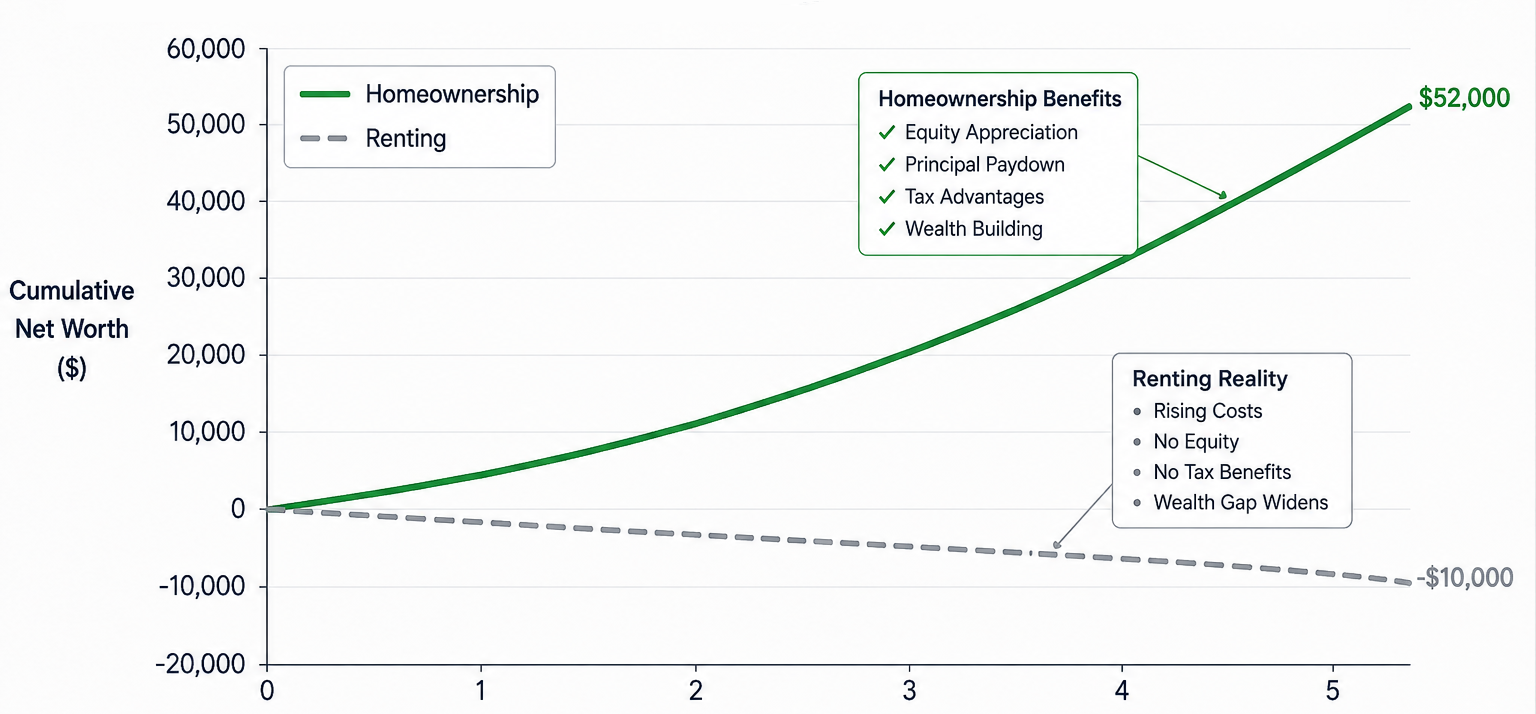
Rent vs. Buy Financial Trajectory 5-Year Horizon
1. The Death of the "Free Rent" Promo
When apartment management companies stop offering free rent concessions, tenant out-of-pocket monthly housing costs instantly jump by 8% to 15% upon renewal. A tenant paying $1,850/month for a two-bedroom unit in Creve Coeur who loses a one-month concession sees their effective monthly expense jump significantly without gaining a single square foot of extra space.
2. Compounding Rent Inflation vs. Fixed Housing Costs
Renting offers flexibility, but it provides zero protection against long-term inflation. Over a 5-year span, a $2,000 monthly rent growing at 2.0% annually costs a tenant over $124,000 in non-recoverable capital. Conversely, purchasing a $290,000 home locks in the principal and interest payment, turning housing from an ongoing expense into an asset-building wealth vehicle.
3. Expanding Single-Family Inventory
While apartment choices are shrinking, single-family inventory across St. Louis County, St. Charles County, and Jefferson County is expanding. Buyers who were priced out or outbid during the frantic seller's market of previous years now have physical homes to inspect, compare, and negotiate on.
Part 2: The St. Louis Single-Family Market – The Rise of Buyer Options
While the rental market is tightening due to reduced apartment construction, the residential home resale market is displaying the exact opposite trend: expanding choice and a return to balanced conditions.
Submarket Analysis: Where is Inventory Growing?
The expansion of single-family inventory isn't uniform across the entire metropolitan region. Understanding local neighborhood dynamics is essential whether you are buying or selling:
-
St. Louis City (South City, Tower Grove, Benton Park): Inventory has increased steadily in historic brick homes and multi-family conversions. Buyers have leverage to ask for building updates, masonry repairs, or closing cost assistance.
-
West St. Louis County (Chesterfield, Wildwood, Ballwin): Move-in ready single-family homes in top school districts remain in solid demand, but properties requiring cosmetic updates or roof repairs are sitting significantly longer on the market.
-
St. Charles & Lincoln Counties (O'Fallon, Wentzville, St. Peters): Newer suburban developments are seeing higher listing counts as existing homeowners list properties to upscale or downsize, creating healthy options for first-time buyers.
| ST. LOUIS SUBMARKET INVENTORY MAP | ||
|---|---|---|
| St. Charles County | West St. Louis County | St. Louis City |
|
|
|
The Role of Owner Financing in Today's Market
With mortgage rates hovering in a range that makes traditional bank financing expensive or difficult for self-employed individuals, small business owners, and non-traditional buyers, alternative deal structures have exploded in popularity across St. Louis.
Owner Financing (or Seller Financing) allows a seller to act as the bank for a qualified buyer. Instead of the buyer obtaining a mortgage from a traditional lender, the buyer makes monthly principal and interest payments directly to the seller based on a mutually agreed-upon promissory note and deed of trust.
Why Owner Financing Works for 2026 Buyers:
-
Bypasses Strict W-2 Requirements: Ideal for entrepreneurs, freelancers, and real estate investors who have strong income and cash reserves but lack traditional tax documentation.
-
Faster Closing Timelines: Closings can occur in as little as 7 to 10 days since there is no underwriting delay or traditional bank bureaucracy.
-
Flexible Terms: Interest rates, down payment amounts, and payment schedules can be customized to fit both parties' needs.
Why Owner Financing Works for 2026 Sellers:
-
Higher Returns: Sellers earn monthly interest income that often exceeds returns from high-yield savings accounts or bonds.
-
Expands the Buyer Pool: Attracts serious buyers who are ready to purchase immediately but are bypassed by conventional bank guidelines.
-
Full Price Realization: Properties sold via owner financing often sell at or near full market value because the seller is offering valuable financing terms.
At House Sold Easy, we specialize in structuring transparent owner financing transactions that protect both buyers and sellers across the St. Louis region.
Part 3: Summer 2026 Seller Playbook – Strategic Pricing & Market Execution
The Headline: The days of throwing a massive price tag on your house and watching thirty over-ask offers roll in within 24 hours are officially over.
If you are planning to sell your home in St. Louis during July, August, or early autumn of 2026, you are entering a market that rewards preparation, positioning, and realism—and severely punishes overconfidence.
The Days on Market (DOM) Shift
To succeed as a seller in 2026, you must understand how buyer behavior has changed. When inventory was scarce, buyers made rushed, emotional offers on homes within hours of listing. Today, with over 6,200 active listings available, buyers are taking their time, attending open houses, and comparing value across multiple properties before making an offer.
A 44-day median market duration means that half of all homes listed take longer than six weeks to go under contract. Properties that are overpriced or poorly presented routinely sit past 60 to 90 days, eventually forcing significant price reductions that damage the seller's negotiating stance.
The Three Golden Rules for St. Louis Sellers in Summer 2026
To achieve a top-dollar sale without letting your property languish on the market, follow these three essential execution strategies:
Rule 1: Price it Right from Day One (The Comp Discipline)
The single biggest mistake St. Louis home sellers make in 2026 is pricing based on what their neighbor sold for during the peak frenzy years, or pricing high with the intention of "leaving room to negotiate."
Here is why the "leave room to negotiate" strategy fails in 2026:
-
Automated Search Filters: Modern buyers search online using rigid price brackets (e.g., $250,000 to $300,000). If your home is worth $295,000 but you list at $315,000 to test the market, you completely miss the exact pool of qualified buyers searching under $300k.
-
The "Stale Listing" Stigma: In a market where average DOM is 44 days, once a property hits 50+ days on market, buyers automatically assume something is structurally wrong with the foundation, roof, or plumbing. They will either ignore the listing entirely or submit low-ball offers.
Actionable Pricing Steps:
-
Request a detailed Comparative Market Analysis (CMA) focusing exclusively on properties sold within the last 30 to 60 days in your immediate subdivision or neighborhood radius.
-
Ignore active listings when establishing your baseline value—active listings show what sellers want, while closed sales show what buyers are actually paying.
-
If your home requires cosmetic updates (original kitchens, older bathrooms, worn carpeting), price 5% to 8% below fully renovated comps to attract buyers seeking value.
Rule 2: Master First Impressions & High-ROI Property Prep
Because 2026 buyers have options, they are far more critical during walk-throughs. They are actively estimating repair costs and mentally subtracting dollars from their offer for every cosmetic flaw they see.
You do not need to execute a $50,000 full kitchen overhaul before listing, but you must address low-cost, high-visibility prep items:
Exterior & Curb Appeal (ROI: 200%+)
-
Landscape Refresh: Lay fresh dark mulch, trim overgrown bushes back from siding, and edge walkways cleanly.
-
Front Entryway Focus: Power wash the driveway, porch, and siding. Paint the front door a crisp, contrasting color, and replace old entry light fixtures and house numbers.
-
Roof & Gutters: Clean out gutters and ensure there are no visible moss growth or missing shingles.
Interior Ambiance & Cleanliness (ROI: 300%+)
-
Professional Deep Clean: Pay for a top-to-bottom professional cleaning service, including window interiors/exteriors, grout scrubbing, and carpet steam-cleaning.
-
Neutralizing Paint: Coat bold or dark accent walls with fresh, neutral paint colors (soft greys, warm off-whites) to reflect light and make spaces feel larger.
-
Decluttering & Depersonalization: Remove 50% of personal items, family photos, and excess furniture. Clear off all kitchen countertops and bathroom vanities.
Rule 3: Be Prepared to Negotiate Terms and Offer Concessions
Selling a home in 2026 is a collaborative negotiation, not a list-price demand. Successful sellers approach offers with flexibility regarding terms, closing dates, and concessions.
High-Impact Seller Concessions in 2026:
-
Closing Cost Credits: Offering a 2% to 3% credit toward buyer closing costs directly reduces the out-of-pocket cash a buyer needs at closing, often unlocking deals for buyers who have income but tight liquid reserves.
-
Mortgage Rate Buy-Downs: Funding a 2-1 temporary rate buy-down (which lowers the buyer's mortgage interest rate by 2% in year one and 1% in year two) provides massive payment relief to the buyer at a fraction of the cost of a flat price drop for the seller.
-
Pre-Listing Home Inspection: Hire an independent inspector before listing your home. Fix minor electrical, plumbing, or handyman items upfront, and disclose the clean report to buyers. This eliminates inspection contingencies and prevents deals from falling apart mid-escrow.
Comprehensive 2026 St. Louis Real Estate Market Matrix
To synthesize the data driving both the rental and resale sectors across the region, review the key indicators below:
| Real Estate Indicator | 2026 St. Louis Data | Strategic Direction | Practical Market Takeaway |
|---|---|---|---|
|
Multifamily Completions |
Down ~40% YoY |
Supply Contracting |
Rent stabilization with fewer apartment promotions. |
|
Multifamily Occupancy Rate |
90.6% |
Flat & Stable |
Landlords retain pricing power while more renters consider buying. |
|
Effective Rent Growth |
~1.9%–2.0% |
Steady Increase |
Predictable rent increases make homeownership more attractive. |
|
Active Residential Listings |
6,200+ Homes |
Expanded (+10.3%) |
Buyers have more choices while sellers face stronger competition. |
|
Median Days on Market (DOM) |
44 Days |
Moderating (+4 Days) |
Fast sales depend on accurate day-one pricing. |
|
Dominant Financing Trend |
Owner Financing Rising |
High Adoption |
More sellers are acting as the bank to maximize sale proceeds. |
Detailed Financial Comparison: Renting vs. Buying in St. Louis (2026 Scenario)
To illustrate why the 2026 market shift makes homeownership compelling, let us examine a realistic 5-year financial projection comparing a luxury 2-bedroom rental in Maryland Heights with purchasing a single-family home in the same area.
Scenario Assumptions:
-
Rental Option: Initial rent of $1,900/month with a modest 2.0% annual rent increase.
-
Home Purchase Option: Purchase price of $290,000, 10% down payment ($29,000), fixed-rate mortgage payment including taxes/insurance of $2,150/month. Estimated modest annual home appreciation rate of 3.0%.
| 5-Year Housing Cost & Equity Comparison (St. Louis 2026) |
|---|
As the data clearly demonstrates, while renting appears slightly cheaper on a raw monthly cash flow basis in Year 1 ($1,900 vs $2,150), the compounding impact of rent increases combined with zero equity accumulation results in a $54,315 net wealth loss compared to homeownership over a 5-year period.
Step-by-Step Action Plan for St. Louis Buyers and Sellers
For St. Louis Home Buyers & Renters Ready to Transition:
-
Audit Your Credit & Savings: Review your credit profile and liquid cash reserves for down payment and closing costs.
-
Explore Creative Financing Options: Don't assume traditional banks are your only route. Investigate owner financing opportunities that allow you to purchase directly from motivated property owners.
-
Get Pre-Approved Early: Establish your purchasing budget before touring active listings so you can write firm, confident offers when you find the right property.
-
Target High-Inventory Neighborhoods: Focus your search in areas where listing numbers have grown, giving you maximum leverage to request repair allowances or seller-paid closing costs.
For St. Louis Home Sellers Preparing for Summer/Fall 2026:
-
Perform a Pre-Listing Audit: Walk through your home with an objective eye or hire a professional home inspector to catch hidden red flags before buyers do.
-
Execute High-ROI Cosmetic Prep: Focus your weekend budget on curb appeal, neutral paint touch-ups, deep cleaning, and decluttering.
-
Study 30-Day Closed Comps: Price your property precisely at market value based on recent closed sales—do not price based on high hope or active competition.
-
Consider Seller Financing Terms: If your property is paid off or has substantial equity, consider offering owner financing terms to command top dollar, sell quickly, and create passive income.
Conclusion: Partnering with St. Louis Real Estate Experts
The 2026 St. Louis real estate market demands clear strategy, accurate regional data, and execution discipline. The contraction in multifamily apartment construction is stabilizing rent growth and encouraging long-term residents to step into homeownership. At the same time, single-family inventory expansion offers buyers unprecedented choices while requiring sellers to execute precise pricing and professional property preparation.
At House Sold Easy, we are dedicated to helping St. Louis homeowners, buyers, and real estate investors achieve their goals regardless of changing market cycles. Whether you need to sell your home fast for cash, want to explore structuring an owner financed transaction, or are looking for your next investment property in St. Louis, our experienced local team is here to guide you every step of the way.
Ready to Buy or Sell in St. Louis? House Sold Easy Has You Covered!
Whether you're thinking about listing your home or exploring a cash offer, it's worth understanding all of your options before making a decision. The right choice depends on your timeline, your property's condition, and your goals. Contact House Sold Easy to discuss your situation and see what makes the most sense for you.Our St. Louis experts know every corner of this city and will make buying your dream home or selling your high-end property a breeze. Don’t miss out on the hottest market in the U.S.! Contact House Sold Easy today and let’s make your real estate goals happen!