3 Actionable Buyer Tips for St. Louis's Shifting 2026 Market
Jul 22, 2026
Written by David Dodge
For the first time in a while, buyers in St. Louis have a little breathing room. That doesn't mean you can afford to be careless about how you use it.
If you tried to buy a house in St. Louis in 2021 or 2022, you remember what it felt like: showings booked in 20-minute windows, offers due by 6 p.m. the same day, and inspection contingencies treated like a punchline. That version of the market hasn't disappeared entirely, but it's not the whole story anymore. Inventory has climbed, listings are sitting a little longer, and buyers are finally getting enough runway to think before they act instead of just reacting.
That's the good news. The catch is that "more balanced" doesn't mean "buyer's market." Well-priced, move-in-ready homes in solid school districts are still getting real interest, and the sellers who are listing right now generally aren't the desperate kind. So the strategy for 2026 isn't "wait them out" — it's "be sharper than the buyer next to you." Here's what that looks like in practice, with the numbers to back it up.
We put this together after a stretch of conversations with buyers who were making one of two mistakes: either treating every listing like it's still 2021 and panic-offering over asking on homes that didn't need it, or swinging too far the other way and assuming every seller is desperate enough to take a lowball. Neither read is accurate right now, and both cost buyers real money and real houses this spring. The market has genuinely changed shape — it just hasn't changed as much as the headlines make it sound.
Where the market actually stands
Start with the plain facts, because a lot of what gets repeated about this market is vibes, not data. According to Houzeo's St. Louis housing market breakdown, the metro's median sale price sat at $223,000 in January 2026, homes were moving in 48 days on average, and there was roughly a 3.6-month supply of inventory on the market. Properties were also closing at about 95.5% of asking price — which tells you sellers are still getting close to what they're asking, just not the bidding-war premiums of a few years back.
The county-level picture from St. Louis REALTORS' monthly housing report, which pulls directly from MARIS data, adds another layer: inventory for residential homes is up 10.5% year over year, days on market have climbed roughly 8%, and months of supply increased about 9%. None of those are dramatic swings, but they all point the same direction — toward more choice and less urgency than buyers have had in years.
Metro
on market
price ratio
growth
The clearest window into what's shifted, though, comes from the metro's price-reduction data. Per eXp Realty's June 2026 local market report, the median St. Louis metro listing spent 44 days on the market last month — four days longer than the same point in 2025. That extra week and a half doesn't sound like much, but it's enough time to actually get an inspection done, sit with the comps, and make a decision that isn't rushed.
St. Louis Metro: Days on Market vs. Price-Reduction Share
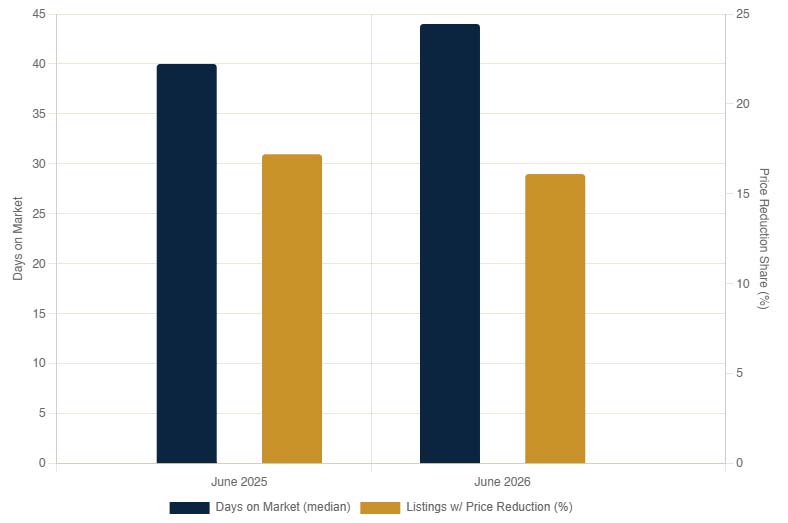
Sources: eXp Realty local market report (June 2025 vs. June 2026 metro data) and St. Louis REALTORS® monthly housing report. Days on market and price-reduction share both ticked up modestly year over year — consistent with a market that's loosening, not collapsing.
Why this shift is actually happening
It's worth pausing on the "why" for a second, because it changes how you should react to it. This isn't a demand collapse. Buyers haven't disappeared from St. Louis — plenty of people are still touring homes, submitting offers, and closing on schedule. What's changed is the supply side. Sellers who sat on the sidelines during the highest-rate years are finally listing, either because they've adjusted to the current rate environment or because life circumstances (a job change, a growing family, a downsize) simply won out over waiting for a better moment. That's a healthier, more sustainable kind of market growth than the panic-driven swings you sometimes see.
New listing activity backs this up. St. Louis REALTORS' own monthly figures show new listings for residential homes up roughly 8% year over year even as pending sales grew at a slower, more modest 3.6% clip. In other words, homes are coming onto the market faster than they're going under contract — which is exactly the mechanism that builds inventory and stretches out days on market. It's not that fewer people want to buy; it's that sellers finally caught up to where demand already was.
That distinction matters for how you plan your search. A demand-driven market cools when buyers get scared off — by rate spikes, job losses, or a broader economic scare — and it usually snaps back sharply once that fear passes. A supply-driven market like this one tends to be stickier and more gradual, which means the current balance of power probably isn't a 60-day window that slams shut in the fall. You likely have real time to be thoughtful. Just don't mistake "time to be thoughtful" for "time to lowball."
Tip 1 — Don't expect massive price cuts
More listings do not mean desperate sellers
The most common mistake buyers make right now is assuming that "inventory is up" translates directly into "sellers will take anything." It doesn't. Only about 16.1% of active listings across the St. Louis metro currently carry a price reduction, according to eXp Realty's June 2026 numbers — and that share is actually slightly lower than it was a year earlier. In plain terms: roughly five out of every six sellers on the market haven't had to touch their asking price at all.
That matters because a lot of buyers walk into a showing assuming they have leverage they don't actually have. If a home has been listed for three weeks with no price cut, that's usually a signal the seller priced it correctly the first time, not that they're getting nervous. Coming in 8-10% under asking on a home like that isn't a negotiating tactic — it's a good way to get your offer ignored while a more realistic buyer closes the deal.
The better move is to build your offer off actual comparable sales, not off what you wish the market looked like. Pull the last three to five closed sales within a half-mile, adjust for square footage, condition, and lot size, and let that number — not your gut — set your opening offer. If a home is genuinely overpriced relative to its comps, the data will show it, and you can negotiate from a position of fact instead of hope. If it's priced in line with the market, respect that and move quickly, because homes selling near 95.5% of list price tell you sellers still have room to hold firm on well-positioned properties.
Where you should expect to find flexibility is in condition, not price. Sellers who know their roof is 18 years old, or their basement has a musty smell, are often far more willing to negotiate on repair credits, closing cost contributions, or a slightly later closing date than they are on the number at the top of the contract. Ask for those concessions directly instead of trying to force a price cut a seller has already decided against.
Tip 2 — Widen your search radius
One or two zip codes over can change your entire budget
St. Louis isn't one housing market — it's several stitched together, and they're not moving at the same pace. St. Louis City, St. Louis County, St. Charles County, Jefferson County, Franklin County, and the Illinois Metro East all have their own supply levels, price points, and buyer competition, and the eXp market report specifically flags this — noting that metro-wide statistics shouldn't be treated as the exact condition of any one submarket.
What that means practically is that the softening happening at the metro level isn't evenly distributed. Some of the closer-in, high-demand pockets — think Kirkwood, Webster Groves, Clayton, Ladue — are still holding their value and moving quickly because inventory in that $250,000-$400,000 sweet spot remains genuinely tight. Meanwhile, areas one or two zip codes further out, or across the river in the Metro East, have more listings sitting longer, which gives buyers real room to negotiate on price, closing costs, or timeline.
If you're locked into a specific neighborhood for school district or commute reasons, that's a legitimate constraint, and no market data changes that. But if your search radius is flexible at all, this is the year to actually use that flexibility. Ask your agent to run inventory and days-on-market numbers for two or three adjacent submarkets before you assume your target neighborhood is your only option. You may find a very similar home, a shorter commute than you expected, or a school district that's just as strong, for tens of thousands of dollars less — simply because the local supply-and-demand math is different a few miles away.
This also applies to housing type, not just geography. Per St. Louis REALTORS' data, townhouse and condo inventory grew at a slower pace than single-family inventory this year, and pending sales in that category actually dipped slightly. That mismatch can work in a buyer's favor if a condo or townhome fits your lifestyle — less competition often means more negotiating room than you'll find in the single-family segment right now.
Tip 3 — Get fully underwritten, not just pre-approved
Make your financing as strong as your offer needs to be
Here's the part of the market that hasn't changed at all: turnkey, move-in-ready homes in good condition are still attracting multiple interested buyers, even with overall inventory up. And when two offers land close together on price, the seller isn't just picking the higher number — they're picking the one least likely to fall apart 30 days before closing.
That's exactly why a standard pre-approval letter isn't the flex it used to be. A basic pre-approval is built on a lender running your numbers through automated underwriting and a quick document check — it tells a seller you're probably qualified, not that you're actually cleared to close. A fully underwritten pre-approval is a different animal entirely. As Sammamish Mortgage's breakdown of the two processes explains, an underwritten pre-approval sends your full financial file — income, assets, credit, debt — through an actual underwriter before you ever make an offer, rather than waiting until after you're under contract.
The practical difference shows up the moment you're in a multiple-offer situation. A buyer with a standard pre-approval is still an unknown quantity to the underwriting process; a buyer who's already cleared underwriting is, for all practical purposes, waiting on an appraisal and a title search. Sellers and their agents can tell the difference immediately, and in a market where inventory is up but good homes still move fast, that certainty is worth more to a seller than an extra few thousand dollars from a shakier buyer.
Getting there takes a little more upfront work — pulling together W-2s, bank statements, and pay stubs before you've even found the house, rather than after. But it's worth doing before you start touring homes seriously, not after you've fallen for one. Ask your lender directly whether they offer a fully underwritten pre-approval product, and if they don't, ask why not. It's become common enough in 2026 that most local and regional lenders can do it — you just have to ask for it by name.
First-time buyers vs. move-up buyers: same data, different plays
Not every buyer should apply these three tips the same way, because "the market" looks different depending on where you're shopping in it. It's worth splitting this out, because the advice that helps a first-time buyer can actually hurt a move-up buyer, and vice versa.
If you're a first-time buyer, you're most likely shopping in that $200,000-to-$275,000 range, which covers a lot of St. Louis City and the more affordable pockets of St. Charles and Jefferson counties. This is where the extra inventory has helped the most — there are genuinely more choices than there were two years ago, and the pace, while still brisk, isn't the frantic same-day-offer environment it once was. Your biggest lever here isn't the price cut you're hoping for; it's the financing edge from Tip 3. Entry-level buyers are usually competing against other entry-level buyers with thinner reserves and less-polished financing, so a fully underwritten pre-approval can separate you from the pack even when everyone's offer price looks similar on paper.
If you're a move-up buyer shopping the $300,000-to-$450,000 range — the classic Kirkwood, Webster Groves, Maplewood, or south-of-Manchester search — you're running into a different dynamic. This band is exactly where turnkey, move-in-ready inventory remains tightest, because it's the sweet spot for young families, relocation buyers, and people trading up from starter homes all at once. Here, Tip 2 does more of the heavy lifting. Widening your radius by even a few miles, or being open to a home that needs cosmetic work instead of one that's fully renovated, opens up meaningfully more inventory than staying rigid on a single ZIP code.
And if you're buying above $500,000, you're in a smaller, slower-moving pool where Tip 1 matters most. Higher-end inventory tends to sit longer regardless of the broader market cycle, simply because the buyer pool is thinner. That's exactly the segment where comp-based offers — not emotional ones — tend to win, because sellers at this price point are often more willing to negotiate on terms if you can show your number is grounded in real, recent sales rather than a guess.
Putting it together: your offer checklist
None of these three tips work in isolation — they're meant to stack. Here's roughly how that plays out in the order you'd actually experience it as a buyer this summer:
A word on timing and patience
One more thing worth saying plainly: a more balanced market doesn't mean every home will sit around waiting for you. The homes getting price reductions and lingering past 60 days tend to share a few traits — they're overpriced relative to comparable sales, they need visible work, or they're in a location with more competing inventory nearby. The homes that are priced right, in good condition, in the $250,000-to-$400,000 range that's still tight across much of the metro, are moving close to full asking price and sometimes faster than that.
So the patience this market affords you should go into your search and your due diligence — touring more homes, actually using your inspection period, taking a weekend to think before you write an offer — not into assuming you can wait out a seller who's already priced correctly. Buyers who understand that distinction are the ones actually benefiting from the extra breathing room this market has created. Buyers who don't tend to lose good homes to someone who moved a little faster and a little smarter.
Quick answers
Is St. Louis actually a buyer's market right now?
Not exactly. Inventory and days on market are both up, which gives buyers more room to be selective and negotiate on terms. But with roughly 3.6 months of supply and sale-to-list ratios still near 95%, it's more accurately described as a balanced market that's tilted slightly less toward sellers than it was a year or two ago — not a market where you can expect steep discounts.
Should I wait for prices to drop further before buying?
The data doesn't really support that bet. Price reductions have stayed roughly flat to slightly lower year over year, and median prices in most St. Louis submarkets are still ticking up modestly rather than falling. Waiting on a broad price drop that isn't showing up in the numbers usually just costs you the equity you'd otherwise start building.
What's the real difference between pre-qualification and a fully underwritten pre-approval?
Pre-qualification is a rough estimate based on numbers you report yourself. A standard pre-approval verifies some of that through automated underwriting. A fully underwritten pre-approval means an actual underwriter has already reviewed and cleared your financial file — the only thing left to approve is the property itself, which is a much stronger position when you're competing against other offers.
Does this "more balanced" market look the same in every part of St. Louis?
No, and this is worth repeating: metro-wide averages blend very different submarkets. St. Louis City, St. Louis County, St. Charles County, Jefferson County, Franklin County, and the Illinois Metro East each have their own supply, pricing, and pace. A neighborhood like Kirkwood or Webster Groves can still behave like a seller's market for well-priced homes even while the metro-wide average shows more breathing room.
Is a fully underwritten pre-approval the same thing as a mortgage commitment?
Not quite, but it's close. It means an underwriter has already reviewed and cleared your income, assets, credit, and debt profile — the remaining steps are almost entirely about the specific property, such as the appraisal and title work. It's a meaningfully stronger position than a standard pre-approval, which is largely based on automated checks rather than a full underwriter review.
Can I ask for an inspection contingency again?
In most cases, yes — and you generally should. With days on market stretching out and fewer homes drawing same-day, contingency-waived offers, buyers have more room to build in a standard inspection period than they did during the peak of the pandemic market. It's still smart to keep the timeline tight and reasonable — five to seven days is typical — since sellers on well-priced homes will still weigh a clean, fast contingency period favorably against one that drags on for weeks.
Bottom line for this market
More inventory is a real advantage — use it to be patient about finding the right home. Just don't confuse "more options" with "leverage on price." Do your comps, widen your radius where it makes sense, and show up with financing that's already done its homework.
Whether you're thinking about listing your home or exploring a cash offer, it's worth understanding all of your options before making a decision. The right choice depends on your timeline, your property's condition, and your goals. Contact House Sold Easy to discuss your situation and see what makes the most sense for you. Our St. Louis experts know every corner of this city and will make buying your dream home or selling your high-end property a breeze. Don’t miss out on the hottest market in the U.S.! Contact House Sold Easy today and let’s make your real estate goals happen!
Ready to Buy or Sell in St. Louis? House Sold Easy Has You Covered!
Whether you're thinking about listing your home or exploring a cash offer, it's worth understanding all of your options before making a decision. The right choice depends on your timeline, your property's condition, and your goals. Contact House Sold Easy to discuss your situation and see what makes the most sense for you.Our St. Louis experts know every corner of this city and will make buying your dream home or selling your high-end property a breeze. Don’t miss out on the hottest market in the U.S.! Contact House Sold Easy today and let’s make your real estate goals happen!