St. Louis Housing Market: 2026 Open House Buyer Guide
Jul 25, 2026
Written by David Dodge
As we close out the third week of July, the local real estate landscape looks remarkably healthier than in recent years. We are seeing a market that is transitioning from a high-stress sprint into a steady marathon. The frantic, fueled-by-panic bidding wars that defined past summer seasons have largely dissolved, replaced by a more deliberate, analytical, and balanced transaction environment.
For the past several years, touring open houses across the Greater St. Louis metropolitan area felt less like shopping for a home and more like entering a gladiatorial arena. You would pull up to a modest brick bungalow in Webster Groves or a ranch in Ballwin, only to find twenty cars double-parked on the street, a line wrapping around the front porch, and listing agents demanding best-and-final offers within twelve hours. Buyers were waiving inspections, closing cost assistance was a pipe dream, and appraisal gaps were being covered with depleted retirement funds.
That routine has officially broken. Entering the final weekend of July 2026, the data confirms what seasoned ground-level observers have felt building over the last ninety days. The market has not crashed, nor has it devalued; rather, it has normalized. We have entered an era where preparation beats panic, where thorough neighborhood evaluation trumps emotional reactivity, and where buyers can finally step across a threshold without feeling the suffocating pressure of instant capitulation.
The Weekend Outlook: Inventory Shifts and What They Mean
Expect open houses to be well-attended but less chaotic. Because new listings jumped 4.3% year-over-year in June, you will likely see fresh inventory hitting the market just in time for weekend tours. This influx of housing stock is not an isolated blip—it represents a structural shift across the Missouri–Illinois bi-state corridor.
According to comprehensive mid-year market data compiled by
To understand why this weekend's tour will feel fundamentally different, we must look at the convergence of three economic forces driving St. Louis real estate in mid-2026:
-
Rate Acceptance Has Replaced Rate Paralysis: For nearly two years, homeowners who secured sub-4% mortgages during the pandemic era remained frozen in place, unwilling to trade their low monthly payments for prevailing borrowing costs. By July 2026, that rate fatigue had transformed into acceptance. With 30-year fixed mortgage rates stabilizing comfortably in the 6.5% to 6.75% range, life events—promotions, retirements, growing families, and downsizing needs—are once again driving housing decisions. Sellers who held off listing in 2024 and 2025 are finally placing their signs in the yard.
-
Days on Market (DOM) Are Expanding: The speed of the market has decelerated from a frantic sprint to a sustainable pace. Verified metrics from
realtor.com -
New Construction Fill-In: Residential builders across St. Charles County, Jefferson County, and outer St. Louis County submarkets like Wentzville, Wildwood, and Eureka have brought substantial new product to completion. This peripheral supply relieves pressure on the inner-ring resale market, creating a healthier distribution of buyer demand across all price tiers.
2026 St. Louis Housing Market Snapshot
The following data visualization illustrates the year-over-year shift in market dynamics between mid-summer 2025 and July 2026 across the Greater St. Louis metropolitan area:
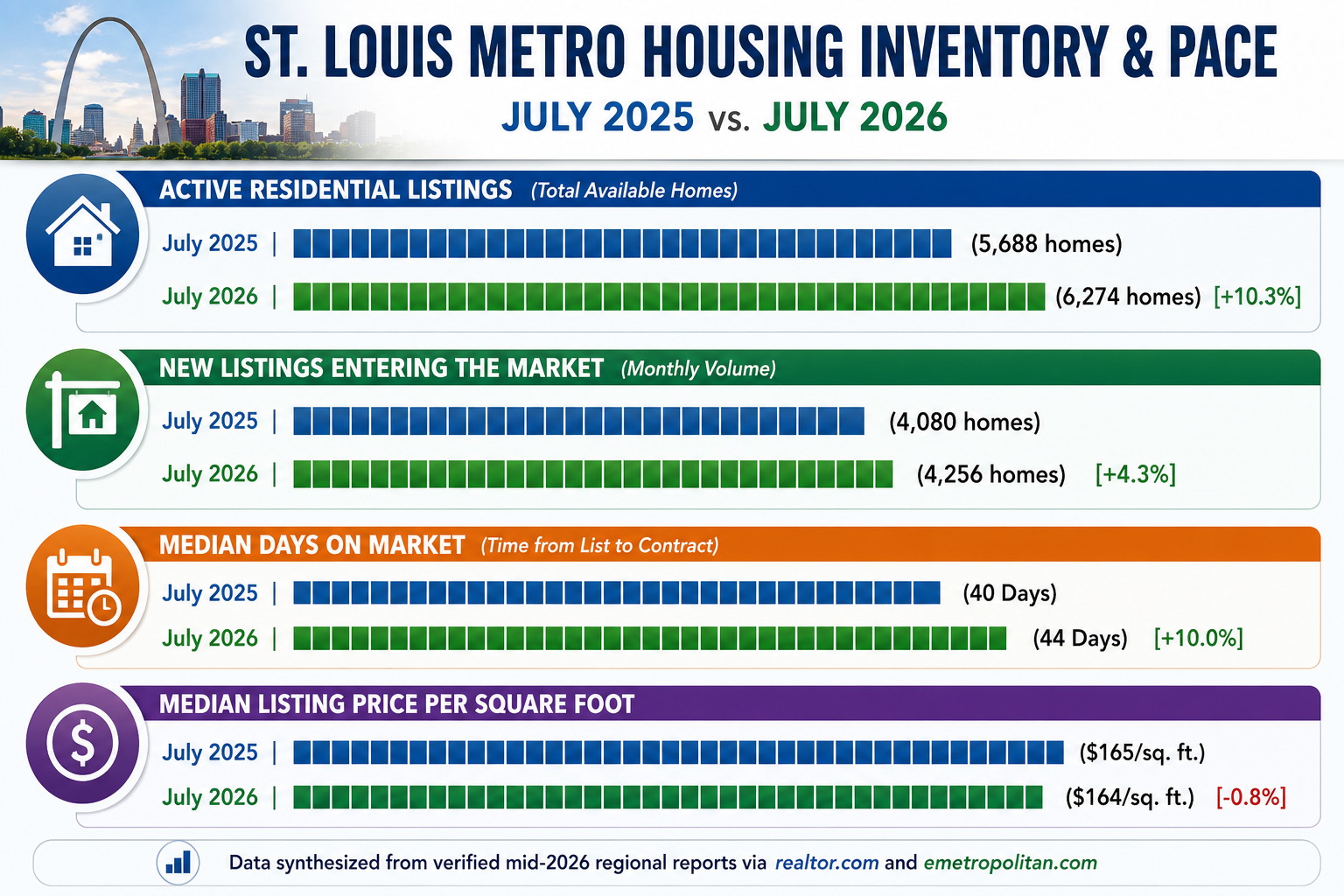
This structural shift provides an immediate tactical advantage for weekend buyers. When inventory expands by more than ten percent while the median price per square foot remains virtually unchanged at $164 per square foot, you are witnessing a market that is expanding horizontally rather than appreciating out of reach. Buyers are gaining options, negotiation leverage, and the most valuable commodity in real estate: time to think.
Submarket Spotlight: Touring the $325,000 Median Sold Price Core
Whether you are scouting out a starter home in the suburbs or checking out properties near the $325,000 median sold price in St. Louis County, take your time. Ask questions, review the neighborhood comps, and enjoy the fact that the St. Louis market has finally given buyers a bit of their power back.
The $325,000 price point represents the absolute heartbeat of the St. Louis County residential market in 2026. While regional listing averages fluctuate depending on how many rural or outlying counties are included in the sample, verified transaction records from
When you step out to tour open houses this weekend within this median core, you will notice a distinct divide in how properties are being received by the market:
| Submarket Corridor | Typical Housing Stock | 2026 Median Price Tier | Open House Vibe & Traffic Expectation |
|---|---|---|---|
|
Central County Core (Kirkwood, Webster Groves, Maplewood) |
Historic brick bungalows, 1940s Tudors, expanded two-story traditional homes. |
$350,000 – $480,000 |
Moderate to High. Highly desirable school districts continue attracting solid weekend traffic, though intense bidding is generally limited to fully updated, move-in-ready homes. |
|
West County Suburban (Ballwin, Chesterfield, Manchester) |
1970s–1980s brick ranches, multi-level traditional homes with two-car garages. |
$320,000 – $425,000 |
Calm and Calculative. Buyers commonly tour three to four homes in one afternoon. Outdated kitchens and original windows are causing many listings to remain on the market beyond 30 days. |
|
North County / Mid-County (Florissant, Hazelwood, Overland) |
Mid-century ranches, solid brick starter homes, slab-on-grade properties. |
$180,000 – $260,000 |
Active First-Time Buyer Market. Strong entry-level demand with consistent open house traffic from buyers using FHA and VA financing. |
|
South County Ring (Oakville, Mehlville, Affton, Sunset Hills) |
Solid brick ranches, split-foyers, homes with finished walk-out basements. |
$280,000 – $360,000 |
Balanced and Steady. Buyers strongly favor homes with finished basements and updated mechanical systems. Multiple-offer situations remain uncommon. |
|
City of St. Louis Core (Tower Grove South, St. Louis Hills, Central West End) |
Historic brick two-story homes, Victorian estates, and modern loft conversions. |
$250,000 – $390,000 |
Highly Neighborhood-Specific. Premium neighborhoods like Botanical Heights and the Central West End continue commanding higher prices, while much of the city remains in the $240k–$260k range. |
Why the Median Price Point is Your Strategic Sweet Spot
Navigating the $325,000 corridor in July 2026 requires a nuanced understanding of seller psychology. During the peak of the post-pandemic market, sellers in areas like Ballwin or Affton could list a property with 1985 oak cabinets, original Formica countertops, and a twenty-year-old roof at the top of the pricing comps, confident that a desperate buyer would overlook deferred maintenance.
Today, that dynamic has inverted. According to recent market analysis from
The 5 Commandment Strategy for 2026 Open House Touring
To maximize your efficiency and leverage during this weekend's open houses, you must abandon the rushed tactics of the past and adopt a systematic, professional approach. When you step through the front door, treat the visit not as a casual walk-through, but as a preliminary physical and financial audit of the asset.
1. Review Neighborhood Comps Before You Turn the Ignition
Do not rely on the listing price as an accurate indicator of a property's true market value. In a transitioning market where inventory has risen by 10.3%, pricing strategies among sellers vary wildly. Some listing agents are correctly pricing homes slightly below the median asking price of $290,000 to stimulate immediate competitive interest, while others are clinging to outdated 2024 valuation models.
Before visiting an open house, pull the sold data for that specific subdivision or half-mile radius over the trailing ninety days using
2. Conduct the "St. Louis Mechanical Audit"
When open houses were packed with thirty competing buyers, spending twenty minutes in a damp basement inspecting plumbing stacks felt impossible. In July 2026, you have the physical space and time to evaluate the structural bones of the house. St. Louis housing stock is famous for its enduring brick construction, but it also carries unique regional maintenance challenges that must be inspected:
-
The Sewer Lateral Line: St. Louis city and county homes built before 1980 frequently utilize cast iron or clay terracotta sewer lateral lines that connect the home's plumbing to the municipal main. Over decades, tree roots crush clay pipes, and cast iron channels rust out from the bottom. Always ask if the seller has conducted a recent video scope of the lateral line. Replacing a collapsed lateral under a concrete driveway can cost between $5,000 and $12,000.
-
Limestone and Rubble Foundation Walls: In historic neighborhoods like Tower Grove, Maplewood, and Kirkwood, pre-1930s homes rest on limestone or limestone-rubble foundations. Walk down to the basement and inspect the mortar joints. Efflorescence (white, powdery chalking on the stone) indicates chronic moisture penetration. Look for tuckpointing needs or bowing walls that require structural tiebacks.
-
HVAC Age and Refrigerant Transition: Check the manufacturing date sticker on the outdoor air conditioning condenser and indoor furnace. With summers in St. Louis routinely pushing heat indices past 100 degrees, an air conditioning unit approaching 15 to 20 years of age is nearing the end of its functional life. In factoring your offer, budget $8,000 to $14,000 for a complete dual-system replacement if the mechanicals are dated.
-
Electrical Service Panels: Many mid-century homes across North County, South County, and older suburban rings were originally equipped with 100-amp electrical service or outdated panels (such as Federal Pacific or Zinsco brands that pose known fire hazards). Inspect the breaker box to ensure the home has been upgraded to a modern 200-amp service capable of supporting today's heavy electronic and electric vehicle charging demands.
3. Read the Agent's Body Language and Ask Scripted Questions
The listing agent hosting the open house is working for the seller, but their candid responses—and what they avoid saying—can provide immense tactical intelligence. Because foot traffic is steadier and less frantic, agents have time to engage in real conversations. Approach the listing agent with these exact phrasing structures:
Strategic Script 1: Assessing Seller Motivation
"We noticed the home has been on the market for [X] days, which is approaching the metro median of 44 days. Has the seller received any written offers so far, and what is their ideal timeline for closing?"
Why this works: It signals that you know the market data and aren't intimidated by the listing. If the agent admits they have had no offers or had a contract fall through due to financing or inspections, you immediately gain negotiation leverage.
Strategic Script 2: Uncovering Pricing Strategy
"Looking at recent neighborhood closed sales on
, we saw that similar floor plans on this street closed around $315,000 last month. What specific upgrades or features factored into pricing this property at $339,000?" realtor.com Why this works: It forces the agent to defend the valuation rationally rather than emotionally. If they stumble or mention subjective factors like "the seller put a lot of love into the garden," you know the price is soft.
Strategic Script 3: Probing Property Disclosure Nuances
"Outside of the standard seller's disclosure statement, are there any structural, drainage, or mechanical items that a buyer's inspector is likely to flag during a standard building inspection?"
Why this works: Listing agents are legally bound to disclose known material defects. Framing the question around what an inspector will find often prompts agents to preemptively reveal minor water seepage, older roof shingles, or aging appliances before you spend money on a formal inspection contract.
4. Observe the Micro-Location and Neighboring Properties
In a competitive market where buyers are scrambling just to get under contract, location flaws are frequently rationalized or ignored. In a calmer market, you must be ruthless about evaluating the micro-location, because when you eventually go to sell the home five or ten years from now, future buyers will hold those same standards against you.
When you pull up to an open house, spend ten minutes walking the exterior perimeter and observing the street. Is the home located on a cut-through street used by rush-hour commuters dodging traffic on Manchester Road or Lindbergh Boulevard? Does the backyard back up directly to a commercial strip center, high-voltage power lines, or a bustling school drop-off zone? In St. Louis County, check the elevation of the lot relative to neighboring yards; properties sitting at the bottom of a downward slope often receive heavy surface water runoff during Midwest summer thunderstorms, requiring expensive French drain installations or sump pump systems to keep basements dry.
5. Structure Your Offer with Normalcy Restored
The most liberating aspect of the July 2026 St. Louis real estate market is the restoration of standard contractual protections. You no longer need to strip your purchase contract naked to get a seller's attention.
When you find a home that meets your criteria this weekend, work with your buyer's agent to draft an offer that includes:
-
Standard 10-to-14 Day Building and Environmental Inspection Contingencies: Never waive your right to inspect. You need sufficient time to bring in a licensed home inspector, a specialized sewer lateral inspector, and a radon gas testing professional.
-
Full Appraisal Contingencies: If the home fails to appraise for the contract purchase price, you should retain the contractual right to renegotiate the price down to the appraised value or walk away with your earnest money deposit intact. Do not agree to blind appraisal gap coverage unless you are competing for an exceptional, under-priced luxury property in a hyper-demand pocket like Clayton or Ladue.
-
Seller Concessions and Rate Buydown Requests: With median list prices metro-wide sitting at $290,000 and properties spending over six weeks on the market, asking the seller for closing cost credits is back on the table. If mortgage interest rates are stretching your monthly debt-to-income ratio, request a 2-1 or 1-0 temporary interest rate buydown funded by the seller at closing. This concession lowers your effective interest rate by one or two percentage points during the first two years of homeownership without requiring the seller to drastically slash their headline listing price.
Seller Psychology in Mid-2026: Why You Have Power Back
To fully leverage the current market environment, buyers must understand the psychological shift currently occurring among St. Louis property sellers. For the past four years, sellers have operated from a position of absolute authority. They were accustomed to listing their homes on a Thursday, hosting a single two-hour open house on Sunday, and reviewing a dozen competing offers on Monday afternoon—many offering tens of thousands of dollars over list price with all contingencies waived.
In July 2026, that playbook is failing spectacularly for overpriced listings.
When a seller places a home on the market today at an aggressive, aspirational price point, the market responds with silence. The first weekend comes and goes with moderate open house foot traffic but no written contracts. By day 14, the seller checks their online syndication views on portals like
This psychological curve is your greatest asset as a buyer. When you tour open houses this weekend, actively seek out properties that are crossing that 30-to-45 day threshold. A seller who has been on the market for six weeks is no longer looking for a bidding war; they are looking for a qualified, reliable buyer who can close without drama. When you submit a clean, professional offer backed by solid pre-approval documentation—even if it is $10,000 or $15,000 below their original asking price—you will find a receptive audience willing to negotiate.
Your Step-by-Step Weekend Open House Itinerary & Route Planner
Navigating a weekend of open houses across the sprawling, fragmented municipalities of Greater St. Louis requires logistical discipline. St. Louis is famously divided into distinct geographical corridors separated by major interstate arteries: I-64/Highway 40 cutting east-west through the central corridor, I-44 angled southwest through the county, and I-270 looping around the outer suburban ring.
To prevent touring fatigue and ensure you have adequate time to inspect each property thoroughly, structure your Saturday and Sunday schedule using this optimized tactical itinerary:
Phase 1: Thursday & Friday Preparation (The Desktop Audit)
-
Step 1: Build a Target List of 5 to 7 Properties Max per Day. Do not attempt to tour twelve homes in a single afternoon. Once you cross seven properties, floor plans blur together, and your ability to spot structural or mechanical defects diminishes rapidly. Use
realtor.com -
Step 2: Map Your Driving Route by Interstate Corridor. Group your showings geographically. Dedicate Saturday afternoon to the West County / Highway 40 corridor (Chesterfield, Town & Country, Ballwin, Manchester) and Sunday afternoon to the Central/South County corridor (Kirkwood, Webster Groves, Crestwood, Sunset Hills, Oakville). This eliminates spending half your afternoon sitting in weekend traffic on I-270.
-
Step 3: Download Property Disclosures Advance. Have your agent pull the Seller's Disclosure Statement and Lead-Based Paint Disclosure from the MLS for your top three target properties before you leave the house. Reviewing these documents in advance allows you to walk into the open house knowing exactly which repairs the seller has already admitted to (e.g., "roof leak repaired in 2023" or "water seepage in basement during heavy rains").
Phase 2: Saturday & Sunday Ground Execution (The 30-Minute Tour Protocol)
When you arrive at an open house, execute a disciplined 30-minute evaluation protocol:
-
Minutes 0 to 5: Exterior & Drainage Perimeter. Walk around the entire outside of the home before stepping inside. Check the slope of the yard, the condition of the gutters and downspout extensions, the age of the architectural roof shingles, and the exterior brick pointing or vinyl siding condition.
-
Minutes 5 to 15: The Basement & Mechanical Core. Walk straight past the staged living room and head directly to the basement. Check the foundation walls for bowing or moisture, inspect the electrical panel, document the serial numbers and age of the furnace and water heater, and look for floor drain backups or water stains along the baseboards.
-
Minutes 15 to 25: Living Spaces & Functional Flow. Walk the main floor and bedrooms. Open kitchen cabinets, check water pressure in the primary bathroom, test window latches to see if they are original wood or updated double-pane thermal vinyl, and evaluate storage and closet space.
-
Minutes 25 to 30: Agent Engagement & Wrap-Up. Approach the listing agent, execute your scripted strategic questions regarding days on market, seller motivation, and pricing methodology, and collect a physical property flyer. As you return to your car, immediately record a 60-second voice memo on your phone noting your initial impressions, red flags, and how the home compares to the neighborhood median sold data you pulled from
redfin.com
Frequently Asked Questions (FAQ) for 2026 St. Louis Homebuyers
To further support your weekend navigation, our editorial team has compiled answers to the most critical logistical and financial questions currently facing homebuyers across the Greater St. Louis real estate market:
Why are median list prices dropping while median sold prices are rising?
This apparent statistical contradiction is caused by a housing inventory mix shift across the bi-state area. As reported in recent mid-2026 market assessments, the median listing price across the broader metro area slipped to $290,000 (a 3.3% YoY decline), while the median sold price for closed residential homes reported by regional REALTOR® associations rose to $350,000 (a 4.5% YoY increase).
This occurs because a larger volume of mid-priced, smaller, or older entry-level homes and condos are currently hitting the market compared to the luxury segment. This influx of affordable inventory pulls the overall median listing price downward without indicating broad property devaluation. Simultaneously, move-in-ready single-family homes in premier suburban districts like Kirkwood, Webster Groves, and Chesterfield continue to command premium closed prices, pushing the finalized sold median upward.
Is it smarter to buy now in July 2026 or wait for mortgage rates to drop further?
Waiting for mortgage interest rates to return to the historic 3% or 4% levels of the pandemic era is a flawed strategy. Economic consensus and market data from
When you purchase a home in the current July 2026 market, you are buying in an environment with 10.3% more inventory, expanded 44-day market timelines, and reduced competition. If you wait on the sidelines for interest rates to drop by a full percentage point, millions of sidelined buyers nationwide will flood back into the market simultaneously, triggering a return to aggressive bidding wars, waived inspections, and rapid price escalation. It is far safer to secure a property today at a fair, negotiated price with full inspection protections, knowing you can refinance the mortgage instrument later if macroeconomic rates decline.
How much earnest money should I offer on a $325,000 home in St. Louis County?
In the current balanced market, standard earnest money deposits in St. Louis County range from 1% to 2% of the purchase price. For a home priced at the $325,000 median, an earnest money check of $3,000 to $5,000 submitted alongside a clean contract and verifiable lender pre-approval letter is entirely sufficient to demonstrate strong buyer intent. You no longer need to offer extravagant, non-refundable $15,000 or $20,000 earnest money deposits to get a seller to take your contract seriously.
What is the difference between the City of St. Louis market and St. Louis County?
The St. Louis real estate market is unique due to the historic 1876 political separation between the City of St. Louis and St. Louis County, creating two independent municipal governments and real estate markets. As tracked by
Conversely, the City of St. Louis offers a denser, urban brick architectural fabric where overall median sold prices sit lower, around $255,000 to $265,000, up a modest 1.9% year-over-year. However, the city market is highly hyper-localized; historic, highly walkable city neighborhoods like the Central West End ($352k median) and Botanical Heights ($389k median) command price-per-square-foot metrics that rival or exceed premier suburban county districts.
Conclusion: Step Into Your Buyer Power This Weekend
As you map out your open house route for Friday, Saturday, and Sunday, carry this fundamental truth with you: the St. Louis housing market has finally returned to a state of equilibrium.
The transition from a high-stress, frantic sprint into a steady, predictable marathon is the best news homebuyers across Missouri and Illinois have received in over four years. With residential inventory up 10.3% to 6,274 active listings, new properties flowing into the market at a 4.3% higher clip, and marketing times stretching to a comfortable 44-day median, you no longer have to make the largest financial decision of your life in a state of panic.
Whether you are exploring a charming brick starter home in Tower Grove, evaluating a mid-century ranch in South County, or placing an offer on a move-in-ready traditional home near the $325,000 median sold price in St. Louis County, you now have the authority to act like a prudent investor. Take your time walking through the basements. Review the dollar-per-square-foot neighborhood comps. Ask listing agents tough, analytical questions about days on market and mechanical ages. And above all, insist on standard contractual protections, professional building inspections, and fair pricing.
The pavement is waiting. Hit the open houses this weekend with confidence, knowing that the St. Louis real estate landscape is finally working in your favor.
Ready to Buy or Sell in St. Louis? House Sold Easy Has You Covered!
Whether you're thinking about listing your home or exploring a cash offer, it's worth understanding all of your options before making a decision. The right choice depends on your timeline, your property's condition, and your goals. Contact House Sold Easy to discuss your situation and see what makes the most sense for you.Our St. Louis experts know every corner of this city and will make buying your dream home or selling your high-end property a breeze. Don’t miss out on the hottest market in the U.S.! Contact House Sold Easy today and let’s make your real estate goals happen!