Mortgage Rate Buydowns in St. Louis for Smart Buyers
Apr 07, 2026
Written by David Dodge
How to lower your monthly payment, who picks up the tab, and why St. Louis buyers are using this strategy right now — without the jargon.
The St. Louis Market Right Now
If you've been on the fence about buying in St. Louis, 2026 offers some of the best conditions this market has seen in years — but rates are still the sticking point for many buyers. That's exactly where mortgage rate buydowns come in.
As of April 2026, the 30-year fixed mortgage rate in Missouri sits at roughly 6.49%, with some lenders quoting closer to 6.25–6.75% depending on your credit profile and loan type. That's meaningfully better than the 7%+ peaks of 2023, but it's still high enough that first-time buyers feel the pinch every month when they run the numbers.
Median Home Price,
St. Louis City (Feb 2026)
Avg 30-Year Fixed Rate,
Missouri (Apr 2026)
Avg Days on Market,
St. Louis
Below National Median
Home Price
Here's the good news on the ground: new construction in St. Charles County is actively offering mortgage rate buydowns and seller concessions — a clear signal that builders understand what's holding buyers back. Homes are sitting on the market an average of 47 days, giving buyers real negotiating room that simply didn't exist two or three years ago.
The St. Louis metro's median sold price in St. Louis County hit $250,001 in February 2026 — up a steady 3.79% from the prior year. That's sustainable growth, not a bubble, and it means the home you buy today is likely to be worth more in a few years. Meanwhile, St. Louis City's median sits around $224,000, which is 48% below the national average. Compare that to Nashville at $430,000 or Denver at $530,000, and you start to understand why more buyers are taking a hard look at the Gateway City.
The St. Charles County corridor — think O'Fallon, Wentzville, and St. Peters — is where you'll find the most aggressive buydown incentives from builders right now. But even on the resale side, sellers in slower-moving neighborhoods are willing to discuss concessions. Understanding how to use a rate buydown is one of the most practical tools you can bring to a negotiation in this market.
What Is a Mortgage Rate Buydown?
At its simplest, a mortgage rate buydown is a way to pay money up front to reduce your interest rate — and therefore your monthly payment — for some period of time. Think of it as prepaying some of your interest before your loan even starts.
There are two flavors: temporary buydowns and permanent buydowns. They work very differently, and choosing between them is one of the first decisions you'll make once you understand the concept.
A buydown is a way for a home buyer to lower their mortgage interest rate for the first few years of their mortgage in exchange for an upfront fee. The key phrase there is "upfront fee" — someone has to pay for this, whether it's the buyer, the seller, or the builder. We'll cover who foots the bill in a later section. For now, just know that this cost is real, and it's essentially the difference between what you'll pay each month at the reduced rate versus what the lender would receive at the full rate.
"A buydown is a trade-off: cash paid upfront to secure a lower rate and reduce your monthly mortgage payment."- David Dodge
The practical appeal in today's St. Louis market is obvious. If you're stretching to qualify on a 6.5% rate or simply want to keep your first couple of years of homeownership manageable — especially while you're absorbing moving costs, furnishing a place, and potentially doing repairs on older housing stock — a temporarily lower payment can be a genuine lifeline. St. Louis has a lot of pre-1960 homes. Budget cushion matters.
One important note: temporary buydowns don't change the total amount you borrow for your loan, and they do not permanently adjust your interest rate. Your lender isn't giving you a discount — they're receiving a lump sum upfront that fills the gap between your reduced payments and the full payment during the buydown period. The math always adds up to the same place for the lender. For you, the benefit is cash flow management.
Permanent buydowns, by contrast, involve buying "discount points" at closing to reduce your rate for the entire life of the loan. One point typically costs 1% of your loan amount and lowers your rate by about 0.25%. For a $250,000 loan, one point costs $2,500. If you plan to stay in your St. Louis home for 10+ years and you can make that upfront investment, permanent points can save you a significant amount over the long haul. The break-even calculation — how many months until your savings exceed the upfront cost — is essential before committing to points.
Types of Buydowns: 2-1, 3-2-1, and Permanent Points
There are three structures you'll encounter most often in the St. Louis market. Here's how each one works in plain terms.
The 2-1 Buydown
This is the most common temporary buydown structure right now, and it's the one you'll hear about most from local lenders and builders. A 2-1 buydown is designed to make the borrower's first two years of homeownership somewhat less costly by temporarily reducing their interest rate. Here's the pattern:
- Year 1: Your interest rate is 2 percentage points below your note rate.
- Year 2: Your rate is 1 percentage point below your note rate.
- Year 3 and beyond: Your rate returns to the full contracted rate and stays there.
So if your mortgage is locked in at 6.5%, you'd pay 4.5% in year one, 5.5% in year two, and 6.5% from year three forward. That difference in the early years can translate to several hundred dollars per month — real money when you're just getting settled into a new home.
As a local St. Louis real estate resource explains it, if your mortgage rate is supposed to be 6%, with a 2-1 buydown, it'll be 4% the first year and 5% in the second. Your average cost for the first three years of ownership will be drastically lower since you saved money in years one and two.
The 3-2-1 Buydown
A 3-2-1 buydown reduces interest by 3 percentage points the first year, 2 percentage points the second, and 1 percentage point the third. It's a more aggressive structure and costs more to fund — but it delivers greater initial savings. This type is less common on resale homes, but does appear in new construction deals where builders are willing to sweeten the pot significantly to move inventory.
The potential downside is psychological: after three years of lower rates, the jump to your full contracted rate can feel steep. You should only use a mortgage buydown if you feel confident you can afford the mortgage payment with the full interest rate. That's the cardinal rule. Never count on refinancing to bail you out — plan as if you'll be paying the full rate forever.
The 1-0 Buydown
Simpler and cheaper: your rate drops by 1% for just the first year, then snaps back to the full rate in year two. This is the lightest lift in terms of upfront cost and can make sense when a seller wants to offer an incentive without a huge concession. For buyers in St. Louis who expect a raise or a career change in the next 12 months, this structure can bridge a gap neatly.
Permanent Discount Points
Unlike temporary buydowns — which are often funded by sellers or builders — discount points are typically paid by the buyer at closing and reduce your rate permanently. One mortgage point typically equals 1% of your loan amount and permanently lowers your interest rate by about 0.25%. On a $250,000 St. Louis home with a $200,000 loan, one point costs $2,000 and shaves your rate by a quarter of a percent for the entire 30 years.
The break-even math matters here. If buying one point saves you $30 a month and costs $2,000, you need to stay in the home for about 67 months — roughly five and a half years — before you come out ahead. St. Louis's strong equity growth history makes it a reasonable bet for buyers who plan to put down roots.
Real Numbers for a St. Louis Home
Let's make this concrete with a scenario built around St. Louis's actual median prices. Assume you're purchasing a home at the St. Louis County median of $250,000, putting 10% down, and financing $225,000 over 30 years at a locked rate of 6.5%.
Your base monthly principal and interest payment at 6.5% would be approximately $1,422/month.
Now, here's how a 2-1 buydown changes that:
Over two years, that's roughly $3,384 in year one savings and $1,740 in year two savings — a total of about $5,124 in reduced payments during the buydown period. That $5,124 is essentially the cost of the buydown that someone has to put into escrow upfront.
A 1-point rate buydown on a $300K loan saves roughly $180/month for the first two years — and that's real money, especially when you're absorbing the costs of a move and settling into a new neighborhood.
These figures don't include property taxes and homeowners' insurance, which will vary significantly across St. Louis City, St. Louis County, and St. Charles County. St. Louis County carries the state's highest property tax rate at 1.24% assessed value, which can add several hundred dollars per month to your total housing cost. Always factor that in before deciding whether a buydown is the right move.
The 5-year break-even calculation also matters for permanent points. If you took out a $300,000 mortgage with a 7% interest rate and bought four points, your interest would drop to 6%, but it would cost you $12,000 — and while you'd save $1,000 a year in interest payments, you'd have to stay in your house for more than 12 years to reach your break-even point. Buydowns make the most sense when they're funded by someone else, or when your time horizon is long enough to justify the investment.
Who Pays for the Buydown?
This is the question that changes everything. The same buydown that's a questionable financial move when you're paying out of pocket becomes a genuinely excellent deal when a seller or builder puts up the money. Let's walk through each scenario.
Seller-Funded Buydowns
In today's St. Louis market, with homes sitting 47+ days and sellers facing increasing pressure, there is real room to negotiate. Seller concessions in Missouri can include providing a mortgage rate buydown to temporarily lower the buyer's interest rate. Rather than asking a seller to cut $5,000 off the price — which could complicate the appraisal — you can ask them to contribute $5,000 toward a buydown account instead. Same dollar amount out of their pocket, but you get a tangible monthly payment benefit for two years rather than a one-time price reduction that may not change your payment dramatically.
Conventional loans cap seller concessions based on your down payment: up to 3% of the purchase price if you put less than 10% down, up to 6% with 10–24% down, and up to 9% if you're putting 25% or more down. FHA loans allow up to 6% in seller concessions. These limits are important to understand before you make an offer, because your lender has to approve how the funds are structured. If a seller is offering a concession, you don't have to use the money for closing costs — a rate buydown is a smart alternative, and one that many St. Louis buyers overlook entirely.
Builder-Funded Buydowns
Builders may offer to pay points to buy down buyers' mortgages, typically to entice early buyers to purchase properties in newly built communities. This is exactly what's happening right now in St. Charles County. Builders in O'Fallon, Wentzville, and St. Peters are actively marketing 2-1 buydowns as incentives to move inventory. If you're shopping for new construction, asking about buydown offers should be among your first questions — not an afterthought.
Builder-funded buydowns are often the cleanest version of this deal. The builder deposits the buydown funds into an escrow account at closing, the mortgage servicer draws from it monthly to cover the gap between your reduced payment and the full payment, and you enjoy lower payments for two years. No negotiating required — it's already baked into the offer.
Lender-Funded Buydowns
Some lenders offer their own buydown programs, either as promotional offers or as part of specialized loan products. These are less common but worth asking about. The lender's version is sometimes structured as a temporary rate reduction in exchange for a slightly higher permanent rate — read the fine print carefully. The economics need to work in your favor, not just sound good in a sales pitch.
Buyer-Funded Buydowns
You can also pay for a buydown yourself, which makes sense in certain specific situations: if you're certain rates will fall and you plan to refinance within 24 months, or if you have surplus cash at closing and a lower monthly payment is worth more to you than keeping that cash liquid. But in general, self-funded buydowns require careful math. Temporary buydowns can help some borrowers temporarily reduce their effective monthly payments, but every borrower's situation is different. Run the numbers with your lender before committing.
St. Louis has a strong veteran population, and VA loans are widely used. Keep in mind that temporary rate buydown costs are treated as seller concessions and count toward the VA’s 4% concession limit. Permanent discount points, however, are considered standard closing costs and do not count toward that cap—meaning they can often be seller-funded without affecting the 4% ceiling. It’s important to work with a lender experienced in VA loans to structure this correctly.
How This Works Specifically in St. Louis
St. Louis is not a generic market, and the buydown conversation doesn't happen in a vacuum. Here are the factors that make this strategy particularly relevant — and particularly nuanced — in the Gateway City.
St. Charles County: The New Construction Hotspot
Builders are offering mortgage rate buydowns and concessions, particularly in St. Charles County, and this is not accidental. The county is the fastest-growing in the St. Louis metro, with O'Fallon and Wentzville among the top destinations for families priced out of Chesterfield or Kirkwood. Builders know that at 6.5% rates, monthly payments on new construction — which often runs $350,000–$500,000 — require buyers to stretch. Buydowns are their answer to that affordability gap. If you're shopping in St. Charles County, ask every builder upfront what their current incentive package looks like.
St. Louis City vs. County: Tax Realities
One factor that affects how much a buydown actually helps you: property taxes. St. Louis City actually has a lower property tax rate than the county, but residents pay a 1% local earnings tax on income earned or earned within the city limits. St. Louis County's property tax rate is the highest in Missouri at 1.24% assessed value. Your school district also matters — rates vary significantly between Ladue, Lindbergh, and other districts. Before finalizing your offer and any associated buydown strategy, get a clear picture of your total monthly PITI (principal, interest, taxes, and insurance), not just the rate-adjusted payment.
MHDC Programs: A Separate Tool Worth Combining
Missouri's Housing Development Commission (MHDC) offers programs that work alongside — not instead of — rate buydowns. The MHDC First Place Loan Program provides cash assistance to help first-time homebuyers get a mortgage, and the Mortgage Credit Certificate program provides income-eligible first-time homebuyers with an opportunity to lower their federal income tax owed annually.
MHDC's programs can provide up to 4% of the purchase price in down payment assistance — on a $250,000 home, that's $10,000. That's money that could go toward your down payment, your closing costs, or even fund part of a buydown. Many St. Louis buyers don't realize these two tools can work in combination. The caveat: national lenders like Rocket Mortgage can't administer MHDC loans. You need a certified MHDC lender, and that means working locally. St. Louis residents often qualify for the MHDC program, which can provide down payment assistance that national lenders may not proactively mention.
Older Housing Stock and Cash Flow
A significant portion of desirable St. Louis neighborhoods — The Hill, Tower Grove, Benton Park, Webster Groves, University City — feature homes built before 1960. These are beautiful, character-filled properties, and they come with maintenance realities. A water heater that needs replacing, a roof with five years left on it, and a furnace that's been running since 1998. Having lower payments in year one and year two, thanks to a buydown, can mean the difference between managing those early repairs comfortably and stretching dangerously thin. For buyers of older St. Louis homes, the breathing room a temporary buydown provides isn't just financial — it's practical.
The Refinancing Horizon
Many buyers in 2025–2026 are approaching homeownership with a "buy now, refinance later" mindset — and that's not unreasonable. Analysts project that 30-year fixed rates could continue to ease modestly through 2026 and beyond. A 2-1 buydown gives you two years of reduced payments while you wait for rates to potentially drop to a point where refinancing makes financial sense. If rates fall to the 5.5% range before your buydown expires, refinancing at that point could lock in permanent savings for the rest of your loan term — making the buydown a bridge, not a long-term crutch.
Pros, Cons, and When It Makes Sense
No financial tool is universally right for everyone. Here's a clear-eyed look at both sides.
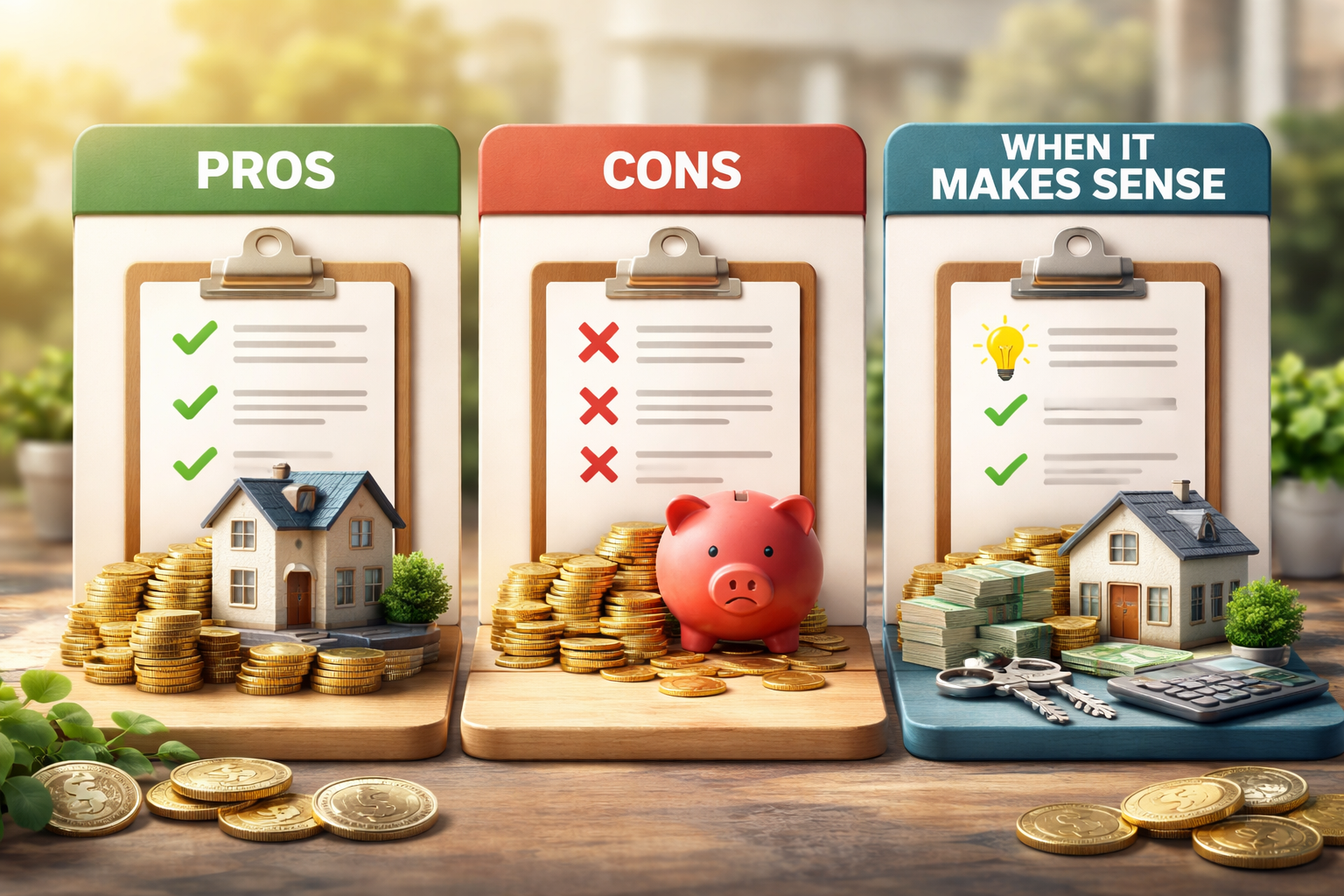
The Case For a Rate Buydown in St. Louis
Monthly breathing room. The first two years of homeownership are typically the most expensive: moving costs, small repairs and upgrades, furniture, and landscaping. A reduced payment during this period lets you handle those expenses without going into credit card debt.
Seller-funded = free money (almost). When a seller or builder funds the buydown, you're getting a real dollar benefit at no direct cost to you. In a market where sellers have been negotiating, this is a legitimate ask.
Broader home search. A 2-1 buydown may broaden your home search — if you're pre-approved up to $450,000 but more comfortable with payments closer to a $400,000 price point, knowing your first two years will have reduced payments could let you reach for a home you'd otherwise pass on.
Works well with expected income growth. If you're a nurse at BJC HealthCare expecting a raise, a consultant about to get promoted, or a dual-income household where one spouse is re-entering the workforce, the buydown structure matches your expected financial trajectory perfectly.
The Case Against (or Cautions)
You still qualify at the full rate. This surprises a lot of buyers: you must qualify for the mortgage based on the full contracted rate, not the buydown rate. To qualify, mortgage borrowers must meet the eligibility criteria for the loan based on the full mortgage rate before the buydown. If you're already at the edge of what you qualify for, a buydown doesn't change that reality.
Payment shock risk. If the buyer's income doesn't change, they may get used to the lower payments and struggle when rates normalize in a few years. Plan your budget around the full payment from day one. The reduced payment should feel like a bonus, not a lifeline you depend on.
Not all loan types allow them. Government-backed loans have specific guidelines. FHA allows temporary buydowns but only on purchase transactions. VA buyers need to factor the 4% concession limit. USDA loans have their own rules. Confirm availability with your lender before building a negotiating strategy around it.
Buyer-funded buydowns require careful math. If you're paying for the buydown yourself, make sure the savings over two years actually exceed the upfront cost. In many cases, that math works out close to break-even — meaning you'd be better off using that cash toward a larger down payment instead.
How to Qualify and Get Started
If a rate buydown sounds like something that might work for your situation, here's the practical path forward in the St. Louis market specifically.
Step 1: Get Pre-Approved with a Local Lender
This is not the moment for an online rate aggregator. National lenders don't understand the specific nuances of the Missouri Housing Development Commission (MHDC) programs, and they may not offer buydown structures that local lenders do. Work with a lender who knows the St. Louis market — someone who understands the difference between city earnings tax and county property tax, who can walk you through MHDC eligibility, and who has experience structuring buydown deals as part of a purchase contract.
Your pre-approval must be based on the full contracted rate, not the buydown rate. Get that number clear before you start making offers.
Step 2: Know Your Loan Type and Its Rules
Conventional, FHA, VA, and USDA loans all handle buydowns differently. The table below summarizes the key differences:
Step 3: Negotiate Strategically
When making an offer on a home where the seller has had it listed for 40+ days, consider asking for a seller-funded buydown rather than a straight price reduction. Frame it as a benefit to both sides: the seller gets to maintain their asking price (which matters for the appraisal and their net proceeds), and you get tangible monthly savings for two years. Many sellers who balk at dropping their price by $5,000 will agree to a $5,000 seller credit toward a buydown because it feels different psychologically, even though the dollar amount out of pocket is identical.
For new construction in St. Charles County, ask the builder's sales rep directly: "What buydown incentive are you offering right now?" Don't assume they'll volunteer it. Some builders are offering 2-1 buydowns as standard incentives, but they won't always lead with that information.
Step 4: Check MHDC Eligibility
Before you finalize any financing plan, spend 15 minutes with an MHDC-certified lender to check whether you qualify for Missouri's First Place or Next Step programs. These can provide up to 4% of the purchase price in down payment assistance — funds that could reduce how much cash you need at closing and potentially free up reserves you'd use for a self-funded buydown. Income limits are broader than most people expect, and the programs fill up during competitive spring markets. Don't wait.
Step 5: Run the Full Monthly Number
Before signing anything, make sure you know your full PITI — principal, interest (at the buydown rate AND the full rate), property taxes specific to your zip code and school district, homeowners insurance, and any HOA fees. Many St. Louis metro communities do have HOAs, particularly newer construction in St. Charles County. Budget as if the buydown doesn't exist for year three and beyond. If that number works, the buydown is a gift. If that number doesn't work, no buydown can fix the underlying problem.
The Bottom Line for St. Louis Buyers
If you've made it this far, here's the concise version of everything above:
- St. Louis is one of the most affordable major metros in the country, with median prices 48% below the national average — and rate buydowns make an already-affordable market even more accessible.
- A 2-1 buydown on a median St. Louis County home ($250,000) can save you $280–300/month in your first year and $140–150/month in your second year — real money during the most expensive phase of homeownership.
- The best buydown is a seller-funded or builder-funded one. In 2026, homes are sitting on the market 47+ days in many neighborhoods, and new construction in St. Charles County is actively advertising buydown incentives. This is a buyer's ask worth making.
- You must qualify at the full rate — the buydown improves your monthly cash flow, but doesn't change what the lender approves you for. Always budget around the full payment.
- Combine a buydown conversation with MHDC program eligibility. Missouri's First Place and Next Step programs offer up to 4% in assistance. Local lenders, not national platforms, can access these.
- For older St. Louis housing stock — and there's plenty of it in desirable neighborhoods — a reduced payment in year one and two isn't just nice to have. It's a practical cushion against the repair and maintenance reality of pre-1960 homes.
- If rates fall toward 5.5% during your buydown period, refinancing at that point could lock in permanent savings — making the 2-1 buydown a bridge strategy with potential long-term payoff.
Rate buydowns aren't a magic trick. They're a financing tool — and like every tool, they work best when used intentionally, at the right moment, for the right reasons. In St. Louis's 2026 market, that moment is right now for a lot of buyers. Know your numbers, work with a local lender, and don't leave negotiating leverage on the table.
Ready to Buy or Sell in St. Louis? House Sold Easy Has You Covered!
Navigating St. Louis’ red-hot luxury market doesn’t have to be a headache. With House Sold Easy, it’s all about less hassle—we’ve got you covered from start to finish. Our St. Louis experts know every corner of this city and will make buying your dream home or selling your high-end property a breeze. Don’t miss out on the hottest market in the U.S.! Contact House Sold Easy today and let’s make your real estate goals happen!