The Housing Market Lie: Good Homes Are Gone in 48 Hours
May 15, 2026
Written by David Dodge
Inventory is technically "up." Move-in-ready homes are still gone in 48 hours. Here's what's actually happening — and what you can do about it.
Key Numbers
28 of 1,000
Homes changed hands in 2025 — the lowest U.S. turnover in decades.
3.7 months
Existing supply in January 2026. A balanced market needs 4.5 to 6 months.
$396,800
Median existing home price in January 2026 — a new record for that month.
You get the Zillow alert at 7:42 in the morning. A three-bed, two-bath ranch in Crestwood. Updated kitchen. Newer roof. Priced about $15,000 below what you expected. You forward it to your agent before your coffee finishes brewing. She says she can get you in after work — 6:30, maybe 6:45. You spend the day mentally rearranging your furniture into those rooms.
By the time you pull up to the address, there's a box of "SOLD" stickers sitting on the counter inside and three "Coming Soon" signs on the block. Your agent calls the listing agent. An offer came in that morning — over asking, no inspection contingency, 21-day close. The house is gone. The house you were mentally living in is gone. And you haven't even crossed the threshold.
If this has happened to you once, you chalked it up to bad timing. If it's happened three times, you're starting to wonder if the market is broken. If it's happened five times, you're quietly searching "is it stupid to just keep renting forever?"
Here's the thing: you're not imagining it, and the market is not fixed. What's happening right now is more complicated and more frustrating than the headlines let on — and understanding it might be the thing that finally helps you get off the sideline.
The Scene That Keeps Repeating
1
Monday: You set up Zillow and Redfin alerts. You feel optimistic. You've been pre-approved. You're ready.
2
Wednesday: Alert fires. A good one — move-in ready, your price range. You text your agent. She's showing another client but can get you in Thursday evening.
3
Thursday morning: Your agent calls. Offer accepted Tuesday night. It never even made it to your showing.
4
Friday: You go look at the one that's been sitting for 90 days. You understand immediately why.
The Two-Tier Market Nobody Talks About
Open any real estate news aggregator, and you'll see some version of the same headline: inventory is rising. Active listings are up year-over-year. The market is "rebalancing." And they're not lying — technically. By November 2025, total active listings climbed to approximately 1.3 million, a significant increase from the historical lows seen during peak pandemic tightness.
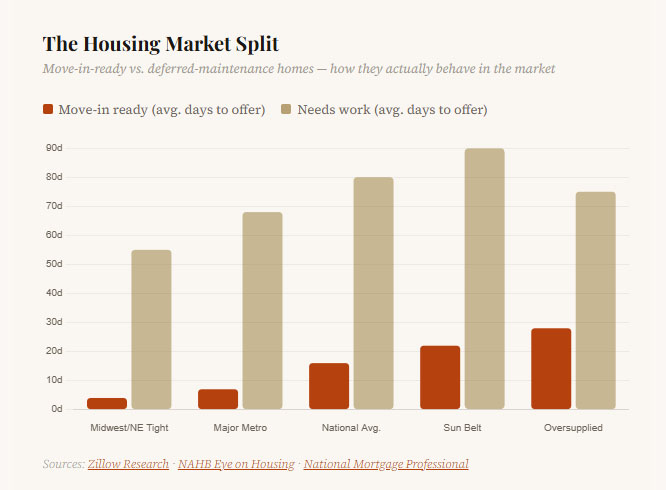
But what those headlines don't tell you is that not all inventory is created equal. There is a two-tier market hiding inside those numbers, and if you're a buyer looking for something move-in ready in a decent school district at a reasonable price, you are shopping exclusively in Tier One — the sliver of listings that actually meet basic human standards for habitability and value.
Tier Two — the stuff inflating those inventory numbers — is everything else. The house with the foundation crack, the seller disclosed on page 11 of the disclosure statement. The estate sale with all original everything, including the knob-and-tube wiring from 1954. The home that's been sitting because it's priced at what the owner paid in 2022, and they refuse to budge. That stuff sits. That stuff piles up. That stuff makes inventory look healthier than it is.
The Data Behind the Illusion
According to Redfin, nearly 85,000 homeowners pulled their listings in September 2025 alone — a 28% jump from the prior year and the highest delisting rate for that month in almost a decade. Homes go up. Buyers don't bite. Sellers pull them. The active inventory number grows, but the pool of genuinely buyable homes barely moves. As one economist put it, the market keeps "inventory tighter than it looks on paper."
The result is a strange optical illusion: your app shows 47 homes available in your target area. But when you filter for updated kitchens, no major deferred maintenance, and something resembling a reasonable price for the condition, you're left with four. And two of those four are already under contract by the time you get there.
Why Move-In Ready Homes Disappear So Fast
In April 2025, the national median days on market before going under contract was just 16 days, according to Zillow. Add a standard 30-to-45-day closing period, and the average time from listing to final sale is somewhere between 47 and 62 days — but that average masks an enormous split.
Move-in-ready homes priced correctly don't spend 16 days on the market. They're spending 16 hours. In competitive markets across the Midwest and Northeast — where new construction is thin and well-maintained older stock is genuinely scarce — good houses routinely receive offers the day they list. In the Bay Area, 41% of first-time buyers in Santa Clara County reported bidding over the asking price within 48 hours of a listing going live.
That's not a local anomaly. It's the pattern nationwide for anything that doesn't require a $40,000 plumbing overhaul or the emotional fortitude to live through a gut renovation with two kids and a dog.
28
homes per 1,000 changed hands in 2025 — the lowest turnover rate in decades
3.7mo
months of existing home supply in January 2026 — well below the 4.5-to-6 months considered balanced
31st
consecutive month of year-over-year existing home price increases as of January 2026
The Lock-In Effect Is Real — and It's Working Against You
Here is the most under-appreciated reason there aren't more good homes on the market: the people who own them have nowhere to go. Millions of homeowners locked in 30-year mortgages at 2.5%, 2.8%, 3.1% between 2020 and 2022. Their monthly payment on a $350,000 home is $1,380. If they sell and buy something comparable today, the same-sized loan at 6.75% runs them $2,270 a month — a 65% jump in housing costs just to move laterally.
Some analysts call this the "lock-in effect" — homeowners who would otherwise sell have opted to stay put rather than give up their historically low mortgage rate. You can't really blame them. But the downstream effect for buyers is brutal. The people most likely to sell the kind of homes you want to buy — move-in-ready, reasonably sized, in a normal neighborhood — are exactly the people most financially incentivized to stay put forever.
New listings are rising. In 2025, the pace of new listings was higher than in 2023 and 2024, which is genuinely good news. But more new listings doesn't automatically mean more of the right listings. When homeowners finally decide they have to move — job change, divorce, death in the family, downsizing — they're listing. But the people who would move just because they want something different? They're staying. And those are often the homes in the best condition, because they've been well-maintained by owners who weren't planning to leave.
What the Numbers on Paper Actually Mean for Your Search
Let's put some specific shape around the problem. In January 2026, existing home sales fell 8.4% to a seasonally adjusted annual rate of 3.91 million — the lowest since August 2024. Prices, meanwhile, hit a new January high at $396,800 — the 31st consecutive month of year-over-year price increases.
That combination — fewer sales at higher prices — tells you something important. It's not that houses aren't selling. The ones worth buying are selling. The price is still going up because demand for those houses hasn't meaningfully declined. The volume is lower because there aren't enough of them to go around. More buyers, same pool of good homes, rising prices: that's the actual equation underneath all the "inventory is up" optimism.
On the new construction side, things are slightly more nuanced. By the end of 2025, there were 128,000 completed, ready-to-occupy new homes available for sale — up 8.5% from a year earlier. That's genuinely good. But those 128,000 homes are spread across the entire country, concentrated in the Sun Belt markets where builders are most active, and priced at a median of $415,000 — before you add landscaping, window treatments, or the five things the builder's salesperson called "standard" that turn out not to be.
So What Do You Actually Do About It?
This is where a lot of housing market coverage frustrates me — it diagnoses the problem clearly and then offers a list of generic tips that amount to "have more money" or "be patient." Neither of which is a strategy. So let me be more specific about what actually moves the needle for buyers in this environment.
- Get pre-approved for real, not just pre-qualified
Pre-qualification means a lender ran your numbers informally. Pre-approval means they've pulled your credit, verified your income, and committed — in writing — to lend you a specific amount. In a market where move-in-ready homes go under contract in 24-48 hours, showing up with a pre-qualification letter is like showing up to a job interview in pajamas. Technically present; effectively out of the running. The sellers who are getting clean offers fast aren't waiting around for your lender to verify your documents.
- Separate "move-in ready" from "turnkey perfect."
There's a spectrum between "needs $50,000 in plumbing work before you can sleep there" and "freshly renovated with all-new everything." A house with older but functional systems, dated but intact finishes, and a yard that needs seasonal work is not the same as a house with deferred maintenance problems. Learning to identify the difference — ideally before you fall in love with the listing photos — will expand your viable pool of homes significantly without wrecking your post-purchase budget.
- Talk to your agent about their network, not just the MLS
Some of the best homes never publicly list at all, or list after an agent has already brought a buyer. The agents who know that a divorce is pending on the corner house, or that a homeowner is considering listing in spring, are the ones who can get you in before competing offers exist. This is a relationship-driven advantage that no Zillow alert can replicate. Ask your agent, plainly: "Are you plugged into the off-market activity in this neighborhood?" If the answer is vague, that's useful information.
-
Think seriously about timing your offer
Listings that go live on Thursday or Friday routinely see their best offers over the weekend. If you can get in the day a good listing drops and move within 12 hours rather than waiting for an evening showing, you'll compete differently than the buyers who are still scheduling their Thursday appointment on Tuesday. This sounds like a small thing. In a 48-hour market for the right home, it isn't.
Know your actual walk-away number before you're emotional
According to a recent Zillow report, nearly 72% of buyers in competitive markets reported at least one form of regret, and the most common was overpaying due to urgency. The way to protect yourself from FOMO-driven regret isn't to feel less excited about a house. It's to decide, before you see it, what the absolute maximum is that you'll pay — and commit to that number as if it were law. If the bidding goes past your number, you walk. Not because you don't want the house, but because you already decided.
Should You Just Wait Until 2027?
Some people will tell you the market is about to break — that rates will drop, inventory will flood, and prices will finally normalize. Maybe. There's some reason to think 2026 and 2027 will be more balanced than 2023 and 2024. Active listings are rising. Price growth has slowed. Days on market for average homes have extended. The worst of the frenzy has eased.
But "more balanced" is not the same as "suddenly easy." And waiting has a cost that doesn't show up on a spreadsheet: you're renting in the meantime, which means you're paying your landlord's mortgage instead of your own, building no equity, and subject to whatever happens with rents in your area. The math of waiting only works in your favor if prices drop enough to offset your lost time and continued rent payments. That math has been wrong for buyers who've been waiting since 2020.
Nobody has a clean answer here, because none exists. What I can tell you is that the buyers who are successfully purchasing homes right now are not lucky — they're prepared, they're patient in the right way (waiting for the right house, not endlessly waiting for the right market), and they're working with agents who actually know their market instead of just knowing how to use Zillow.
The house is out there. It just isn't going to wait for you.
Bottom Line
The housing market is not broken — it's bifurcated. Move-in-ready homes at fair prices are still selling fast, in almost every market. Everything else is sitting. Your job as a buyer is to be ready to move when the right home hits, not to wait for the market to hand you a deal on perfect timing. Get pre-approved. Know your number. Build a real relationship with a connected agent. And stop comparing today to 2021. That market is gone.
Ready to Buy or Sell in St. Louis? House Sold Easy Has You Covered!
Navigating St. Louis’ red-hot luxury market doesn’t have to be a headache. With House Sold Easy, it’s all about less hassle—we’ve got you covered from start to finish. Our St. Louis experts know every corner of this city and will make buying your dream home or selling your high-end property a breeze. Don’t miss out on the hottest market in the U.S.! Contact House Sold Easy today and let’s make your real estate goals happen!