The 7-Day Window: Why STL Homes Sell Fast or Sit
May 21, 2026
Written by David Dodge
New Zillow data reveals a tale of two markets playing out in your backyard — and the single decision that determines which side you land on.
Two Markets, One City
If you've been watching the St. Louis housing market lately and feeling confused, you're not wrong to be confused. Things genuinely do not make sense on the surface. Some houses go up on a Friday and have multiple offers by Sunday. Others sit for six, eight, or ten weeks with barely a showing. Same city. Same mortgage rates. Same general economy. So what exactly is going on?
The answer came into sharp focus when Zillow published a detailed market analysis in April 2026, confirming what a lot of us in the real estate business have been watching unfold in real time. According to that report, St. Louis is one of the fastest-moving markets in the entire country, with 36.4% of homes going pending within seven days of listing. That puts St. Louis ahead of Seattle, ahead of most major metros, in the top tier nationally for speed of sale.
But here's the part that doesn't get talked about enough: that same data shows the median active listing in St. Louis has been sitting on the market for 47 days. Not 7. Not 10. Forty-seven days.
That is not a contradiction. That is a market split — and understanding it is the most important thing a seller can do right now.
“The cream of the crop is still selling fast, even in markets that have slowed considerably. Desirability is ultimately a function of price, and getting the pricing strategy right from day one can be the difference between a week on the market and months.”
— Orphe Divounguy, Senior Economist, Zillow
The Data Behind the Split
Zillow's analysis — which looked at national and metro-level data through February 2026 — shows this isn't just a St. Louis phenomenon, but St. Louis is one of the most dramatic examples of it. Nationally, only 18.5% of homes go pending within seven days. In St. Louis, it's nearly double that at 36.4%.
More striking is what happens to those fast-moving homes. Of the St. Louis listings that go pending within a week, 44.3% sold above asking price — making them 2.6 times more likely to attract a bidding war than the typical listing. That's the second-highest such multiple in Zillow's data going back to 2018.
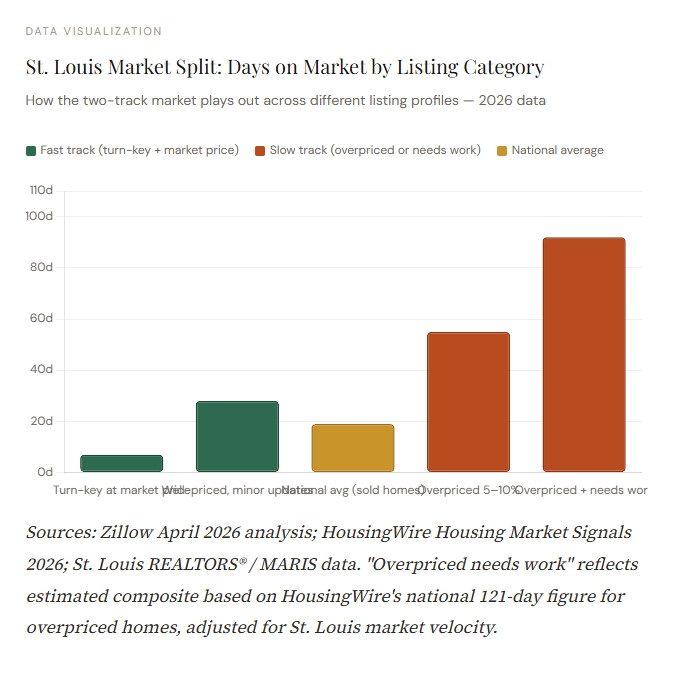
Then there's the other side. The typical active listing — the one that didn't catch fire in week one — has been sitting on the market for 47 days locally, compared to a national median of 56 days. HousingWire's analysis of 2026 housing trends puts this into even starker terms nationally: well-priced homes are still selling in about 63 days, while overpriced homes are sitting for an average of 121 days — a 58-day gap that defines what researchers are calling the "two-speed market."
🏆 The Fast Track
7Days to pending for turn-key, well-priced homes. Bidding wars. Above-asking offers. Buyers move fast to lock in their rate.
⏳ The Slow Track
47+Days on market for overpriced or outdated listings. Price reductions. Stigma. Buyers wonder what’s wrong with it.
Why Buyers Are So Rate-Sensitive Right Now
To understand why this split is so extreme in 2026, you have to understand what buyers are actually dealing with at the kitchen table. Mortgage rates have been hovering in the mid-6% range for the better part of two years now. According to U.S. Bank's latest market analysis, the average 30-year fixed mortgage rate was at 5.98% in late February 2026 before climbing back to 6.30% by mid-April. That kind of volatility — a third of a percentage point in six weeks — translates directly into hundreds of dollars per month on a typical St. Louis mortgage.
Put yourself in a buyer's shoes. You've been pre-approved. You've been searching for months. You've already mentally adjusted your lifestyle to a certain monthly payment. Then you find a house that checks every box. It's priced right. It doesn't need work. You know what your mortgage payment will look like if you lock in today.
You are not waiting around. You're making an offer this weekend.
Now imagine you find a house that's priced $20,000 over what you think it's worth. It needs a new roof. The kitchen was last updated in 2003. You like it, but you're not panicking. You'll check back in a few weeks. Maybe they'll reduce the price. Maybe not — and if not, you'll find something else. You have options. Inventory is better than it was a year ago, and you know you're not the only buyer who noticed those issues during your showing.
That psychology — multiplied across hundreds of active buyers in the St. Louis metro — is exactly what produces a 36.4% fast-sale rate alongside a 47-day median. Buyers are decisive about the right house and completely patient about the wrong one. The old idea that any buyer will eventually come around on price? It doesn't hold in a 6.3% rate environment.
The 7-Day "Hack" That Isn't Really a Hack
Real estate agents have been talking about the importance of pricing at market value for decades. But right now, in this specific market moment, the gap between pricing right and pricing aspirationally has never been more consequential. What plays out as a "hack" is really just supply and demand with urgency layered on top.
Here's what actually happens when a well-prepared home hits the market at exactly what the comps say it's worth:
⚡ The 7-Day Sequence
Day 1 (Thursday/Friday listing): Zillow, Redfin, and Realtor.com algorithms immediately surface the home in “new listing” alerts for buyers with saved searches in that area and price range. Showing requests flood in within hours.
Days 2–3 (Weekend showings): A correctly priced, well-presented home gets 8–15 showings across the weekend. Buyers compare it to overpriced homes they've already seen, making it feel like a strong value even at full price.
Day 4 (Offer deadline): Multiple offers come in. Several are at or above asking. Some waive inspection, while others include escalation clauses. The seller is now in the driver’s seat.
Day 5–7: The seller accepts the strongest offer, and the home goes pending before hitting the stigmatized 21-day mark that makes buyers question what’s wrong with it.
Now here's what happens when that same home is priced $25,000 over market value because the sellers "want to leave room to negotiate."
Week one: a handful of curious showings from buyers at the top of their budget, none of whom can really afford it or feel comfortable stretching to that price. Week two: silence. Week three: the listing hits the "price reduced" threshold on the apps. Buyers who see it now assume there was something wrong with it — that's why it didn't sell. By the time the price gets to where it should have been on day one, you've lost the best buyers, burned through your listing momentum, and you're negotiating from a position of weakness rather than strength.
In a market where buyers are watching rates tick up and down weekly and trying to time their lock, a home that needs price reductions is telling them: "This seller doesn't understand the market." That's not a message you want to send.
What Makes St. Louis Different From Other Markets
One of the things the Zillow data highlights that's worth dwelling on is how different St. Louis's situation is from other major metros. Sun Belt markets like Austin, San Antonio, and Jacksonville have seen inventory surge dramatically over the past 18 months. In those markets, fewer than 1 in 10 homes sells within seven days. Buyers have abundant options and very little reason to make an immediate decision.
St. Louis is structurally different. The metro's relative affordability — median home values around $171,000–$275,000 depending on the county — has kept demand steady even as rates climbed. Inventory remains below 2 months of supply in most active submarkets. When a good home comes on, buyers feel genuine urgency because they know inventory won't suddenly flood the market the way it did in Texas or Florida.
Several other Midwest markets — Cincinnati, Kansas City — share similar dynamics, which is why they show up alongside St. Louis in Zillow's fastest-market data. The Midwest's affordability relative to coastal metros has actually insulated these housing markets from some of the softening seen elsewhere.
None of that changes the core dynamic, though. Even in a demand-healthy market like St. Louis, an overpriced home sits. The buyers are out there — they're just not going to overpay for a home when correctly priced alternatives exist.
Practical Takeaways for Sellers Listing This Spring
If you're planning to put your home on the market in the next 60 to 90 days, here's what the data actually tells you to do — not what real estate myths tell you:
- Price at market, not above it. Pull the last 90 days of closed comps in your specific neighborhood — not your zip code, your street, and immediate surrounding blocks. What did comparable square footage with comparable condition actually close for? That number is your list price. Not that number plus $15,000 "to leave room." That number.
- The condition is pricing. If your home needs a new HVAC, a roof, or a kitchen that looks like 2005 — you have two choices: fix it or price the home to reflect it. There is no third option where buyers overlook it at full price. In this rate environment, buyers have done the mental math on what a 6.3% loan costs them, and they are not layering a $30,000 renovation on top of that math for an overpriced home.
- List on a Thursday. This sounds tactical and small, but it matters. Listing on Thursday gives your home Friday to gain algorithm traction, a full weekend of showings, and a natural Monday offer deadline. Listing on a Tuesday or Wednesday means you're competing with weekend momentum for a different crop of homes.
- The first seven days are your best seven days. The data on this is unambiguous. Homes that don't generate serious interest in the first week are fighting an uphill battle for the rest of their listing period. Everything you invest in preparation — staging, professional photography, pre-listing inspections, accurate pricing — is an investment in those first seven days. Don't cut corners there and try to save money.
The Bottom Line
The St. Louis housing market in 2026 is not slow. It is not soft. It is bifurcated — and the dividing line runs directly through your pricing decision. Local MARIS data confirm that inventory remains below 2 months of supply for single-family homes, indicating that underlying demand is real. The buyers are there. They are pre-approved, they are watching rates, and they are ready to move — but only for the right home at the right price.
That 36.4% that goes pending in seven days isn't a lucky group. They're the sellers who priced correctly, presented well, and didn't let wishful thinking get in the way of a strategy that actually works. The 47-day median doesn't have to be your story.
The window is seven days. Everything before that window is preparation—everything after it is recovery. Which side of that window you land on is almost entirely within your control.
Ready to Buy or Sell in St. Louis? House Sold Easy Has You Covered!
Navigating St. Louis’ red-hot luxury market doesn’t have to be a headache. With House Sold Easy, it’s all about less hassle—we’ve got you covered from start to finish. Our St. Louis experts know every corner of this city and will make buying your dream home or selling your high-end property a breeze. Don’t miss out on the hottest market in the U.S.! Contact House Sold Easy today and let’s make your real estate goals happen!