How to Sell a House in Probate Without the Stress
Jun 12, 2026
Written by David Dodge
Losing a loved one and inheriting their South City brick home or Florissant ranch house is hard enough. Here is exactly what Missouri probate law means for your timeline, your options, and your sanity.
Nobody plans to inherit a house. You are in the middle of mourning, sifting through decades of someone’s belongings, and then a letter from the St. Louis County Probate Court shows up in the mailbox telling you there’s a legal process standing between you and any decision you make about the property. For most families I’ve worked with or spoken to, that letter is the moment everything gets real in the worst possible way.
I want to walk you through what that process actually looks like on the ground here in St. Louis—not the sanitized version from a national legal blog that has never dealt with the City Circuit Court’s specific filing quirks, but the real sequence of events, the numbers you need to know, and the decisions you will actually face when you are trying to sell an inherited home while also just trying to grieve.
What Probate Actually Means for a St. Louis Home
Probate is the court-supervised process of validating a will (or determining heirs when there is no will), paying the decedent’s outstanding debts, and legally transferring property to its new owners. In Missouri, virtually every piece of real estate that was solely in the deceased person’s name must pass through probate before it can be sold to a third party, refinanced, or even formally transferred within the family.
For a home in St. Louis City, that means filing in the 22nd Judicial Circuit Court. For properties in St. Louis County—think Kirkwood, Florissant, Mehlville—you’re dealing with the St. Louis County Probate Division out in Clayton. The two courts have their own clerks, their own forms, and their own pace. Getting confused between the two is one of the most common early mistakes families make.
The key distinction you need to understand right away is whether the estate will go through Independent Administration or Supervised Administration. That one factor will shape almost every decision you make about selling the house.
Independent vs. Supervised Administration: The Fork in the Road
Missouri is one of the relatively generous states when it comes to giving personal representatives—what most people call an executor—flexibility over an estate. Under Missouri’s Revised Statutes Chapter 473, if a will specifically grants independent administration, or if all heirs agree in writing, the personal representative can manage and sell estate property without getting court approval at each step.
That means if you are the appointed personal representative under independent administration, you can list the house with a realtor, negotiate an offer, and close—all without filing a motion and waiting for a judge to sign off. You still have duties to the heirs and creditors, and you still need to account for everything at the end, but you are not stuck waiting for a court date every time a buyer wants to bump up the closing date by two weeks.
Independent Administration: What It Gets You ✓ Freedom to list, negotiate, and accept offers without court approval at each step.
✓ Ability to close on a buyer’s preferred timeline—a major advantage in competitive STL markets.
✓ Fewer attorney fees tied to court filings and hearing appearances.
✓ Still requires notifying heirs, paying valid creditor claims, and final accounting.
Supervised Administration is the other side of that coin. It applies when the will requires it, when heirs are in dispute, when there is no valid will at all (intestate estates), or when the court decides oversight is warranted. Under supervised probate, you need court approval before you sell the home. That means filing a petition, having the property formally appraised, publishing notice, waiting for any objections, and attending a hearing.
None of that is impossible—Missouri probate attorneys navigate it every day—but it adds weeks or months to a process that already feels endless when you’re paying property taxes, utilities, and maybe a mortgage on a house you cannot live in and cannot yet legally sell.
The 75% Rule: Missouri’s Floor on What You Can Accept
If you are in supervised administration and want to sell the inherited property, Missouri law sets a meaningful guardrail: under RSMo § 473.497, real estate generally cannot be sold for less than 75% of its court-ordered appraised value without explicit court consent. The appraiser must be court-approved, and their valuation becomes the baseline from which everything else flows.
In practical terms: if a licensed appraiser hired by the court values a Maplewood bungalow at $240,000, the personal representative cannot accept an offer below $180,000 without going back to the judge and explaining why. Creditors or heirs could challenge the sale otherwise, and the personal representative could face personal liability for accepting an inadequate price.
This rule matters a lot in a city like St. Louis, where there is a significant market for distressed and as-is properties. Investor buyers sometimes approach grieving heirs with low offers, counting on the family being exhausted and wanting a quick resolution. The 75% floor provides real protection—but heirs and personal representatives need to know it exists to enforce it.
The rule does not apply in independent administration, which is another reason obtaining independent authority—where the will or heirs allow it—is often a strategic priority for estates that include real property.
Missouri Probate Timeline: Supervised vs. Independent Administration
Estimated months from death to closing, based on typical St. Louis County estate complexity (2024–2026 data)
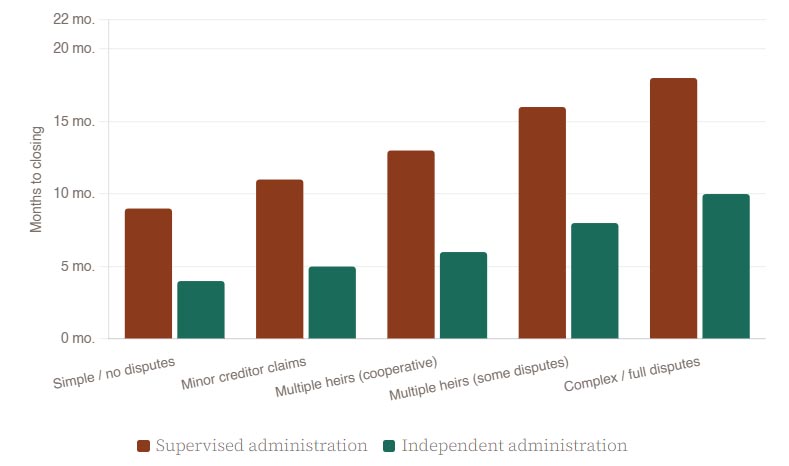
Sources: Missouri Bar Probate & Trust Committee reports; practitioner estimates from St. Louis County attorneys (2026).
Ranges reflect variance in creditor claims, heir disputes, and court scheduling.
The Six-Month Creditor Window: Why Everything Moves Slowly
Here is the part nobody tells you upfront. Even under independent administration, and certainly under supervised administration, Missouri law gives creditors six months from the date of the first published probate notice to come forward with claims against the estate. That notice gets published in a local legal newspaper—often a publication most of us have never heard of—and the clock starts ticking.
Under RSMo § 473.360, creditors who do not file within that window generally lose their right to collect from the estate. That is actually designed to protect the estate—it creates a hard cutoff so heirs know they are in the clear. But it also means that the personal representative is wise to wait out most of that window before distributing assets or—in many cases—before finalizing a property sale that would consume most of the estate’s cash.
For heirs holding a house in South City or anywhere else in the metro, those six months can feel brutal. You are paying utilities, property taxes (St. Louis City and County both require tax payments to stay current regardless of probate status), possibly a mortgage if the decedent still had one, and homeowner’s insurance on a property you cannot legally sell yet. Those carrying costs add up fast, especially on an older home that may need maintenance while sitting vacant.
Monthly Carrying Cost Estimate: Vacant STL Property
- Property taxes — $150–$500/month, depending on assessed value and municipality
- Utilities (minimum service) — $80–$200/month for heat, electric, water
- Homeowner’s insurance (vacant) — $100–$300/month (vacant policies cost more)
- Lawn/maintenance — $50–$150/month to avoid city code violations
Total Range: $380–$1,150 per month just to hold the property.
This is where the math behind an as-is or cash sale starts to make real sense. Even if a traditional retail listing might yield $20,000 more at closing, if reaching that closing requires six more months of carrying costs at $700/month, plus $5,000–$10,000 in repairs a buyer’s inspector will demand, plus additional attorney fees for prolonged court involvement—the numbers often close the gap faster than heirs expect. More on that in a moment.
The Local Wrinkle: St. Louis City vs. St. Louis County Probate
One thing that trips up a lot of heirs—and even some out-of-town attorneys—is the split jurisdiction in the St. Louis metro. The City of St. Louis is not part of St. Louis County. They are two separate political entities, each with its own probate court. If your late mother owned a home in Soulard (City) and a rental property in Webster Groves (County), you may be dealing with two separate probate proceedings, each with their own filing fees, their own clerks, and their own timelines.
Most Missouri estates can consolidate, but the logistics get complicated. This is one of several reasons that working with a local St. Louis probate attorney rather than a general estate attorney or out-of-state counsel is genuinely important, not just a sales pitch. The 22nd Circuit Court in the City and the St. Louis County Probate Division in Clayton operate on different schedules, use different forms, and—frankly—have different cultures around how quickly things move.
Your Three Realistic Sales Options as an Heir
Once you understand the framework, the decision about how to sell usually comes down to three realistic paths. Let me lay them out honestly, because the right answer is different for every family.
| Option | Timeline to Close | Net Proceeds | Hassle Level |
|---|---|---|---|
|
Traditional MLS Listing Full retail, buyer’s inspector, repairs |
6–12+ months after probate clears |
Highest potential |
High |
|
As-Is Listing (MLS, Priced Lower) Disclosed condition, no repairs |
4–8 months after probate opens |
Moderate |
Medium |
|
Cash Investor / Direct Buyer No repairs, quick close, below market |
2–6 weeks after court authority granted |
Below market |
Lowest |
The traditional listing makes the most sense when: the property is in genuinely good condition, you have independent administration so you can move at market speed, heirs are not fighting, and the estate does not have significant debts eating into any delay. In St. Louis’s stronger submarkets—Kirkwood, Ladue, parts of Webster Groves—a well-priced traditional listing can move quickly even during probate, with the closing contingent on final court clearance.
An as-is listing is often the sweet spot for properties that need work but are in decent enough shape that a fix-and-flip buyer or an owner-occupant willing to take on a project will compete for it. The St. Louis investor market is active enough that good bones properties in most zip codes attract genuine competition when priced right and marketed properly.
The direct cash sale makes the most sense when: carrying costs are high, the property is in rough shape, heirs are geographically scattered (a surprisingly common St. Louis situation as families have spread to Chicago, Kansas City, and beyond), or the estate has debts that require quick liquidation. The discount is real, but so is the relief of ending months of obligation to a house that nobody actually wants to keep.
A word on cash buyers and investor pitches
If you inherit a property in St. Louis and publish a probate notice, expect your phone to ring. Investors and “we buy houses” operations actively monitor probate filings because they know heirs are often motivated sellers. There is nothing inherently wrong with that—many heirs genuinely need exactly what those buyers offer. But you should know a few things before you engage: get at least two or three offers, always verify the 75% floor if you’re in supervised administration, and understand that legitimate cash buyers will not pressure you to sign quickly or skip having an attorney review the contract.
The Step-by-Step Process: What Actually Happens
1. File the Petition for Probate
File with the appropriate court (City or County) to open the estate. Submit the original will if one exists, the death certificate, and the petition for letters testamentary or letters of administration. Pay the filing fee (currently around $150–$200, depending on estate size).
2. Receive Letters Testamentary / Letters of Administration
The court issues letters that officially give you authority to act on behalf of the estate. You cannot sign a real estate contract in probate without these. Most title companies and buyers’ attorneys will ask to see a certified copy.
3. Publish Notice to Creditors
Missouri requires publication in a newspaper of general circulation in the county. This starts the six-month creditor claim window. Most probate attorneys handle this, but it is your personal representative’s responsibility to ensure it happens and happens correctly.
4. Appraise the Property (Required in Supervised)
Under supervised administration, get a court-approved appraisal. The appraised value sets the 75% floor. Under independent administration, you still want a professional appraisal or comparative market analysis so you know what a reasonable price looks like.
5. List, Negotiate, and (If Supervised) Petition the Court
Under supervised probate, once you have an accepted offer, you must file a petition for authority to sell, publish notice of the sale hearing, wait the required period, attend the hearing, and obtain a court order confirming the sale. Under independent administration, you skip the court approval step.
6. Close and Pay Claims
Proceeds flow through the estate account. Valid creditor claims get paid first, then costs of administration (attorney fees, court costs), then distributions to heirs. Your probate attorney will prepare a final accounting for the court.
What Grief and Practicality Actually Look Like Together
I want to step back from the procedural detail for a moment, because I think the practical framing can obscure something important. Most of the people navigating this process are doing it while they are still in some form of grief. They are driving past the house where their parent, sibling, or child lived. They are going through closets. They are fielding calls from people who want to know “what’s happening with the property.”
The legal process does not care about any of that. Missouri Revised Statutes § 473 is what it is, and the deadlines are what they are. But your decisions about how quickly to move, whether to sell at all, whether to keep the property or sell it, whether to take the quick cash offer or hold for a higher number—those decisions should be made with your family, with an attorney you trust, and with a clear picture of the numbers. Not out of panic. Not because some investor sent you a postcard three days after the obituary ran.
The families I have seen navigate this most smoothly are the ones who do two things early: they hire a St. Louis probate attorney who knows the local courts, and they get a real market analysis of the property from a local agent or appraiser who knows the specific neighborhood. With those two things in hand, you can make decisions from a position of knowledge rather than anxiety.
A Note on Taxes: The Step-Up Basis Advantage
One more piece that often gets overlooked in the stress of the probate process: when you inherit real property, you generally receive what the IRS calls a “stepped-up” cost basis. That means your basis in the property is not what your parent paid for it in 1978—it is the fair market value on the date of death. For many inherited St. Louis properties that have appreciated significantly over the decades, this can mean substantial capital gains tax savings if you sell shortly after inheriting.
According to guidance published by the IRS in Publication 559 (Survivors, Executors, and Administrators), inherited property receives this stepped-up basis treatment automatically, which is one of the more meaningful tax advantages available to heirs. The practical implication: if you are going to sell, selling relatively soon after the date of death—before the property appreciates further under your ownership—often minimizes your capital gains exposure.
This is not tax advice, and you should talk to a CPA about your specific situation. But it is worth knowing the general framework before you make decisions about timing.
Finding the Right Help in St. Louis
Missouri requires a licensed attorney to handle most aspects of formal probate, and this is not an area where DIY is advisable. The St. Louis Bar Association’s Lawyer Referral Service is a reasonable starting point. Many probate attorneys in the area work on a percentage-of-estate basis (Missouri statute allows up to about 5% on the first $5,000 and scaling percentages thereafter), so you can often get representation without a large upfront retainer.
For the real estate side, look for an agent who specifically lists themselves as having probate or estate sale experience. The National Association of Realtors’ Certified Probate Real Estate Specialist (CPRES) designation exists partly because this is genuinely a specialized area of practice.
And if you are genuinely at the end of your rope and the property is in rough shape—or you just need it done and behind you—a reputable local cash buyer is a legitimate option. Get references, verify they are licensed if they are also acting as an agent, and never, under any circumstances, sign anything without having your attorney review it first.
Probate is hard. But in St. Louis, with the right people around you, it is survivable.
Bottom Line for Your Weekend:
This is not a market to sit out. It's a market to show up differently in. Here's the short version of what that looks like in practice: Pull a list of "Temporarily Off Market" and "Withdrawn" listings from the last two weeks in your target neighborhoods. Reach out today — not with a pitch, with a question. Lead your open houses with a "Real Cost" board that translates the rate environment into specific monthly savings for this specific home. And when someone tells you they're waiting for rates to drop, give them the honest math on what that wait might actually cost them. None of this is magic. It's preparation, transparency, and showing up with something different. In a market full of agents running the same tired script, that's more than enough to stand out.
Ready to Buy or Sell in St. Louis? House Sold Easy Has You Covered!
Navigating St. Louis’ red-hot luxury market doesn’t have to be a headache. With House Sold Easy, it’s all about less hassle—we’ve got you covered from start to finish. Our St. Louis experts know every corner of this city and will make buying your dream home or selling your high-end property a breeze. Don’t miss out on the hottest market in the U.S.! Contact House Sold Easy today and let’s make your real estate goals happen!