Summer 2026 Housing Market Shift: What Buyers Must Know
Jun 15, 2026
Written by House Sold Easy Team
Active listings are up. Prices have softened for seven straight months. Here's why that's not the disaster headline it sounds like — and what it actually means if you're buying or selling this summer.
Let's be honest — when you see headlines about median list prices dropping for a seventh straight month and active listings climbing, your first instinct might be to panic. Is this the crash everyone's been whispering about? Should you wait? Should you sell fast before things get worse?
The short answer is: no. What we're watching unfold this June is not a housing market in freefall. It's a housing market returning to more normal conditions. What we're seeing is a market rebalancing. Understanding what that means can help buyers and sellers make better decisions than reacting to headlines alone.
So what exactly changed in June?
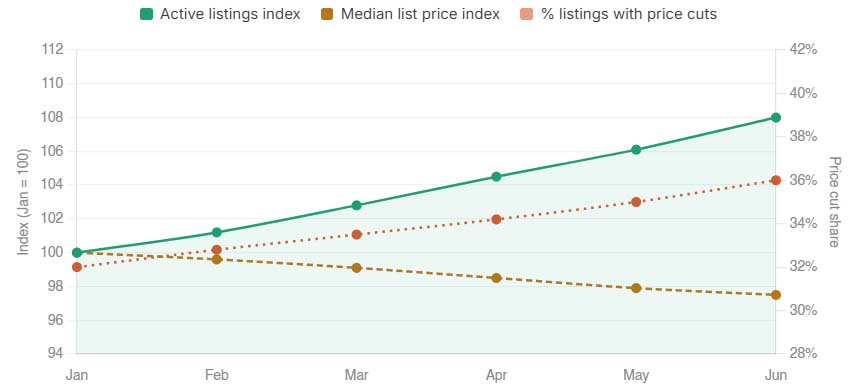
The latest data from Churchill Mortgage's June 2026 Real Estate Market Update tells a story that deserves more nuance than it's getting. Active listings are up 1.8% year over year. New listings climbed 2.1%. At the same time, median list prices slipped another 2.4% compared to last year — making this the seventh consecutive month of softening at the national level.
Meanwhile, the National Association of Realtors reported that existing home sales hit a 5-month high in May, rising 3.2% to 4.17 million annualized units. First-time buyers made up 35% of all purchases — the highest share in years. That combination — more listings, softer prices, and rising sales volume — is not a contradiction. It's what a market returning to equilibrium looks like.
“This is not a collapsing market. It is a market negotiation.”
U.S. Housing Market: Key indicators, Jan–Jun 2026
Active listings index (Jan = 100), median list price index, and monthly price cut share
Sources: Churchill Mortgage · HousingWire · Redfin
What "balancing" actually looks like on the ground
Here's a number that should reframe everything: roughly one-third of all active listings nationally are sitting with a price cut. HousingWire's April 2026 analysis found that median list prices are hovering near $440,000, while sellers are increasingly accepting offers below asking — creating what the outlet called "a meaningful gap between pricing intent and market reality."
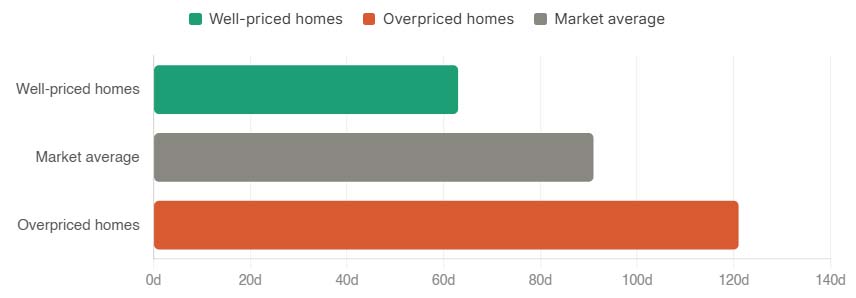
But here's the context that doesn't make it into the scary headlines: well-priced homes are still selling in around 63 days. It's the overpriced ones — the sellers who haven't gotten the memo yet — that are dragging the average days-on-market to 121 days. The market is becoming more price-sensitive, and buyers are paying closer attention to value.
And buyer behavior confirms this. Redfin's most recent data shows 308,446 homes sold in May 2026, up 5.2% from a year earlier. The 30-year fixed mortgage rate sits at 6.4%, down 0.37 points year over year. That's not cheap, but it's more manageable than the peak, and buyers who held off for two years are starting to move again.
Days on market by pricing strategy (May 2026)
Well-priced homes sell quickly; overpriced listings drag the average
Source: HousingWire Intelligence, April 2026
The inventory picture: more homes, but not too many
One of the quieter stories of 2026 is just how geographically uneven this inventory rebound has been. According to ResiClub Analytics, active listings nationally are up about 8.1% from March 2025 to March 2026 — but that number hides a wide spread. Some markets that were deep sellers' territory have now tipped to balanced. Others that were balanced are inching toward buyer-favored territory.
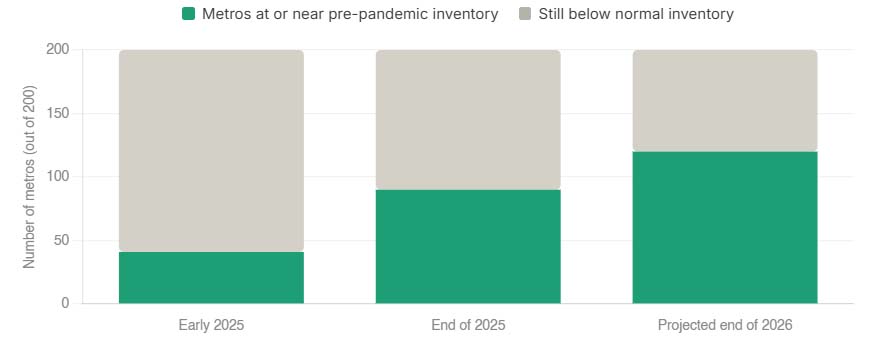
At the start of 2025, just 41 of the 200 largest metro areas had returned to what you'd call "normal" pre-pandemic inventory levels. By the end of last year, that number had doubled — 90 metros were back to normal. That's a significant geographic expansion of healthier conditions that simply doesn't fit neatly into a single national headline.
The Midwest and parts of the Northeast are absorbing inventory fastest. Markets in the South and parts of the West are recovering more slowly — partly because they saw more dramatic price runups during 2021 and 2022, and sellers there are still reluctant to revise their expectations. The lock-in effect — where homeowners who locked in 2% to 4% mortgage rates during the pandemic era are understandably hesitant to list — is still suppressing new supply in many of these markets, which is part of why prices haven't cratered.
Metro areas returned to "normal" inventory levels
Out of the 200 largest U.S. metros tracked by ResiClub Analytics
Source: ResiClub Analytics, April 2026
What this means if you're buying this summer
For buyers, this is genuinely the best setup you've had in several years — not because it's a buyer's market everywhere, but because the panic is gone. You don't need to make a six-figure decision in 24 hours anymore. Bidding wars are still happening on well-priced homes in tight markets, but you're no longer competing against 22 other offers on a house that needs a new roof.
Buyer's Takeaway
If you've been pre-approved and are waiting for prices to fall further, you may be waiting a long time. Zillow's 2026 forecast projects home values rising just 0.3% for the year, meaning dramatic discounts are unlikely. The good news? Buyers now have more time to evaluate homes, negotiate repairs, and request closing cost assistance—opportunities that can put real money back in your pocket.
The 30-year fixed rate at 6.4% — down from its peak — also means the monthly payment math looks different than it did 18 months ago. A $400,000 home at 6.4% costs about $2,500/month in principal and interest. Not cheap, but not the 7.8% peak environment we were in either. And with the median days on market at 49 days nationally (per Redfin), there's still enough activity to tell you this market has real buyers in it — it just isn't a fire sale frenzy.
What does this mean if you're selling this summer?
Sellers need to hear something direct: Pricing right out of the gate is not optional anymore. HousingWire's data makes this brutally clear — overpriced listings are sitting for four times as long as competitively priced ones. Every extra month on the market is a month of carrying costs, a month of psychological wear, and a month where buyers start wondering what's wrong with the house.
✓ What's Working for Sellers
- Pre-inspected, move-in ready homes
- Strategic pricing at or just under market
- Homes near public transit (buyers saving $8K+ annually)
- Midwest & Northeast markets remain competitive
⚠ What's Creating Friction
- Overpriced listings stagnating at 121+ days
- Florida and parts of the South are softening most
- HOA-burdened condos facing extra scrutiny
- Lock-in effect limiting fresh competition
The silver lining for sellers? Confidence is still relatively high. Realtor.com's spring survey found 83% of potential sellers expect to receive their asking price or more — 37% expect above asking. That confidence isn't delusional, but it does need to be tempered with an understanding that "at asking" in today's market means priced correctly to begin with, not priced optimistically and hoping for the best.
The bigger picture: this isn't 2008
Every time prices soften and inventory rises, a portion of the population starts whispering about 2008. It's worth being direct: the conditions that created the 2008 housing crash don't exist today. We don't have a wave of adjustable-rate mortgages set to reset. We don't have widespread negative equity. Homeowners who purchased in the last several years locked in low fixed rates and have substantial equity — the national median is in the high $400,000s after years of appreciation.
What we do have is a market that overshot on the way up and is doing the uncomfortable, necessary work of finding a new equilibrium. That process involves price cuts, longer days on market, and softened list prices. But it also involves rising sales volume, first-time buyers returning, and inventory levels that are finally giving people options without triggering a collapse in values.
Hannah Jones, Senior Economic Research Analyst at Realtor.com, put it plainly earlier this year: housing conditions are "gradually rebalancing after several years of extreme seller advantage." That's the right frame. Not a crash. A correction toward something more sustainable — and honestly, more fair.
“The markets gaining momentum in 2026 are not the tightest markets. They're the ones proving most capable of converting listings into transactions.”
Bottom line: what to do with this information
If you're watching the market from the sidelines, this data should give you clarity — not more anxiety. The story of June 2026 isn't that the housing market is collapsing. It's that for the first time in years, you have room to actually think. To compare homes. To negotiate. To make a decision that makes financial sense for your specific situation rather than one driven by fear of missing out.
That's not nothing. In 2021 and 2022, that kind of breathing room simply didn't exist. People were waiving inspections, going $50,000 over asking on sight-unseen offers. The fact that we've moved away from that environment is healthy — even if the adjustment feels uncomfortable in the short term.
At House Sold Easy, we'll be watching the June existing home sales release (due out July 9 from NAR) closely. That data will be the real-time read on whether the activity we saw in May held through June or whether higher summer competition is pulling things tighter again. Either way, we'll break it down for you here, with real numbers and zero fluff.
In the meantime, if you're trying to figure out what any of this means for your specific neighborhood — your zip code, your price range, your timeline — that's a much more useful question than the national average. Local data is where decisions get made. We're here to help you read it.
Ready to Buy or Sell in St. Louis? House Sold Easy Has You Covered!
Whether you're thinking about listing your home or exploring a cash offer, it's worth understanding all of your options before making a decision. The right choice depends on your timeline, your property's condition, and your goals. Contact House Sold Easy to discuss your situation and see what makes the most sense for you.Our St. Louis experts know every corner of this city and will make buying your dream home or selling your high-end property a breeze. Don’t miss out on the hottest market in the U.S.! Contact House Sold Easy today and let’s make your real estate goals happen!