South City vs. West County: Best St. Louis Homes for $300k
Jul 29, 2026
A visual neighborhood comparison breaking down lot sizes, historic charm, and school districts at the St. Louis median price point.
Written by David Dodge
If you have been shopping for a home in the Greater St. Louis area during the summer of 2026, you already know the significance of the $300,000 price mark. It is no longer just an arbitrary budget number; it is the absolute epicenter of our regional real estate market. Whether you are a first-time homebuyer stepping up from a tight downtown loft, a growing family outgrowing your starter home, or a move-up buyer looking to maximize your equity, $300k represents the ultimate crossroad in St. Louis real estate.
Why is this specific price point so critical right now? Because it sits squarely at the intersection of local affordability and competitive buyer demand. Across the broader metro area,
However, St. Louis is notoriously a region of hyper-local micro-markets. The moment you divide your search along the city-county line, the numbers diverge in fascinating ways. Within city limits,
This puts a $300,000 budget in a fascinating position. In South City, $300k places you well above the city median, giving you premium access, historically significant homes in top-tier walkable neighborhoods. In West County, $300k puts you just below the broader county median, meaning you are hunting for entry-level single-family homes, classic mid-century ranches, or highly coveted townhomes in powerhouse school districts.
So, where do you actually get the most for your money? Let’s strip away the generic real estate advice and dive deep into the bricks, backyards, basements, and boundaries of St. Louis.
Classic 1920s St. Louis red brick craftsmanship in South City. Source: Kennedy Painting
1. The Architectural Breakdown: Historic Brick vs. Mid-Century Ranches
When you spend $300,000 in St. Louis, the physical structure you buy is dictated entirely by which side of the city-county border you choose. We are talking about two completely different eras of American residential architecture, each with its own aesthetic appeal, construction materials, and functional layouts.
The South City Profile: The $300k Gingerbread & St. Louis Bungalow
In South City—specifically within neighborhoods like Northampton, Southampton, Holly Hills, St. Hills Borough, and the residential pockets surrounding Tower Grove South—a $300,000 budget is the sweet spot for quintessential St. Louis masonry.
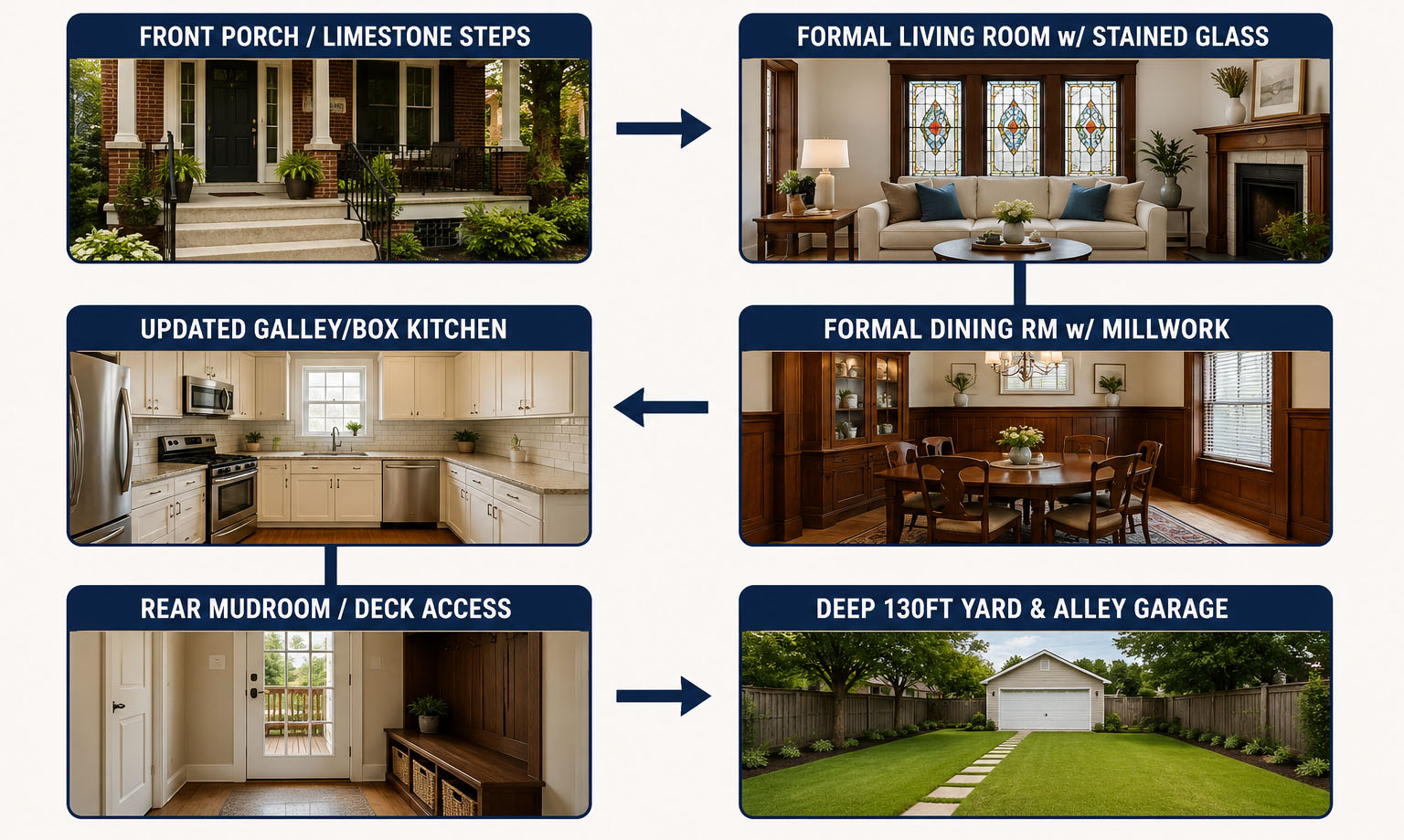
At this price point, you are primarily looking at single-family solid brick bungalows, Tudor-revival "gingerbread" homes, or beautifully converted two-family flats (where an owner has opened up the staircase to create a 2,000+ square foot single-family residence). These homes were constructed between 1915 and 1935, built during St. Louis’s industrial boom using local clay brick that is virtually indestructible.
What $300k buys inside a South City home:
-
Square Footage: 1,600 to 2,100 sq. ft. of above-grade living space, plus a full (often unfinished or semi-finished) basement.
-
Architectural Character: Original stained-glass windows framing the chimney, original oak and maple hardwood floors with walnut inlay borders, unpainted chestnut or gumwood trim, plaster walls, archways, and decorative fireplaces with Pewabic or Grueby-style tile hearths.
-
Layout Realities: Traditional formal floor plans. You will have a distinct living room, a formal dining room, and a kitchen that has likely been updated by a previous owner but remains structurally separated from the main living areas. Bedrooms are typically situated on the second floor of 1.5-story bungalows, often featuring charming dormer ceilings.
-
The Wow Factor: Unmatched curb appeal. The masonry detailing—including brick corbels, terra cotta medallions, and sweeping limestone front porches—cannot be replicated in modern construction at any price point.
SOUTH CITY $300K ARCHITECTURE
The West County Profile: The $300k Suburban Ranch & Split-Level
When you take that same $300,000 into West St. Louis County—targeting entry-level pockets in Ballwin, Manchester, unincorporated St. Louis County near Dougherty Ferry, or northern Ellisville—the architecture shifts by thirty to forty years. Because prime West County hubs like Town & Country and Chesterfield carry median prices well over $600,000, a $300k budget here means you are hunting for smart entry points into established, mature subdivisions.
Here, you are looking at classic 1960s and 1970s mid-century ranch homes, multi-level split-levels, or spacious end-unit townhomes in master-planned communities.
What $300k buys inside a West County home:
-
Square Footage: 1,350 to 1,750 sq. ft. on the main level, but often accompanied by a finished lower-level walkout that adds another 500 to 800 sq. ft. of functional living space.
-
Architectural Character: Brick-veneer or brick-front facades paired with vinyl or James Hardie fiber-cement siding on the sides and rear. Interior details favor clean, horizontal lines, large picture windows overlooking expansive lawns, and conventional drywall construction rather than heavy plaster.
-
Layout Realities: Open-concept potential. Ranches from this era were designed with casual suburban living in mind. Kitchens often open directly into informal family rooms or breakfast nooks. You get single-level living where the primary suite and secondary bedrooms are all on the main floor—a massive selling point for buyers who want to avoid stairs.
-
The Wow Factor: Functional modernization and flow. At $300k in Ballwin or Manchester, you will frequently find homes where walls have already been removed by rehabbers, offering modern kitchen islands, vaulted ceilings, and direct access from the kitchen to an elevated rear deck.
2. Lot Sizes, Outdoor Living, and the Garage Factor
If architecture is what draws you into a home, the land underneath it dictates your weekend lifestyle. The difference in site planning between South City and West County is night and day.
South City: The Urban Lot & Alley Culture
In neighborhoods like Southampton or Tower Grove South, homes were built before the automobile dominated daily life. Lots are narrow and deep—typically measuring 30 to 40 feet wide by 120 to 135 feet deep (around 0.10 acres).
Because the houses sit close together, outdoor living is heavily oriented toward two spaces: the covered front porch and the fenced backyard. The front porch in South City is a social institution; on any given spring evening on streets like Nottingham, Brannon, or Murdoch, neighbors sit outside with a beverage, chatting with dog walkers and watching the neighborhood go by.
The backyard is accessed via St. Louis’s iconic network of paved residential alleys. At $300k, you should expect a detached one- or two-car garage sitting at the rear property line off the alley. While older garages might be tight for oversized modern SUVs, many owners have upgraded to modern, two-car brick or tin-roof garages that double as weekend workshops. Your yard space is intimate, highly private (thanks to 6-foot cedar privacy fences), and perfect for urban container gardening, string lights, and brick patios.
%20RESIZED.jpg)
Sprawling lawns, mature trees, and attached garages define West County living.. Source: Fischer Homes
West County: The Sprawling Lawn & Attached Garage
Move out to Parkway or Rockwood school district territory in Ballwin or Manchester, and your footprint expands dramatically. Here, homes were built during the post-war automotive boom. A standard $300k home sits on a lot ranging from a quarter-acre to over a half-acre (10,000 to 22,000 sq. ft.).
The relationship with the street changes entirely. You swap the social front porch for a sweeping front lawn, mature oak and hickory trees, and a long concrete driveway leading to an attached two-car garage. Having an attached garage is a non-negotiable luxury for many move-up buyers—the ability to pull directly into your home during a January St. Louis ice storm or unload groceries without stepping outside is a major lifestyle upgrade.
In the backyard, privacy comes from distance and topography rather than wooden fences. West County backyards frequently feature multi-tiered wooden decks, stone retaining walls, and gentle slopes leading into wooded ravines or neighborhood green belts. The trade-off? You will be spending significantly more time and money on lawn maintenance, leaf removal in the autumn, and landscaping equipment.
| Outdoor Metric | South City ($300k Target) | West County ($300k Target) |
|---|---|---|
|
Typical Lot Size |
3,500–5,000 sq. ft. (0.08–0.11 Acres) |
10,000–20,000+ sq. ft. (0.25–0.45 Acres) |
|
Garage Style |
Detached 1–2 Car (Alley Access) |
Attached 2-Car (Front or Side Driveway) |
|
Yard Privacy |
High 6-ft wooden privacy fences standard |
Moderate to High Mature trees & spacious lots |
|
Outdoor Hub |
Covered front porch & brick rear patio |
Elevated wooden rear deck & walkout patio |
|
Lawn Maintenance |
Minimal Push mower, ~20 minutes weekly |
Substantial Riding/self-propelled mower & seasonal leaf management |
3. The School District Equation: City Options vs. West County Powers
For move-up buyers with children—or buyers looking to maximize long-term resale value—the school district calculation is often the deciding factor between City and County living.
The West County Draw: Public School Powerhouses
There is no overstating the gravitational pull of West County public schools. When buyers tell real estate agents they want to move to Ballwin, Manchester, or Chesterfield, they are almost always targeting three specific school districts:
-
Parkway School District (specifically Parkway West, Parkway South, and Parkway Central feeding paths).
-
Rockwood School District (serving areas like Ballwin, Ellisville, and Wildwood through high-performing schools like Marquette and Lafayette High).
-
Lindbergh Schools (dominating the Kirkwood/Sunset Hills/West County border areas).
At the $300,000 price point, securing a single-family home within the Parkway West or Rockwood footprint is like finding gold. These districts consistently rank among the top public school systems in the state of Missouri, offering state-of-the-art STEM facilities, robust Advanced Placement (AP) catalogs, championship athletics, and special education resources that rival elite private institutions.
For buyers, buying into these districts at $300k is an insurance policy on your property value. Because inventory in Parkway and Rockwood remains exceptionally tight—remember,
The South City Landscape: Magnets, Charters, and Parochial Networks
Navigating education in St. Louis City requires a completely different playbook. The traditional neighborhood public school model of the suburbs does not apply here in the same way. Instead, South City families utilize a highly specialized, multi-tiered educational network:
-
SLPS Magnet Schools: St. Louis Public Schools operates several academic powerhouses that require application and lottery entry. Schools like Kennard Classical Junior Academy (elementary gifted), McKinley Classical Leadership Academy, and Metro Academic and Classical High School consistently achieve test scores and college placement rates that rival or beat the top suburban high schools.
-
High-Performing Charter Schools: Over the last decade, tuition-free public charter networks have built deep roots in South City. Institutions like City Garden Montessori, Gateway Science Academy (with campuses in Southampton and St. Hills), and St. Louis Language Immersion School offer specialized curricula that attract devoted family communities.
-
The Parochial & Independent Tradition: St. Louis has one of the highest per-capita rates of Catholic and independent school attendance in the United States. In South City, parish K-8 schools like St. Gabriel the Archangel (in Nottingham/Southampton), St. Joan of Arc, St. Raphael the Archangel, and Our Lady of Sorrows serve as neighborhood anchors. For high school, families frequently utilize private networks (like St. Louis University High, Rosati-Kain, Nerinx Hall, or St. Mary's South Side).
The Takeaway for Buyers: In West County, your $300k mortgage buys your public school admission ticket directly via your street address. In South City, your $300k home places you in a rich, diverse urban environment where you must actively navigate application lotteries, magnet testing, or private school tuition budgets.
4. Lifestyle, Walkability, and Daily Commutes
Your home is only part of the equation; the surrounding two miles dictate your daily existence. How do South City and West County compare when you step out your front door on a Saturday morning?
South City: The Walkable Urban Village
South City is designed around community nodes. If you buy a $300k bungalow in Tower Grove South or Southampton, your lifestyle is fundamentally pedestrian and hyper-local:
-
The Park Culture: Tower Grove Park—a 289-acre Victorian walking park featuring historic pavilions, lily ponds, and acoustic music—is the absolute living room of South City. On Saturday mornings from May through November, half the neighborhood walks or bikes to the Tower Grove Farmers' Market for artisan pastries, local produce, and yoga on the lawn.
-
Neighborhood Dining & Retail: You don't drive to commercial strip centers; you walk to neighborhood corridors. On Macklind Avenue in Southampton, you can stroll to Onesto Pizza & Trattoria, grab morning espresso at Espresso Yourself, or get pastries at Russell's on Macklind. On Morganford Road, you have local favorites like The Civil Life Brewing Company and Alpha Brewing. And no mention of South City is complete without Ted Drewes Frozen Custard on Chippewa—an absolute summer tradition where lines wrap around the block on July evenings.
-
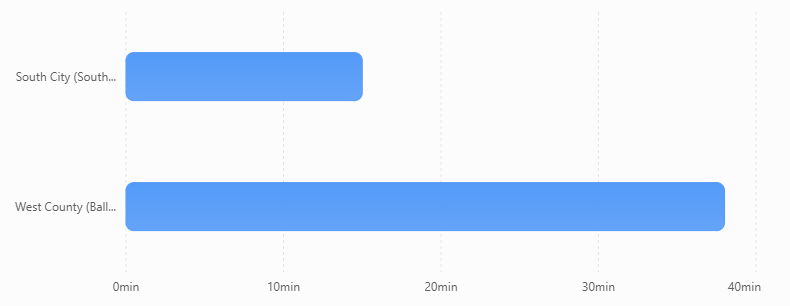
The Commute: If you work in Downtown St. Louis, Midtown, at BJC HealthCare / Washington University Medical Campus, or at Cortex Innovation Community, South City is unbeatable. You are looking at a 10-to-15 minute commute via surface streets (Kingshighway, Grand, or Gravois) or a quick hop onto Interstate 44. You rarely deal with sprawling highway gridlock.
Commute Time to Downtown St. Louis
Typical drive time comparison from two popular residential areas.
West County: Suburban Convenience & Regional Access
Life in Ballwin, Manchester, or Ellisville is structured around retail efficiency, expansive parks, and automotive convenience:
-
The Retail Corridors: Your daily commerce centers around Manchester Road (Route 100) and Clarkson Road. Everything you could possibly need is within a five-minute drive: flagship grocery stores like Dierbergs and Schnucks, specialty retailers at West County Center in Des Peres, gourmet dining in Downtown Kirkwood (just a quick drive east), and home improvement centers for your weekend yard projects.
-
Expansive Outdoor Recreation: While South City has manicured Victorian parks, West County offers rugged, large-scale nature. You are minutes away from Castlewood State Park (famous for mountain biking and hiking bluffs overlooking the Meramec River), Queeny Park (offering 500+ acres of trails, dog parks, and ice rinks), and Love Park.
-
The Commute: Living west of Interstate 270 means you must factor commute times into your quality of life. If you work along the I-64/Highway 40 corporate corridor (Chesterfield, Town & Country, Creve Coeur, or Clayton), your commute is a manageable 15 to 25 minutes. However, if you commute all the way Downtown or to the Central West End during rush hour, expect to spend 35 to 50 minutes navigating I-64, I-44, or Route 141.
5. The Financials: Maintenance, Property Taxes, and Long-Term ROI
Let’s look at the hard numbers. When you buy a $300,000 home in summer 2026, your down payment and interest rate—currently hovering around
The Maintenance Reality Check
-
South City (1920s Masonry): Historic brick homes are built like fortresses, but Father Time undefeatedly taxes mechanical systems. When budgeting for a $300k South City home, you must keep an emergency reserve for specific urban maintenance items: tuckpointing (re-grouting exterior brickwork every 20-30 years, which can cost $3,000–$8,000 depending on elevation), sewer lateral lines (older clay pipes running from the house to the city main underneath the alley), and historic roof maintenance (original architectural slate or clay tile roofs require specialized roofers). Furthermore, while most $300k homes have updated PVC plumbing and 200-amp electrical panels, you should always inspect for residual knob-and-tube wiring or galvanized plumbing stacks.
-
West County (1960s-1970s Frame/Brick): Suburban ranches present a different maintenance profile. While you don't worry about massive tuckpointing bills or 100-year-old sewer laterals (many West County municipalities have robust sewer lateral insurance programs built into property taxes), you have a larger physical footprint to maintain. Roof replacements on sprawling, low-pitched ranch homes involve significantly more square footage of asphalt shingles. You will also deal with aging retaining walls, asphalt driveway resurfacing, and managing larger HVAC systems tasked with cooling 2,000+ square feet of multi-level living space during humid St. Louis summers.
Property Taxes and the 1% City Earnings Tax
One of the most misunderstood financial differences between City and County living involves the tax structure.
If you live or work within the city limits of St. Louis, you are subject to the 1% St. Louis City Earnings Tax, assessed on your gross municipal income. For a household earning $150,000 annually, that represents an immediate $1,500 cash outlay every year ($125/month). If you live and work in West County, your municipal earnings tax liability is zero.
However, property tax assessment rates often balance this equation out:
| Financial Metric | South City ($300k Home) | West County ($300k Home) |
|---|---|---|
|
Estimated Effective Property Tax Rate |
~1.30% – 1.45% of Assessed Value |
~1.45% – 1.65% (Higher in fire & school districts) |
|
Annual Property Tax Bill (Est.) |
$3,900 – $4,350 per year |
$4,350 – $4,950 per year |
|
St. Louis City 1% Earnings Tax |
Applies if you live or work in the City |
None, unless your workplace is located in the City |
|
Typical Municipal Sewer Lateral Fee |
Included in utility/tax bill (~$50/year) |
Varies by municipality (~$28–$50/year) |
|
HOA / Subdivision Fees |
Seldom exist in South City |
$150 – $600 per year in established subdivisions |
|
Primary Long-Term Maintenance Expense |
Brick tuckpointing, clay sewer laterals, slate roofs |
Asphalt driveway, retaining walls, and larger roof footprints |
Resale Value and Equity Growth in 2026
From an appreciation standpoint, both markets have proven resilient through the economic shifts of 2024–2026. Because the broader metro region continues to see stable pricing power—with
In South City, equity growth is driven by scarcity of historic architecture. They simply will never build 1920s stained-glass brick bungalows again. As neighborhoods like Southampton and Tower Grove South continue to attract young professionals and remote workers who prioritize walkability over square footage, property values remain insulated.
In West County, equity growth is anchored by school district demand. As long as Parkway and Rockwood maintain their elite academic standings, there will be an evergreen supply of move-up buyers bidding on entry-level single-family homes in Ballwin and Manchester. A $300k ranch home in Parkway West territory is one of the most liquid real estate assets in Missouri—if you price it correctly, it will sell in any market cycle.
6. Buyer Persona Matchup: Which $300k Home is Right for You?
To bring all of this data together, let’s look at three typical move-up buyer profiles shopping in St. Louis during the summer of 2026. Which side of the border wins for each?
Case Study A: The Urban Professional Couple
-
The Profile: Sarah and David are both 31. Sarah works in biotech at the Cortex Innovation District in Midtown; David is a hybrid financial analyst who works from home three days a week. They currently own a 2-bedroom condo in Downtown St. Louis but want a yard for their two rescue dogs and a dedicated home office. They love trying new restaurants, craft breweries, and walking to coffee on weekends.
-
The Verdict: SOUTH CITY (Southampton or Tower Grove South).
-
Why: For Sarah and David, a $300,000 budget in South City buys them a gorgeous 1,800 sq. ft. brick bungalow with a fenced yard for the dogs and a two-car garage. Sarah’s commute to Cortex is an effortless 10-minute drive down Kingshighway. They don't have school-age children yet, so the public school district boundary is not an immediate operational concern, and they value being within walking distance of Tower Grove Park and Macklind Avenue dining over having a half-acre suburban lawn to mow.
Case Study B: The Growing Family on the Move
-
The Profile: Michael and Elena have a 5-year-old daughter entering kindergarten next year and a 2-year-old son. They have outgrown their 1,100 sq. ft. starter home in St. Ann. Michael works in sales in Chesterfield; Elena is a physical therapist in Creve Coeur. Their top priorities are securing a top-tier public school district, having four bedrooms (or three large bedrooms plus a finished basement playroom), an attached garage, and a safe, quiet street where the kids can ride bikes.
-
The Verdict: WEST COUNTY (Ballwin or Manchester - Parkway/Rockwood districts).
-
Why: This family is the textbook target audience for West County. By allocating their $300,000 budget toward a 3-bedroom, 2-bath ranch or split-level in Ballwin or Manchester, they immediately secure tuition-free access to elite public schools, saving them tens of thousands of dollars in potential private school tuition over the next decade. Michael and Elena’s commutes to Chesterfield and Creve Coeur are under 20 minutes. The attached garage and quiet cul-de-sac environment perfectly align with their daily parenting routine.
Case Study C: The Hybrid Buyer (The Inner-Ring Compromise)
-
The Profile: Rachel is a single professional who wants historic charm, hardwood floors, and personality in a home, but she commutes to a corporate headquarters in Town & Country and dreads highway traffic. She wants walkability, but she also wants an easy suburban drive and a strong neighborhood resale floor.
-
The Verdict: THE INNER-RING BORDERLANDS (Maplewood, Webster Groves border, or Kirkwood condos).
-
Why: If you are torn between the historic charm of South City and the convenience of West County, you don't necessarily have to choose an extreme. While the median prices in prime Webster Groves and Kirkwood sit well above $400,000 in 2026, a patient $300,000 budget can still unlock charming entry-level bungalows in Maplewood, borderline properties in Shrewsbury, or spacious historic townhomes in Des Peres/Kirkwood. These inner-ring suburbs offer the exact bridge between city walkability and county highway access.
Final Verdict: Where Does Your Money Work Harder?
When we look at the St. Louis real estate landscape in July 2026, the question of whether South City or West County offers "more" for $300,000 depends entirely on how you define value.
If your definition of value is architectural artistry, walkability, cultural vibrancy, and urban intimacy, South City is the undisputed champion. Nowhere else in the Midwest can you purchase an indestructible, 100-year-old solid brick home with original stained glass, custom millwork, and a vibrant neighborhood café culture at a $300,000 price point. You are buying into a rich piece of St. Louis history with an unmatched lifestyle floor.
If your definition of value is square footage, educational power, automotive convenience, and low-friction suburban living, West County takes the crown. At $300,000, securing a solid mid-century home within the Parkway or Rockwood school districts is one of the smartest long-term wealth-building plays in the region. You trade the front porch for a deck, the alley for a driveway, and the urban grid for quiet cul-de-sacs surrounded by mature trees.
Both markets are thriving in 2026. Because
Ready to Buy or Sell in St. Louis? House Sold Easy Has You Covered!
Whether you're thinking about listing your home or exploring a cash offer, it's worth understanding all of your options before making a decision. The right choice depends on your timeline, your property's condition, and your goals. Contact House Sold Easy to discuss your situation and see what makes the most sense for you.Our St. Louis experts know every corner of this city and will make buying your dream home or selling your high-end property a breeze. Don’t miss out on the hottest market in the U.S.! Contact House Sold Easy today and let’s make your real estate goals happen!