Why Your St. Louis Home Isn't Selling (And How to Fix It)
Jun 19, 2026
Written by House Sold Easy Team
Every homeowner's situation is different. If you've owned your home for decades or inherited a property, it may be worth reviewing your potential tax exposure before deciding how to sell. Understanding your options early can help you avoid surprises later.
You remember the week you listed. The deep scrub, the staging, the small bowl of fruit on the counter you saw in a real estate video. You left the house at 6 p.m. so strangers could walk through your kitchen. You refreshed your agent's showing app every couple of hours. And then — nothing. A week goes by. Then two. Then three.
If this sounds like where you are right now, you are not alone, and something is probably not wrong with your house. What's happening is a shift in the St. Louis market that a lot of sellers got caught on the wrong side of — and there is a real path forward if you understand what the numbers are telling you.
Let me walk through what is actually going on, what the checklist of stall reasons looks like, and what your real options are — including one that most sellers never hear about until they've already spent two or three months chasing the market down.
What the St. Louis market is actually doing in 2026
Here's the thing about the St. Louis real estate market this year: it is not crashing. That's the honest framing you need before anything else makes sense. Cities like Nashville and Austin are seeing dramatic buyer-seller imbalances that have forced sellers to slash prices or pull listings entirely. St. Louis is not that. According to a January 2026 report in St. Louis Magazine, the local market has held up meaningfully better than those metros, which is a sentence you may be unaccustomed to reading.
But balanced does not mean frictionless. The market has normalized after a few years of sellers being able to name almost any price and have buyers agree. That era is over. Data from Houzeo's 2026 St. Louis market report shows that homes are now spending an average of 48 days on the market — up 4% year-over-year — and are selling at roughly 95.5% of asking price, not above it. The share of sellers who have had to reduce their list price climbed from 23.3% to 28.46% in the same period.
That last number matters. Nearly 30% of St. Louis sellers have had to cut their prices just to get noticed. If your home is sitting, you are in the company of a lot of sellers who mispriced at the start, and the market quietly told them so.
St. Louis, 2026
cut their list price
sale-to-list ratio
in St. Louis
Days on market vs. final sale price — the two-speed market
Well-priced St. Louis homes vs. overpriced listings — 2026 trend data
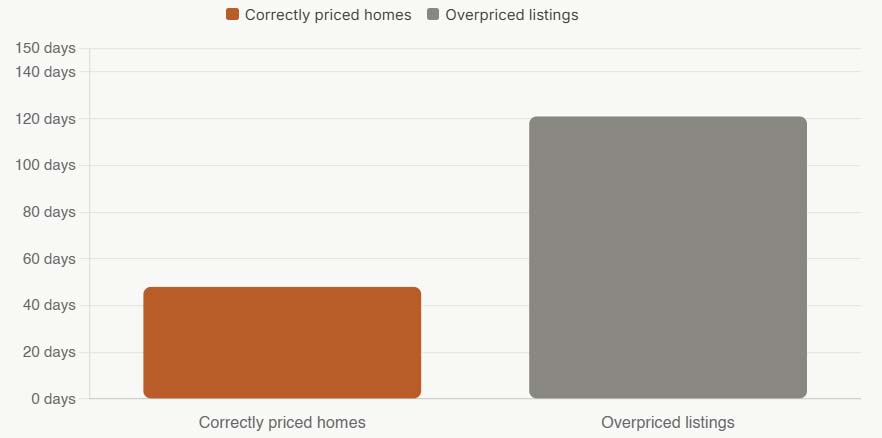
That gap — 48 days versus 121 days — is not an accident. HousingWire's April 2026 ten-year data analysis found that while well-priced homes are still moving in around 63 days nationally, overpriced homes are sitting at an average of 121 days — a 58-day spread that defines what analysts are calling the "two-speed market." You are either in the fast lane or the slow one, and the difference is almost always rooted in price.
The checklist: six real reasons a home stalls
Before you decide what to do, you need an honest diagnosis. In my experience, the stall reasons almost always come down to one or more of these six things. Run through each of them.
Why your home might be sitting — an honest checklist
- Price is above what comparable sales support. This is the number one reason, and it is the hardest one for sellers to hear because it feels like a judgment of their home. It is not. It is a judgment of the market. If homes with similar square footage, condition, and location have been closing at $235,000 and yours is listed at $259,000, buyers are passing — not because they don't like your house, but because they can see the math.
- Layout or functional issues that feel hard to overlook. A bedroom that you can only reach through another bedroom. A kitchen so small that two people can't stand in it. No primary suite. These are not dealbreakers for every buyer, but they shrink your buyer pool significantly, which means your price needs to reflect that reality.
- Location signals that buyers are factoring in. Busy road. Power lines. Proximity to commercial zoning. School district boundaries that fall just outside a more desirable zone. None of these is your fault, but all of them affect what buyers are willing to pay. A location discount is real, and a listing that doesn't price for it will wait.
- Interest rate sensitivity in your price range. The Spring 2026 St. Louis market update puts the 30-year fixed around 6.4–6.83% right now. At that rate, a $30,000 price difference on a home can mean $90 or more per month in mortgage payments. Buyers at the edge of their budget are paying close attention to that, and homes priced at the ceiling of a bracket often get skipped for ones just below.
- The stigma of time on market. Once a listing passes around 30–45 days without an accepted offer, buyers start to wonder what's wrong. They're not being irrational — they're pattern-matching. A house that hasn't sold in six weeks when comparable homes moved in two weeks is sending a signal, even if the reason is simply that it was overpriced at launch. The longer you wait to correct, the harder the correction has to be.
"I tell my clients that we know a home is overpriced if the days on market are a week or more above average. The market is telling us it is overpriced."
What to actually do about it — five real pivots
Once you've done the honest diagnosis, you have real options. The mistake most stalled sellers make is waiting — assuming the right buyer is just around the corner, or that a seasonal uptick will rescue them. Sometimes that works. More often, time on market compounds the problem. Here is what the actual pivot menu looks like.
The part about price cuts that nobody tells you
There is a counterintuitive dynamic that plays out when sellers start chasing the market with price reductions. Every time you cut, it resets buyer expectations downward. A buyer who saw your home at $249,000 and passed will see the $239,000 price and think: Why did it drop? What's wrong? They will offer $229,000.
Real estate agents who work with buyers are trained to look at cumulative days on market, not just the current listing date. You can relist under a slightly different description, but a savvy buyer's agent will pull the history. The stigma accrues. And each subsequent price cut is treated as confirmation that more cuts are coming.
This is why the sequence matters. The right move is to price correctly from the start, or to make a single meaningful correction early — not a series of small drips that telegraph desperation. A January 2026 GoBankingRates survey of real estate agents found that sellers who chase the market down with price cuts can "wipe out all of the profit" from months of additional carrying costs, negotiating pressure, and buyer skepticism. One agent put it plainly: "I see sellers give credits after inspections just to get a deal done."
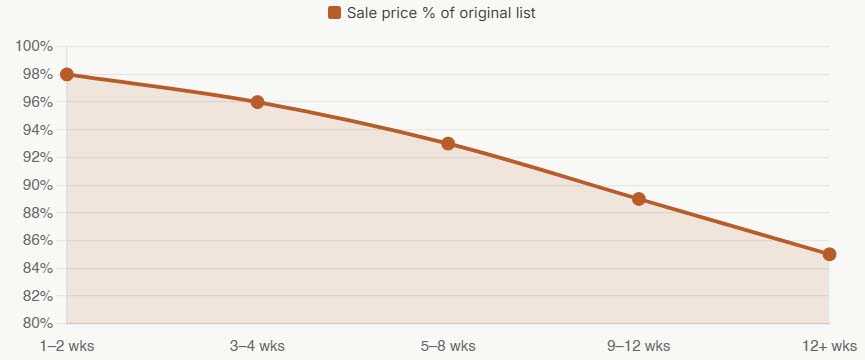
Impact of extended time on market — seller outcomes
Estimated final sale price as % of the original list price by weeks on market
What a cash offer actually does for you
Most sellers treat a cash offer as a last resort — something you do when you've given up. That's backwards. A no-obligation cash offer is actually a tool you should have in hand at any point in the selling process, because it does something nothing else can: it gives you a real floor.
Think about how differently you make decisions when you have a guaranteed number. If House Sold Easy offers you $198,000 on your home and your market listing is at $219,000, you know exactly what you're negotiating for when you're on the traditional market. You're working to close a $21,000 gap — not chasing an abstract ideal. And if after six more weeks the best offer you've received is $201,000, you can make a real comparison instead of a panicked one.
The other thing a cash offer does: it removes contingencies. No financing fall-through. No inspection renegotiation. No appraisal gap. No buyer who gets cold feet two days before closing. In a market where homes are sitting, that certainty has real value — and it doesn't cost you anything to know the number.
Find Out What Your St. Louis Home Is Worth — In Cash
No repairs. No open houses. No waiting. Get a real cash offer within 24 hours and compare it to your other selling options with zero obligation.
Get My Cash Offer →
The part about timing that sellers get wrong
A lot of sellers in a stall convince themselves that the answer is to wait for a seasonal uptick. Spring brings more buyers. Summer brings relocated families. This is true — to a degree. But it obscures something important: the homes that sell quickly in spring are not the homes that sat through winter and are still carrying the scent of a stale listing. They're the fresh listings.
If you've been on the market for six weeks or more, you are not going to benefit from a spring surge the way a new listing will. Buyers shopping in May or June are going to filter by "newest first," and your home will be buried. The seasonal argument for waiting is mostly a rationalization.
What actually helps: pulling the listing, making a meaningful change — whether that's a real price adjustment, repairs, or upgraded photos — and relaunching. A fresh listing date resets the clock on most buyer search platforms. It signals something changed. Done right, it can re-energize a property that had gone invisible.
The honest bottom line
If your St. Louis home has been on the market for three or more weeks without a serious offer, the market has told you something. That something is almost always one of a short list of fixable things. The worst response is to keep waiting and hope the market rescues you — because in a balanced market, it probably won't.
The best response is to run through the checklist honestly, make a single decisive pivot, and have a real backup number in your pocket so you're never making decisions from a place of pure uncertainty. A cash offer from House Sold Easy takes 24 hours to get and costs you nothing. Even if you never accept it, knowing the number changes every other decision you make.
You did the hard work of listing. Now make sure the strategy matches the market you're actually in — not the one from 2021.
Ready to Buy or Sell in St. Louis? House Sold Easy Has You Covered!
Whether you're thinking about listing your home or exploring a cash offer, it's worth understanding all of your options before making a decision. The right choice depends on your timeline, your property's condition, and your goals. Contact House Sold Easy to discuss your situation and see what makes the most sense for you.Our St. Louis experts know every corner of this city and will make buying your dream home or selling your high-end property a breeze. Don’t miss out on the hottest market in the U.S.! Contact House Sold Easy today and let’s make your real estate goals happen!