What $300K Buys in St. Louis: 2026 Mid-Year Reality Check
Jul 02, 2026
Written by David Dodge
Inventory is quietly creeping up. Interest rates are holding stubbornly. And well-priced homes are still gone in under three weeks. Here's the honest breakdown of what the summer market actually looks like.
Every summer, buyers convince themselves that the market is finally going to slow down. They watch the calendar, wait for back-to-school season to cool things off, and tell themselves that if they just hold on a little longer, they'll have more leverage. In most markets, they'd be right. In St. Louis in mid-2026, they're still wrong — but the picture is more nuanced than it's been in years.
Six months into 2026, the St. Louis metro is sitting in a strange kind of limbo. Inventory has nudged up enough to give buyers a little more to look at, but not nearly enough to loosen the grip that sellers have held since the pandemic reshuffled the entire housing landscape. According to mid-year data from the St. Louis REALTORS® 2026 Mid-Year Market Report, metro-wide supply is running between 1.8 and 2.4 months — depending on which sub-market you're looking at. For context, a balanced market where buyers and sellers have roughly equal footing sits around 5 to 6 months of supply. We're still less than half of that.
What that means in plain terms: if no new homes came on the market starting today, the existing inventory would be absorbed by buyers in under two and a half months. That's tight. That's been tight. And despite everything — higher mortgage rates, inflation hangover, a presidential election cycle that always puts buyers on edge — demand in this market has not meaningfully softened.
But here's where July 2026 gets interesting. If you know which zones to target, what your $285,000–$325,000 budget realistically gets you, and how to compete without losing your mind or your financial sanity, St. Louis is still one of the most compelling housing markets in the country for everyday buyers. The question is just where you're willing to live — and what you're willing to compromise on.
The Numbers First: What the Mid-Year Data Actually Shows
Let's set a baseline. The metro median sale price for the St. Louis area entered 2026 at roughly $292,000 and has drifted up to $304,000 through the first half of the year — a modest 4.1% year-over-year gain according to the Missouri REALTORS® Q2 2026 Housing Statistics report. That appreciation pace is slower than the 7–9% we saw during the 2021–2023 boom years, but it's also notably steadier. This isn't a market that's correcting. It's a market that's digesting its gains and holding.
The days-on-market story is equally telling. Well-priced homes — meaning homes that hit the MLS at or slightly below recent comparable sales — are still going under contract in 14 to 22 days metro-wide. Overpriced listings are sitting 45, 60, even 90 days, and then chasing the market down with price reductions. The bifurcation between accurate pricing and aspirational pricing has never been sharper. Sellers who get it right get multiple offers. Sellers who don't get along, uncomfortable education.
metro-wide (June 2026)
for well-priced listings
(mid-2026)
On the interest rate side, the 30-year fixed mortgage is sitting in the mid-to-upper 6% range as of late June 2026 — elevated compared to where buyers got spoiled in 2020 and 2021, but more or less where the market has been operating for over two years now. Buyers have acclimated. The NAR REALTORS® Confidence Index for June 2026 shows buyer traffic nationally is running above-average for this time of year, which tells you the demand side hasn't dried up. People need to live somewhere. Life events — job changes, divorces, new families, aging parents — don't pause for the rate environment.
St. Louis Metro: Mid-Year 2026 Market Snapshot by Zone
Months of supply, median days on market, and median sale price across key sub-markets
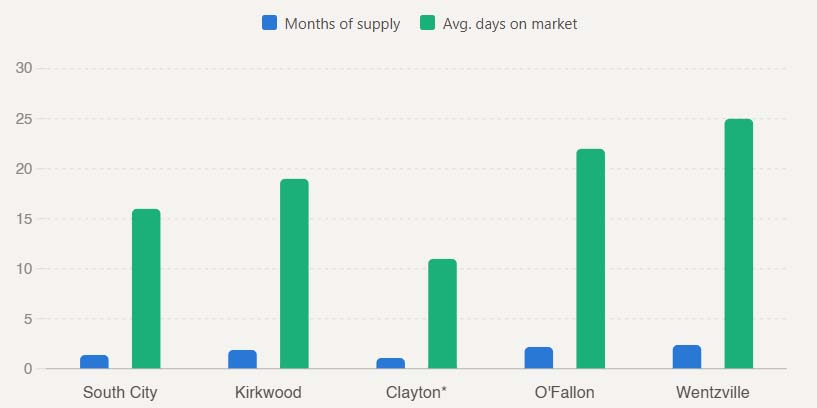
Source: St. Louis REALTORS® Mid-Year 2026 Market Report · Missouri REALTORS®
What that chart makes clear is that the tightest inventory isn't in the sprawling suburbs — it's in the inner-ring neighborhoods closest to the urban core. South City and Clayton are essentially a seller's paradise right now. O'Fallon and Wentzville give buyers a little more breathing room, and that's exactly the trade-off we're going to unpack.
What a $285k–$325k Budget Looks Like Across Different STL Zones
The current metro median of around $304,000 is a number that sounds manageable on paper, but the experience of buying at that price point varies dramatically depending on which part of the map you're targeting. Let's break it down honestly.
South City: Brick, Character, and a Fair Fight Every Weekend
South St. Louis City — Benton Park, Tower Grove South, Fox Park, Dutchtown, Compton Heights, Marine Villa — is where the city's architectural identity lives. These are the compact, tree-lined blocks of brick bungalows, two-story rowhouses, and the occasional craftsman that make St. Louis look like St. Louis. For buyers who value walkability, proximity to restaurants and nightlife, and a neighborhood with genuine community texture, South City is still an extraordinary value relative to comparable urban neighborhoods in other cities.
In the $265,000–$300,000 range, you're typically looking at a 3-bed, 1-bath brick bungalow or shotgun-style home that's been renovated in the last five to ten years — updated kitchen with quartz or granite counters, updated bath, refinished original hardwood floors, new HVAC. The bones of these houses are exceptional. A hundred-year-old brick exterior that hasn't moved in decades, eight-foot ceilings, and deep front porches are genuinely hard to replicate with new construction. What you won't always get is a two-car garage, a large yard, or a finished basement.
Stretch the budget to $300,000–$325,000 in South City, and you start competing for the truly gut-renovated properties — open kitchen-to-living concepts, primary suite additions, rooftop decks. These are the listings that generate 8 to 15 offers over a weekend. They're real. They're happening right now. If you want one, you need to be pre-approved before you walk in the door, prepared to offer above asking, and mentally ready for an appraisal gap conversation with your agent.
The walk scores in established South City corridors routinely run in the high 80s and low 90s. You can walk to Sasha's on Shaw or Mission Taco Joint for dinner. You can bike to Tower Grove Park on a Sunday morning. That quality of life is priced in, but it's priced in at a level that would still look like a bargain to anyone moving from Chicago, Denver, or the D.C. suburbs.
Kirkwood: The Walkable Suburb Premium
Kirkwood sits about 15 miles southwest of downtown and has built a reputation as one of the most livable small cities in the entire metro. Downtown Kirkwood's dining and retail district, the Amtrak and MetroLink connectivity, the historic train station, the farmers market — all of it contributes to a place that genuinely earns its premium.
The Kirkwood school district carries some of the highest ratings in St. Louis County, and that pulls family buyers willing to pay a price-per-square-foot that runs noticeably higher than comparable square footage in South County or Jefferson County. In the $300,000–$325,000 range in Kirkwood proper, you're typically looking at a smaller footprint than your budget would command elsewhere — maybe a 1,400–1,600 square foot 3-bed/2-bath with a modest yard, solid bones, and a cosmetic renovation that's a few years old but not fresh.
The trade-off is real. You're paying for the zip code and the school district. That's a completely legitimate priority for many buyers. It's just important to go in with clear eyes about what $310,000 actually buys you inside Kirkwood city limits versus what that same number buys you two miles away in Webster Groves or Glendale, where the housing stock is similar in character but slightly more abundant.
Days on market in Kirkwood for move-in-ready listings are running around 19 days metro-average, but the good stuff — the listings on the blocks closest to downtown Kirkwood — often goes faster than that. Supply in Kirkwood has always been constrained because it's a geographically small city that built itself out decades ago. There's no vacant land for new subdivisions. What's there is what you get, and buyers know it.
O'Fallon and Wentzville: The New Construction Proposition
Cross the Missouri River on I-70 west, and the whole equation flips. O'Fallon and Wentzville in St. Charles County represent the other end of the spectrum from South City — car-dependent, fast-growing, amenity-rich in a chain restaurant and big-box retail sense, and home to some of the most active new construction pipelines in the entire metro.
In the $285,000–$325,000 range, new construction builders in this corridor are putting up 1,700–2,200 square foot homes with 3 or 4 bedrooms, 2.5 baths, open-concept living areas, two-car garages, and builder warranties. The lot sizes are modest — typically 6,000–8,000 square feet — and the neighborhoods are built on what used to be agricultural land, so the street trees are young and the landscaping is sparse. But the houses themselves are brand new, everything works, and the major system warranties give first-time buyers genuine peace of mind.
The catch is layered. First, HOA fees in many of these new developments run $60–$130 per month, which effectively reduces your purchasing power when a lender factors that into your debt-to-income calculation. Second, the commute reality is significant — getting from Wentzville to anywhere in the city core during rush hour is a 45-to-60-minute experience that doesn't show up on the weekend test drive. Third, some builders are managing demand by controlling release schedules and keeping prices firm, so the multiple-offer dynamics that exist in established neighborhoods also creep into the new construction market when a desirable plan hits a new phase.
That said, the Zillow Research 2026 Mid-Year Housing Market Outlook notes that St. Charles County continues to see above-average demand growth among buyers in the 30–40 age range — exactly the demographic that's weighing suburban space against urban proximity and, in many cases, choosing space. Wentzville, in particular, has added significant retail and restaurant development over the past three years that didn't exist five years ago, making the lifestyle trade-off less severe than it used to be.
South City
Benton Park / Tower Grove1,100–1,500 sq ft
3BR / 1–2BA
1.4 mo supply
16 days DOM
Walk score 85–92
Historic brick
Inner-Ring Suburb
Kirkwood / Webster Groves1,300–1,700 sq ft
3BR / 2BA
1.9 mo supply
19 days DOM
Walk score 68–78
Craftsman / Cape Cod
Outer Suburb
O'Fallon / Lake St. Louis1,600–2,000 sq ft
4BR / 2.5BA
2.2 mo supply
22 days DOM
Walk score 30–45
Mix: resale + new
Growth Corridor
Wentzville / Foristell1,750–2,200 sq ft
4BR / 2.5BA
2.4 mo supply
25 days DOM
Walk score 20–35
New construction
Why Inventory Is Still So Tight — and Why That Won't Change Fast
The supply question is the one everyone keeps waiting to resolve. There's a belief, loosely held but widely shared, that eventually inventory will normalize and buyers will get their moment. That moment is probably not coming in the second half of 2026, and here's why.
The biggest driver of constrained inventory right now is the rate lock-in effect — the phenomenon where homeowners who refinanced into 2.75%, 3.1%, or 3.4% mortgages in 2020 and 2021 are deeply reluctant to sell and trade into a 6.5%+ mortgage on their next purchase. If you bought a $280,000 home in 2021 at 3%, your payment is around $1,180 per month on principal and interest. If you sold that home for $340,000 today and moved up to a $375,000 purchase at 6.75%, your new payment would be around $2,430. That's over a thousand dollars more per month for a lifestyle move. A lot of people are just not willing to do that math, and so they're staying put.
The Missouri REALTORS® data confirms this pattern — new listing volume in the St. Louis metro for Q2 2026 remained 12% below the Q2 2019 baseline, which was itself not a robust inventory environment. We're not returning to some imagined golden era of housing inventory. The pool of sellers is structurally smaller than it used to be.
New construction is helping at the margins. The St. Charles County growth corridor — O'Fallon, Wentzville, and further west — is adding units. But new construction in the $285k–$325k price range is increasingly difficult for builders to pencil given land costs, labor, and materials. Most of what's being built at true entry-level price points requires buyers to look at the very outer edges of the metro, which not everyone is willing to do. The zip codes with the highest construction activity and the highest buyer demand are not, generally speaking, the same zip codes.
The NAR Confidence Index data also points to something else: the buyers competing in this market are increasingly motivated. These aren't casual lookers. The people making offers in June and July of 2026 have been in the market for months, in many cases, and they know what they want and how to move fast. First-time buyers who still haven't figured out how to compete are getting squeezed out by repeat buyers who are leveraging existing equity — even modest equity — to come in stronger.
Practical Buyer Strategy for the Rest of 2026
None of this is meant to discourage. St. Louis is still one of the most attainable major metros in the country at the $285,000–$325,000 price point. You can own here. You just need to be honest with yourself and strategic about how you approach it. Here's what actually works right now.
1. Get fully pre-approved, not just pre-qualified.
Pre-qualification is a conversation. Pre-approval means a lender has actually pulled your credit, verified your income documents, and issued a conditional commitment letter. In competitive situations, listing agents will call your lender. If your lender answers that call and sounds confident, you're in better shape. If your paperwork is loose, you lose.
2. Understand the appraisal gap conversation before you have it.
In competitive neighborhoods, winning offers often come in above the list price — sometimes meaningfully above. If the home doesn't appraise at the contracted price, you're responsible for covering the difference in cash. Know your liquid reserves. Know how much of an appraisal gap you can absorb before the deal stops making sense.
3. Don't ignore the less-obvious neighborhoods.
Dutchtown and Marine Villa in South City offer character-rich housing stock at price points that are 8–12% below the Tower Grove South premium, with improving restaurant and retail scenes. In St. Charles County, the Lake St. Louis area offers a different suburban feel than Wentzville, with slightly shorter commutes for some employment centers. Hyper-local knowledge — from an agent who actually tracks these pockets — is more valuable than general metro data.
4. Set new listing alerts and have a decision framework ready before anything hits.
The homes you want are going under contract in under three weeks. If you need two weekends, three conversations with your parents, and a contractor quote before you can make a decision, you're not going to win in this environment. Know your must-haves versus nice-to-haves before you start touring, and know your walk-away price before every showing.
5. Consider a backup offer strategy on passed-over listings.
About 8–12% of accepted contracts in St. Louis fall through — financing issues, inspection findings, cold feet. Homes that went under contract in the first week and then came back on the market are often excellent opportunities, because the competition reset at a lower temperature. Having a backup offer in place or monitoring relisted properties closely can get you into a great home with significantly less competition.
The Bigger Picture: St. Louis Is Still One of the Best Value Propositions in America
Zoom out from the day-to-day frustration of competing offers and appraisal gaps, and the St. Louis housing market tells a compelling long-term story. The Zillow 2026 Mid-Year Outlook continues to place the St. Louis metro in the top tier of markets for price-to-income ratio affordability among major Midwestern metros. We're not at the levels of 2019, but we're still meaningfully more accessible than Kansas City, Columbus, Indianapolis, and virtually every Sun Belt market that exploded in price from 2020 onward.
At a $304,000 median, you are buying actual real estate in a city with genuine cultural infrastructure — free world-class museums, a nationally recognized food scene, one of the great park systems in the country in Forest Park, professional sports across multiple leagues, and a downtown that is genuinely in the middle of a multi-year revitalization story. The narrative about St. Louis being "that place people leave" has been quietly contradicted by the numbers for several years now. Net migration data is improving. Young professionals who might have bypassed the city a decade ago are finding it as remote-work culture lets them optimize for cost and quality of life simultaneously.
The $285,000–$325,000 buyer in St. Louis in mid-2026 is not settling. They're buying into one of the most underrated real estate markets in the country, at a price point that would get them a condo — at best — in most coastal cities. The competition is real, the market is tight, and the process will require patience and preparation. But the outcome, for buyers who get there, is ownership of a real home in a city that continues to deliver on value in ways that are easy to overlook until you sit down and actually compare the numbers.
Bottom Line
St. Louis remains highly competitive with 1.8–2.4 months of supply and homes moving in under three weeks. Your $285k–$325k budget buys character and walkability in South City, school district equity in Kirkwood, or significantly more square footage in the outer suburban growth corridors. None of those paths is easy right now — but all of them are real. Know your priorities, get your financing locked, and have a strategy before you start touring.
Ready to Buy or Sell in St. Louis? House Sold Easy Has You Covered!
Whether you're thinking about listing your home or exploring a cash offer, it's worth understanding all of your options before making a decision. The right choice depends on your timeline, your property's condition, and your goals. Contact House Sold Easy to discuss your situation and see what makes the most sense for you.Our St. Louis experts know every corner of this city and will make buying your dream home or selling your high-end property a breeze. Don’t miss out on the hottest market in the U.S.! Contact House Sold Easy today and let’s make your real estate goals happen!