St. Louis Homes Are Defying the Market This June
Jun 01, 2026
Written by David Dodge
Tight inventory. Climbing prices. A 10% year-over-year appreciation rate that nobody saw coming. Here's what local sellers need to know before the summer peak closes out.
There's a particular kind of quiet confidence that defines the St. Louis real estate market right now — the kind that comes not from boom-era hysteria, but from fundamentals that simply keep stacking up in sellers' favor. While coastal markets have been sputtering, adjusting, and spooking buyers with rate anxiety since 2023, St. Louis has been doing something quietly extraordinary: holding firm, appreciating steadily, and entering the summer of 2026 in arguably the strongest seller's position the metro has seen in years.
If you've been watching the national headlines and assuming they apply to your neighborhood, they don't. The story playing out in Webster Groves, Chesterfield, South County, and the inner-ring suburbs is a different one entirely. And if you're thinking about listing your home this summer, the next few weeks may represent the single best window you'll have for the foreseeable future.
Let me walk you through the numbers — and what they actually mean for you.
Year-over-year price appreciation, 2026
Months of housing supply — critically low
Median home sale price, St. Louis 2026
Below the national average in housing cost
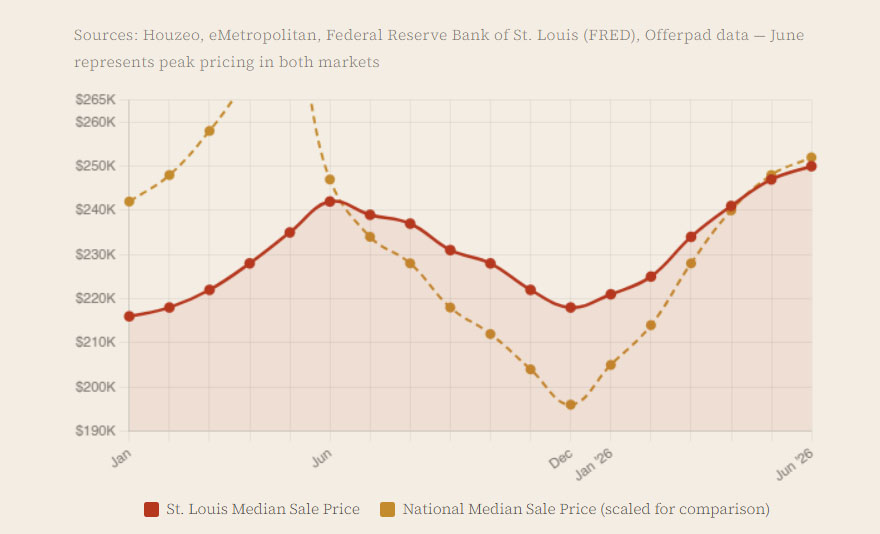
Seasonal Price Trends: St. Louis vs. National Market (National Data Scaled for Comparison)
June Is Not Just a Good Month. It's the Month.
Let's start with the national baseline, because it's an important context before we get local. Every serious piece of real estate research published in 2026 points to the same conclusion: May and June are the dual peaks of the selling season. According to Offerpad's analysis of over 2.1 million single-family transactions across 16 U.S. metro areas. May produces the most competitive offers — averaging 23.6% above list price — while June delivers the highest median closing prices at $388,791 nationally.
This isn't a coincidence. It's the convergence of three forces that hit every year like clockwork: families racing to move before the school year starts, buyers who cashed their tax refunds and now have flexible down payments, and the pleasant weather that simply gets more people to open houses. The result is a market where buyers compete harder, sellers negotiate from strength, and deals close faster.
Key Market Trend
The percentage of homes sold above list price peaked at 31% in June 2025. For the past five years, this annual peak has consistently occurred during May or June.
That data comes from Redfin, cited by The Close in their comprehensive April 2026 timing analysis. Nationally, homes sold at the seasonal peak can fetch 5% to 13% more than the same home listed in December or January. For a $250,000 St. Louis property, that's a $12,500 to $32,500 gap — real money that evaporates if you wait until fall.
The Numbers on Waiting
Opendoor's 2026 analysis found that in February 2026, a record 34% of home sellers nationwide cut their list price. Days on market averaged 57 days in January nationally, compared to just 33 days in May and June. Every month you delay past peak season can cost you leverage, time, and potentially tens of thousands of dollars. Source: Opendoor, May 2026
St. Louis Is No Longer a Secret — And That Changes Everything
Here's where it gets interesting for our market specifically. St. Louis has always had a reputation as one of the most affordable mid-size metros in the country — and that affordability has historically kept it off the radar of out-of-state investors and buyers. That era appears to be ending.
In 2026, the St. Louis housing market posted a 10% year-over-year appreciation rate — a figure that, according to local market reporting, far outpaced earlier forecasts and highlighted just how hard buyers are competing for available homes. Meanwhile, inventory sits at a critically tight 2.4 months of supply. To put that in perspective: a balanced market is typically defined as 5 to 6 months of supply. We're running at less than half that.
What does critically low inventory actually feel like on the ground? It means turnkey homes in desirable school districts — Kirkwood, Ladue, Rockwood district neighborhoods, Glendale — continue to see multiple offers. It means buyers who aren't pre-approved and ready to move fast are losing out, sometimes repeatedly. It means sellers who price well and prepare their homes properly are still getting very close to, and often at or above, the asking price.
The eMetropolitan April 2026 market report reinforces this picture: St. Louis County and St. Charles County remain firmly in seller-favored territory. Benchmark 30-year fixed mortgage rates hovered around 6.40% in late April — slightly lower than a month prior — which has nudged more buyers off the fence. Housing in the St. Louis region sits approximately 21.2% below the national average, giving it a relative affordability advantage that continues to attract buyers priced out of larger metros.
Your Zip Code Matters More Than the Metro Headline
One thing I want to be honest about: the St. Louis "market" is not a monolith. It never has been. The data you read in a national headline about St. Louis is an average across a region
that spans everything from the rapidly gentrifying neighborhoods around Forest Park and the Cortex district to quieter, more stable suburban communities in Jefferson County and beyond. Here's how the sub-markets stack up right now, based on current data:
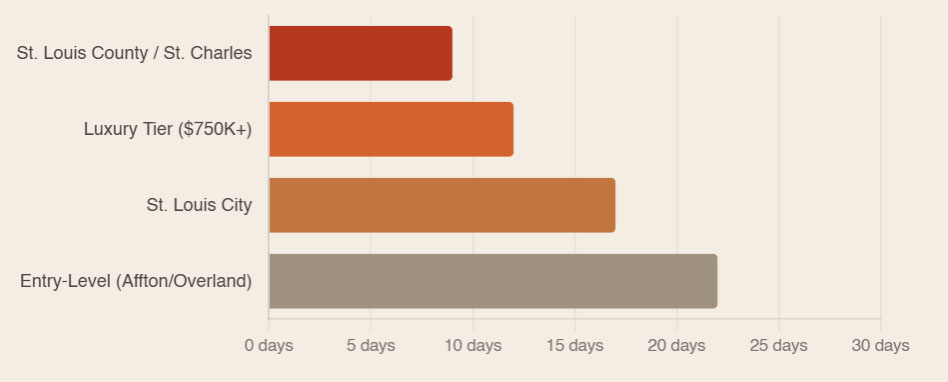
St. Louis County and St. Charles County are the hottest territories for sellers. Days on market in these counties are averaging between 7 and 10 days for move-in ready homes in competitive school districts. Buyers are paying close to full list price, and in some pockets, slightly above it. If you own a well-maintained 3-to-4-bedroom home in these areas, you are sitting on a genuine asset at its peak moment.
St. Louis City tells a slightly different story — more balanced, with a 3.5-month supply and buyers averaging about 98.6% of list price according to eMetropolitan's data. Days on market run closer to 17 days here. That's still a respectable seller's environment, just with a bit more room for negotiation. The right pricing strategy matters more in the city than in the county suburbs.
The luxury tier — homes above $750,000 — remains notably competitive. St. Louis Magazine's January 2026 market report noted that local agents were uniformly optimistic about this segment heading into spring, with move-in-ready homes at this price point described as "quite competitive."
The value segment in neighborhoods like Affton and Overland is experiencing its own shift — buyers in these areas are finally getting first offers accepted without entering bidding wars, a sign that inventory has ticked up slightly in the entry-level range. For sellers in these neighborhoods, that doesn't mean trouble; it means proper pricing and presentation matter more than they did in 2022 and 2023.
STL Market Speed: Days on Market by Area Type (June 2026)
Seller's advantage is sharpest in suburban counties — shorter DOM means more leverage and less room for buyer negotiation. Source: eMetropolitan, 2026
What the Traditional Listing Process Is Costing You This Summer
Here's a conversation that I keep having with homeowners who are sitting on the fence — and it goes something like this: they know the market is good, they know prices are up, but they're not sure if this summer is really that much better than next spring. And they're concerned about the hassle. The showings, the open houses, the negotiations, the uncertainty of where they'll go after they sell.
I understand that hesitation completely. But I want to put some actual numbers on what "waiting" looks like in this specific environment.
With the inventory of single-family homes having decreased by a notable 13.6% compared to prior periods — per Norada Real Estate's 2026 analysis of the St. Louis market — the supply constraint currently driving prices isn't guaranteed to last. Markets shift. Interest rate changes can either pull more buyers in or push them back to the sidelines. The 2026 window — specifically this June — represents the intersection of multiple favorable conditions that don't all line up every year: peak seasonal demand, critically low inventory, and a 10% year-over-year price appreciation rate that won't maintain that pace indefinitely as the market normalizes.
Seller Advantage
With only 2.4 months of housing supply, buyer demand continues to outpace the number of homes available. That's why many turnkey properties are still receiving multiple offers and why sellers continue to hold significant negotiating power in today's market.
The traditional listing process — while absolutely valid for the right seller in the right situation — does carry hidden friction costs that are worth examining honestly. Prepping a home for market, coordinating showings, waiting for offers, navigating inspection negotiations, and managing a 30-to-45-day close timeline all add up to weeks of uncertainty. In a market this competitive, the sellers who move decisively tend to capture the best results, while those who linger sometimes see their window shift around them as inventory gradually ticks up through the fall.
The Norada Real Estate forecast for late 2026 and early 2027 anticipates that the market will continue a path of moderate growth, but projects appreciation settling into a more normalized 2% to 3% annual range. That's still healthy, but it's a significant step down from the 10% rate sellers are riding right now. The sellers who act in June are not selling at the start of a long runway. They are selling at, or very close to, the peak of the current cycle.
A Practical Gameplan for June Sellers
If you're reading this and thinking it might be time to make a move, here's what I'd suggest your next steps look like — regardless of which route you take to sell.
Get a current comparative market analysis for your specific address. Not a Zestimate. Not what your neighbor thinks their house is worth. A real, agent-prepared CMA based on what has actually closed in your neighborhood in the past 60 to 90 days. The market has moved fast enough that anything older than that is already stale.
Understand your equity position. With 10% year-over-year appreciation, many St. Louis homeowners are sitting on significantly more equity than they realize. If you bought or refinanced in the past five years, run the numbers before assuming you need to stay put.
Think about your next move before you list. The inventory that's making this a seller's market affects you on the buying side, too, if you're planning to purchase locally after you sell. Sellers who have a clear plan for their next chapter — whether that's upsizing, downsizing, relocating, or a bridge solution — move with more confidence and often negotiate from a stronger position because they're not panicking on the back end.
Don't let the perfect be the enemy of the profitable. The data is clear: homes listed on Thursdays during late May through June attract the most first-weekend showings and statistically sell for more. Per Realtor.com's 2026 research, Redfin consistently identifies Thursday as the optimal listing day. You may not be able to hit every variable perfectly — but getting your home live in the next few weeks, in solid condition, at the right price, is worth far more than waiting until fall for ideal circumstances that may not arrive.
The bottom line:
St. Louis is not defying gravity. It's defying the national narrative — because our market's fundamentals are different. Affordability is well below the national average, constrained inventory, steady demand, and the seasonally strongest listing window of the year is happening right now. That combination doesn't come along every June. This one is real. (Houzeo, May 2026)
The question isn't really whether the St. Louis market is good for sellers. It clearly is. The question is whether you're going to act while the conditions are aligned — or watch this particular window from the sidelines and explain to yourself in October why you didn't move in June.
I'll leave that one with you.
Ready to Buy or Sell in St. Louis? House Sold Easy Has You Covered!
Navigating St. Louis’ red-hot luxury market doesn’t have to be a headache. With House Sold Easy, it’s all about less hassle—we’ve got you covered from start to finish. Our St. Louis experts know every corner of this city and will make buying your dream home or selling your high-end property a breeze. Don’t miss out on the hottest market in the U.S.! Contact House Sold Easy today and let’s make your real estate goals happen!