Sell a House in Probate in St. Louis | 2026 Guide
Jun 09, 2026
Written by David Dodge
Missouri's probate rules hit differently at the local level — from the St. Louis City Probate Court to St. Louis County's division, knowing the rules can save you months and thousands of dollars...
Losing someone you love is hard enough. Finding out the house they left behind — maybe a 1920s brick bungalow in Bevo Mill or a mid-century ranch in Florissant — is now tangled up in the Missouri probate court is a different kind of exhausting. I've watched families spend a year and a half trying to sell a property they didn't even want to keep, simply because nobody told them how Missouri's system actually works at the local level.
This guide is written for the St. Louis heir who is standing in a house full of memories and a mailbox full of legal notices. Whether you're dealing with the St. Louis City Probate Court, the St. Louis County Probate Division in Clayton, or one of the surrounding county courts in Jefferson or St. Charles, the rules below apply to you — and knowing them changes everything.
First: Does the House Even Have to Go Through Probate?
Not every inherited property in Missouri requires full probate, so before you do anything else, it's worth understanding when the court gets involved at all.
If the home was held in a living trust, had a transfer-on-death deed (Missouri allows these), or was jointly owned with right of survivorship, the property typically passes outside of probate entirely. The same goes for small estates — under Missouri's small estate statute, estates valued at $40,000 or less can sidestep full administration through a simpler affidavit process, though a bond and creditor notice may still be required if personal property exceeds $15,000.
But if none of those apply? If the house was titled solely in your loved one's name, with no beneficiary designation, probate is most likely required before the property can be legally sold. Until the court appoints a personal representative, nobody — not the closest relative, not the named executor in a will — has legal authority to sell that house.
Quick Reality Check for St. Louis Heirs
Simply being named as executor in a will does not give you legal authority to sell. You are only nominated — not appointed — until the St. Louis City or County Probate Court issues you Letters Testamentary. That appointment is where your real authority begins.
The Two Tracks: Independent vs. Supervised Administration
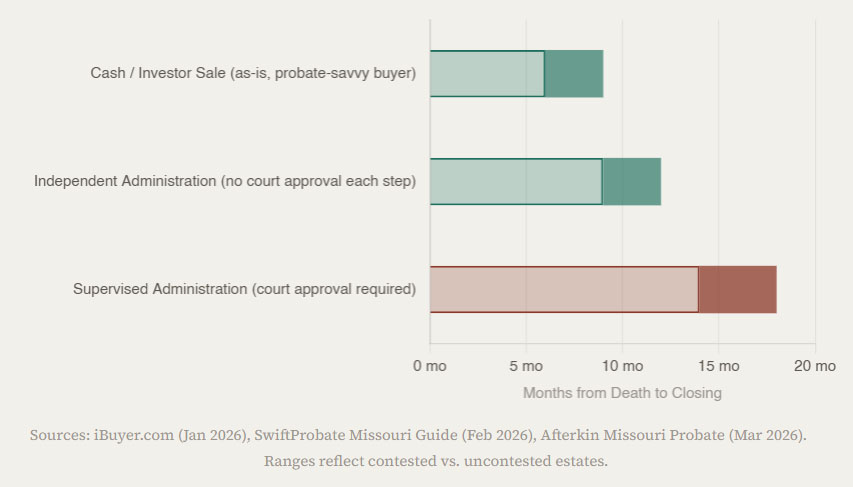
Here is where Missouri probate diverges from what people assume — and where picking the wrong path can add six to twelve months to your timeline. Missouri allows two fundamentally different ways to administer an estate, and the difference matters enormously when a house is involved.
Independent Administration: More Freedom, Less Court
Independent administration is exactly what it sounds like. The personal representative acts without court approval at each step, which means you can list the property, accept an offer, and proceed to closing without asking the court's permission for every move. This path is available when the will expressly authorizes it, or when all interested parties consent.
For most heirs trying to sell an older St. Louis home in a reasonable timeframe, independent administration is the preferred route. You still need to follow Missouri law — file your inventory within 30 days of appointment, publish notice to creditors, pay valid debts before distributing — but you are not waiting on a judge to sign off on your sale contract.
Supervised Administration: Court Approval at Every Turn
Supervised administration brings the court into the process much more actively. The personal representative must file annual accountings, and the Probate Division reviews and audits them. More critically for anyone trying to sell real estate: you need court permission before listing, and court approval before closing.
Some probate attorneys actually prefer supervised administration because it provides built-in protection against disputes between heirs — if everyone is unhappy, they can at least be unhappy with the court's blessing. But for an heir who just wants to move the property and close the chapter, supervised administration can feel like navigating a slow-moving bureaucracy.
Missouri Probate Insight
"In Missouri probate, a personal representative with letters testamentary can sell estate property unless the court orders otherwise — but in supervised estates, you cannot sign closing documents until you have a signed Court Order approving the sale."
— The Probate Law Center, Missouri
The 75% Rule: Missouri's Floor on What You Can Accept
This is probably the single most important — and most overlooked — detail in Missouri probate real estate law. If you are selling under supervised administration, Missouri law (RSMo 473.500) generally prohibits selling the property for less than 75% of its appraised value without explicit findings by the court that a lower price is justified.
Let's put that in concrete terms. If a probate appraiser values the family's South City brick two-flat at $240,000, the estate generally cannot sell it for less than $180,000 without court intervention — even if the heirs want to, even if the property needs significant repairs, and even if accepting less would close the estate faster. Going below 75% requires the court to make specific findings justifying the exception, which takes additional time and legal effort.
Missouri RSMo 473.500 — What This Means in Practice
The 75% floor applies in supervised estates. In an independently administered estate, the personal representative has more pricing flexibility — but still has a fiduciary duty to act in the best interest of heirs and creditors. Selling dramatically below market without justification can expose a personal representative to personal liability.
This rule is also why getting a real appraisal — not a Zillow estimate, not the county assessor's assessed value — is so critical. Those figures routinely diverge from true fair market value by 15% to 30% in St. Louis's older housing stock. A legitimate MAI appraisal from a licensed Missouri appraiser protects you legally and sets the floor from which you negotiate.
Missouri Probate Sale Timeline vs. Traditional Sale
Average months from death to closing — St. Louis metro area, 2026 estimates
The Six-Month Creditor Clock: The Real Reason Everything Takes So Long
Even if you have a willing buyer and a fair price lined up, Missouri law imposes a waiting period that catches most families completely off guard. After the personal representative publishes the Notice to Creditors in a local newspaper, creditors have six months to file claims against the estate. That clock does not start until publication — which can itself take weeks to arrange — and it cannot be shortened, waived, or bypassed, no matter how cooperative everyone is.
The estate cannot be formally closed, and assets cannot be finally distributed until that six-month period expires and all valid creditor claims have been reviewed and paid. This is why Missouri probate for a typical estate routinely runs nine to fifteen months from start to finish — and why the timeline in St. Louis City and St. Louis County can run even longer due to court scheduling backlogs.
Now, here is where it gets nuanced: the law doesn't necessarily prevent you from selling the house during that creditor window. In an independently administered estate, a personal representative with proper letters testamentary can list and sell the property before the six months are up — they just cannot distribute the proceeds to heirs until the creditor period closes and all debts are paid. The sale proceeds stay in the estate account. This distinction matters enormously if you are trying to prevent an inherited property from deteriorating while the legal clock runs.
The Real Cost of Probate in St. Louis: A Number People Don't Expect
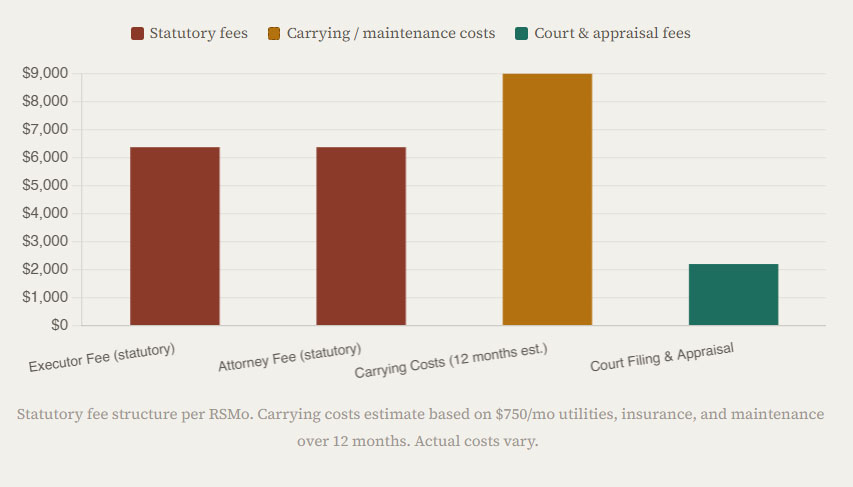
Beyond the time, probate carries real financial costs — and in Missouri, they're set by statute, which means they aren't negotiable in the usual sense. Missouri law sets executor and attorney compensation on a sliding scale: 5% of the first $5,000, 4% of the next $20,000, 3% of the next $75,000, 2.75% of the next $300,000, and 2.5% on amounts over $400,000. Both the personal representative and the estate attorney are each entitled to these fees.
For a St. Louis home worth $250,000, that means approximately $6,375 each for the executor and the probate attorney — totaling around $12,750 in statutory fees alone, before court filing costs, appraisal fees, property taxes, insurance, utilities, and any maintenance or repairs needed to keep a vacant property safe during administration.
Your Step-by-Step Roadmap: Selling a House in St. Louis Probate
Here is what the process actually looks like when you're working through it in real time. Every situation is different, but this is the general path for a standard estate in St. Louis County or St. Louis City:
-
File for probate in the right court. In St. Louis City, that's the Civil Courts Building downtown. In St. Louis County, it's the Probate Division of the Circuit Court in Clayton. You generally have one year from the date of death to file. Bring the original will (if one exists), the death certificate, and a list of known assets.
-
Receive Letters Testamentary or Letters of Administration. This is your legal authority. Nothing happens without it — no listing, no accepting offers, no accessing estate bank accounts. The court schedules an initial hearing to issue these letters and officially appoint the personal representative.
-
File the inventory and appraisement within 30 days. You must list all estate assets and their fair market values, and the court may appoint an appraiser for certain assets including real property. This is also when you get your formal appraisal of the house.
-
Publish Notice to Creditors and start the six-month clock. Your probate attorney handles the publication in a newspaper of general circulation in the county. The creditor period begins from the first publication date.
-
List and sell the property. In independent administration, you can do this while the creditor clock is running. In supervised administration, you need a court order before listing and another before closing. Work with a real estate agent who has actual probate experience — the process is genuinely different, and conventional agents often frustrate buyers by misjudging timelines.
-
Close the estate after the creditor period. Once the six months expire, all valid claims are paid, taxes are filed, and your final accounting is approved, the court releases the estate for distribution. Proceeds from any home sale held in trust during the creditor period are distributed to heirs at this point.
Why Tired Heirs Often Choose a Cash Buyer — And When It Makes Sense
I want to be honest here, because a lot of content on this topic is written by cash buyers trying to scare you into a low offer. That said, there are very real situations where a probate-specific cash buyer or investor sale is the right answer — not just for speed, but financially.
The classic scenario: an estate with a vacant 1950s ranch in Ferguson or a multi-family property in north St. Louis that hasn't been maintained. The house needs $40,000 in repairs to be retail-ready. The heirs live out of state. The estate has creditors. Every month it sits, it costs $700 in utilities, insurance, and upkeep — plus the psychic cost of managing contractors from 800 miles away. A cash buyer who can close in 30 to 45 days, accepts the property strictly as-is, and understands the probate process doesn't require a conventional buyer's financing contingency or inspection repair credits.
What cash buyers offer is not a higher price — it's certainty, speed, and the elimination of carrying costs that can erode 5% to 8% of a home's value over a year-long probate. When you do the math honestly, a $185,000 cash offer on a $220,000 house can net more than a $225,000 retail sale that closes 14 months later after $15,000 in repairs, $9,000 in carrying costs, and $12,750 in statutory fees.
| Factor | Traditional Retail Sale | Cash / Investor Sale |
|---|---|---|
| Time to Close | 10–18 months (with probate) | 30–60 days (probate-experienced buyer) |
| Sale Price | Full market value possible | Typically 70–85% of ARV |
| Repairs Required | Usually expected by the buyer | None — strict as-is |
| Court Approval Needed | Yes (supervised) / No (independent) | Same rules apply — but process is faster |
| Financing Risk | High — loan fall-through is common on older homes | None — cash buyer doesn't need financing |
| 75% Rule (Supervised) | Must comply — limits low offers | Must comply — cash doesn't exempt you |
| Best For | Updated, well-maintained properties; heirs in agreement; local family |
Deferred maintenance; out-of-state heirs; estate with creditors; urgent closure |
Things That Derail St. Louis Probate Sales — And How to Avoid Them
In my experience watching families navigate this process, the same mistakes recur. Here are the biggest ones:
Relying on Zillow or the County Assessor for Value
St. Louis County's assessed values are notoriously inconsistent with actual market value, especially for older properties in established neighborhoods. Zillow's algorithm struggles with brick construction, non-standard layouts, and the condition disparities that define St. Louis's older housing stock. Using either figure as your benchmark for the 75% rule is a mistake that can create legal exposure. Get a real appraisal.
Listing Without Court Authority (Supervised Estates)
I've seen heirs list a house on the MLS before the Letters Testamentary were issued, or in a supervised estate, before a court order was obtained. This creates a mess — any accepted offer that can't close due to a lack of legal authority burns bridges with buyers and agents and delays the actual sale by months.
Choosing an Agent Who Doesn't Know Probate
A conventional agent who quotes a buyer a 45-day closing timeline on a supervised probate property, then has to explain three weeks later that the sale requires court approval before closing, will lose that buyer. Work with someone who knows the process cold and sets accurate expectations from day one.
Ignoring Carrying Costs on Vacant Property
A vacant house in St. Louis is not neutral — it is actively depreciating. Break-ins, vandalism, pipe freezes in winter, and overgrown lots — these all hit the final sale price. If the estate is moving slowly, be proactive: winterize, board windows if necessary, maintain the lawn, and keep insurance current. Many insurance carriers will not cover a property that's been vacant for more than 30 or 60 days without a specific rider.
The Bottom Line for St. Louis Heirs in 2026
Missouri probate is not a quick process, and St. Louis's court system — while staffed with knowledgeable probate judges — has real scheduling constraints that extend timelines beyond what the law technically requires. The typical Missouri probate runs 9 to 15 months, and St. Louis City and County courts can extend that further.
The families who get through this with the least damage — financially and emotionally — are the ones who hire a probate-experienced attorney early, understand which type of administration they're in from day one, get a real appraisal before making any pricing decisions, and make an honest assessment of whether a traditional or cash sale better fits the specific property and their family's situation.
The house is just a house. What matters is closing this chapter cleanly, honoring what your loved one left behind, and getting everyone to the other side without unnecessary fights over money or timeline.
If you're working through this right now in St. Louis, you don't have to figure it out alone.
Ready to Buy or Sell in St. Louis? House Sold Easy Has You Covered!
Navigating St. Louis’ red-hot luxury market doesn’t have to be a headache. With House Sold Easy, it’s all about less hassle—we’ve got you covered from start to finish. Our St. Louis experts know every corner of this city and will make buying your dream home or selling your high-end property a breeze. Don’t miss out on the hottest market in the U.S.! Contact House Sold Easy today and let’s make your real estate goals happen!