Lou-midity Survival Guide: 5 St Louis Missouri Home Checks
Jul 01, 2026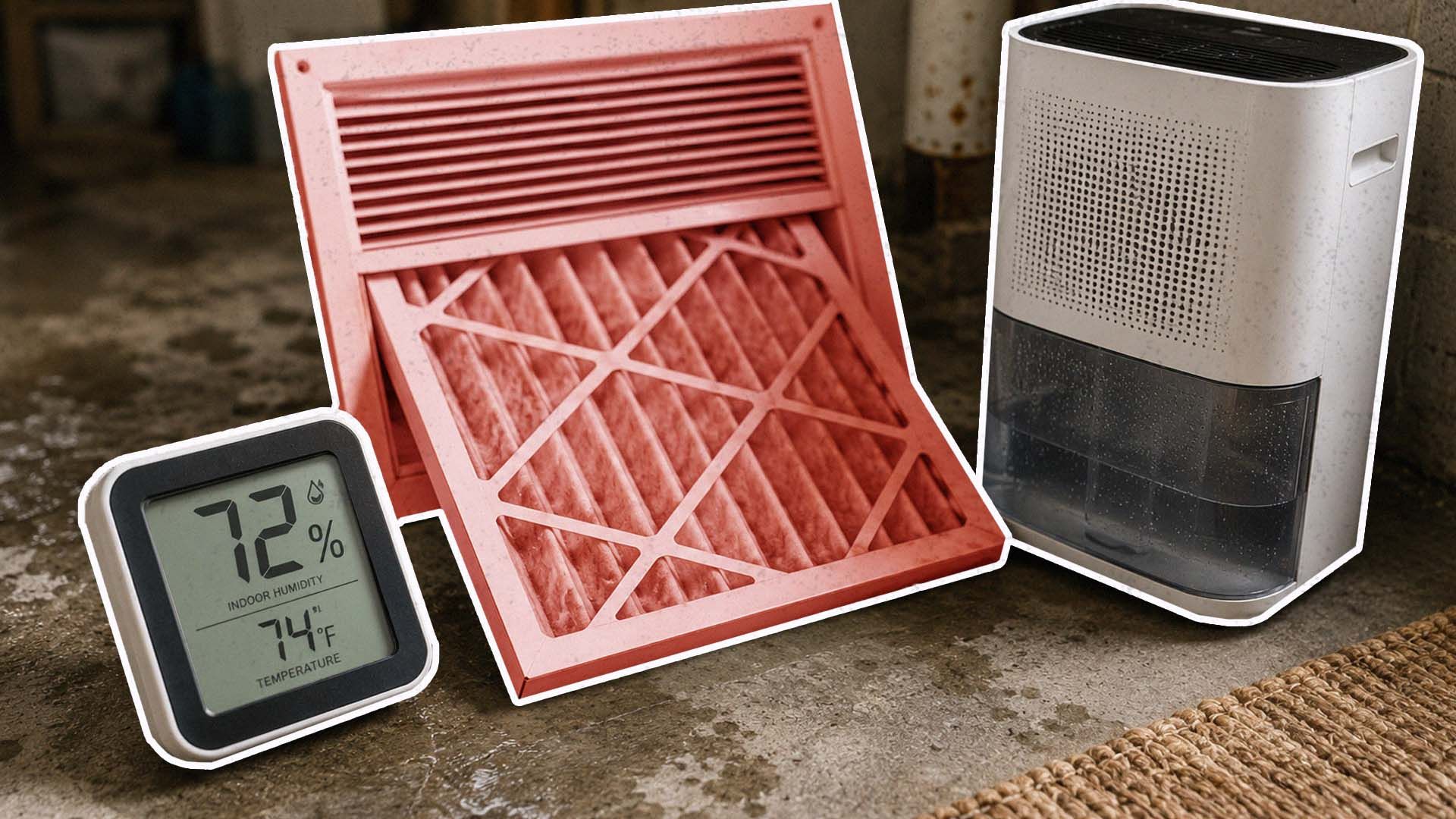
Written by David Dodge
There's a moment every year, usually right around the last week of June, when you step outside in St. Louis, and the air just changes. It's not simply hot — Phoenix is hot. It's that thick, soupy, can't-quite-catch-your-breath humidity that locals have come to call "Lou-midity." If you've lived here longer than a single summer, you already know the drill: the cicadas start buzzing, the window units start groaning, and every basement in South City and Webster Groves starts sweating right along with the rest of us.
This year is shaping up to be a textbook example. Meteorologist Glenn Zimmerman's 2026 summer outlook for the St. Louis region describes a pattern where overnight lows barely dip, which keeps afternoons brutally hot, and notes that humidity will run high again this summer with a 99- or 100 degree day possible — what he calls a classic St. Louis August. That's not a one-off forecast quirk. It's the same pattern that's been hammering older homes in this region for decades: hot days, warm nights, and air so saturated with moisture that it finds its way into every crack, crawl space, and stone foundation in the metro.
So before you write off another summer of musty basements and surprise AC repair bills, let's walk through the five maintenance checks that actually matter right now — not generic "spring cleaning" advice, but the specific stuff that keeps a St. Louis home running smoothly (and holding its value) through a heatwave like the one we're already in.
Why this particular week matters
Late June into early July is a strange in-between period for St. Louis homeowners. The novelty of summer has worn off, the AC has been running for a few weeks straight, and the first real heat-and-humidity combo of the season is starting to expose whatever weaknesses your home's systems were hiding. It's also, not coincidentally, prime real estate season — and that timing matters more than people think.
Buyers shopping for homes this summer aren't just looking at countertops and curb appeal anymore. According to a nationwide Bright MLS survey covered in a recent 2026 housing market breakdown, more than 56% of buyers said a home's move-in-ready condition was "very important," with another 38% calling it "somewhat important" — a sharp shift from the pandemic-era market where buyers would overlook deferred maintenance just to win a bidding war. That same piece notes that higher interest rates and elevated ownership costs have made today's buyers far more cautious about inheriting expensive repairs after closing.
HVAC conditions in particular have become a flashpoint. A buyer-focused breakdown of what people are looking for in 2026 points out that experienced repeat buyers — who now dominate the market as first-time buyer numbers shrink — read inspection reports closely because they understand how hidden systems quietly drive up ownership costs over time. The same source recommends sellers keep simple documentation on hand, including dates of HVAC tune-ups, repairs, filter changes, and any duct or air-quality service, because that paperwork builds trust fast.
In other words, whether you're planning to sell next spring or you're simply trying to protect the biggest investment you own, the next few weeks of summer heat are exactly when small maintenance gaps turn into big, expensive ones. Here's where to focus.
1. Change your AC filter — and check it more often than you think you need to
This is the most boring item on the list and also the one most homeowners blow off. In St. Louis, where the AC is running nearly nonstop from June through August, a dirty filter doesn't just reduce comfort — it forces your whole system to work harder, which shortens its lifespan and spikes your electric bill.
A general rule of thumb is to check a standard 1-inch filter every 30 days during peak season and swap it out as soon as it looks gray or matted. If you've got pets, allergies, or a home near a busy street, you may need to check it every two to three weeks instead. It sounds almost too simple to matter, but a clean filter directly affects airflow, humidity removal, and the load on your compressor — the exact component most likely to fail during a 95-degree week.
There's also a buyer-facing reason to take this seriously, even if you're not selling this year. Recent buyer behavior research notes that today's home shoppers don't usually ask for technical HVAC specs right away — they notice comfort clues instead, like whether the home smells clean when the air starts moving and whether the vents look dusty. A fresh filter and clean supply vents are a five-minute fix that changes how a home feels the moment someone walks in.
Quick check: Pull the filter, hold it up to a light source. If you can't see light coming through clearly, it's time to replace it — full stop.
2. Check your basement dehumidifier (this one's non-negotiable for stone foundations)
If you own a home in South City, Webster Groves, Maplewood, or any of the older neighborhoods built on classic limestone or fieldstone foundations, this section is for you specifically. Those foundations are gorgeous and durable, but they were built in an era before modern vapor barriers and exterior drainage systems, which means they're naturally more susceptible to ground moisture — especially once dew points climb into the 70s, a pattern St. Louis sees regularly throughout July and August.
A properly sized basement dehumidifier isn't a luxury appliance in these homes; it's structural maintenance. Run a quick checklist this week:
- Empty or check the drain line. If your unit drains into a floor drain or condensate pump rather than a bucket, make sure that line isn't clogged or kinked — a blocked line will shut the unit down or cause it to overflow.
- Clean the coils and filter. Dust and lint buildup on the coils dramatically reduces efficiency, just as it does on your central AC.
- Set the target humidity correctly. Most basements should sit between 45% and 55% relative humidity in summer. Above 60%, you're in mold and dust mite territory; below 40%, you're paying for moisture removal you don't need.
- Listen for it. A dehumidifier that's running constantly without ever shutting off is either undersized for the space or losing efficiency — both worth investigating before peak humidity season hits in late July.
This matters for more than comfort. Persistent basement dampness is one of the most common — and most preventable — sources of long-term home damage, and it's also one that insurers are quick to point to when a claim gets denied. A breakdown of water damage coverage published earlier this year notes plainly that homeowners insurance covers water damage only when it's sudden, accidental, and starts from inside your home — gradual seepage and humidity-driven moisture problems generally aren't covered, no matter how bad they get. Staying ahead of basement humidity with a working dehumidifier is one of the few maintenance tasks that protects both your foundation and your insurance position at the same time.
3. Clear gutters and downspouts before the next round of summer storms
St. Louis summers don't just bring heat — they bring violent, fast-moving thunderstorms that dump an inch or two of rain in under an hour. If your gutters are clogged with the seed pods, leaves, and debris that built up over spring, that water has nowhere to go except straight down the side of your house and into the soil around your foundation.
This is a classic case of a five-dollar problem becoming a five-thousand-dollar one. AAA's 2026 spring maintenance guidance specifically flags this as one of the most common preventable insurance claims, recommending homeowners clear leaves and debris from gutters and downspouts and confirm that water is actually flowing away from the foundation, noting that clogged gutters force water into roof trim, siding, and interior walls instead of away from the home. Worth noting too — most standard homeowners insurance policies treat gutter neglect as a maintenance issue, not a covered peril, so the cost of skipping this falls entirely on the homeowner.
A few things to check on the same trip up the ladder:
- Downspout extensions. Water should discharge at least 4–6 feet away from the foundation. If your extensions are missing, crushed, or pointed straight at the basement wall, that's an easy fix that prevents a hard problem.
- Splash pooling near the foundation. After the next storm, walk the perimeter of your house and look for standing water within a few feet of the walls. That's a strong early warning sign of grading or drainage issues that get worse every year if ignored.
- Sagging sections or pulling fasteners. Heavy debris and standing water add weight that strains gutter hangers over time, especially on older homes where the fascia board itself may have softened.
4. Inspect your outdoor condenser unit and clear its airflow
Your AC's outdoor unit works overtime in St. Louis summers, and it's also the piece of equipment most likely to be quietly choked by yard debris, mulch, or overgrown landscaping without anyone noticing until the system starts struggling. Walk outside and check for at least two feet of clearance on all sides — grass clippings, mulch buildup, and overgrown shrubs all restrict airflow and force the compressor to run harder than it should.
While you're out there, gently hose down the condenser coils (with the power off) to clear dust and pollen, and confirm the unit is sitting level — ground settling over time can tilt the pad and stress the refrigerant lines. This single check takes ten minutes and is one of the most effective things a homeowner can do to prevent a midsummer breakdown, which, in St. Louis, always seems to happen on the hottest day of the year and never on a convenient Tuesday morning.
5. Reseal and inspect exterior caulking around windows and doors
This last one doesn't get nearly enough attention, but in a humid climate, it matters just as much as anything on this list. Cracked or shrinking caulk around window frames and exterior doors lets humid outdoor air seep directly into your walls, which both undermines your AC's efficiency and creates a slow-moisture pathway that can lead to wood rot and mold growth behind the drywall — problems that are far more expensive to fix than they are to prevent.
Walk the exterior of your home and look for any visible gaps, cracking, or peeling caulk lines, particularly on the side of the house that gets the most direct afternoon sun, since UV exposure breaks down sealants faster than people expect. A tube of quality exterior caulk costs under $10, and a couple of hours of work on a Saturday morning can meaningfully cut your home's humidity infiltration for the rest of the season.
The bigger picture: why this connects to your home's value, too
It's tempting to treat summer maintenance as purely a comfort issue — nobody wants a sticky basement or a wheezing AC unit. But there's a real financial dimension here too, and it's becoming more pronounced every year. Buyer behavior research focused on the 2026 market consistently points to mechanical systems and moisture control as top-tier concerns, not afterthoughts. The same buyer-priorities research cited earlier notes that sellers who only focus on cosmetic updates are increasingly missing the mark, since buyer confidence today is shaped by clean HVAC performance, safer air, moisture control, and visible evidence that a home has been cared for over time.
That's worth sitting with for a second if you're a St. Louis homeowner with an older stone foundation or a system that's a decade or more old. The maintenance described above isn't just about getting through this particular heatwave comfortably — it's about avoiding the kind of inspection-report red flags that turn into negotiating leverage for a buyer, or worse, an insurance claim denial because a moisture problem was allowed to become "gradual damage" instead of being caught early.
What "Lou-midity" actually looks like this year, by the numbers
To put this summer's pattern in context, it helps to see how St. Louis humidity actually tracks month to month compared to the rest of the country's hot zones. The chart below shows average July relative humidity and average high temperature for St. Louis against a few other regions known for tough summer climates — useful context for understanding why a stone basement here behaves so differently than one in, say, Phoenix or Denver.
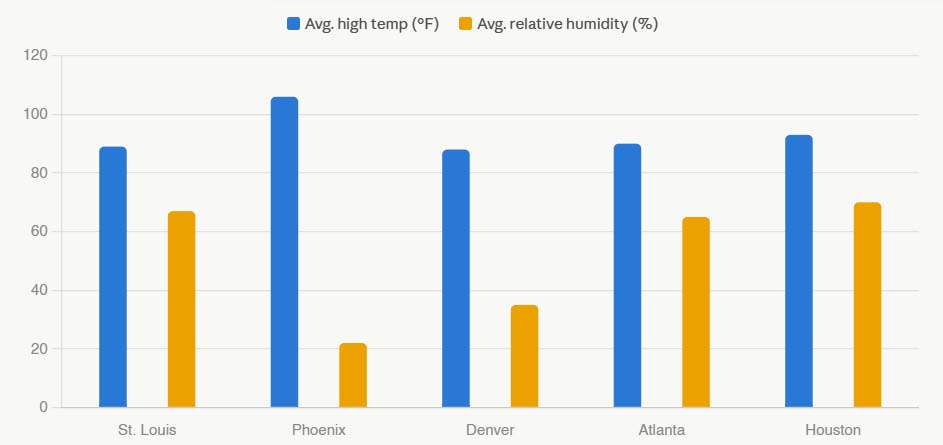
The takeaway from that comparison is simple: St. Louis doesn't have the highest temperatures in the country, but it consistently ranks near the top for the combination of heat and humidity — which is exactly the combination that stresses HVAC systems, basement moisture levels, and exterior building materials simultaneously. That's the whole reason "Lou-midity" is a distinct, locally understood phenomenon rather than just a nickname.
A simple weekend checklist
If you only have one Saturday morning to spend on this before the next heat wave rolls through, here's the priority order:
- Check and replace your AC filter if it's been more than 30 days.
- Confirm your basement dehumidifier is draining properly and holding 45–55% humidity.
- Clear gutters and confirm downspouts discharge well away from the foundation.
- Clear two feet of space around your outdoor condenser unit.
- Spot-check exterior caulking on the sun-facing side of your home.
None of these require a contractor or a big budget. Most take less than 30 minutes each, and together they cover the four areas — air handling, moisture control, drainage, and building envelope — that do the most damage when neglected through a long, humid St. Louis summer.
The bottom line
St. Louis summers are not subtle. Between the heat, the humidity, and the storm pattern that tends to roll through every few days from late June onward, this is a climate that punishes deferred maintenance faster than most. The good news is that the fixes are straightforward, inexpensive, and don't require specialized skills — just a regular habit of checking the systems that quietly keep a home dry, cool, and structurally sound.
Whether you're staying put for another decade or thinking about listing in the next year or two, the homes that handle a St. Louis summer the best are the ones where someone is paying attention to the boring stuff: filters, drains, gutters, and caulk. Beat the humidity this year, and your basement, your AC bill, and your home's resale value will all thank you for it.
Ready to Buy or Sell in St. Louis? House Sold Easy Has You Covered!
Whether you're thinking about listing your home or exploring a cash offer, it's worth understanding all of your options before making a decision. The right choice depends on your timeline, your property's condition, and your goals. Contact House Sold Easy to discuss your situation and see what makes the most sense for you.Our St. Louis experts know every corner of this city and will make buying your dream home or selling your high-end property a breeze. Don’t miss out on the hottest market in the U.S.! Contact House Sold Easy today and let’s make your real estate goals happen!