Leaving STL for the 4th? Pre-Stage Your Home First
Jun 30, 2026
Written by David Dodge
It happens every year around this time. The cooler is in the trunk, the dog is at the in-laws', and half of St. Louis is pointed west toward the Lake of the Ozarks or south toward Table Rock for the Fourth of July. For most homeowners, that's a welcome break from the heat. But if your house is currently on the market — or about to be — leaving town during the last week of June doesn't pause your sale. It just changes the conditions you're selling under.
This is peak season. Buyers are still touring. Agents are still scheduling showings. And in a metro where homes are moving in well under two months on average, a week of neglect at the wrong moment can cost you a showing, a buyer, or worse, an offer. The good news is that none of this requires canceling your trip. It requires about ninety minutes of prep before you load the car.
Why This Week Matters More Than You Think
St. Louis is not a market where sellers can afford to "go dark" for a week without consequence. The numbers back this up. Local data from the St. Louis REALTORS® Monthly Housing Report shows residential days on market actually decreased in the most recent reporting period even as inventory rose, which tells you buyers are still moving fast when they find something they like. Redfin's May 2026 figures put the metro's average time on market at 21 days, with the broader region still scoring as a "very competitive" market. Houzeo's 2026 forecast describes the city as sitting in "neutral territory" with homes moving in 48 days and 3.6 months of supply — balanced, but still active enough that a stale listing gets noticed.
Here's the part sellers tend to forget: showings don't stop just because you're at the lake. Buyers relocating for jobs at BJC HealthCare, Centene, or Wash U's research corridor, along with what local analysts are calling "equity migrants" — buyers arriving from pricier markets like Chicago or Denver with cash from a prior sale — are actively touring St. Louis homes right through the holiday week. If your house looks neglected on the one day a serious buyer walks through, that's the impression that sticks, regardless of how good your listing photos were three weeks ago.
There's also a less obvious risk: the home itself. An empty house in July, in St. Louis humidity, is its own liability. HVAC strain, mail piling up, packages sitting on a porch in full view of the street — these aren't just safety concerns; they're showing concerns. A buyer's agent walking a client through a home with a stuffed mailbox and a thermostat blasting AC to 65 degrees for no one is going to notice. So will a buyer's nose, when a humid, closed-up house starts to smell musty after four days.
The Climate Control Balancing Act
St. Louis summers are brutal on a vacant house. Humidity in the 70-90% range is normal for late June and July, and a home that sits closed up with the AC off — or worse, fully shut down to save money — becomes a breeding ground for mold, warped wood, and a stale smell that's nearly impossible to air out before a showing.
The fix isn't "blast the AC the whole time you're gone." It's a smarter setpoint. Most HVAC technicians recommend holding an empty home around 78–80°F while you're away rather than shutting the system off entirely. That keeps humidity in check without burning through electricity for an empty house. If your thermostat is a smart model — Nest, Ecobee, or similar — you can also set a "ready in 2 hours" schedule that drops the temperature back to a comfortable 72°F automatically before a scheduled showing window, so the house feels fresh rather than swampy when a buyer walks in.
Several recent home-security guides covering this exact scenario point to remote-controlled thermostats as one of the simplest wins for a vacant property. As one 2026 industry guide on summer home security put it, even if you forget to manually adjust your HVAC before leaving, thermostats can be remotely pre-set to turn up or down at specific times, and temperature sensors can detect extreme outdoor weather fluctuations. That's a meaningful difference between coming home to a warped hardwood floor and coming home to a house that's still showing-ready.
If you're working with a listing agent, this is also worth a quick conversation before you leave: ask whether they can get into the smart thermostat app, or give them a guest code, so they can adjust the temperature ahead of a same-day showing request without you needing to be reachable from a boat dock.
The Porch Problem: Packages and Curb Signals
Nothing undercuts a listing's curb appeal faster than a stack of Amazon boxes baking on the front step. It's not just unsightly — it's a flashing sign to anyone driving by that nobody's home, which is exactly the wrong message to send to a neighborhood full of potential buyers, nosy passersby, and yes, opportunistic thieves.
This is one of the most consistent pieces of advice across nearly every current home-security resource covering summer travel. One 2026 home-protection checklist is blunt about it: empty driveways, uncollected mail, and inactive entry points can quickly signal that a home is unattended, and that absence is often the first thing an opportunistic person notices. A separate 2026 guide focused specifically on holiday travel echoes the same point, recommending that homeowners pause mail delivery or have a trusted neighbor collect mail and packages to avoid a tell-tale overflowing mailbox, and that if deliveries can't be paused entirely, tracking them through carrier apps, rerouting to a locker, or using a secure delivery box helps avoid the problem altogether.
For a home that's actively listed, this matters on two fronts:
Buyer perception. A buyer pulling up for a showing forms an opinion before they ever get out of the car. A clean, lived-in-looking exterior signals a well-maintained home. A pile of boxes signals the opposite, even if the inside is immaculate.
Practical security. An empty house sitting on the market, often with a lockbox on the door and showing times posted in an app multiple agents can see, is already a slightly more exposed property than a typical occupied home. Compounding that with visible signs of an absent owner is an easy problem to avoid.
A few practical options for the week:
- Hold mail at the post office through USPS's online hold-mail request, which stops delivery until a date you specify.
- Reroute Amazon and other carrier packages to an Amazon Locker, a neighbor's address, or simply push delivery dates to the week you're back.
- Ask a neighbor or your agent's team to do a single midweek porch sweep if you can't avoid deliveries entirely — this is the single most-cited tip across current home security guidance for exactly this kind of situation.
Automated Lighting: The Cheapest Insurance You'll Buy This Summer
If there's one piece of advice that shows up in literally every current guide on securing a home during travel, it's this: make the house look occupied. Static, always-off lighting reads as "nobody's home" almost instantly after dark. A smart lighting setup that mimics a normal evening routine — a lamp in the living room around dusk, a bedroom light later, porch light on a timer — does the opposite.
A 2026 vacation security checklist describes this directly, noting that one of the smartest vacation home security strategies is making it appear that someone is still home, using smart plugs or automated timers to set lamps on a natural staggered cycle rather than one predictable on/off pattern that an observant passerby could clock in a day or two. A separate 2026 guide aimed at holiday travelers gives the same advice in plainer terms: use timers for lights or smart home devices to make it seem like someone is home, which can deter potential break-ins.
For a listed home specifically, this has a dual benefit. It protects the property exactly the way it would for any vacant home — but it also means that if a showing happens to land in early evening (common in summer, when buyers tour after work to avoid the afternoon heat), the house already has warm, ambient light instead of sitting dark and uninviting. You're not just deterring a break-in. You're staging the home for the 6:30 pm walkthrough you didn't know was coming.
Smart plug kits start under $30 for a basic two-bulb setup and can be controlled entirely from a phone, meaning you can adjust the schedule from the boat ramp at the Lake of the Ozarks if a showing gets added to your agent's calendar mid-week.
The Bigger Picture: Why Summer Specifically Raises the Stakes
It's tempting to treat all of this as generic "going on vacation" advice that applies any time of year. The data says otherwise — summer is measurably the highest-risk season for this exact category of problem.
According to a special report from the U.S. Department of Justice's Bureau of Justice Statistics, researchers who analyzed seventeen years of national victimization data found that household property victimization rates increased in the summer, averaging 11 percent higher than the lowest winter seasonal rates, with summer registering as the peak season in nearly every year studied. That's not a one-off statistic from a single bad year — it's a consistent, multi-decade pattern.
The chart below illustrates that seasonal pattern, indexed against winter as the baseline:
Household Property Crime Rises in Summer
U.S. Seasonal Index, 17-Year DOJ/BJS Analysis
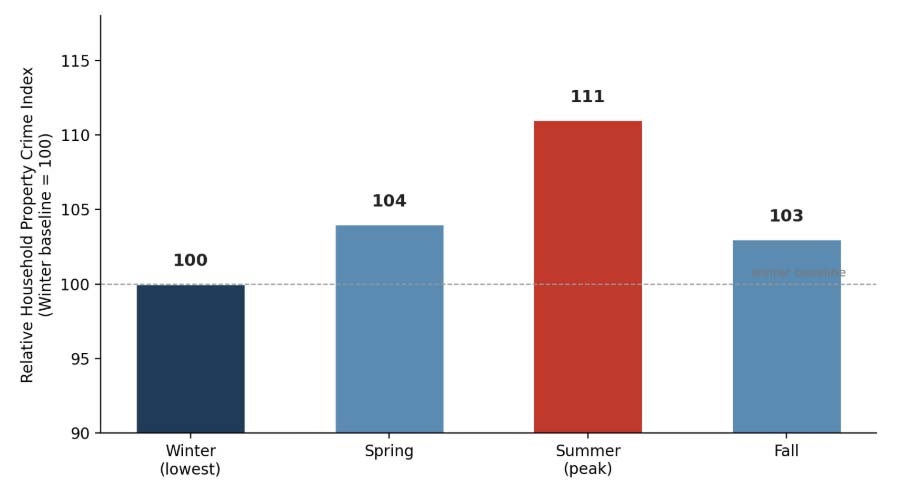
Put plainly: the week you're most likely to be out of town for the Fourth is also, statistically, one of the higher-risk windows of the entire year for an unattended property. That's true whether your home is your primary residence or an active listing — but for a listing, the consequences compound, because an incident during showing season doesn't just cost you peace of mind, it can cost you a closing.
A Quick, Realistic Pre-Departure Checklist
None of this needs to eat into your packing time. Treat it as a fifteen-minute lap around the house before you load the cooler.
- Set the thermostat to 78–80°F (not off) to control humidity without wasting energy on an empty house. If you have a smart thermostat, schedule a "showing-ready" temperature drop your agent can trigger remotely.
- Pause or reroute deliveries for the dates you'll be gone, or arrange for a single trusted person to clear the porch midweek.
- Put interior and porch lighting on a staggered smart-plug schedule rather than one predictable timer setting.
- Confirm exterior doors, windows, and the garage are locked, and remove any spare key hidden outside — a habit flagged repeatedly across this year's home-security guidance as one of the easiest entry points to overlook.
- Hold off on posting vacation photos in real time. As one current guide on this exact topic puts it, a safer approach is to wait until you return home before sharing your trip online, since this simple habit can help reduce the risk of your absence being noticed by the wrong people. That's good advice for any homeowner, but especially for one whose address is currently searchable on every major listing site.
- Loop in your agent. Let them know your travel window, confirm who has access for showings, and ask how last-minute showing requests will be communicated to you while you're out of cell range at the lake.
What This Looks Like Neighborhood by Neighborhood
St. Louis isn't one market — it's dozens of micro-markets stacked on top of each other, and how aggressively you need to pre-stage before a trip depends partly on where your listing sits.
In high-demand inner-ring suburbs like Kirkwood, Webster Groves, Glendale, and Des Peres, agents have described inventory as tight enough that well-priced, move-in-ready homes are still drawing competitive interest well into the summer. One Webster-Kirkwood area broker put it plainly earlier this year: pricing and presentation have to be right because buyers are walking away from deals more often than they used to, which means the margin for a sloppy showing — a stuffy house, a porch full of packages — is thinner than it would be in a true seller's free-for-all. If your home is in one of these tighter pockets, a week of neglect is a week a more polished comparable listing gets the showing instead.
In the city proper and some of the more affordable inner suburbs, the math is a little different but the stakes aren't lower. Homes there have been sitting slightly longer on average — Redfin's data put the city's median days on market in the high teens to low twenties, while broader city-level analysis from Houzeo shows homes citywide averaging closer to 48 days with a 3.6-month supply. That's a more balanced market, which actually raises the importance of presentation rather than lowering it: when buyers have a few comparable options instead of one obvious winner, the small things — curb appeal, a fresh-feeling interior, no overflowing mailbox — become differentiators instead of afterthoughts.
And at the top of the market, anything above roughly $750,000, agents covering the Kirkwood-Webster corridor have said that segment remains genuinely competitive for move-in-ready properties and is expected to stay that way through the rest of 2026. Higher-end buyers touring in this range are also more likely to be relocating from out of state — Wash U-affiliated researchers, healthcare executives recruited to BJC or Centene, or what local analysts have started calling "equity migrants" arriving with cash proceeds from selling a home in a pricier metro. These buyers often compress their entire St. Louis house-hunting trip into a long weekend, which means the few days they're in town touring could easily land during your holiday week, whether you planned for it or not.
What Your Agent Should Be Doing While You're Gone
Pre-staging the house before you leave solves half the problem. The other half is making sure whoever's running point on your listing has what they need to keep things moving without you physically present.
Before you head out, it's worth a five-minute call or text thread covering a few specifics:
- Lockbox and showing access. Confirm the lockbox code is current and that your agent's showing service (most St. Louis brokerages use ShowingTime or a similar platform) is set to notify both of you the moment a showing is booked, not just after the fact.
- A point of contact for last-minute requests. If a buyer's agent calls asking for a same-day showing on July 3rd, your listing agent needs the authority to say yes without tracking you down on a boat. Decide ahead of time what your agent can approve unilaterally versus what needs your sign-off.
- Smart home access. If you're using a smart thermostat or lighting system to keep the house showing-ready, consider sharing guest access with your agent so they (or a showing assistant) can nudge the temperature down or check that lights are functioning before a same-day appointment, rather than relying on a schedule set a week in advance and hoping it holds.
- A quick midweek check-in. Even a simple text — "anything come up?" — on day three or four of your trip keeps you from coming home to a week's worth of missed showings or feedback you didn't see in real time.
This is also a good moment to ask your agent directly how they handle showings during major holiday weeks generally. Some teams intentionally front-load showings into the days just before a holiday, anticipating that buyer traffic dips on the holiday itself and picks back up the weekend after. If that's the case for your listing, you may have more flexibility to relax for the actual 4th than you'd expect — but you'll only know if you ask.
The Cost of Getting This Wrong
It's worth being direct about what's actually at stake here, because "pre-stage your home before vacation" can sound like a nice-to-have rather than something with real financial consequences.
A vacant, neglected-looking home during an active listing period creates a few compounding risks. First, there's the showing itself — a buyer who walks into a humid, stale-smelling house with mail piled on the counter forms an impression that's hard to undo, even if they come back for a second look later. First impressions in a home sale are disproportionately powerful; buyers routinely make a gut decision within the first ninety seconds of walking in the door, and a house that smells like it's been sealed up for a week starts that ninety seconds in a hole.
Second, there's the practical risk to the property itself. St. Louis humidity left unchecked for several days can warp hardwood floors, encourage mold growth in bathrooms and basements, and stress HVAC systems that then have to work overtime to recover, sometimes triggering exactly the kind of mechanical issue that shows up on a buyer's home inspection a few weeks later. A thermostat held at a sane setpoint the entire time is far cheaper than an emergency HVAC repair mid-contract.
Third, and most avoidable, is the curb-appeal damage from something as simple as an overflowing mailbox or a stack of packages. Buyers and their agents are driving by listed homes constantly — sometimes scouting a neighborhood before they ever book a showing. A home that looks abandoned, even temporarily, can quietly drop off a buyer's mental shortlist before an actual appointment is ever scheduled.
None of these are dramatic risks individually. Together, over a week when buyer traffic doesn't actually slow down the way you might assume, they add up to a meaningfully worse selling position than the fifteen minutes of prep it takes to avoid them.
Quick Questions Sellers Actually Ask
Should I just take the house off the market for the week instead? For most active St. Louis listings, no — pulling a listing or marking it temporarily off-market resets some of the momentum it's built, and re-listing later can reset the "days on market" clock buyers and agents pay attention to. Pre-staging the home so it can still be shown is almost always the better move than going dark entirely, unless you have a specific strategic reason your agent recommends otherwise.
Is it worth paying for a house sitter just for one week? It depends on the home and the price point. For higher-end listings, particularly anything north of $750,000 where buyers expect a flawless walkthrough, a midweek check from a trusted person — even a neighbor doing a quick once-over rather than a paid service — is usually worth the peace of mind. For more modestly priced homes, a combination of paused deliveries, smart lighting, and a controlled thermostat covers most of the same ground without the added cost.
What if a showing gets requested while I'm out of cell range? This is exactly why the conversation with your agent beforehand matters. If they already know your travel dates and have clear authority to approve standard showing requests on your behalf, a dead zone at the lake doesn't have to mean a missed opportunity.
Does any of this actually move the needle on sale price? Not directly — pricing strategy and market conditions do the heavier lifting there. But a home that consistently shows well, smells fresh, and looks cared for tends to spend fewer days getting written offers, and homes that sell faster typically see less price erosion from repeated showings, feedback-driven price cuts, or a listing that starts to look stale on portals like Zillow and Redfin. In a market where St. Louis REALTORS® and Redfin both show days-on-market hovering in the three-to-seven-week range depending on the segment, shaving even a few days off that timeline by avoiding a bad showing week is a real, if modest, advantage.
Final Thought
St. Louis's summer market doesn't take a holiday, even when half the metro does. The metro's affordability advantage and steady demand from relocating buyers mean serious showings keep happening through the Fourth of July week, not despite it. A house that's pre-staged to look occupied, climate-controlled, and clutter-free at the curb is a house that's still competing for buyers while you're floating on the lake — instead of quietly losing ground to a tidier listing three doors down.
Enjoy the holiday. Just give your house fifteen minutes before you go.
Ready to Buy or Sell in St. Louis? House Sold Easy Has You Covered!
Whether you're thinking about listing your home or exploring a cash offer, it's worth understanding all of your options before making a decision. The right choice depends on your timeline, your property's condition, and your goals. Contact House Sold Easy to discuss your situation and see what makes the most sense for you.Our St. Louis experts know every corner of this city and will make buying your dream home or selling your high-end property a breeze. Don’t miss out on the hottest market in the U.S.! Contact House Sold Easy today and let’s make your real estate goals happen!