Why St. Louis Multifamily Real Estate is Surging in 2026
Jun 25, 2026
Written by House Sold Easy Team
St. Louis apartment building transactions nearly doubled last quarter. Median prices per unit have climbed 23% to $207,900, St. Charles County now drives roughly a third of all trades, and new supply is on pace to reach its lowest level in a decade.
For investors who understand what's happening beneath the headlines, this isn't market noise—it's a window of opportunity.
The numbers that got my attention
I've been watching the St. Louis multifamily market closely for a few years now, and I'll be honest — nothing has moved quite like what we've seen in the first half of 2026. Transaction volume has nearly doubled compared to where we were this time last year. That's not a seasonal blip or a one-off portfolio deal skewing the data. That's a sustained wave of buyer activity that tells you something structural has shifted.
The price-per-unit story is equally telling. At $207,900 — up 23% year-over-year — we're watching median unit values appreciate faster than almost any comparable Midwest market. And yet St. Louis still trades at a meaningful discount to national benchmarks, which is precisely what makes it attractive to both regional operators and out-of-state capital hunting yield.
According to Colliers' Q1 2026 St. Louis Multifamily Market Report, effective rents climbed from $1,330 in Q4 2024 to $1,398 by Q1 2026, with absorption outpacing new deliveries for six consecutive quarters. That's a streak that directly supports both occupancy and rent growth — the two fundamentals every income investor cares most about.
St. Louis multifamily — key metrics over time
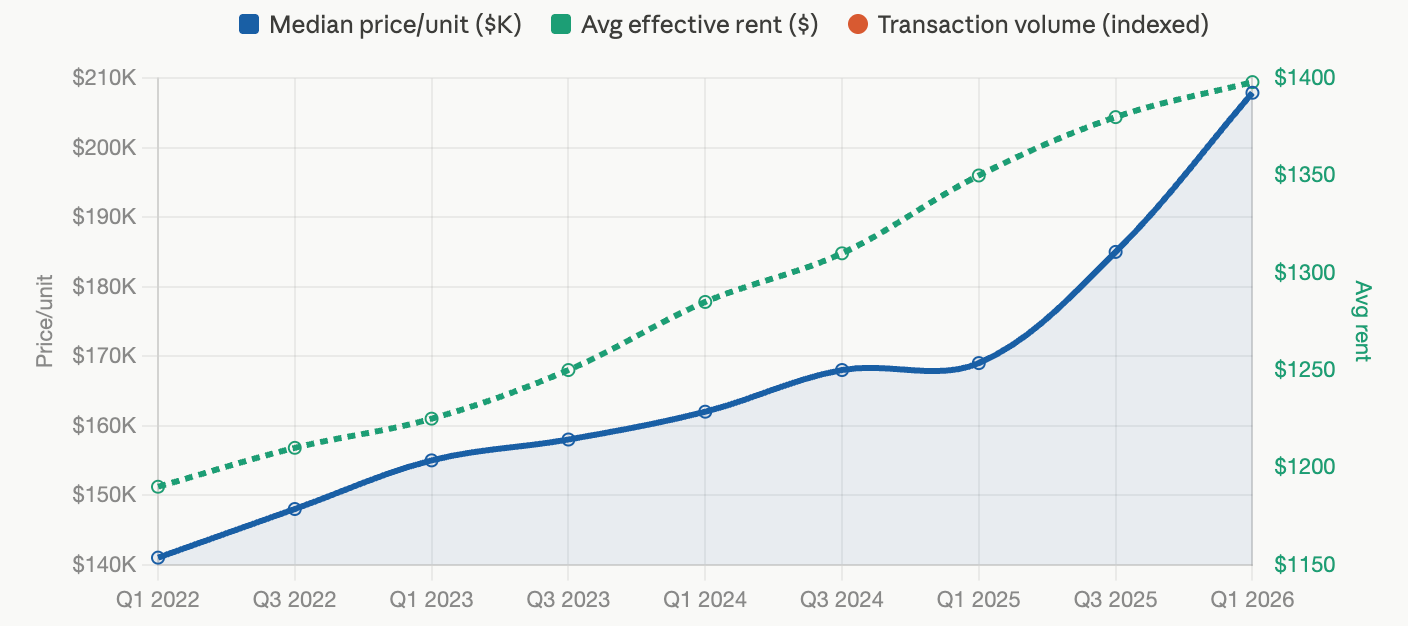
Sources: Colliers Q1 2026 STL Multifamily Report; Marcus & Millichap 2026 Investment Forecast; Northmarq STL Market Analysis
The supply story is the real driver
Here's the part most people gloss over when they talk about St. Louis: the demand side is solid, but the supply side is what makes this moment genuinely rare. New apartment deliveries are forecast to come in roughly 60% below the metro's five-year average this year. That's not a minor correction — that's a near-halt in new inventory at a time when renter demand is holding firm.
To understand why this matters, think about what the previous few years looked like. Deliveries peaked in 2022 and have been declining since, but the cumulative effect of several heavy construction years kept vacancy elevated heading into 2025. Now, according to Northmarq's March 2026 analysis, 2026 is shaping up to be one of the slowest years for new construction completions in the past decade. The pipeline has dried up precisely as the backlog of prior years has been absorbed.
The result: vacancy is trending lower, not higher. Marcus & Millichap's 2026 St. Louis Investment Forecast reported metro-wide apartment vacancy beginning the year under 4% — something the market has achieved only once in the last two decades. In higher-demand corridors like St. Charles County and Chesterfield, Class A vacancies are running in the mid-to-high 3% range. Those are effectively full buildings.
"Absorption has exceeded new deliveries for six consecutive quarters, supporting rent growth and gradually improving occupancy."
— Colliers, Q1 2026 St. Louis Multifamily Market Report
Annual new apartment deliveries vs. 5-year average (metro St. Louis)
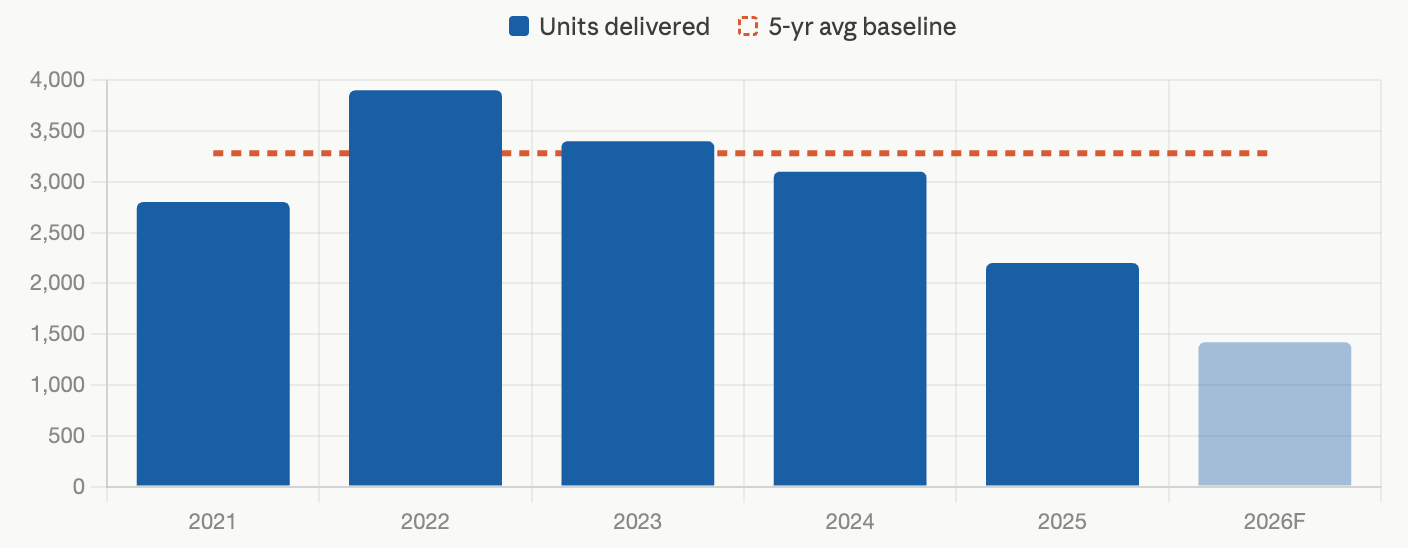 Illustrative based on Northmarq (March 2026) and Marcus & Millichap (2026) data. 5-year average represents the 2021–2025 delivery trend.
When you layer tight vacancy on top of constrained supply, you get a market where landlords don't need to offer concessions to fill units — they just raise rents. That's the environment we're in right now across most St. Louis submarkets, particularly in the suburban corridors where workforce renters have been concentrating.
Why St. Charles County is running the table
Of all the submarkets I watch, St. Charles County stands out the most heading into the second half of 2026. It's been responsible for roughly a third of all multifamily trades in the metro — an outsized share that reflects a combination of demographics, infrastructure, and a fundamental lack of competing new product.
The county has benefited from steady population growth driven by young families and professionals who relocated from St. Louis City proper or moved in from out of state. The school districts, highway access, and cost of living have made it a landing zone for renters who can afford more but are still choosing to rent — either because ownership is priced out at current rates or because they're not yet ready to commit to a purchase. That demographic profile is exactly who Class B operators want as a tenant base.
At the same time, STLToday reported in mid-2025 that at least one St. Charles County municipality — Dardenne Prairie — enacted a moratorium on new multifamily proposals through at least July 2026, citing strain on infrastructure from rapid growth. That kind of supply-side friction is exactly the dynamic that protects existing asset values. When cities are actively limiting new construction, the cap rates on existing stabilized properties don't compress as fast — meaning buyers can still acquire at reasonable yields.
| Submarket | 2026 Activity | Vacancy Trend | Signal |
|---|---|---|---|
|
St. Charles County |
~33% of all trades |
Mid-3% Class A |
🔥 Hot |
|
Central West End |
~20% of trades (Q1) |
Mixed |
💪 Strong |
|
Jefferson County / Fenton |
~20% of trades (Q1) |
Stabilizing |
💪 Strong |
|
South City / South County |
Growing share |
Under 4% |
🔥 Hot |
|
North County |
Recovering (2 deals Q1 '25) |
Elevated |
👀 Watch |
The Class B and C opportunity most investors overlook
When people talk about multifamily in St. Louis, the conversation often drifts toward the downtown repositioning plays or the new Class A product being developed in Clayton and Midtown. Those are real stories, but they're not where the most accessible entry points are for the majority of investors — especially those coming in with less than $2 million in equity.
The Class B and Class C segment — 2-to-4 unit buildings, small apartment complexes from 8 to 30 units — is where the action is for local operators and cash buyers right now. These properties are dominating transaction volume precisely because they're affordable enough to acquire with conventional financing, generate rent yields that pencil at current cap rates (typically mid-to-high 6% range across the metro), and benefit disproportionately from supply constraints. After all, no developer is building new product to compete with them at that price point.
Southern submarkets — Fenton, Affton, Lemay, parts of Webster Groves and Crestwood — are where I'm seeing the strongest combination of rent growth and reasonable acquisition costs. These aren't glamorous neighborhoods, but they're functionally strong: low crime for the price tier, proximity to employment centers in South County, and tenant bases that tend to be stable, working-class households with multi-year tenancy patterns.
The house hack entry point
For investors who are earlier in their portfolio-building journey, the 2-to-4 unit "house hack" in southern submarkets deserves serious attention. The basic structure: you acquire a small multifamily as your primary residence using owner-occupant financing (FHA as low as 3.5% down, conventional at 5% on 2-4 units), live in one unit, and rent the others. The rental income offsets — and in many St. Louis submarkets, fully covers — your mortgage payment.
What makes this work in 2026 is the combination of price points and rent levels. A four-unit building in South County or South City can still be acquired in the $350,000–$550,000 range. With three rentable units generating $900–$1,200 each per month — conservative for the area — you're looking at $2,700–$3,600 in gross rental income against a mortgage in the $2,200–$2,800 range. That's a position where the property effectively carries itself while you build equity.
The rent side of that equation has legs. Colliers' Q1 2026 data shows suburban occupancy remaining stabilized while effective rents have climbed steadily. Northmarq projects that 2026 rent growth will come in faster than 2025 — which was already positive — driven by constrained supply and sustained demand. That trajectory supports the income assumption without requiring you to model aggressive rent escalation.
Effective rent growth trend — St. Louis metro vs. national average
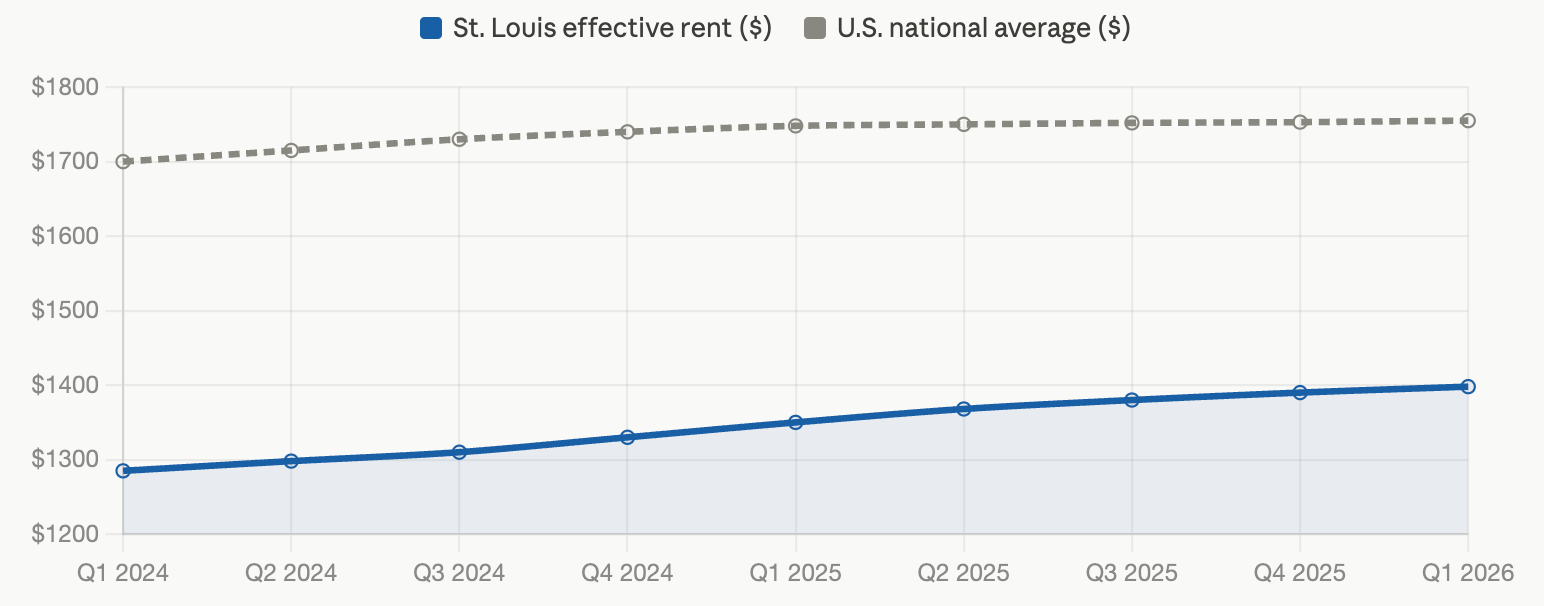
Sources: Colliers Q1 2026; Yardi Matrix St. Louis Market Report (2025). U.S. national averages per Yardi Matrix national multifamily reports.
What the cap rate environment tells us
Cap rates across St. Louis multifamily have been running in a wide band — roughly 5.0% on the low end (well-located, stabilized suburban assets) to 7.0% on the higher end (value-add situations in recovering submarkets). The bulk of reported transactions are settling in the mid-6% range, which is meaningfully above what you'd find in comparable assets in Chicago, Nashville, or Kansas City right now.
That spread matters because it tells you two things. First, there's still real yield available — St. Louis hasn't been cap-rate-compressed into irrelevance the way coastal markets were during the 2020–2022 boom. Second, there's room for further compression as more institutional and out-of-market capital discovers the market. Investors who get in at 6.5% today are well-positioned if cap rates tighten to 5.5%–6.0% over the next two or three years, which would represent meaningful equity appreciation on top of the income they're already collecting.
Northmarq's 2026 outlook notes that while cap rates drifted upward in the second half of 2025, that shift may prove temporary — and that rates are expected to stay within a 5.0%–7.0% band throughout the year, with the possibility of compression as fundamentals continue to improve.
Three strategies that make sense right now
Strategy 1: Small multifamily house hack (2–4 units)
Acquire with owner-occupant financing in South City or South County. Live in one unit, rent the others. Target properties in the $350K–$550K range where three rental units can generate enough income to offset the full mortgage. Ideal for investors with $25K–$60K available for a down payment and who want to build a portfolio from a live-in base. Hold for 3–5 years and refinance out once equity has built.
Strategy 2: Value-add Class B acquisition in St. Charles County
Target 8–20-unit properties with deferred maintenance and below-market rents. St. Charles County's tight vacancy and supply restrictions create a strong backdrop for value-add plays — tenants have limited alternatives, so you can execute renovations, reset rents to market, and stabilize into a disposition or refinance in 24–36 months. Seek assets trading at the high end of the cap rate range (6.5%–7%) where the in-place income covers debt service while you execute the business plan.
Strategy 3: Cash buyer assembly strategy in southern submarkets
For all-cash buyers or those with access to bridge capital, the southern submarkets — Fenton, Affton, Lemay, Oakville — offer the ability to move quickly on off-market deals and acquire at prices that still generate double-digit cash-on-cash returns. Sellers in these areas often prefer speed and certainty over top dollar, which is a structural advantage for buyers who can close in 10–14 days without financing contingencies. Build a small portfolio of 3–6 units across two or three assets in the same submarket for management efficiency.
What could slow this down?
No market analysis is complete without acknowledging the risks. The St. Louis economy — while diversified across healthcare, logistics, and biotech — has seen employment growth lag national averages in 2025 and early 2026. Weaker job growth constrains the pool of renters who can absorb rent increases, and in Class C submarkets where tenants are cost-burdened, there's a ceiling on how aggressively landlords can push rents.
Interest rate trajectory remains the other major variable. The mid-6% cap rate environment works at current financing costs, but if rates were to move materially higher, debt coverage constraints would tighten and put downward pressure on valuations. That said, the supply dynamics are a genuine counterweight — in a market where vacancy is this low and new deliveries this constrained, income protection is real even if appreciation moderates.
The opportunity window also has a natural expiration date. As out-of-market capital continues to notice what local operators have known for a year, competition for well-located assets will intensify, and cap rates will compress. The time when you could acquire stabilized suburban product at 6.5%+ is finite. That doesn't mean the market becomes bad — it means the entry advantage narrows.
The bottom line
St. Louis multifamily in 2026 is not a speculation play. It's not a turnaround story that requires you to believe in a narrative. The fundamentals are visible in the data: vacancy under 4%, supply constrained to decade lows, transaction volume doubling, and rents growing consistently quarter over quarter. The question isn't whether the market is performing — it is. The question is whether you're positioned to participate before the window of accessible pricing closes.
For investors who are patient, local, and willing to do the work of finding the right asset in the right submarket, St. Louis remains one of the most compelling multifamily markets in the Midwest heading into the second half of the decade. The math is there. The supply dynamics are there. The only thing missing is action.
Ready to Buy or Sell in St. Louis? House Sold Easy Has You Covered!
Whether you're thinking about listing your home or exploring a cash offer, it's worth understanding all of your options before making a decision. The right choice depends on your timeline, your property's condition, and your goals. Contact House Sold Easy to discuss your situation and see what makes the most sense for you.Our St. Louis experts know every corner of this city and will make buying your dream home or selling your high-end property a breeze. Don’t miss out on the hottest market in the U.S.! Contact House Sold Easy today and let’s make your real estate goals happen!