St. Louis HVAC Repair Costs & AC Troubleshooting Guide
Jun 23, 2026
Written by House Sold Easy Team
AC blowing warm air in this 98°F heat? Do these four things before you call a technician — and know exactly what a repair or full replacement will cost you.
It's 97 degrees and climbing. You crank your AC for the first time since September — and nothing. Or worse, warm air. You're not alone. Every summer, the phones at St. Louis HVAC companies ring off the hook in mid-June, and 2026 is shaping up to be one of the worst on record for early-season system failures.
Before you panic and drop $8,000 on a new unit, or get taken advantage of by surge pricing, there are a few free things you should check yourself. And if you do need a pro, this guide will tell you exactly what fair repair and replacement pricing looks like in the St. Louis metro right now — plus how a broken or aging system can quietly drain your home's resale value if you're planning to sell this summer.
Bottom line up front: Minor HVAC repairs in St. Louis typically cost between $150 and $600 in 2026, while a full system replacement can range from $5,800 to $12,500 depending on the size of the home and the efficiency of the unit. If your HVAC system is nearing the end of its life, it could impact more than comfort—an aging or failing system may reduce your home's appraised value by approximately 2% to 5%, potentially affecting buyer interest and financing options.
The 4-Step DIY Checklist Before You Call Anyone
I've been writing about St. Louis home systems for going on eleven years. The single biggest money-waster I see is homeowners calling a technician for something they could have fixed in ten minutes. Before you schedule an appointment — which right now means waiting two to four days minimum — run through this list.
-
Change or inspect your air filterA clogged filter is the #1 cause of reduced airflow and system freezing. If it's gray and thick with dust, swap it out. Filters should be replaced every 60–90 days; most St. Louis homeowners go six months or more. A $12 filter fix beats a $300 service call.
-
Check your circuit breakers. Go to your breaker panel and find the breaker labeled "AC" or "Air Handler." If it's tripped (sitting in the middle position), flip it fully off, then back on. A one-time trip can happen during a power fluctuation. If it trips again within an hour, that's a sign of a larger electrical problem — stop resetting it and call a pro.
-
Clear debris from the outdoor condenser unit. Walk outside and look at your condenser (the large box unit). If grass clippings, cottonwood fluff, leaves, or weeds are packed against the fins, the unit can't shed heat efficiently and will shut itself off. Turn the system off at the thermostat, then carefully spray the unit outward with a garden hose. Give it 30 minutes to dry before turning it back on.
-
Check your thermostat settings and batteries. It sounds obvious, but verify the thermostat is set to "COOL" (not "FAN ONLY"), and that the set temperature is actually below the current room temperature. If your thermostat has batteries, replace them — a low-battery thermostat will give erratic signals to your system. Smart thermostats (Nest, Ecobee) sometimes need a firmware update restart after a power outage.
When it's time to call a professional: If you've completed all four basic troubleshooting checks and your system still isn't cooling properly, the problem is likely more serious. Common causes include a refrigerant leak, a failed capacitor, a malfunctioning compressor, or an incorrect refrigerant charge. These issues require specialized tools and expertise to diagnose and repair. In Missouri, refrigerant handling is legally restricted to technicians certified under EPA Section 608 regulations, making professional service the safest and most compliant solution.
St. Louis HVAC Repair vs. Replacement Costs in 2026
Pricing has shifted noticeably over the past two years. The 2023 federal mandate phasing out R-22 refrigerant is essentially complete, and 2025 saw the first wave of HVAC equipment manufactured under the new DOE efficiency standards go mainstream — meaning systems made before 2023 are now harder and costlier to service with compatible parts. Labor rates in St. Louis City and St. Louis County have also climbed about 11% since 2023, tracking with the general trades shortage across the Midwest.
| Service / Repair | St. Louis City | St. Louis County | Notes |
|---|---|---|---|
| Diagnostic / Service Call | $85–$125 | $75–$110 | Often applied toward repair if you proceed. |
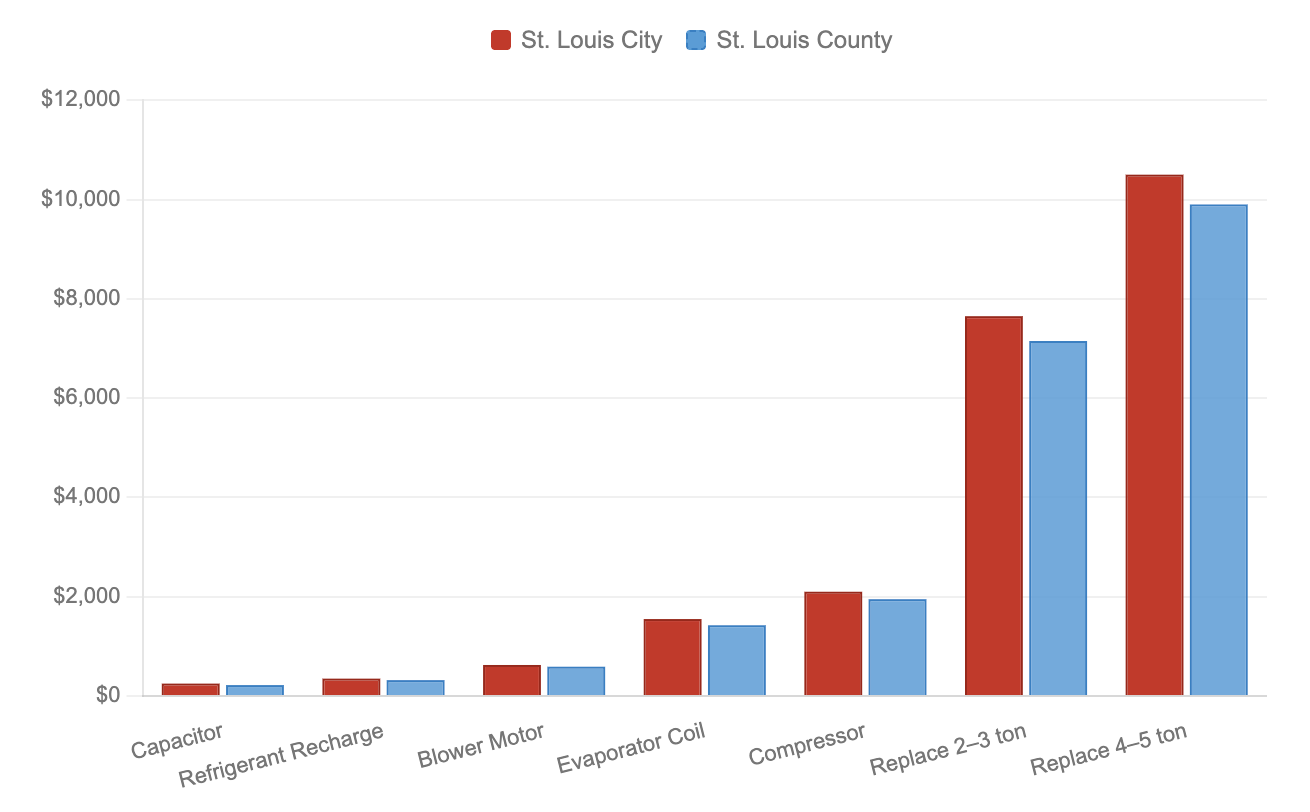
| Capacitor Replacement | $150–$350 | $130–$310 | Most common single repair; typically a 30-minute job. |
| Refrigerant Recharge (R-410A) | $200–$500 | $180–$460 | Cost depends on refrigerant level; leak detection is extra. |
| Contactor Replacement | $175–$375 | $155–$340 | Controls the compressor’s on/off cycle. |
| Blower Motor Replacement | $400–$850 | $380–$800 | Higher-end costs usually involve variable-speed motors. |
| Evaporator Coil Replacement | $900–$2,200 | $850–$2,000 | Labor-intensive repair that often leads to replacement discussions. |
| Compressor Replacement | $1,200–$3,000 | $1,100–$2,800 | At this price point, a new system may offer better value. |
| Full System Replacement (2–3 Ton) | $5,800–$9,500 | $5,500–$8,800 | Central AC and air handler; ductwork not included. |
| Full System Replacement (4–5 Ton) | $8,500–$12,500 | $8,000–$11,800 | Designed for larger homes and premium-efficiency systems. |
Ranges reflect mid-tier equipment from brands like Carrier, Lennox, and Trane. Budget brands run 15–20% lower; premium inverter-compressor units run 20–30% higher. Ductwork repair/replacement billed separately. Source: HomeAdvisor Cost Report 2026, Missouri HVAC contractors survey.
Average HVAC Repair & Replacement Costs — St. Louis Metro, 2026
Midpoint of reported price range, in USD. Source: HomeAdvisor 2026 Cost Report, local contractor data.
The "repair or replace" decision rule
The industry standard formula is called the 5,000 rule: multiply the unit's age (in years) by the estimated repair cost. If the result exceeds $5,000, replacing the system is usually better economics. A 12-year-old system needing a $450 repair? That's $5,400 — borderline. A 15-year-old unit needing a $600 repair? $9,000 — time to replace.
In St. Louis specifically, systems that are 12 years or older are worth scrutinizing carefully. The average useful life of a central AC system is 15–20 years, but our summer humidity and the freeze-thaw cycling we get in shoulder seasons shortens that curve.
How a Failing HVAC System Affects Your Home's Sale Price
If you're planning to list your home this summer — and a lot of St. Louis sellers are, given current inventory levels — a broken or visibly aging HVAC system is one of the fastest ways to lose negotiating power. Buyers in 2026 are more aggressive about HVAC inspections than I've ever seen, partly because replacement costs are front-of-mind after two years of price increases, and partly because buyer's agents have gotten good at using it as a concession lever.
Here's what the data actually shows for the St. Louis market:
HVAC Condition & Home Value Impact (St. Louis Metro, 2025–2026)
An HVAC system that is more than 12 years old and lacks documented service records can reduce an appraiser's value estimate by approximately 1–3%. On a $400,000 home, that could mean a value reduction of roughly $4,000–$12,000.
If the system is non-functional, appraisers often classify it as functional obsolescence, which may reduce value by 2–5%. It can also create financing issues, as FHA and VA loans frequently require HVAC-related repairs before closing.
On the other hand, a new HVAC system installed within the last two years is a meaningful selling advantage. St. Louis homebuyers consistently rank HVAC age among their top mechanical concerns, alongside the roof and foundation.
Sellers who keep maintenance records such as annual tune-ups and filter replacement logs often experience fewer inspection-related negotiations and repair requests during the sale process.
Some homeowners choose to replace their HVAC system before listing. While results vary by neighborhood and buyer demand, a $7,500 HVAC replacement may contribute to an adjusted sale price increase of approximately $6,000–$9,000 in today's St. Louis market.
The practical takeaway: if your system is on borrowed time, making a repair decision now — before you list — gives you control of the narrative. A home that goes to inspection with a functional, recently serviced HVAC is in a far stronger position than one where the inspector flags it, and the buyer demands an $8,000 credit at the eleventh hour.
💡 Pro Tip for Sellers: After any HVAC service, ask your technician for a written "functional assessment" in addition to the invoice. A simple one-page letter confirming that the system is operating properly can provide buyers with added confidence, reduce concerns during inspections, and serve as valuable documentation during negotiations. It's an inexpensive step that can help prevent unnecessary repair requests or price reductions.
Finding a Reputable St. Louis HVAC Contractor
During a heat emergency, desperation pricing is real. Here's how to protect yourself:
- Verify their Missouri license: All HVAC contractors in Missouri must hold a valid license with the Division of Professional Registration. You can look up any contractor at pr.mo.gov.
- Get at least two estimates for anything over $500. During peak season, some companies run at 20–30% over the fair market rate on refrigerant and coil repairs.
- Be skeptical of "we have to replace the whole unit today" diagnoses on a first visit without a written parts estimate.
- Ask about financing before committing. Most major HVAC brands (Carrier, Lennox, Trane) offer 12–18-month same-as-cash financing through their dealer networks, which can make a smart replacement more accessible than a high-cost band-aid repair.
- Check for utility rebates: Ameren Missouri and Spire offer rebates on qualifying high-efficiency units (SEER2 16+). These rebates can offset $300–$700 of your replacement cost. See Ameren's rebate page for current offers.
Final Thoughts
An HVAC breakdown in St. Louis in June is genuinely stressful — it's not just discomfort; it's a health risk for kids, elderly residents, and pets. But the worst decisions get made in a panic. Run the checklist first. Know your fair price range before anyone gives you a quote. And if you're selling this summer, don't let a $250 capacitor turn into a $6,000 concession at closing.
If you found this guide useful, the companion piece on whole-home energy audits and insulation upgrades in the St. Louis area is worth reading before the next utility bill arrives.
Ready to Buy or Sell in St. Louis? House Sold Easy Has You Covered!
Whether you're thinking about listing your home or exploring a cash offer, it's worth understanding all of your options before making a decision. The right choice depends on your timeline, your property's condition, and your goals. Contact House Sold Easy to discuss your situation and see what makes the most sense for you.Our St. Louis experts know every corner of this city and will make buying your dream home or selling your high-end property a breeze. Don’t miss out on the hottest market in the U.S.! Contact House Sold Easy today and let’s make your real estate goals happen!