Mid-2026 St. Louis Housing Report: Low Supply Drives Prices
Jun 26, 2026
Written by David Dodge
If you've put in an offer on a turnkey home in St. Louis County or St. Charles County in the past month, you already know the feeling: you weren't the only one. Maybe you weren't even the fifth one. As we move into the back half of June, the St. Louis metro is sitting in one of the tightest inventory stretches we've seen this cycle, and it's reshaping how both sellers and buyers need to approach the next ninety days.
This isn't a national headline dressed up with a local dateline. The pressure is showing up in the actual MLS numbers coming out of MARIS, the region's multiple listing service, and it's showing up differently depending on which side of the city limits you're standing on. St. Louis County and St. Charles County are running at a 2.3- to 2.6-month supply of homes — territory that hasn't been this tight since the frenzy years of 2021-2022. St. Louis City, meanwhile, is sitting closer to 3.5 months of supply, which sounds like a small gap on paper but translates into a real, usable difference in negotiating leverage.
Below is a breakdown of where the numbers stand right now, why turnkey inventory specifically is driving the squeeze, and what it actually means if you're trying to buy or sell before the leaves turn.
Anyone who's been watching this market since the spring saw this coming. New listings have been arriving slower than usual for this time of year, even as buyer traffic stayed steady through the typically busy April-through-June window. Open houses on well-presented homes in Kirkwood, Webster Groves, and Ladue have been drawing the kind of foot traffic that hasn't been typical since the height of the 2021 frenzy, and agents on both sides of the transaction are adjusting their advice accordingly. What follows isn't speculation about where things might go — it's a read on where things already stand, based on the most recent MLS-sourced reporting for the region.
The Headline Number: 2.3 to 2.6 Months of Supply
Months of supply is the simplest gauge real estate agents use to read a market's temperature. It answers one question: at the current pace of sales, how long would it take to sell off every home currently listed if not a single new listing hit the market? Six months is generally considered "balanced." Anything under four starts to favor sellers. Under three, and you're in a market where buyers are competing hard for whatever shows up.
St. Louis County and St. Charles County are both well under that three-month mark right now. According to the most recent local market data compiled for the metro, St. Louis County is holding a median sale price of $287,500 against a 2.3-month supply, while St. Charles County is running just slightly behind it at $289,950 with 2.6 months of supply. Those two counties, plus Jefferson County to the south, have stayed firmly seller-favored through the spring, with supply parked at or below 2.6 months in nearly every reporting period since March.
That kind of supply doesn't leave much room for buyers to be picky. A well-priced, move-in-ready three-bedroom in Kirkwood, Webster Groves, or Wildwood is realistically getting multiple offers within the first long weekend it's listed, and in plenty of cases, it's going under contract before the first open house even happens. The same is true across the river in St. Charles, O'Fallon, and Cottleville, where new construction and recently renovated resales are absorbing buyer demand almost as fast as it's listed.
The regional MLS data backs this up at a broader level, too. The St. Louis REALTORS® Monthly Housing Report, which pulls directly from MARIS and covers both the city and county, has shown new listings actually declining even as pending sales tick upward — the textbook signature of a market where demand is outrunning what's coming onto the shelf. Nationally, that report notes existing-home sales have been constrained by the same combination of tight supply and ongoing affordability pressure that's been a theme of this cycle for going on three years now.
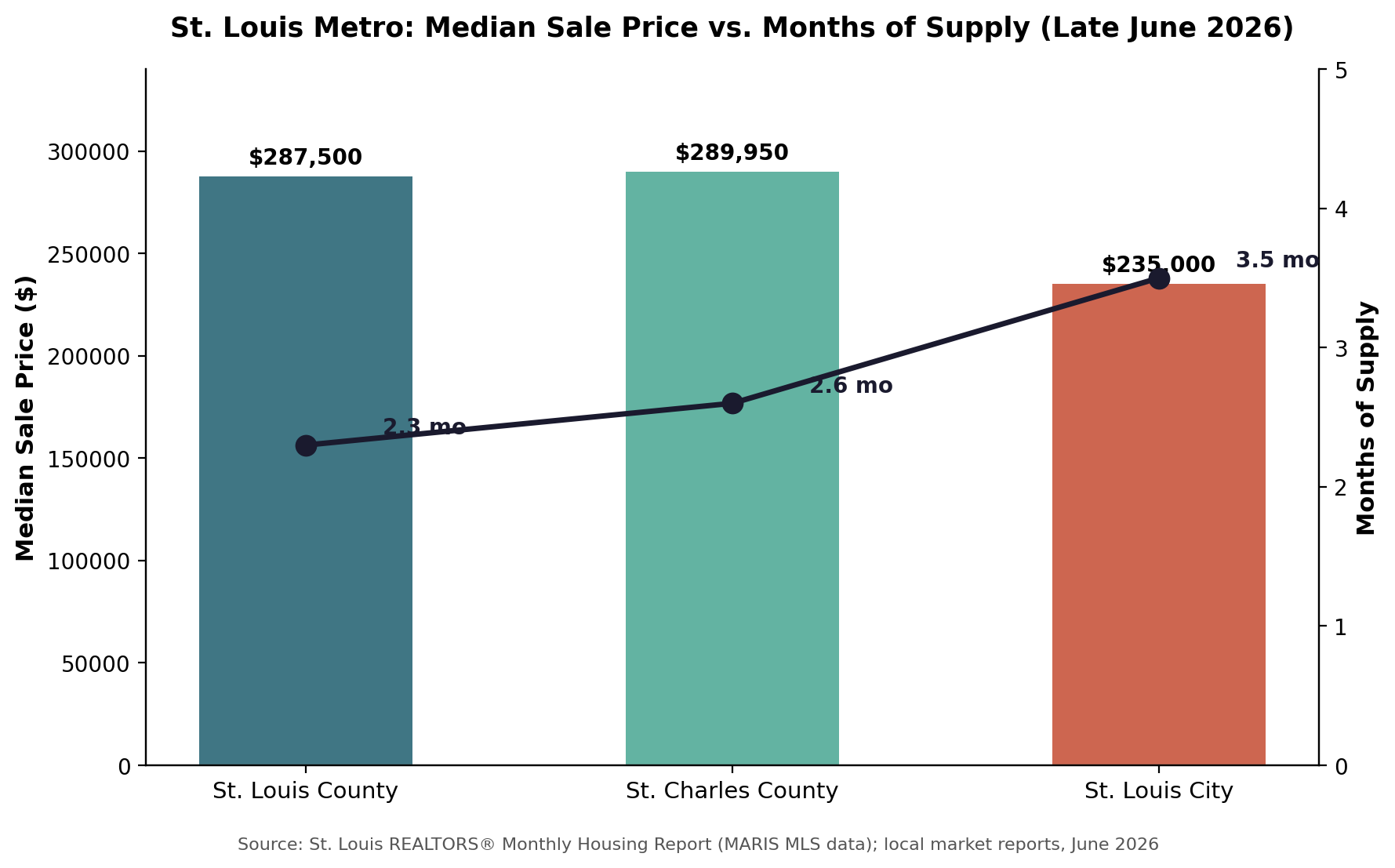
The chart above lays the three sub-markets side by side. Notice that price and supply don't move in lockstep — St. Louis City actually has the lowest median price of the three but the highest months of supply, which is exactly the kind of divergence worth understanding before you set a strategy.
County by County: Where the Pressure Is Concentrated
St. Louis County remains the engine of the region's price stability. At $287,500 median and 2.3 months of supply, it's the tightest of the three major sub-markets covered here. Homes in the county's stronger school districts are going under contract in well under two weeks in most cases, and buyers are routinely paying at or above 100% of list price to win. That's not universal — there are still pockets, particularly older inventory needing work, where things move slower — but turnkey product in desirable ZIP codes is the clear battleground.
St. Charles County is running a near-identical story with $289,950 median and 2.6 months of supply. The extra few tenths of a month of inventory gives buyers there marginally more breathing room than in the county proper, but not much. New construction has helped soften the edges somewhat, since builders have been able to add inventory faster than what's possible with existing-home resale stock, but resale homes in good condition are still moving fast and pricing aggressively.
St. Louis City is the outlier worth paying attention to. The median sale price sits at a noticeably more accessible $235,000, and supply is running closer to 3.5 months — still a seller-leaning market by the textbook definition, but meaningfully looser than the suburbs. Buyers in the city are paying an average of 98.6% of list price, according to the same regional reporting, which means sellers there are seeing more give-and-take in negotiations than their suburban counterparts. Days on market in the city are also running longer, averaging around 17 days compared to the 7 to 10 days typical in St. Louis County and St. Charles County.
Independent data from Redfin's market trackers tells a complementary story. Redfin's St. Louis County page shows the county's median sale price running closer to $312,000 over the trailing three months through May, up 3.6% year-over-year, with homes typically going under contract in just 11 days — a pace that's barely budged from a year ago despite fewer total homes selling. That gap between the county-level figure here and the metro report's $287,500 isn't a contradiction; it reflects different reporting windows and methodology (median sale price over a rolling three months versus a single-month snapshot), but both point in the same direction: prices are firm, and homes are moving quickly.
Meanwhile, Redfin's tracker for the city of St. Louis shows a median sale price around $255,000 over the same trailing window, up 6.2% year-over-year, with the average home receiving roughly two offers and selling in about three weeks. That's a smaller bidding pool than what's happening in the suburbs, but it's still a competitive environment by any historical standard — it's just less of a sprint.
Why Turnkey Homes Specifically Are Driving This
It's worth being precise about what's actually scarce right now, because "low inventory" can mean different things depending on price point and condition. The shortage isn't evenly distributed across every type of home. Fixer-uppers, homes needing significant updates, and properties priced above the upper-middle of the market are sitting longer and seeing fewer competing offers. The real scarcity is concentrated in turnkey, move-in-ready homes priced in that $250,000 to $400,000 sweet spot where the bulk of move-up buyers, young families, and relocation buyers are shopping.
A few forces are compounding that specific shortage:
First, a large share of homeowners who locked in mortgage rates in the 3% range during 2020 and 2021 are still reluctant to sell and trade into a new loan at current rates, even with 30-year fixed rates having eased somewhat. That "rate lock-in" effect has been one of the defining features of this housing cycle nationally, and St. Louis isn't immune to it — it just shows up most acutely in exactly the kind of well-maintained, updated homes that would otherwise be cycling onto the market.
Second, builders have been more active in St. Charles County and the outer-ring suburbs than in St. Louis County proper, where available land for new subdivisions is scarcer. That's part of why St. Charles has been able to absorb demand slightly better — new construction adds turnkey inventory that doesn't depend on an existing owner deciding to sell.
Third, renovation and flip activity, which historically helps refresh the turnkey supply by taking dated homes and bringing them to market move-in ready, has slowed somewhat as material and labor costs have stayed elevated. Fewer flips finishing each month means fewer "ready to go" listings hitting the market relative to a few years ago.
There's a fourth factor that doesn't get talked about as much but matters locally: school-district timing. A meaningful share of move-up buyers in St. Louis County and St. Charles County are families trying to close and settle before the new school year, which compresses an already tight summer window into an even more concentrated burst of activity in May, June, and early July. That seasonal rush layers on top of the structural lock-in and construction issues, which is part of why the squeeze tends to feel sharper right now than it might in, say, October or November.
It's also worth noting what this scarcity does to pricing psychology on both sides. Sellers of genuinely move-in-ready homes have started to price with more confidence, sometimes testing slightly above recent comps, because they've seen enough multiple-offer outcomes this spring to believe the market will support it. Buyers, meanwhile, have grown more disciplined about walking away from anything that needs real work, focusing their offers — and their escalation clauses — on the listings that don't require a renovation budget on top of the purchase price. That bifurcation is exactly why the "low inventory" headline can be true and somewhat misleading at the same time: the shortage is real, but it's concentrated, not universal.
The Mortgage Rate Backdrop
None of this is happening in a vacuum separate from financing costs. Benchmark 30-year fixed mortgage rates have been hovering in the mid-6% range through the spring and into early summer, a modest improvement from where they sat a year prior but still well above the sub-4% environment many current homeowners are sitting on. That gap is precisely what feeds the lock-in effect described above, and it's also shaping how aggressively today's buyers need to shop.
For a buyer competing on a $287,500 St. Louis County listing, even a quarter-point swing in rate can change a monthly payment by well over a hundred dollars. That's part of why fully underwritten pre-approval — not just a pre-qualification letter — has become close to mandatory for anyone trying to compete on tight-supply listings in the county or St. Charles. Sellers and their agents are increasingly screening offers for financing strength before they even get to price, because a shaky pre-approval on a multiple-offer property is a fast way to lose out even with a strong number attached.
What This Means for Sellers Through Labor Day
If you're listing a home in St. Louis County or St. Charles County this summer, the single biggest lever you control is initial pricing, and the data makes a strong case for pricing at or very near fair market value from day one rather than testing the ceiling.
In a 2.3 to 2.6-month supply environment, well-priced listings are still drawing multiple offers within the first one to two weeks. That competition is what pushes final sale prices above asking — but it only works if the starting price reflects what the market will actually bear. Overpricing in a tight market doesn't get you a higher final number; it gets you a stale listing that sits past the point where buyer interest peaks, forces a price reduction, and then sells for less than it would have if priced correctly from the start. The data on days-on-market bears this out — homes priced accurately in the county and St. Charles are still moving in well under two weeks, while overpriced inventory drags the average up.
A few practical takeaways for sellers heading into July and August:
- Lean on a recent comparative market analysis rather than last year's Zestimate or a number a neighbor mentioned at a barbecue. The market has moved enough in twelve months that stale comps can mislead you in either direction.
- If your home isn't truly turnkey — meaning it needs paint, flooring, a kitchen update, or has deferred maintenance — price with that reality in mind. The shortage is concentrated in move-in-ready inventory, and homes needing work are competing in a noticeably less frantic lane.
- Expect financing scrutiny on incoming offers. Buyers without strong, verified pre-approval may submit attractive numbers that don't hold up, so factor that into how you evaluate multiple offers rather than going purely on price.
- In St. Louis City specifically, where supply is looser and the sale-to-list ratio is running under 99%, build in a touch more room for negotiation rather than pricing as aggressively as you might in the county.
What This Means for Buyers
For buyers, especially in St. Louis County and St. Charles County, the summer ahead requires moving with more preparation and speed than the market demanded even two years ago.
Full underwritten pre-approval, not a quick pre-qualification, is close to table stakes for anything priced in that competitive $250,000–$400,000 turnkey band. Agents on the listing side are routinely asking for proof of funds and a closer look at financing before recommending a seller accept an offer, particularly when there are several offers to compare.
Beyond financing readiness, a few strategies are worth considering given the current supply picture:
- Widen the search radius slightly. If you're set on a specific suburb where supply is at 2.3 months, you're fighting the tightest part of the market. Adjacent areas with marginally higher supply can mean less competition for a comparable home.
- Consider homes that need light cosmetic work. Since the shortage is concentrated in fully turnkey listings, properties that need paint, flooring, or a kitchen refresh — but are otherwise structurally sound — tend to draw fewer competing offers and leave room to negotiate.
- Look seriously at St. Louis City if your work and lifestyle allow for it. A median price nearly $50,000 below the county's, combined with a sale-to-list ratio under 99% and longer average days on market, means meaningfully more negotiating room for buyers willing to consider city neighborhoods like Tower Grove, Soulard, or the Central West End.
- Explore creative financing when conventional terms are tight. In a market this competitive, some sellers — particularly those who own a property free and clear or are motivated by a fast, simple closing — are open to owner financing or seller-assisted structures. It won't fit every transaction, but for buyers who can present a strong down payment and clean terms, it's worth raising with a seller's agent as an option, especially on listings that have had a little more time on the market.
- Move fast once you've found the right home. In a 2.3-to-2.6 month supply environment, hesitating over a weekend to "think about it" on a well-priced, turnkey listing is, in practice, deciding to lose it to another buyer.
The Bigger Picture Heading Into Fall
Zooming out, St. Louis remains one of the more affordable major metros in the country, and that relative affordability is precisely what's kept demand this resilient even as rates have stayed elevated. That dynamic isn't likely to reverse sharply in the next quarter. Builders are adding supply at the margins, particularly in St. Charles County, and the typical seasonal pattern in this market sees inventory loosen modestly later in the year as the pace of new listings picks up relative to buyer activity. But "loosen" doesn't mean "flip" — even the more buyer-friendly months later this year are unlikely to push St. Louis County or St. Charles County out of seller-favored territory entirely.
The practical message for the next ninety days is straightforward: sellers in the county and St. Charles have real pricing power if they use it correctly, sellers in the city have a bit less of it and should plan accordingly, and buyers across the board need their financing buttoned up and their decision-making fast if they want to win in the price bands where competition is concentrated. The numbers from this spring suggest that won't change meaningfully before the fall selling season begins.
Renters Are Feeling It Too
It isn't just the for-sale market that's tight. Average rents across the St. Louis metro have been creeping up alongside home prices, sitting in the neighborhood of $1,100 to $1,200 a month as of late spring — still well below the national average, but up modestly from a year ago. That matters for this report because the rental market and the for-sale market are connected: when rents rise even modestly while mortgage rates stay elevated, it changes the math for the "rent versus buy" decision that a lot of would-be first-time buyers are running right now.
For some renters, a rent increase of even fifty or seventy-five dollars a month is enough to tip the scales toward locking in a purchase before rates or prices move further, which adds another layer of demand onto the same tight pool of turnkey starter homes that move-up buyers are also competing for. It's a quieter pressure than the headline supply numbers, but it's part of the same overall picture: demand staying resilient across multiple buyer segments at the same time supply stays constrained.
Putting the Local Numbers in National Context
St. Louis isn't experiencing this in isolation. The same forces — elevated mortgage rates relative to the ultra-low-rate years, a sizable share of existing homeowners reluctant to give up favorable financing, and builders unable to fully close the supply gap left by years of underbuilding after the 2008 downturn — have been shaping housing markets across the Midwest and much of the country for several years now. National reporting on existing-home sales has repeatedly pointed to the same combination of tight supply and affordability strain limiting overall transaction volume, even as prices in many metros continue to post year-over-year gains.
What makes St. Louis a bit different from the national story is the affordability cushion. Home prices here remain meaningfully below the national median, which is a big part of why demand has stayed as resilient as it has despite rate pressure. Buyers who might be priced out entirely in coastal or Sun Belt boomtowns can still find a turnkey three-bedroom in St. Louis County or St. Charles County in the high $200,000s, and that relative affordability is functioning almost like a release valve, pulling in buyers — including remote workers and relocating professionals — who are stretching their dollar further than they could elsewhere. That inbound demand is one more reason the region's low-supply story has staying power rather than being a one-month blip.
Frequently Asked Questions
Is the St. Louis housing market going to crash in 2026? Nothing in the current data points that direction. A crash typically requires a sharp oversupply of inventory relative to demand, and the metro is showing the opposite — supply well under three months in the strongest sub-markets. Most analysts following the region describe this as a normalization after a prolonged stretch of constrained supply, not a bubble.
Is it a bad time to buy a home in St. Louis right now? It depends heavily on where and what you're buying. Turnkey homes in St. Louis County and St. Charles County require speed, strong financing, and realistic expectations about competition. St. Louis City and homes that need some updating offer more breathing room and more negotiating leverage for patient buyers.
Should I wait until fall to list my home? Not necessarily. Supply typically loosens a bit later in the year as new listings pick back up, which can mean slightly less urgency among buyers. If your home is genuinely move-in ready, listing now while supply is this tight is likely to produce a faster sale and a stronger price than waiting for a less competitive buyer pool in the fall.
What's the biggest mistake sellers are making right now? Overpricing on the assumption that "the market is hot" will cover for an aggressive number. It can work on truly exceptional properties, but on a typical turnkey listing, an overpriced home still sits, still requires a reduction, and often closes for less than accurate pricing would have achieved from the start.
Ready to Buy or Sell in St. Louis? House Sold Easy Has You Covered!
Whether you're thinking about listing your home or exploring a cash offer, it's worth understanding all of your options before making a decision. The right choice depends on your timeline, your property's condition, and your goals. Contact House Sold Easy to discuss your situation and see what makes the most sense for you.Our St. Louis experts know every corner of this city and will make buying your dream home or selling your high-end property a breeze. Don’t miss out on the hottest market in the U.S.! Contact House Sold Easy today and let’s make your real estate goals happen!