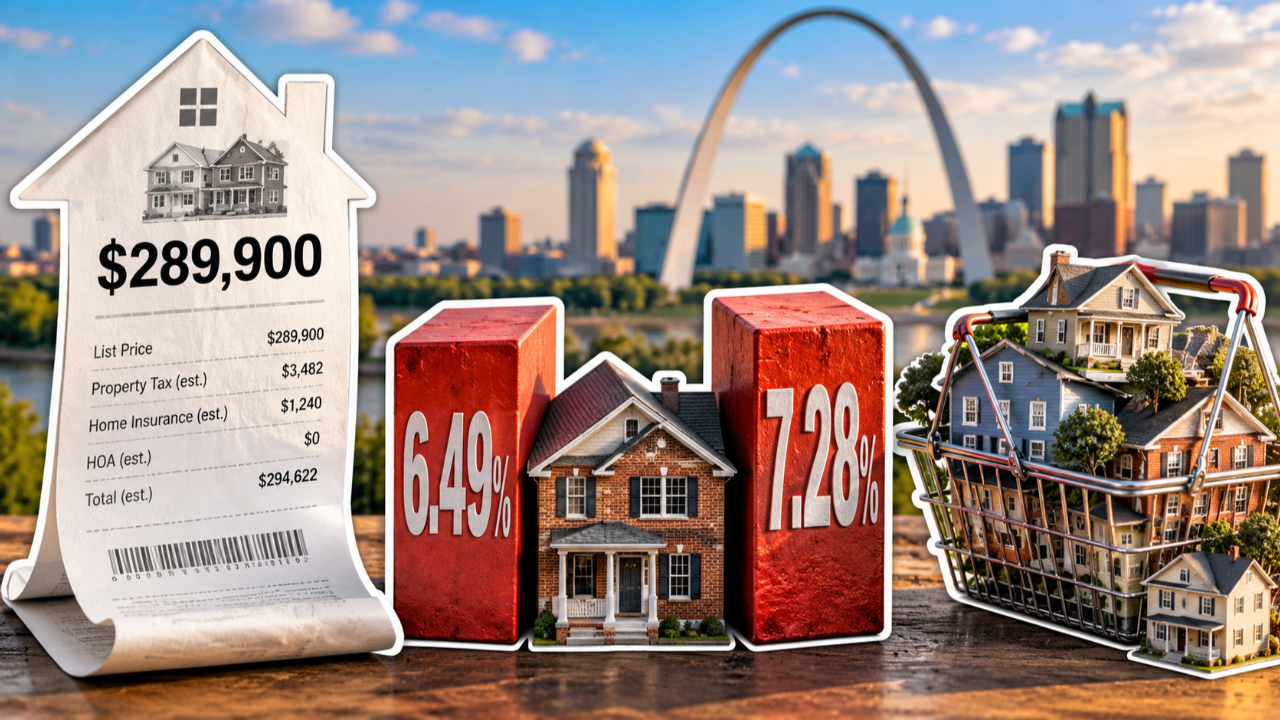
Buying a Home in St. Louis: 7 Strategies for 7% Rates
Oct 08, 2026
Written by House Sold Easy Team
If you have been circling the St. Louis housing market for a year, waiting for mortgage rates to fall back to something that feels normal, this has probably been a frustrating September. The rate you were hoping would drop went the other way. Quotes that started the month in the high sixes finished it right around 7%, and every headline seems to be telling you the window is closing.
Here is the thing, though. A 7% rate is uncomfortable, but it is not the end of the road for buyers in Missouri. St. Louis has always been one of the more affordable big-city markets in the country, and this fall the local numbers are quietly tilting toward people who come prepared. Homes are sitting longer. A large share are selling below the asking price. Sellers who stuck with optimistic pricing in the spring are now having to listen to offers.
I want to walk you through what is actually happening, why waiting for a rate miracle is a risky plan, and seven specific strategies you can use to buy well right now. I will lean on current data from September 2026; I will tell you where the sources disagree, and I will keep the jargon to a minimum. Think of this as the conversation you would have with a friend who happens to follow this market closely.
One note before we start: nothing here is personal financial advice. Your lender, your agent, and your tax professional know your situation. My job is to help you walk into those conversations informed.
The Reality Check: 7% Rates Are Here, and Waiting Will Not Make Them Disappear
Let's start with the number everyone is talking about. Freddie Mac's survey for the week of September 3 put the 30-year fixed rate at 6.71%, up from 6.66% the week before and above the 6.50% average from a year earlier. That already felt like a step in the wrong direction. Then the month got more interesting. By the week of September 17, the average had climbed to 6.95%. By the survey dated September 24, the 30-year fixed average had reached 7.03%, the highest reading since May 2024.
Freddie Mac 30-year fixed-rate average, September 2026. Weekly national averages for conventional, conforming loans. Source: Freddie Mac Primary Mortgage Market Survey .
What does a move like that mean in real dollars? Take a St. Louis home at roughly $290,000 with 10% down, which leaves a $261,000 loan. At 6.71%, the principal-and-interest payment lands around $1,686 a month. At 7.03%, it is closer to $1,742. A year ago, at 6.50%, it would have been about $1,650. So the gap between last year and today is roughly $90 a month. That is real money, but it is not the catastrophe the headlines imply, and it is a very different conversation than the one buyers had at 8% in 2023.
Now, the temptation is to hold out for the next dip. I understand it. But consider what you would be betting on. Rates are driven by bond markets, inflation data, and decisions made far from Missouri. Nobody, including the professionals who get paid to forecast them, has a reliable record of calling the bottom. If rates do fall next spring, you will not be the only person who noticed. Buyers who sat out the high-rate months will rush back in, competition will stiffen, and the negotiating leverage you have today will shrink.
There is also a quieter point that gets lost. You can change your interest rate later by refinancing. You cannot change the price you paid for the house. If you buy well now, with a good negotiated price and a smart structure, a future rate drop becomes a bonus instead of a requirement.
Plain-English takeaway: You are not buying a rate; you are buying a house. The house is the part you cannot renegotiate later. The rate usually can be.
Demand data tells the same story from another angle. The Mortgage Bankers Association reported in September that its unadjusted purchase index was 11% lower than the same week a year earlier, though that comparison was distorted a little by the Labor Day holiday. Fewer applications mean fewer competing buyers. That is the silver lining of expensive money: the crowd thins out, and the people who stay in the market gain bargaining power.
Why Fall 2026 May Be Your Best Window in St. Louis
Spring is traditionally when everyone shops for houses, and it is also when sellers feel most confident. By September, that confidence has usually cooled, and this year it has cooled more than usual. According to Veterans United's September snapshot of the St. Louis market, the median home price was about $289,900, down 3.4% from last year, and homes spent an average of 44 days on the market. The same page reported that nearly 41% of homes sold below the asking price, which is a strong signal that buyers are getting concessions.
Now I should be honest about something, because you will run into it if you do your own research. Different sources describe St. Louis very differently, and none of them is exactly wrong. Redfin's mid-year review put the St. Louis median sale price at $283,762, up 5.0% year over year, with a median of 29 days on market. That looks like the opposite of the Veterans United picture. The explanation is that these sources measure different things. One tracks list prices, the other tracks closed sale prices. One covers the first half of the year, the other reflects recent weeks. Sale prices lag, and they still carry the momentum of a strong spring. List prices respond faster, and they are softening now.
For a buyer, the lesson is simple. Do not assume the whole market is cooling evenly. A well-priced, move-in-ready home in Kirkwood will still draw offers. An overpriced, dated home in an out-of-the-way pocket is where you have the upper hand. The skill this fall is knowing which one you are looking at.
|
Measure |
St. Louis Figure |
|---|---|
|
Median list price (Sept 2026) |
About $289,900, down 3.4% YoY |
|
Average days on market |
44 days |
|
Homes selling below asking |
Nearly 41% |
|
Median sale price (Jan–Jun 2026) |
$283,762, up 5.0% YoY |
|
Median days on market (Jan–Jun 2026) |
29 days |
|
U.S. median sale price (for comparison) |
$391,879, up 1.5% YoY |
Table: St. Louis market snapshot, fall 2026. Figures come from different providers and time periods, so compare them as directional signals rather than exact matches.
Look at the last row of that table. Even after a year of strong price growth, a typical St. Louis sale price sits roughly $108,000 below the national median. That gap is the reason people from pricier metros keep moving here, and it is the reason a 7% rate hurts you less in Missouri than it would in Denver or Boston. A smaller loan amount means a smaller payment, even at a higher rate.
7 Buyer Strategies for the Current Market
Here is the practical part. These are the seven moves I would focus on if I were buying in the St. Louis area this fall. You do not need all seven. Pick the ones that fit your budget, your timeline, and your tolerance for risk.
1. Target Homes with Price Reductions
When a seller drops the price, they are telling you something. Maybe the first number was a stretch. Maybe the house has been showing poorly. Maybe a job move is forcing the timeline. Whatever the reason, a price cut means the seller has already admitted that their original expectation was off, and that changes the psychology of the negotiation.
Veterans United's local data pointed to a market where a large share of listings had their price reduced in the most recent month, so you will not be short of candidates. Set up saved searches that filter for price drops in the last 30 days, and look at your top neighborhoods daily. The best deals often show up on the first day of a cut, before other buyers have refreshed their alerts.
One piece of advice I give everyone: pull your own comparable sales. Do not rely on the list price, and do not lean too heavily on an online estimate. Ask your agent for the last six months of closed sales within a half mile, matching bedrooms, square footage, and condition. A reduced price is only a bargain if it is below what comparable homes actually sold for. A cut from $340,000 to $325,000 means nothing if the real market value is $300,000.
2. Ask for Seller-Paid Temporary Rate Buydowns
This is one of the most underused tools in a high-rate market, and it deserves a plain explanation. A temporary buydown uses money to lower your interest rate for the first year or two of the loan. With a 2-1 buydown, your rate is two percentage points lower in year one and one point lower in year two, and then it settles at the full note rate for the remaining years. The cash to fund it can come from the seller as a concession, which is why it works so well when sellers are motivated.
Let's use the same example from earlier: a $261,000 loan at a 7.03% note rate. In year one at 5.03%, your principal-and-interest payment drops to about $1,406. In year two at 6.03%, it is around $1,570. Compared with the standard payment near $1,742, you save roughly $336 a month in year one and $172 a month in year two. Over those two years, that adds up to about $6,000.
The reason to ask for this instead of a straight price cut is that sellers often prefer it. A price reduction lowers the number that shows up in public records and can drag down the neighborhood comps. A concession for a buydown keeps the sale price intact while giving you real payment relief. Many sellers will say yes to that trade more readily than a lower price.
3. Consider an Adjustable-Rate Mortgage (ARM)
Adjustable-rate loans got a bad reputation after 2008, and some of that was earned. But a modern 5/1 or 7/1 ARM is a different animal. The rate is fixed for the first five or seven years, then adjusts on a schedule with caps that limit how far it can move. Nobody is surprised by a payment doubling overnight.
Buyers are noticing. The MBA reported that the ARM share of applications reached 9.8% as rates climbed, with 5/1 ARM rates more than a percentage point below fixed-rate loans. Earlier in the month, MBA data showed 5/1 ARM rates at 5.94%, comfortably under what 30-year borrowers were paying.
So when does an ARM make sense? If you are fairly confident you will sell or refinance within five to seven years, you are paying less interest during the years you actually own the loan. Relocating professionals, people who expect to outgrow a starter home, and buyers who plan to refinance when rates ease are the usual candidates. If you plan to stay in this house for thirty years and sleep badly when your payment could change, the certainty of a fixed rate is worth paying for.
4. Focus on Neighborhoods with Strong Demand
Not every pocket of St. Louis is sitting. Areas with great schools, walkable main streets, and established housing stock continue to attract buyers even at 7%. Think Kirkwood, Webster Groves, Creve Coeur, Chesterfield, and University City. Local agents quoted in the Webster-Kirkwood Times credited steady price growth of around 80% over the past decade in the Kirkwood and Webster Groves school districts for keeping supply tight there.
What that means for you is a decision about your priorities. If you want to live in one of those high-demand areas, expect less room to negotiate and be ready to move quickly on a good listing. Strong preparation matters most here: a verified pre-approval, a clean offer, and a realistic inspection plan.
If your priority is price, the calculation flips. Look at neighborhoods where the stock is older, where homes need some updating, and where sellers are more motivated. You may give up a bit of polish, but you gain negotiating power and often a lower entry price. Plenty of buyers have built real equity by buying a slightly dated house in a solid neighborhood and updating it over time.
5. Budget for Inspection Items Upfront
St. Louis has a lot of beautiful older homes. Brick bungalows, two-family flats, and mid-century ranches give the region much of its character. They also come with age-related surprises, and in a market where sellers are negotiating, your inspection is your best source of leverage.
Three items deserve special attention. The first is the sewer lateral, the line that runs from your house to the main. In older neighborhoods, clay or cast-iron pipes can crack or be invaded by tree roots. A camera scope before you close costs a few hundred dollars and can save you from a repair that runs into the thousands. The second is the foundation and basement, since moisture and settling are common in older construction. The third is the electrical panel, because outdated or undersized panels can be a safety issue and an insurance headache.
Also check whether the city or municipality where you are buying requires an occupancy inspection. Many St. Louis-area municipalities do, and the rules vary. Sometimes the seller is responsible for fixing flagged items before closing, and sometimes the obligation is negotiated. Ask your agent early so nothing catches you off guard.
Here is how to use it. When the inspection report comes back, resist the urge to hand the seller a thirty-line list of nitpicks. Focus on the big-ticket items and safety issues, and ask for repairs or a credit. In a market where about four in ten homes sell below asking, a reasonable credit request is unlikely to scare anyone off. Also, keep a cash reserve after closing. A good rule of thumb is to set aside one to two percent of the purchase price for the first year of surprises.
6. Use the 14–21 Day Rule for Negotiations
Here is a rule of thumb I like because it gives you a simple trigger. Watch how a home performs in its first two to three weeks. If it has had very few showings and no offers in the first 14 to 21 days, the market is giving the seller feedback: the price is too high. The seller will often respond within the next week or two, and that is the moment to move.
In practice, many sellers in that situation will accept an offer a few percentage points below the list price, in the neighborhood of three to five percent, especially if the buyer is well-qualified and the terms are clean. Treat that as a starting point for conversation, not a guarantee. Every house and seller is different.
7. Do Not Wait for "Perfect" Conditions
Perfect conditions, meaning a low rate, a low price, and a motivated seller all at once, rarely happen at the same time. Waiting for them often means waiting for years. Meanwhile, you are paying rent that builds nobody's equity but your landlord's.
Look at the trend lines in the market rather than the noise. The market in St. Louis has softened this fall, but it is not collapsing. Listing prices are down modestly while closed sales from earlier in the year were still rising. That is a market in transition, not a crash. If you are waiting for a dramatic drop in home prices, you may be waiting a long time, because the same forces that keep St. Louis relatively affordable also keep demand steady.
A better frame is to ask whether you can comfortably afford this house today and whether you would be okay if rates stayed here for a few years. If the answers are yes, the question is less about timing the market and more about finding the right house at the right negotiated price. If you are not sure you can afford it today, no amount of waiting fixes that, but a conversation with a lender about your numbers might open options you did not know existed.
St. Louis Neighborhoods Worth Watching
Neighborhood choice drives your price, your negotiating power, and your day-to-day happiness, so here is a quick tour of the areas I would look at, grouped by the kind of buyer they tend to suit. Treat this as a starting list rather than a ranking.
- Kirkwood, Webster Groves, Creve Coeur, and Chesterfield. These areas draw buyers who prioritize schools, parks, and stable values. The tradeoff is that competition for good homes stays firm, and prices reflect that. You will have less room to negotiate, but your home is likely to hold its value over time. If you want one of these zip codes, get pre-approved early and be ready to act.
- University City and Maplewood. These inner-ring suburbs combine older housing stock, walkable commercial districts, and strong rental demand. They can be a smart middle ground. You often find charming homes with character, and because older homes can have condition issues, you may find more room to negotiate than in the western suburbs. The sewer lateral and electrical advice from earlier matters a great deal here.
- Tower Grove South and Dutchtown. These South City neighborhoods offer some of the more affordable entry points in the city, with a mix of brick two-family buildings and single-family homes. Buyers here tend to be first-timers, house hackers who rent out a unit, and investors. If you are considering a two-family, remember that rental income can help you qualify and cover the mortgage, but ask your lender how they count it.
- Florissant, Ferguson, and Hazelwood. North County offers lower price points and a lot of house for the money. Sellers in some pockets are more flexible, which is useful when you are asking for concessions. As always, walk the neighborhood, check recent sales, and look at the condition of nearby homes before you commit.
- What First-Time Buyers Need to Know About Affordability
If this is your first purchase, the numbers can feel overwhelming. Let me simplify them.
First, remember the comparison I made earlier. Redfin's mid-year figures show a St. Louis median sale price of $283,762 against a national median of $391,879. You are shopping in a market where the typical price is far below the national average, and that is a real advantage when rates are high. A smaller loan cushions you against rate swings.
Second, think about the total monthly cost, not just the interest rate. Your payment includes principal and interest, property taxes, homeowners insurance, and possibly mortgage insurance if you put down less than 20%. Property tax rates vary across St. Louis City and the surrounding counties, so ask your agent for the actual tax bill on any house you are seriously considering. Insurance costs can also vary with the age and roof condition of the home.
Third, look into assistance. Missouri offers down payment and closing cost help through state housing programs, and some local nonprofits and lenders offer additional support. The details change, so ask a loan officer which programs you may qualify for. For some first-time buyers, this help is the difference between waiting two years and buying now.
Fourth, consider the long-term tax picture. Missouri recently changed its rules on capital gains for individual state income tax filers, which may matter when you eventually sell. The rules have details and exceptions, so talk to a tax professional rather than relying on a blog post, including this one.
Putting It All Together
The St. Louis market this fall is not the one you read about in the national headlines. Nationally, mortgage rates are pushing up against 7%, and buyers are getting nervous. Locally, you have more time, more selection, and more negotiating power than buyers had a year or two ago, and a home price level that still makes ownership realistic for many households.
The strategies in this article all share one idea: you cannot control the rate, but you can control how you buy. Target motivated sellers. Ask for concessions that give you payment relief. Consider whether an ARM suits your timeline. Choose neighborhoods that match your priorities. Inspect carefully. Negotiate with timing and terms in mind. And do not let the pursuit of perfect conditions rob you of a good opportunity.
If you have been waiting on the sidelines, this might be the moment to run the numbers with a lender and see where you actually stand. You might be closer than you think.
Ready to start your home search with a buyer strategy tailored to your budget and timeline? Schedule a free buyer consultation to talk through rate buydown strategies, neighborhood selection, and negotiation tactics for the St. Louis market.
Ready to Buy or Sell in St. Louis? House Sold Easy Has You Covered!
Whether you're thinking about listing your home or exploring a cash offer, it's worth understanding all of your options before making a decision. The right choice depends on your timeline, your property's condition, and your goals. Contact House Sold Easy to discuss your situation and see what makes the most sense for you.Our St. Louis experts know every corner of this city and will make buying your dream home or selling your high-end property a breeze. Don’t miss out on the hottest market in the U.S.! Contact House Sold Easy today and let’s make your real estate goals happen!