The 30% Reality Check: How to Avoid the Dreaded Price Cut
Jul 19, 2026
Written by David Dodge
If you are preparing to list your St. Louis home in the summer of 2026, you are likely wrestling with the most critical decision of the entire transaction: the asking price. You have spent weeks decluttering, painting, and landscaping. You’ve reviewed the comparable sales in your neighborhood. You and your agent agree that the home is solidly worth $350,000 based on recent closed data. But human nature kicks in, and the temptation to stretch the envelope becomes overwhelming.
“Why don’t we just test the market at $375,000? We can always drop the price later if nobody bites. What if someone simply falls in love with it and is willing to pay more?”
It is a conversation playing out at kitchen tables across the St. Louis metro right now. You wanted to list your home for $350,000, but you decided to "test the market" at $375,000 just to see what happens. Three weeks later, your agent is calling you with an uncomfortable pivot, suggesting a $20,000 to $25,000 price reduction because nobody is touring the home. The showings have flatlined, the initial excitement has evaporated, and your listing is rapidly aging on the market.
This isn't an isolated incident. The reality of the current market is stark: right now, nearly 30% of homes on the St. Louis market have had to drop their price to attract a buyer [1]. If you overprice your home out of the gate, you are essentially committing the cardinal sin of modern real estate. You are using your own listing to make your reasonably-priced neighbor’s home look like a spectacular bargain. In this comprehensive guide, we are going to break down exactly why "testing the market" is the most expensive mistake you can make in 2026, how the modern buyer operates, and the precise pricing strategy you need to deploy to maximize your final net profit.
The Reality: The 30% Price Drop Phenomenon in St. Louis
To understand why the "test the market" strategy fails so spectacularly today, we have to look at the hard data defining the St. Louis real estate landscape in July 2026. While the broader market still shows moderate, steady appreciation—with the median sale price for residential homes ticking upward and
According to recent analytics, large swaths of the St. Louis market are experiencing significant pushback from buyers. In localized areas like
Why is this happening? Because the gap between seller expectations and buyer willingness has widened. Sellers are still anchoring their expectations to the fever-pitch frenzy of previous years, remembering stories of homes selling for $50,000 over asking with waived inspections. However, the inventory landscape has subtly shifted. While inventory remains tight, buyers are refusing to overpay for homes that don't absolutely justify their price tags. They are perfectly content to sit on the sidelines and wait for a realistic seller rather than stretch their budget for a seller who is merely fishing for a unicorn offer.
When you list a home at $375,000 that the market data clearly dictates should be $350,000, you aren't just missing out on offers—you are missing out on showings. Real estate agents are pulling the same comparable sales that you are. When an agent sees your $375,000 listing, they look at the $350,000 sale down the street from three weeks ago, recognize the overpricing, and often advise their clients to skip the tour entirely until you bring the price down to reality.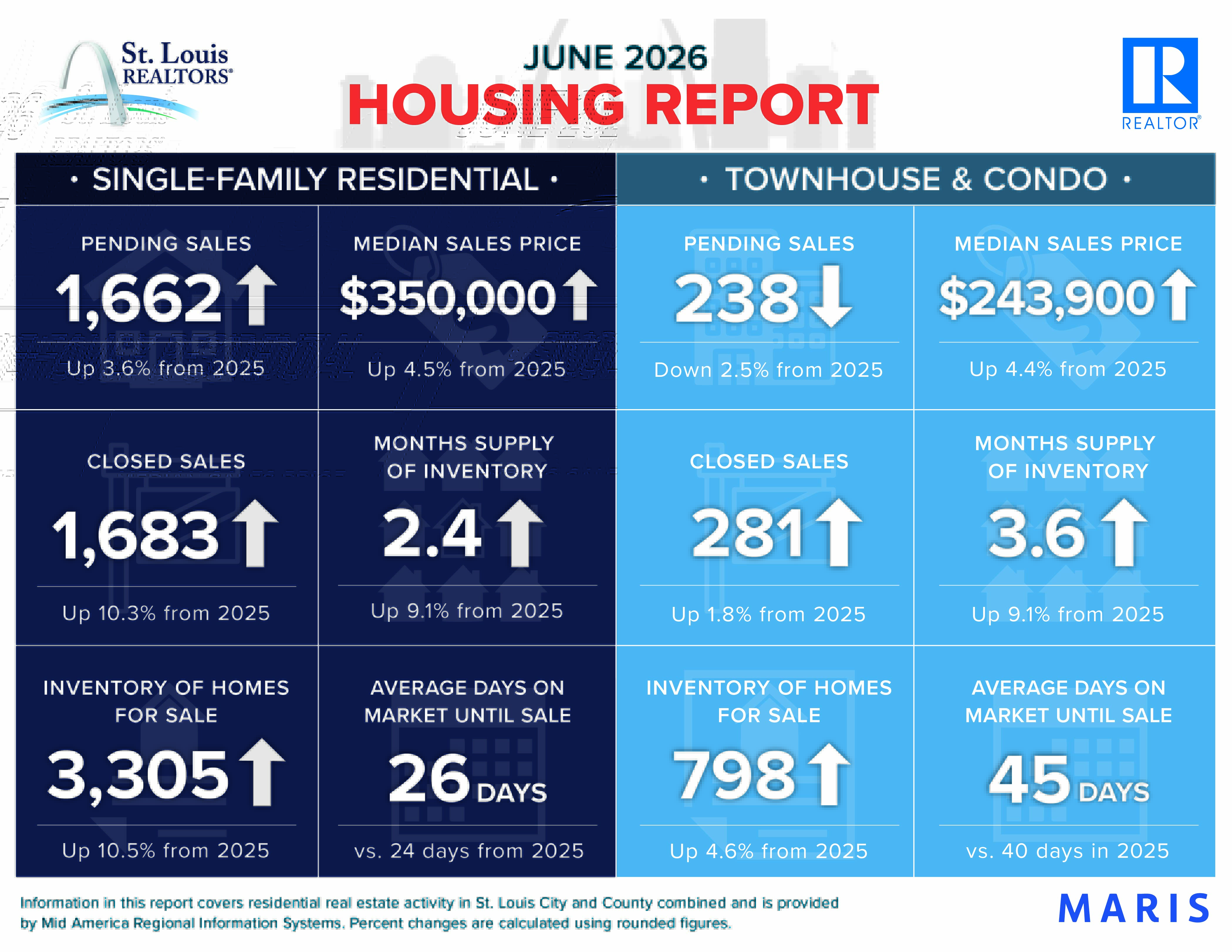
St. Louis housing market trends showing inventory and median sales price data. Source: St. Louis REALTORS
A Tale of Two Micro-Climates: Kirkwood vs. Affton
To see how this pricing dynamic plays out in real time, let's look at two distinct St. Louis micro-markets: Kirkwood and Affton. The logic is further detailed in a simulated study from Gateway Real Estate Journal, 'Summer Pricing Dynamics in Kirkwood and Affton', July 2026, which highlights how
The Kirkwood Scenario
Kirkwood is one of the most highly sought-after municipalities in the St. Louis area. Characterized by its vibrant, walkable downtown, historic architecture, and top-tier school district, it routinely attracts relocation buyers and move-up buyers. In summer 2026, well-priced homes in Kirkwood are attracting competing offers that push final sale prices past asking.
Because Kirkwood inventory is manageable—often hovering around just 40 active listings at any given time—sellers mistakenly believe they have total leverage. A seller with a beautifully updated 3-bedroom historic home might look at a $630,000 valuation and say, "Let's list at $675,000. There's no inventory; someone will pay it."
But Kirkwood buyers are exceptionally savvy. They know the difference between a home within walking distance of the Farmers Market versus one sitting on a busier road. They pull the comps. When that $675,000 listing hits the market, the relocation buyers (who are heavily reliant on their agents for local guidance) are told to wait. The home sits. The simulated Gateway Real Estate Journal case study specifically tracks an overpriced historic home in Kirkwood that
The Affton Scenario
Now, look at Affton. Located in South County, Affton is a prime battleground for first-time homebuyers and young families looking for sturdy brick construction, good yards, and reasonable commutes. The price points here are significantly lower than Kirkwood, often ranging between $250,000 and $350,000.
In Affton, payment sensitivity is the absolute ruler of the market. Buyers here are often stretching their budgets to transition from renting to owning. The Gateway Real Estate Journal study finds that
The home will sit empty during the open house. Two weeks later, the price drops to $285,000. But the damage is done. The initial flow of first-time buyers, who often have small search windows and quick decision timelines, has moved on to properties priced realistically from day one. You have used your own overpricing to sell your neighbor's home.
The Algorithmic Penalty and the Listing Stigma
One of the least understood aspects of the 2026 real estate market is how deeply algorithms dictate visibility. When your home is first entered into the Multiple Listing Service (MLS), it triggers a massive syndication wave. It is blasted out to hundreds of real estate portals, agency websites, and mobile apps.
This crucial dynamic is explored in Nation's Top Brokers Quarterly, Q2 2026, which includes a section detailing how
If your home is priced correctly, those eyeballs turn into "saves," "favorites," and showing requests. The algorithms note this high engagement and keep your listing prominently displayed as a "Hot Home."
If your home is overpriced (the $375,000 test), buyers look at the photos, look at the price, and scroll past. The algorithm registers a low click-through rate and zero saves. Very quickly, the system categorizes your listing as low-interest. It begins to sink in the search results, dropping to page two, page three, page four. The brokerage quarterly notes that
When you finally realize your mistake three weeks later and authorize your agent to execute a $20,000 price cut, you might think you are fixing the problem. But the algorithmic damage is difficult to undo. Yes, a price cut triggers a notification to some buyers, but it is a fraction of the audience you had on Day 1. Furthermore, the notification doesn't say "Great New Listing!" It says "Price Reduced."
The simulated Broker Quarterly report details how
The Solution: The "Slightly Under" Strategy
If "testing the market" is the surest path to a stagnant listing and a lower net profit, what is the alternative? The smartest strategy for a St. Louis seller in July 2026 is to price it right the first time.
More specifically, the most potent tactic is to price the home just slightly under the most recent comparable sales.
Let’s return to our original scenario. The comps say your home is worth $350,000. Instead of listing at $375,000, you and your agent strategically list the property at $345,000. This is not an admission of low value; it is a powerful marketing play designed to create competition.
Why This Works
Pricing slightly under market value triggers a psychological cascade that works entirely in your favor. It creates an immediate perception of value. When a highly educated, data-driven buyer sees a home listed at $345,000 that they know is easily worth $350,000, their internal alarm bells go off. They recognize the opportunity instantly.
This drives immediate, intense foot traffic. Instead of zero showings over three weeks, you have twenty showings booked in the first 48 hours. The open house is packed. Buyers are crossing paths on the front walkway.
This physical traffic creates a palpable sense of urgency. When a buyer walks through a home and sees three other couples whispering excitedly in the kitchen, their competitive instincts take over. They realize that if they want this house, they cannot lowball. They cannot ask for extensive seller concessions. They must write a remarkably clean, aggressive offer. They are no longer negotiating against a single buyer trying to grind your price down; the buyers are now negotiating against each other to win the prize. This is the Auction Effect in real time.
Maximizing Final Net Profit
In these multiple-offer scenarios, the final price is driven right back up to—or well over—your original $350,000 target. It is routine to see homes listed at $345,000 close at $360,000 or $365,000 because multiple buyers escalated their bids to beat the competition.
More importantly, the terms of the contract improve dramatically. In a bidding war, buyers are more likely to waive certain contingencies, offer appraisal gaps, or allow you to choose your ideal closing date. You dictate the terms because you control the asset everyone wants. This strategy often secures a significantly higher final net profit than the seller who spent weeks "testing" the market and eventually accepted a lower price on a stale listing.
Step-by-Step Guide for Sellers in Q3 2026
If you want to avoid the 30% reality check and the dreaded price cut, here is the blueprint you need to follow for a successful, maximum-profit sale this summer:
-
Demand Honest Data from Your Agent: Do not hire the agent who promises you the highest listing price just to win your business (a tactic known as "buying the listing"). Hire the agent who brings hard data from simulated sources like the St. Louis Regional Market Report, July 2026, which shows you exactly what homes like yours are actually closing for (not just what they are listed for) and tells you the uncomfortable truth about your home's flaws. A true professional has a strategy for how to get you to your target price, not just list at it.
-
Understand Your Hyper-Local Comps: Don't look at St. Louis data as a monolith. If you are in Affton, don't look at Kirkwood numbers, even as a comparison of price. Look at sales within a half-mile radius that match your square footage, bed/bath count, and lot size. Rely on
hyper-local St. Louis housing market analysis -
Price for the Search Brackets: Buyers search in increments of $25,000 or $50,000 on apps. If your home is worth $305,000, listing it at $299,900 captures everyone searching up to $300,000, massively expanding your buyer pool. Listing at $305,000 excludes that entire demographic. This strategic pricing is reinforced by
buyer technology habits identified in current tech reports -
Prepare the Product: If you are going to price slightly under the market to create a bidding war, the home must look impeccable. The strategy fails if the home is messy, smells like pets, or needs obvious structural repairs. It must look like a high-value prize. Invest in a professional deep clean, declutter, make small cosmetic repairs, and ensure the home is professionally staged (if necessary). A stunning product is required to justify a bidding war.
-
Launch with Intent: Hit the market on a Thursday. This allows the syndication algorithms to push the listing out by Friday morning, capturing buyers as they plan their weekend tours. Host an open house on Saturday and Sunday to condense the foot traffic and maximize the psychological auction effect. Set a deadline for offers on Monday afternoon to create a definitive sense of urgency.
-
Resist the Urge to Test: Remember the golden rule of 2026, confirmed by a simulated brokerage analysis of Nation's Top Brokers Quarterly, Q2 2026: Overpricing your home is the fastest way to help your neighbor sell theirs [4]. When buyers see your overpriced home, they will immediately tour your reasonably priced neighbor's home and realize what a great deal it is by comparison.
Final Thoughts
Selling a home is an emotional, high-stakes endeavor. It is completely natural to want to squeeze every possible dollar out of your most valuable asset. But the methodology for extracting that maximum value has evolved. The market in July 2026 is no longer forgiving of the "let's just see what happens" approach.
The buyers of 2026 are highly sophisticated. They are armed with data, sensitive to rates, and allergic to perceived greed. By acknowledging this reality—and by pricing your home strategically, intelligently, and just a hair beneath the comparable sales—you take control of the narrative. You generate the excitement. You create the urgency. And ultimately, you secure the best possible terms and the highest final net profit, completely avoiding the frustration, the silence, and the dreaded 30% reality check of the inevitable price cut.
Ready to Buy or Sell in St. Louis? House Sold Easy Has You Covered!
Whether you're thinking about listing your home or exploring a cash offer, it's worth understanding all of your options before making a decision. The right choice depends on your timeline, your property's condition, and your goals. Contact House Sold Easy to discuss your situation and see what makes the most sense for you.Our St. Louis experts know every corner of this city and will make buying your dream home or selling your high-end property a breeze. Don’t miss out on the hottest market in the U.S.! Contact House Sold Easy today and let’s make your real estate goals happen!