St. Louis Renters: 5 Reasons to Buy Before Year-End 2026
Aug 22, 2026
Written by House Sold Easy Team
For three summers in a row, St. Louis buyers got used to a routine: find a house on Thursday, tour it Friday, lose it to a cash offer by Sunday night. That routine is breaking down. Sellers are still listing homes at a healthy pace, but inventory of residential homes across the St. Louis metro climbed 15.2% year-over-year in the most recent St. Louis REALTORS® report, and new listings are up too. That's not a market crash. It's a market that finally has room to breathe — and it doesn't look the same in every ZIP code.
This isn't a generic national housing story dressed up with a local dateline. St. Louis has its own supply pipeline, its own pricing patterns, and its own pockets that never got the memo that conditions are supposed to be easing. Understanding the difference between the metro-wide numbers and what's happening on your specific street is the whole game right now.
What Is Happening in the St. Louis Real Estate Market?
Start with the headline number, because it tells you where the year is heading. In the most recent monthly snapshot, new residential listings rose 11.6% compared to the same month last year, while townhouse and condo listings increased 8.5%. More sellers are testing the market than they were twelve months ago, and that supply is sticking around rather than getting scooped up instantly.
Prices, meanwhile, are still climbing — just not at the panic-buying pace of a few years ago. Median sales prices for residential homes rose 5.9% year-over-year to $350,000, while townhouse and condo prices increased 6.3% to $227,000. That's a healthy appreciation rate, not a bubble, and it's happening at the same time buyers are gaining more room to negotiate — a combination that only makes sense once you understand that price growth and inventory growth aren't opposites. They can, and currently do, move together.
Zoom out to the county level, and the picture gets more textured. In St. Louis County specifically, homes sold for a median of $325,000 in the most recent month, a 6.56% increase from the year-earlier figure of $305,000, and transaction volume jumped sharply too. Redfin's independent tracking tells a similar story at the city level: the median sale price in St. Louis is $255,000 over the most recent three-month window, up 6.2% from the same period a year ago. Two different data providers, two overlapping geographies, and both point the same direction — moderate, sustained appreciation rather than the double-digit spikes of 2021 and 2022.
Mortgage rates are the other half of the equation, and they've quietly become less of an obstacle than headlines suggest. Freddie Mac's Primary Mortgage Market Survey put the 30-year fixed rate at 6.67% as of August 13, 2026 — essentially flat compared to 6.58% at the same point a year earlier. Rates aren't falling dramatically, but they've stopped being the wildcard they were in 2023 and 2024, which means buyers can budget with more confidence than they've had in years. The 15-year fixed rate has followed a similar pattern, averaging 5.96% in the same mid-August survey, giving buyers who can handle a higher monthly payment a meaningfully lower total interest cost over the life of the loan.
It's worth putting St. Louis in a national context, because the metro isn't drifting through this cycle in isolation. Nationally, existing-home sales slipped 2.4% from the previous month to a seasonally adjusted annual rate of 4.09 million units, though sales were still up 2.8% from a year earlier. The national median existing-home price hit a fresh record, climbing to $440,600 — a 1.8% year-over-year gain that marked the 36th consecutive month of annual price increases. St. Louis, by contrast, remains one of the more affordable large metros in the country: a $350,000 median residential sale price sits roughly $90,000 below the national figure, which helps explain why local demand has stayed resilient even as rates hover in the high-6% range. Nationally, there were 1.56 million properties for sale heading into the month, representing a 4.6-month supply at the current sales pace — a level many economists consider close to balanced. St. Louis's inventory growth is outpacing that national trend, which is part of why local buyers are noticing the shift more than a national headline alone would suggest.
Inventory Is Changing
Here's the part worth sitting with: inventory growth of this size hasn't happened in St. Louis in a long time, and it's not just a one-month blip. Months' supply of inventory for residential homes increased 13% year-over-year, and 15.2% for townhouses and condos — meaning it would now take noticeably longer to sell through everything currently listed if no new homes came onto the market at all.
Why is this happening now? A few forces are converging. First, sellers who locked in sub-4% mortgage rates during the pandemic and then froze in place for two years are starting to move again, whether for job changes, growing families, or retirement — life events don't wait forever for rates to drop back to 2021 levels. Second, new construction has been catching up steadily rather than dramatically, adding a slow but consistent trickle of fresh listings, particularly in the outer suburbs. Third, homes that would have sold in days back in 2022 are now sitting long enough that they show up as "active" in the data for weeks instead of hours, which mechanically inflates the inventory count even without a flood of brand-new listings.
What does that mean in practice? It does not mean every neighborhood has flipped to a buyer's market. Months of supply below five to six is still technically a seller's market by the textbook definition real estate economists use, and much of St. Louis remains under that threshold. What it does mean is that buyers finally have room to comparison-shop, walk away from a home with a bad inspection, and negotiate on price or closing costs instead of waiving contingencies just to get noticed. Sellers, in turn, are competing with more alternatives than they were used to, which raises the stakes on pricing a home correctly the first time.
Days on market backs this up at a granular level. Redfin reports St. Louis homes are now taking a median of 21 days to sell, compared to 20 days a year earlier — only a one-day shift, but a meaningful signal that the frantic under-a-week timelines of the post-pandemic peak have eased across the board, even if the change looks modest on paper. Homes in St. Louis are also receiving an average of two offers, according to Redfin's tracking — down noticeably from the five, six, or more offers that defined the tightest years of the pandemic-era market, and another sign that competition, while still real, has cooled from its peak intensity.
It also matters that this inventory growth is happening at the same time transaction volume is climbing, not falling — a combination that separates a healthy rebalancing from a demand collapse. St. Louis County alone saw 1,451 closed transactions in the most recent month, a 19.82% jump from 1,211 sales during the same month a year earlier. More listings and more closings moving up together is exactly what you'd expect from a market absorbing pent-up seller activity rather than one where buyers are pulling back.
Where Buyers Are Seeing More Choices
The inventory increase isn't distributed evenly, and that's the piece a metro-wide headline can't capture. Entry-level and mid-priced pockets in North County — Florissant, Hazelwood, and Ferguson among them — tend to see supply build faster than premium suburbs because affordability constraints slow down demand even as more sellers list. Buyers working with tighter budgets or first-time buyer programs are generally finding more homes to choose from and more room to negotiate seller concessions in these areas than they had a year or two ago.
South County tells a similar story. Oakville, Mehlville, and Affton have historically offered a middle ground — solid school districts, reasonable commutes, and prices below the premium inner-ring suburbs — and that combination is now drawing in sellers who were previously sitting on the sidelines. Buyers here are less likely to face the multiple-offer scrums that defined 2021 and more likely to get an accepted offer with an inspection contingency intact.
St. Charles County's outer communities are worth watching too. New construction has been a bigger share of the market out toward O'Fallon and Wentzville than in the older, built-out parts of the metro, and new residential listings across the metro climbed 11.6% year-over-year, with builder activity contributing meaningfully to that growth in the newer subdivisions further from the urban core. Buyers who want a brand-new home with a warranty, rather than a century-old brick two-story with character (and character-building maintenance bills), are finding more builder inventory to choose from than they had at this point last year.
Where Competition Is Still Strong
None of this means St. Louis has become an easy market everywhere. The premium inner-ring suburbs — Kirkwood, Webster Groves, and Clayton chief among them — remain tight by almost any measure. Move-in-ready homes in these communities, along with hot pockets of St. Louis City like the Central West End, continue to see accepted offers well inside the two-week mark even as the broader metro average stretches out. School district reputation, walkability, and proximity to Forest Park or downtown employment centers keep demand concentrated in a shrinking set of desirable blocks, and that scarcity hasn't meaningfully loosened just because metro-wide inventory has grown.
The reason is structural rather than cyclical: these neighborhoods are largely built out, with limited teardown or infill opportunity, so supply can't expand the way it can in a greenfield subdivision in St. Charles County. When a well-maintained four-bedroom colonial in Webster Groves hits the market, it's still competing against a shrinking pool of comparable listings rather than a growing one. Sellers in these ZIP codes are, for now, largely insulated from the negotiating leverage buyers are gaining elsewhere in the metro.
Condos and townhomes occupy an odd middle ground worth flagging separately. Even though condo and townhouse inventory grew 9.2% year-over-year, days on market for that segment jumped 24.4% — a much sharper slowdown than the single-family market experienced. That combination suggests the condo and townhome segment is cooling faster than headline inventory numbers alone would indicate, likely tied to HOA fee increases and insurance cost pressure that have made attached housing a harder sell in the current environment.
What This Means for Buyers
More listings change your leverage, but only if you use it. A few practical shifts worth making:
- Widen your search radius on days-on-market. Homes that have sat for three or four weeks are far more open to price or closing-cost negotiation than they were in 2022, when "day one" listings were the only ones worth touring.
- Don't assume every neighborhood has softened. If you're set on Kirkwood, Webster Groves, or Clayton, treat it like 2021 conditions still apply — be pre-approved, be ready to move fast, and don't expect much room on price.
- Use the rate environment, not just the price. With 30-year rates sitting around 6.67%, ask about seller-paid rate buydowns rather than just chasing a lower list price; a temporary 2-1 buydown can matter more to your monthly payment than a small discount off asking.
- Get a real inspection. In a market where sellers are more willing to negotiate, walking away from a home with a bad inspection report is a realistic option again — something that was nearly impossible during the waived-contingency years.
- Compare offer counts, not just list price. With Redfin tracking an average of about two competing offers per listing metro-wide, most homes are no longer generating the frenzy of the 2021–2022 peak — a useful data point to bring up with your agent when deciding how aggressive to make an opening offer.
- Factor in the true monthly cost, not just principal and interest. Property taxes, homeowner's insurance, and routine maintenance can add 25–35% on top of your mortgage payment; run the full number before comparing it to your current rent, especially if you're moving from an apartment with fewer built-in costs.
None of this means buyers should expect a discount on every property. In tight suburbs, the old playbook — strong pre-approval, competitive earnest money, and a quick response time — is still the price of admission. The new playbook applies mainly to listings that have already sat for a few weeks, which is a growing share of what's on the market metro-wide.
What This Means for Sellers
Rising inventory raises the cost of getting pricing wrong. When your listing is one of a handful in the neighborhood, buyers stretch to make an offer work. When it's one of a growing pool, an overpriced listing just sits — and a listing that sits accumulates a stigma that makes buyers wonder what's wrong with it, even if the honest answer is simply that it was priced ambitiously.
That doesn't mean sellers need to panic or slash prices preemptively. Median sales prices are still up 5.9% year-over-year, which tells you demand hasn't disappeared — it's just no longer desperate. The sellers doing best right now are pricing at or slightly below recent comparable sales rather than testing the market's ceiling, investing in basic presentation (a fresh coat of paint, decluttering, addressing obvious deferred maintenance before it becomes a negotiating chip during inspection), and being realistic that a 44-day close is a normal timeline again rather than a red flag.
Location still matters enormously to your strategy. A well-priced home in Kirkwood or the Central West End can likely still expect a fast, competitive process. A comparable listing in a South County or North County ZIP code with more competing inventory needs to work harder — better photography, a pricing strategy anchored to the most recent closed comps rather than last year's peak, and patience with a process that may take a few weeks longer than it would have in 2022.
Timing your listing also matters more than it did when almost anything sold regardless of season or condition. Homes hitting the market in obviously dated condition, or with deferred maintenance visible in listing photos, are the ones most likely to accumulate the extended days-on-market numbers behind the metro-wide averages. A pre-listing inspection — once considered an unnecessary expense in a hot seller's market — is becoming a more common way to get ahead of issues before a buyer's inspector finds them and uses the discovery as leverage to renegotiate mid-contract.
What Investors Should Watch
Rising inventory generally means more acquisition opportunities, but the details matter more than the headline. Watch for extended days-on-market listings in North County and South County submarkets — these are the properties most likely to see price reductions and motivated sellers, particularly for buy-and-hold rental strategies where cash flow, not appreciation speed, is the priority.
The condo and townhome segment deserves particular attention given its sharply longer time on market despite growing inventory. That combination can spell opportunity for investors comfortable underwriting HOA risk and insurance cost trends, but it's also a segment where distressed pricing can reflect a real structural problem with the building or association rather than just a temporary market lull — due diligence on HOA financials matters more in this environment than it did a few years ago.
New construction in St. Charles County's outer suburbs is worth monitoring for a different reason: builder incentives (rate buydowns, closing cost credits, design upgrades) tend to expand when inventory is rising, and those concessions can sometimes beat negotiating on an existing home, particularly for investors targeting newer housing stock with lower near-term maintenance risk. On the flip side, investors should be cautious about assuming rising metro-wide inventory translates to bargains in tight, built-out suburbs like Clayton or Webster Groves — those markets are still operating with the scarcity dynamics of a seller's market, and acquisition costs there haven't softened the way they have elsewhere.
Financing costs deserve equal weight in any acquisition model right now. With 30-year rates around 6.67% and unlikely to fall sharply in the near term, deals that only pencil out on the assumption of a future refinance carry real risk if that refinance doesn't materialize on schedule. Investors underwriting new purchases in this environment are generally better served stress-testing cash flow at something close to current rates rather than betting on a return to the sub-4% financing environment of a few years ago. The metro's relative affordability compared to national price levels remains a genuine long-term tailwind for St. Louis as a rental market — but that tailwind works over years, not months, and shouldn't be used to justify overpaying on a deal that doesn't work at today's borrowing costs.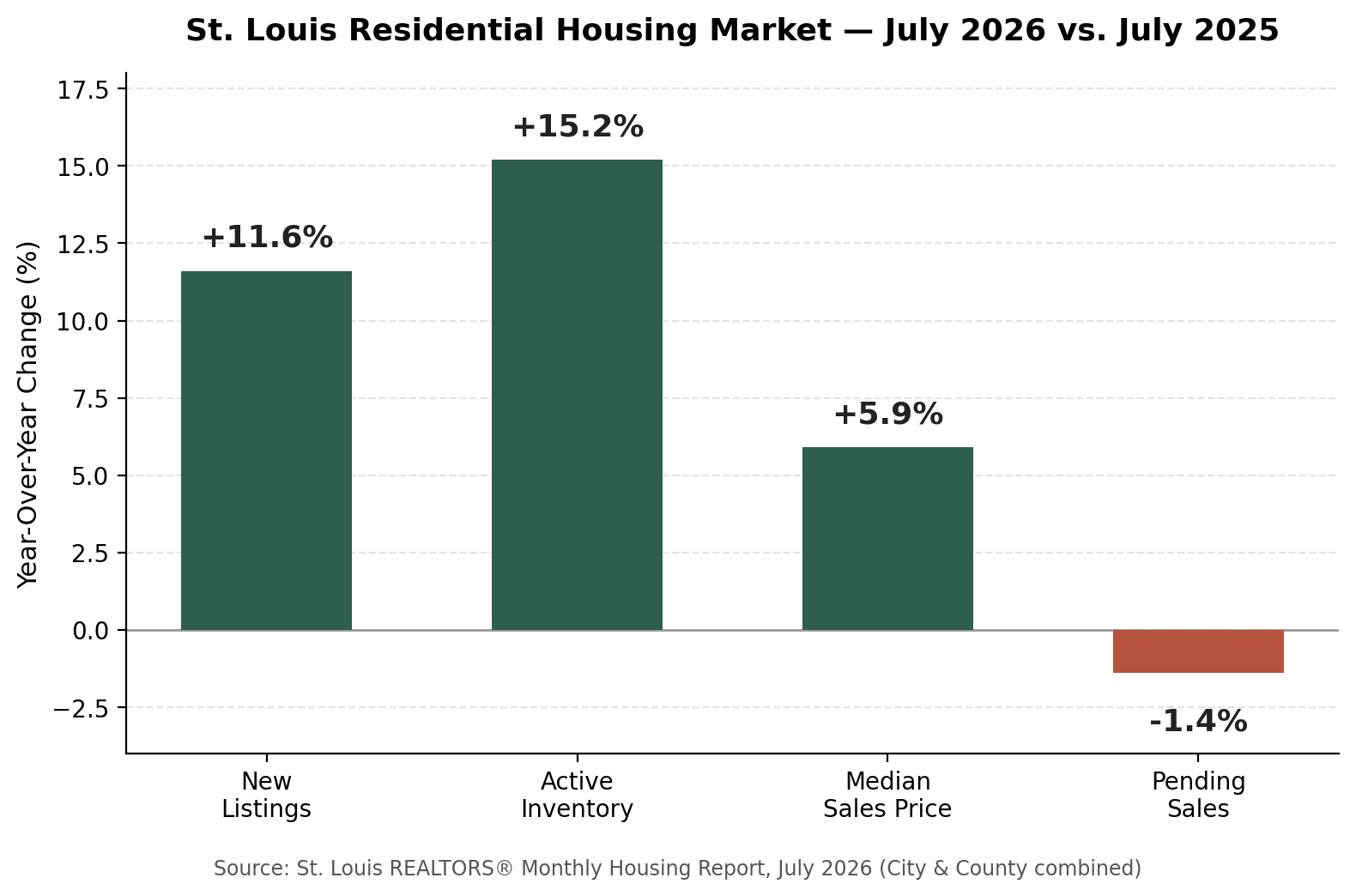
Market Snapshot: Key Indicators
| Market Indicator | Year Ago | Current | Change |
|---|---|---|---|
|
6.58% (Aug. 2025) |
6.67% (Aug. 2026) |
+0.09 pts |
|
|
20 days |
21 days |
+1 day |
|
|
$305,000 |
$325,000 |
+6.56% |
| Metro-Wide Indicator (YoY) | Residential Homes | Condos / Townhomes |
|---|---|---|
|
+11.6% |
+8.5% |
|
|
+15.2% |
+9.2% |
|
|
+5.9% to $350,000 |
+6.3% to $227,000 |
|
|
+13% |
+15.2% |
Source: St. Louis REALTORS® Monthly Housing Report, most recent release (encompassing St. Louis City and County).
Key Takeaways
- Metro-wide residential inventory grew 15.2% year-over-year, the sharpest supply increase St. Louis has seen in years, but it's a shift toward balance — not a crash.
- Prices are still rising: median residential sale prices are up 5.9% year-over-year to $350,000, proof that more supply and continued appreciation can coexist.
- Buyers have real new leverage in North County, South County, and parts of St. Charles County — but premium inner-ring suburbs like Kirkwood, Webster Groves, Clayton, and the Central West End remain tight and competitive.
- Mortgage rates have held nearly flat over the past year at 6.67%, making budgeting more predictable even though rates haven't dropped meaningfully.
- Sellers should price to recent comps, not last year's peak — an overpriced listing in a market with more competing inventory will sit, and sitting listings tend to sell for less than a correctly priced one from day one.
- Investors should watch extended days-on-market listings and the condo/townhome segment closely, where longer time on market may signal both opportunity and added underwriting risk.
The Bottom Line
St. Louis hasn't flipped from a seller's market to a buyer's market — it's landed somewhere more interesting: a metro where both sides finally have leverage, depending on where they're shopping and what they're selling. A double-digit jump in inventory sounds like it should hand buyers the upper hand everywhere, but Kirkwood, Webster Groves, Clayton, and the Central West End are proof that scarcity is still local, not metro-wide. Meanwhile, North County, South County, and the outer reaches of St. Charles County are where the new supply is actually landing, and where negotiating room has genuinely opened up.
The takeaway for anyone transacting in this market is the same one that's true in most years, just easier to act on right now: know your specific submarket cold before you set a price or make an offer. A seller pricing a Ferguson listing off a Clayton comp will sit on the market for weeks. A buyer walking into Webster Groves expecting 2026's metro-wide softening will lose the house. The data says St. Louis is rebalancing — but rebalancing happens block by block, not all at once, and the next few months will show whether this inventory growth holds through the fall selling season or whether it was a summer catch-up that fades as rates and seasonal demand shift again.
Ready to Buy or Sell in St. Louis? House Sold Easy Has You Covered!
Whether you're thinking about listing your home or exploring a cash offer, it's worth understanding all of your options before making a decision. The right choice depends on your timeline, your property's condition, and your goals. Contact House Sold Easy to discuss your situation and see what makes the most sense for you.Our St. Louis experts know every corner of this city and will make buying your dream home or selling your high-end property a breeze. Don’t miss out on the hottest market in the U.S.! Contact House Sold Easy today and let’s make your real estate goals happen!