St. Louis Is Defying the National Slowdown
Feb 26, 2026
Written by David Dodge
With home prices up 6.8% year-over-year and the Gateway City ranked one of America's hottest luxury housing markets, St. Louis is rewriting its real estate story — one competitive offer at a time.
Walk the sun-drenched streets of Clayton or scroll through Zillow listings in Soulard, and you'll see the same thing: "Under Contract." The St. Louis housing market, long overlooked by coastal investors and dismissed by national commentators as a rust-belt afterthought, has quietly become one of the most competitive real estate arenas in the Midwest — and its momentum is showing no signs of stopping heading into 2026.
This isn't a story about a boom-and-bust cycle driven by speculative fever. St. Louis's real estate strength is rooted in something more durable: genuine affordability, a diversified local economy anchored by healthcare, financial services, and biotechnology, and a growing recognition that the Gateway City offers a quality of life that coastal metros charge triple the price for. The data is catching up to what longtime residents already knew.
According to data from Redfin, St. Louis home prices closed December 2025 at a median of $235,000, a 6.8% increase from the same month a year prior. Meanwhile, the broader metro area — tracked by St. Louis Realtors® — recorded a median residential sales price of $275,000, up 1.9% over the year. Both figures underscore a market that, while not immune to national headwinds like elevated mortgage rates, remains fundamentally strong. When you consider that the national median home price sits north of $420,000, St. Louis's numbers represent something increasingly rare in American housing: genuine value.
Median Home Sale Price — St. Louis Metro
Monthly trend, January 2024 – February 2026
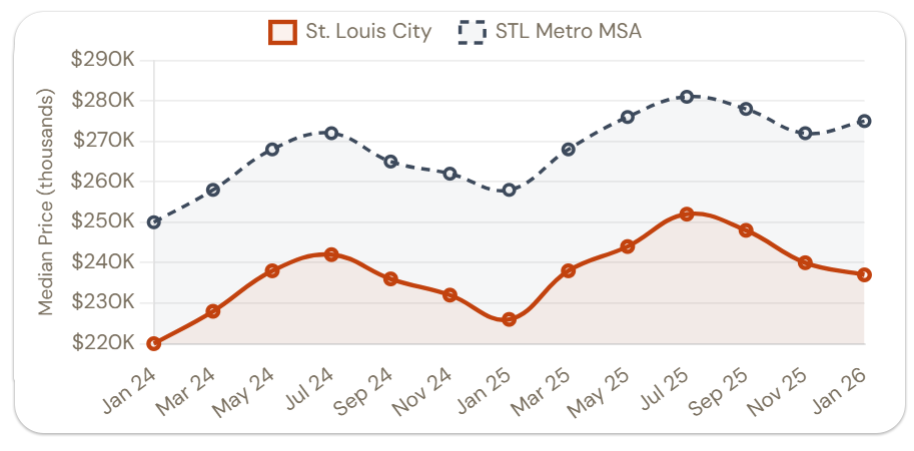
Source: Redfin St. Louis Market Data, St. Louis Realtors® Monthly Housing Reports. City of St. Louis figures differ from broader MSA data.
A Seller's Market — With Asterisks
The phrase "seller's market" has been attached to St. Louis for several years running, but the picture in early 2026 is more nuanced than that simple label suggests. Yes, well-priced, move-in-ready homes in desirable neighborhoods still draw multiple offers — sometimes within days. But the market is showing signs of normalization that favor attentive, well-prepared buyers who might have been shut out entirely in 2022 or 2023.
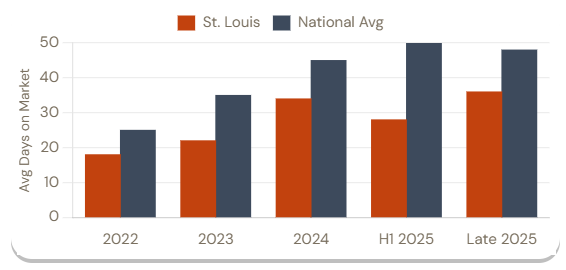
Days on market ticked up to 36 days citywide (from 34 a year ago), and homes in the broader MSA are spending 28% more time listed compared to 2023 lows. Inventory has also expanded: St. Charles County alone saw new listings rise roughly 8% year-over-year by mid-2025, offering buyers more options than at any point since before the pandemic. This isn't a sign of a failing market — it's a sign of a market finding its footing after years of frenzied, unsustainable conditions.
The shift is most visible in the mid-market price range — homes listed between $250,000 and $400,000. These properties, which saw the most aggressive bidding wars in 2021 and 2022, are now seeing somewhat more measured competition. Buyers in this range are conducting more due diligence, requesting inspections (which were routinely waived at the height of the market), and in some cases successfully negotiating minor concessions. It's a notable cultural shift in a market that, not long ago, routinely saw buyers waiving every contingency just to have their offer considered.
At the same time, the sub-$200,000 segment remains intensely competitive, particularly in neighborhoods like Benton Park, Tower Grove South, and parts of South City. Entry-level inventory in St. Louis has been persistently thin, and the convergence of first-time buyers, investors seeking rental income, and house-hackers has kept demand outpacing supply in this price band. Redfin data suggests that homes priced under $200,000 in the city are still receiving an average of three or more offers, with above-list sales remaining common.
"Sellers of great homes, priced right and marketed to the highest level, are still experiencing competitive bidding. But overpriced listings are sitting — and that's actually healthy."
— The Gellman Team, April 2025 Market Update
The normalization at the higher end of the market is giving buyers leverage they haven't enjoyed in years. Homes priced above $500,000 — particularly in the western suburbs of Chesterfield, Wildwood, and Ballwin — are taking longer to sell and, in some cases, are undergoing price adjustments. This doesn't signal weakness so much as a recalibration: after years of extraordinary appreciation, sellers who bought at pre-pandemic prices are still well ahead, but the days of setting any price and watching offers flood in are over.
Median Home Price: St. Louis vs. Peer Cities
Source: Zillow, Redfin. Figures represent approximate median sale prices for the metro area as of late 2025.
Forecast: Steady Climb Through 2026
Analysts are cautiously optimistic about the year ahead. Zillow's latest model projects St. Louis home values will rise approximately 2.0% by November 2026 — modest by pandemic-era standards, but meaningful and positive given the national backdrop of cooling prices and affordability strain. CoreLogic's broader U.S. forecast of 4.1% national growth aligns with local St. Louis City data showing a 4.76% year-over-year increase in median prices through mid-2025, suggesting the metro may actually outperform modest expectations if economic conditions cooperate.
What gives analysts confidence in St. Louis's continued trajectory isn't speculation — it's structural. The region's economy is anchored by institutions and industries that don't disappear in a recession. BJC HealthCare and Mercy Health are among the region's largest employers, providing tens of thousands of stable, well-compensated positions. Washington University in St. Louis and Saint Louis University generate consistent demand for housing near their campuses and spin off biotech and research startups that bring high-earning talent to the metro. Emerson Electric, Edward Jones, and World Wide Technology round out an economic base that is far more diversified than its Midwestern contemporaries.
Population trends, historically a weak point for St. Louis, are beginning to turn. While the city proper has seen decades of population decline dating back to the mid-20th century, the broader metropolitan statistical area has stabilized and in some counties — particularly St. Charles — is growing. The emergence of hybrid work as a permanent feature of the professional landscape has allowed people to remain employed by their original employers while relocating for quality of life, and St. Louis has been a significant beneficiary of this shift.
Mortgage rates remain a wildcard. The Federal Reserve held rates steady through much of 2025, and while some economists project incremental cuts in 2026, most expect the process to be gradual and data-dependent. The result: buyers who have been waiting on the sidelines for a dramatic rate drop may be waiting in vain. Current 30-year fixed mortgage rates in the 6.5%–7.0% range are historically not unusual — in fact, rates averaged over 8% throughout much of the 1990s — but after the extraordinary sub-3% environment of 2020–2021, today's rates feel punishing to a generation of buyers conditioned by that anomaly.
As Midwest BankCentre's mortgage advisors have noted publicly, the better strategy is preparation over patience. Buyers who wait for rates to fall to 5% before entering the market may find that any rate relief is immediately absorbed by rising prices, leaving them no better off than they would have been buying today. The calculus of "when to buy" is less about finding the perfect rate environment and more about personal financial readiness, job stability, and the strength of the home being purchased.
New construction activity is another factor shaping the outlook. After years of undersupply, builders in the St. Louis metro — particularly in St. Charles and Jefferson Counties — have been ramping up production of new single-family homes. Permits for new residential construction increased in several key suburban markets through 2025, which will gradually increase inventory and provide some relief to buyers who've struggled to find suitable existing homes. However, construction costs remain elevated due to ongoing materials and labor pressures, meaning new builds are priced at a premium and not likely to solve the affordability gap in the near term.
Zillow MSA Forecast — St. Louis Home Value Index
Projected appreciation (Nov 2025 baseline = 0%)

Source: Zillow Home Value Forecast, November 2025 publication. The forecast reflects the percentage change from the Nov 2025 baseline.
Neighborhood Spotlights
One of the defining characteristics of the St. Louis real estate market is its extraordinary diversity of neighborhoods, each with its own identity, price dynamics, and buyer profile. The city and its surrounding municipalities offer a range of options that few metros can match — from beautifully preserved Victorian architecture in historic city neighborhoods to sprawling new construction in master-planned suburban communities to everything in between. Here's a deeper look at the neighborhoods driving the most conversation in early 2026.
- Botanical Heights & Fox Park — Rising Stars
- Among the neighborhoods generating the most buzz in the city, Botanical Heights and Fox Park stand out for their combination of relative affordability, active revitalization investment, and authentic urban character. Both areas have seen a wave of new residents drawn by community investment programs, improved walkability scores, and proximity to the Missouri Botanical Garden — one of St. Louis's crown jewel cultural institutions. Median prices in both neighborhoods have risen steadily, with Botanical Heights now averaging in the $200,000–$250,000 range for renovated brick homes — still accessible by St. Louis standards but climbing faster than the city average. For investors and first-time buyers willing to embrace emerging corridors, these neighborhoods represent the kind of long-term upside that defined now-expensive areas like The Hill or Soulard a decade ago. The signs of sustained improvement are there: new restaurants opening, long-vacant storefronts being converted, neighborhood associations actively engaging with city planners, and a demographic mix that suggests organic, community-driven growth rather than displacement-heavy gentrification. Those who bought in Botanical Heights in 2019 or 2020 have seen their equity appreciate substantially, and there's no indication that the trend is reversing.
- Soulard & Benton Park — The Established Gems
- Soulard, long considered one of St. Louis's most vibrant urban neighborhoods, continues to command premium prices relative to the city average. The neighborhood's famous Soulard Market — one of the oldest public markets in the United States — anchors a community of renovated townhomes, beer gardens, and live music venues that have attracted young professionals and empty-nesters alike. Median prices in Soulard hover in the $275,000–$350,000 range for well-maintained row houses, with fully renovated properties and larger corner lots fetching well above that. Benton Park, just south of Soulard, has followed a similar trajectory at a slightly lower price point, making it an attractive option for buyers who love the aesthetic and community feel of Soulard but are working with tighter budgets. Both neighborhoods have extremely limited inventory — turnover is low because residents tend to love where they live and stay put, which keeps demand high relative to supply and supports continued price appreciation.
- St. Charles County — Suburban Surge
- Just west of the Missouri River, St. Charles County continues to capture the lion's share of suburban demand in the greater St. Louis area. Inventory expanded roughly 23% year-over-year in late 2024, yet absorption remains strong — a testament to the sheer volume of buyers targeting this corridor. The county's combination of top-rated public school districts (Francis Howell, Fort Zumwalt, and Wentzville school districts consistently rank among Missouri's best), newer construction, extensive retail and restaurant development, and a generally safe, suburban environment has made it a magnet for families relocating to the St. Louis metro from other cities as well as St. Louis city and county residents seeking more space. O'Fallon and Wentzville, in particular, have seen explosive growth in new residential development. Master-planned communities with amenities like pools, walking trails, and recreation centers are selling quickly, even at price points in the $350,000–$500,000 range. The trade-off — longer commutes and a more car-dependent lifestyle — is a calculation many families are making in favor of space, schools, and neighborhood amenities.
- Clayton & University City — The Professional Premium
- Clayton, the seat of St. Louis County government and home to a remarkable concentration of corporate headquarters, law firms, and financial services companies, occupies its own tier in the local real estate market. The downtown Clayton area — essentially a city within a city — has seen sustained demand from professionals who want to live close to their offices and enjoy one of the region's best restaurant scenes. Condominiums in Clayton proper start around $400,000 and climb well above $1 million for larger, luxury units. Single-family homes in the surrounding residential streets routinely trade in the $700,000–$2 million range. University City, adjacent to Washington University, offers a slightly more accessible entry point with a similar urban walkability and cultural richness. The Delmar Loop, one of the most celebrated commercial strips in the Midwest, anchors a neighborhood that attracts academics, young professionals, and lifelong residents who appreciate the area's diversity and intellectual energy. Median home prices in U-City have risen to approximately $280,000–$350,000, with continued upward pressure from buyers who want walkability without Clayton's price tag.
- Clayton & Ladue — Luxury Holding Firm
- At the very top end of the market, the established luxury communities of Ladue, Frontenac, and Huntleigh remain resilient in the face of broader softening in the high-end national market. Limited supply of premium inventory — there are only so many estate properties on multi-acre lots within 20 minutes of downtown St. Louis — and consistent demand from corporate relocations (particularly in healthcare administration, financial services, and private equity) keep high-end sales moving even as the broader luxury sector cools nationally. Ladue, often described as St. Louis's most prestigious address, has a median home price above $700,000, with the high end of the market exceeding $5 million for the most spectacular estates. What makes these numbers remarkable in context is the comparison: similar properties in comparable suburban luxury markets outside Chicago, Atlanta, or Dallas would carry price tags 40–60% higher. The relative value proposition holds even in the luxury tier, which is part of what earned St. Louis that #1 luxury market ranking.
Investment Opportunities: What the Data Is Telling Investors
For real estate investors — whether they're first-time landlords or experienced portfolio operators — St. Louis presents opportunities that have become increasingly difficult to find in higher-cost markets. The math works in ways that many investors across the country have given up trying to achieve. With median home prices in the $200,000–$250,000 range for investment-grade properties and median rents yielding $1,100–$1,400 per month, gross cap rates in the 6%–8% range are achievable — and in some emerging neighborhoods, higher than that.
North city neighborhoods like Baden, Walnut Park, and O'Fallon Park offer the highest gross yields in the metro, with purchase prices sometimes below $80,000–$120,000 for habitable properties and rents achievable in the $800–$1,100 range. However, these areas carry higher management demands, higher vacancy risks, and require investors with experience operating in challenged neighborhoods. For investors willing to do the work and build relationships with quality tenants and management partners, the returns can be exceptional — but this is not passive investing territory.
For more conservative investors seeking stability alongside reasonable returns, south city neighborhoods and inner-ring suburbs like Maplewood, Webster Groves, and Kirkwood offer the best blend of price appreciation potential, rental demand, and tenant quality. These areas have strong school systems, walkable commercial corridors, and housing stock that attracts long-term tenants — all of which reduce turnover and vacancy risk. Purchase prices in these neighborhoods have risen, reducing gross yields compared to five years ago, but the trade-off in stability and appreciation is often worth it for investors with longer time horizons.
Key Takeaways for Buyers
The window of slightly increased inventory and moderating price growth that characterizes the current St. Louis market is real, but it is unlikely to last indefinitely. Interest rates, though elevated relative to recent historical norms, are not expected to fall dramatically in 2026, which means buyers waiting for a perfect rate environment may be disappointed. The better approach is to get pre-approved by a local lender who understands the St. Louis market — someone who can move quickly and communicate effectively with listing agents — and to identify target neighborhoods with precision rather than shopping broadly.
In competitive price bands (sub-$200K and the $250K–$350K move-up range in desirable neighborhoods), buyers should still come prepared with competitive offers. While the days of waiving every contingency are largely behind us, limiting inspection period length, offering a meaningful earnest money deposit, and demonstrating genuine pre-approval (not just pre-qualification) remain important signals to sellers. Working with an experienced buyer's agent who has relationships with other agents in your target neighborhood is worth every penny of their commission.
First-time buyers should pay particular attention to the neighborhood trajectory rather than just the current price. Areas like Botanical Heights, Fox Park, and parts of South City that are actively improving represent better long-term investments than already-expensive neighborhoods where the appreciation runway is shorter. Buying the least expensive home in a rapidly improving neighborhood almost always outperforms buying the most expensive home in a stable but static one.
Key Takeaways for Sellers
Pricing discipline matters more than ever in this evolving market. The St. Louis market from 2020–2023 allowed sellers to push prices aggressively and still find buyers — those days are behind us. Today's buyers are more discerning, conducting more due diligence, and have access to more comparable sale data than ever before through platforms like Zillow, Redfin, and Realtor.com. Overpriced listings are being identified quickly, and the stigma of a listing that has been sitting (and particularly one that has undergone price reductions) is real and damaging to final sale outcomes.
Sellers who work with experienced local agents to price their homes accurately based on recent comparable sales — ideally within the last 90 days and within a half-mile — and who invest in quality photography, staging, and marketing will continue to see strong results. Homes priced competitively relative to recent comps continue to attract multiple offers in most price ranges and neighborhoods. The key is not to try to "test" the market at an aspirational price; that strategy now backfires more often than it succeeds.
Timing still matters. The spring selling season — March through June — remains the peak period for buyer activity in St. Louis, as families seek to move before the next school year begins. Sellers who list during this window with a properly prepared home have access to the deepest pool of motivated buyers. Fall can also be productive, particularly for the luxury segment, where buyers are less school-year-dependent. The summer months and winter holidays are historically the slowest periods, though properly priced homes continue to sell year-round.
Ready to Buy or Sell in St. Louis? House Sold Easy Has You Covered!
Navigating St. Louis’ red-hot luxury market doesn’t have to be a headache. With House Sold Easy, it’s all about less hassle—we’ve got you covered from start to finish. Our St. Louis experts know every corner of this city and will make buying your dream home or selling your high-end property a breeze. Don’t miss out on the hottest market in the U.S.! Contact House Sold Easy today and let’s make your real estate goals happen!