Rent vs. Buy in St. Louis: What Makes Sense in 2026?
Aug 21, 2026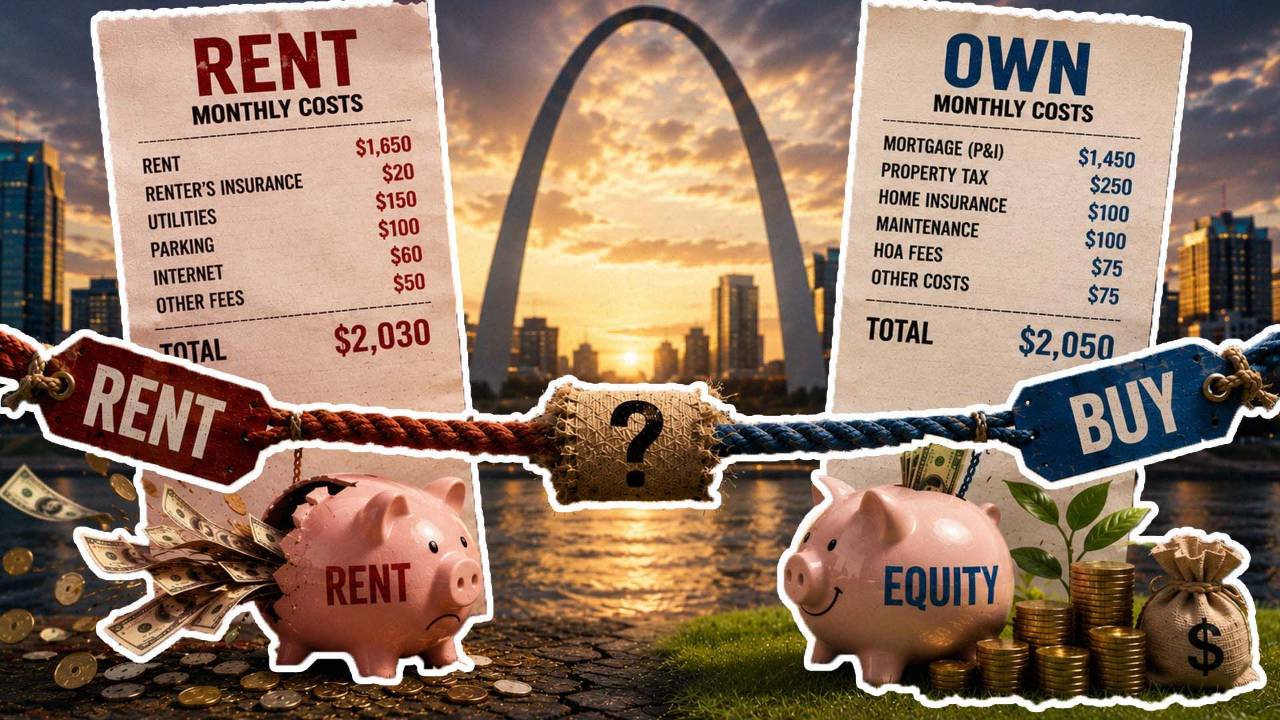
Written by House Sold Easy Team
A renter in St. Louis who ran the numbers a year ago and decided to wait it out would find, checking back in August 2026, that the math has barely budged — and in one important way, it's actually tilted a little further in renting's favor. That's not the story you'd expect given how much has been written this year about mortgage rates finally easing. But St. Louis is one of the 50 largest U.S. metros where renting a starter home still costs meaningfully less per month than buying one, according to Realtor.com's July 2026 Rent Report, and the gap hasn't closed nearly as fast here as it has elsewhere.
That doesn't mean buying is a bad idea. It means the decision is more nuanced than the "rates are dropping, buy now" headlines suggest. Here's what the actual August 2026 numbers say, what's driving them, and how to think through the decision for your own situation.
What's Happening in the St. Louis Market Right Now
Three things are true at the same time in St. Louis this summer, and they pull in different directions depending on whether you're renting or buying.
First, for-sale inventory has grown substantially — St. Louis REALTORS®' July 2026 Monthly Housing Report shows residential inventory up 15.2% year over year, with new listings up 11.6%. That's a real shift from the tight, multiple-offer conditions that defined the local market for much of the past few years. Buyers have more to choose from than they did twelve months ago.
Second, prices haven't backed off because of it. The same St. Louis REALTORS® report shows the residential median sales price rose 5.9% year over year to $350,000 across the city and county combined, and Redfin's most recent data puts the city of St. Louis at a $255,000 median sale price, up 6.2% from a year earlier, with homes typically selling in 21 days. More inventory hasn't translated into falling prices — it's translated into more choice and slightly longer shopping windows, which is a different thing.
Third, mortgage rates have eased, but only modestly. Freddie Mac's Primary Mortgage Market Survey put the 30-year fixed rate at 6.67% as of August 13, 2026, down from 6.69% the week before and roughly in line with the 6.58% recorded a year earlier. That's meaningful relief compared to the 7%-plus rates of 2023 and early 2024, but it's not the kind of drop that transforms monthly payments on its own.
Put together, this is a market that's loosening for buyers without becoming cheap, and where renters are watching their own costs climb again after a quieter stretch. None of that answers the rent-vs-buy question by itself — it just sets the stage for the actual math.
The Current State of Renting in St. Louis
If you're renting in St. Louis right now, your costs have been creeping upward, not falling. RentCafe's July 2026 market analysis puts the average apartment rent across the city at $1,439 a month, a 2.37% increase from $1,405 a year earlier. Broken out by unit size, RentCafe reports studios averaging $1,055, one-bedrooms at $1,344, two-bedrooms at $1,631, and three-bedrooms at $1,793.
Location changes that math considerably. Zumper's neighborhood data shows the Central West End averaging $2,045 a month as of May 2026, up 9% from a year earlier — well above the citywide figure and a reminder that "average rent in St. Louis" can mean very different things depending on the zip code.
Zoom out to the level Realtor.com uses for its national rent-versus-buy comparison — a "starter home," meaning a studio, one-bedroom, or two-bedroom unit — and the St. Louis, MO-IL metro's median asking rent was $1,284 in July 2026, down 1.9% from a year earlier. That's a slightly different (and somewhat lower) number than RentCafe's citywide average because it's pulled from a different data set and a narrower unit definition, but the direction matters more than the exact figure: at the starter-home level, St. Louis rent actually eased slightly this year even as citywide averages ticked up. That's not a contradiction — it reflects a market where smaller starter units softened while the broader average, pulled up by larger and pricier units, kept climbing.
That split matters for anyone actually shopping the rental market right now. If you're looking at a studio or one-bedroom, you're more likely to be negotiating from a position of relative strength, since that segment of the market cooled slightly this year. If you need a two-bedroom or larger unit — the kind of space a family or a couple with a home office actually needs — you're competing in the segment where rents have kept climbing, and landlords have less reason to negotiate. It's worth checking which side of that line your own search falls on before assuming the "rent is down" headline applies to you.
Why Rent Growth Hasn't Gone Away
The apartment construction boom that helped hold St. Louis rents down for the past couple of years is losing steam, and that matters for anyone deciding whether to lock in a lease or start house-hunting. Colliers' Q1 2026 St. Louis Multifamily Market Report shows effective rents climbing from $1,330 in the fourth quarter of 2024 to $1,398 by the first quarter of 2026, with absorption outpacing new deliveries for six consecutive quarters. In plain terms: renters have been filling up new apartments faster than developers have been building them, which hands landlords more pricing power than they've had in a while.
That matters because it undercuts the assumption that renting will just keep getting cheaper while buyers wait for better conditions. If new supply keeps thinning out, the rent side of the rent-versus-buy equation is more likely to tighten than loosen from here — even if it isn't spiking the way it did earlier in the decade.
The Cost of Buying in St. Louis Right Now
On the ownership side, the entry price depends heavily on which St. Louis you mean. The St. Louis, MO-IL metro's median listing price was $290,000 in June 2026, according to Realtor.com data tracked by the Federal Reserve Bank of St. Louis. That's the metro-wide asking-price figure — a different, and typically higher, number than the $255,000 median sale price Redfin reports for the city proper, since city and metro cover different housing stock and suburban listings tend to skew the metro number up.
Layer in financing, and the monthly cost of owning becomes clearer. At Freddie Mac's reported 6.67% rate, here's roughly what principal and interest looks like on a 10%-down purchase at a few common price points in the St. Louis market:
| Home Price | Down Payment (10%) | Loan Amount | Monthly P&I* | Est. Total Payment** |
|---|---|---|---|---|
|
$255,000 |
$25,500 |
$229,500 |
$1,481 |
$2,050–$2,150 |
|
$290,000 |
$29,000 |
$261,000 |
$1,685 |
$2,300–$2,450 |
|
$350,000 |
$35,000 |
$315,000 |
$2,034 |
$2,750–$2,950 |
*Principal and interest only, calculated at a 6.67% 30-year fixed rate. **Includes estimated property taxes, homeowners insurance, and a maintenance reserve, which typically add 30–40% on top of principal and interest in the St. Louis market.
That range spans a fairly ordinary starter purchase up through the metro-wide median-priced home, and it shows why the "just look at the mortgage payment" version of this comparison is misleading — taxes, insurance, and upkeep aren't optional line items; they're a third or more of what ownership actually costs each month.
The down payment itself is worth sitting with for a moment. Putting 10% down on a $290,000 home means finding roughly $29,000 before closing costs even enter the picture — and most St. Louis closings run another $6,000 to $10,000 on top of that, whether paid up front or partially rolled into the loan. For a lot of renters, that's not a hurdle that eases with a slightly lower mortgage rate; it's a savings target that takes years to hit regardless of where rates sit. A smaller down payment is possible — plenty of first-time buyer programs go as low as 3% to 5% down — but that comes with private mortgage insurance added to the monthly payment, which narrows some of the benefit of a smaller upfront check.
The Rent vs. Buy Math, By the Numbers
This is where Realtor.com's methodology is genuinely useful, because it does the apples-to-apples work for you: comparing a starter-home rent against the full monthly cost of buying an equivalent starter home, including a 10% down payment, the prevailing mortgage rate, HOA fees, taxes, and insurance.
For the St. Louis, MO-IL metro in July 2026, that comparison puts renting a starter home at $1,284 a month against $1,621 a month to buy an equivalent one — a $337 monthly difference, or 26.2% more expensive to buy than to rent. For context, the average gap across all 50 largest U.S. metros was $858 a month, or roughly 50.6% more expensive to buy than rent, in the same July 2026 report — so St. Louis's rent-versus-buy gap is actually narrower than the national picture, which is part of why this metro has long had a reputation as a relatively buyer-friendly market even when the raw numbers still favor renting.
What that $337 doesn't show is where the money goes. Rent is a pure expense — every dollar leaves your net worth. A mortgage payment splits between interest (an expense) and principal (money that builds your equity). On a $290,000 loan at 6.67%, the first year of payments includes a modest but real amount of principal paydown that grows every year as the loan amortizes. Renting is cheaper today; it just isn't building anything for tomorrow.
When Buying Makes More Sense Than Renting
- You expect to stay put for at least five years. Closing costs, agent commissions, and the slower early-years amortization of a mortgage mean the first few years of ownership rarely pencil out compared to renting. The advantage shows up later, once you've captured a few years of principal paydown and any appreciation. If your timeline in St. Louis is genuinely uncertain, that argues for staying flexible.
- You want payment stability, not just savings. Even with rent growth in St. Louis running above the national average for two-bedroom units specifically, a fixed-rate mortgage payment doesn't move. That predictability has real value if you're budgeting tightly or planning around a fixed income.
- You have the down payment and closing costs without draining your safety net. A 10% down payment on a $290,000 St. Louis home runs about $29,000, plus another $6,000 to $10,000 in closing costs. If covering that would leave you without an emergency fund, the math on paper doesn't matter — you'd be trading a manageable monthly bill for real financial fragility.
- You're comfortable being your own landlord. Ownership means the furnace, the roof, and the water heater are your problem and your budget line, not someone else's.
When Renting Still Makes More Sense
Your timeline in St. Louis is under three years. Job changes, relationship changes, or just general uncertainty are all good reasons to stay flexible. Selling within two or three years often means you haven't recouped closing costs, particularly if the market cools in the meantime.
Buying would stretch your budget past 35–40% of gross income. Qualifying for a loan and being able to comfortably afford it are two different things. With buying already running 26.2% more expensive than renting a comparable starter home in St. Louis, stretching further to buy more house than you need adds risk without a matching benefit.
You're renting in a neighborhood you couldn't otherwise afford to own in. Areas like the Central West End command a real premium — Zumper's data puts average rent there at $2,045 a month — but that can still be a reasonable trade if it buys you a location, commute, or lifestyle that ownership in the same neighborhood would put out of reach.
You value not being responsible for maintenance and repairs. That's a legitimate preference, not just a financial calculation, and it's a real reason people choose to keep renting even when the numbers are close.
Where This Plays Out Differently Across St. Louis
The rent-versus-buy math isn't uniform across the metro, because home prices and rents don't move together in every submarket. Denser, high-demand areas of St. Louis City — the Central West End, Tower Grove, Soulard — tend to carry rent premiums that partly reflect walkability and amenities buyers would also pay for if they purchased in the same area, which can narrow the rent-versus-buy gap locally even when the metro-wide numbers favor renting. Suburban submarkets in St. Louis County and St. Charles County, by contrast, often show a wider gap between what a comparable rental costs and what a comparable purchase costs, partly because new-construction pricing in fast-growing suburbs like O'Fallon and Wentzville has kept purchase prices elevated relative to rents in those same areas. North County communities such as Florissant and Hazelwood tend to have some of the metro's more accessible entry-level purchase prices, which is worth knowing if affordability, rather than any particular neighborhood, is the driving factor in your decision.
The practical takeaway: the metro-wide 26.2% rent-versus-buy gap is a useful benchmark, not a verdict on any specific St. Louis zip code. Running the comparison for the specific neighborhoods and property types you're actually considering will usually tell a more accurate story than the metro average alone.
The Hidden Costs Both Sides Forget
Renters often budget for the monthly rent check and stop there, but a few line items add up: renter's insurance typically runs $15 to $30 a month and is frequently required by landlords; parking can add $50 to $150 a month in denser buildings; pet rent commonly adds $25 to $50 a month; and moving itself — deposits, application fees, a truck or movers — can run $500 to $2,000 or more every time you relocate. None of it builds equity.
Buyers have their own blind spots. Property taxes in the St. Louis metro commonly run $300 to $600 a month depending on the municipality and school district. Homeowners insurance adds another $80 to $150. A reasonable maintenance reserve — the rule of thumb is 1% to 2% of home value annually — works out to roughly $2,900 to $5,800 a year on a $290,000 house. HOA fees, where they apply, can add anywhere from nothing to a few hundred dollars a month. And the down payment itself carries an opportunity cost: money parked in home equity isn't available to invest elsewhere, for better or worse.
There's also a category of buying costs that only shows up after you've closed: the first-year furnishing and setup expenses that renters don't face in the same way. A previous owner's window treatments, appliances, or yard equipment may or may not convey with the sale, and older St. Louis housing stock in particular — much of the city's inventory predates 1950 — can come with deferred maintenance that only becomes visible once you're living in the house day to day. A home inspection before closing is the standard way to catch the big-ticket issues (roof, foundation, HVAC, electrical), but it won't catch everything, and budgeting a cushion beyond the 1-2% maintenance rule for the first year or two of ownership is a reasonable precaution rather than pessimism.
What Investors Should Watch
For anyone looking at St. Louis rental property rather than a personal home, the same data points cut differently. Rising for-sale inventory and a 5.9% year-over-year increase in the metro's median sales price mean acquisition prices for rental properties are climbing too, not falling — this isn't a distressed-seller market. At the same time, multifamily absorption outpacing new deliveries for six straight quarters, per Colliers' Q1 2026 report, points to firming rental demand and less near-term competition from new supply, which is generally favorable for existing rental property owners. The risk to watch is the same one buyers face: at a 6.67% mortgage rate, financing costs eat into cash-on-cash returns more than they did a few years ago, so underwriting needs to account for financing costs as they stand today, not the sub-4% rates of the early 2020s. None of this is investment advice — it's simply what the current data shows, and every acquisition still needs its own underwriting.
Buy cost includes 10% down, a 30-year fixed mortgage at the prevailing July 2026 rate, HOA, taxes, and insurance. Source: Realtor.com July 2026 Rent Report.
Conclusion: The Right Choice Depends on Your Timeline
In St. Louis, renting still has the monthly cost advantage in 2026, but buying can make more sense for people who are financially prepared and plan to stay long enough to build equity. The current starter-home comparison puts renting at about $1,284 per month versus $1,621 to buy, a difference of $337 per month.
At the same time, buyers have more inventory to choose from, while home prices remain relatively strong and mortgage rates are still around the mid-6% range. That means there isn't one universal winner. If flexibility, lower upfront costs, and a cheaper monthly payment matter most, renting may still be the better fit. If you're financially ready, have a solid emergency fund, and expect to stay in St. Louis for five years or longer, buying allows you to build equity and create more predictable long-term housing costs.
The best move isn't simply to rent or buy because the market says so—it's to run the numbers for your budget, neighborhood, and timeline and choose the option that puts you in the strongest position for the years ahead.
Ready to Buy or Sell in St. Louis? House Sold Easy Has You Covered!
Whether you're thinking about listing your home or exploring a cash offer, it's worth understanding all of your options before making a decision. The right choice depends on your timeline, your property's condition, and your goals. Contact House Sold Easy to discuss your situation and see what makes the most sense for you.Our St. Louis experts know every corner of this city and will make buying your dream home or selling your high-end property a breeze. Don’t miss out on the hottest market in the U.S.! Contact House Sold Easy today and let’s make your real estate goals happen!