5 Pricing Mistakes St. Louis Sellers Are Making Right Now
Aug 20, 2026
Written by House Sold Easy Team
The St. Louis housing market has recalibrated over the last twelve months. For home sellers across the region—from St. Charles County to South City—the dynamic has transformed from an environment of automatic bidding wars to a calculated market where buyers are selective, rate-conscious, and willing to walk away from inflated listings.
Market metrics illustrate this evolution clearly.
Because buyers are no longer rushing to make offers on the first weekend, pricing strategy has become the single most critical factor determining a seller's net proceeds. Yet, many local sellers are still attempting to use 2021-era strategies in an August 2026 environment.
If you are planning to list a property in the St. Louis metropolitan area this season, navigating this shift requires recognizing where other sellers are losing leverage. Here are the five most frequent pricing mistakes St. Louis sellers are making right now, the underlying data behind them, and how to avoid them.
1. Pricing Based on Net Equity Needs Rather Than Market Value
The most frequent strategic misstep made by sellers is establishing a list price anchored to their financial goals rather than actual market value.
Whether a seller needs a specific dollar amount to pay off an existing mortgage, fund a down payment on an upcoming purchase, or cover relocation costs, the listing price must reflect what buyers are actively willing to pay. Prospective buyers evaluate properties relative to competing listings in the same neighborhood, entirely independent of a seller’s individual debt or investment requirements.
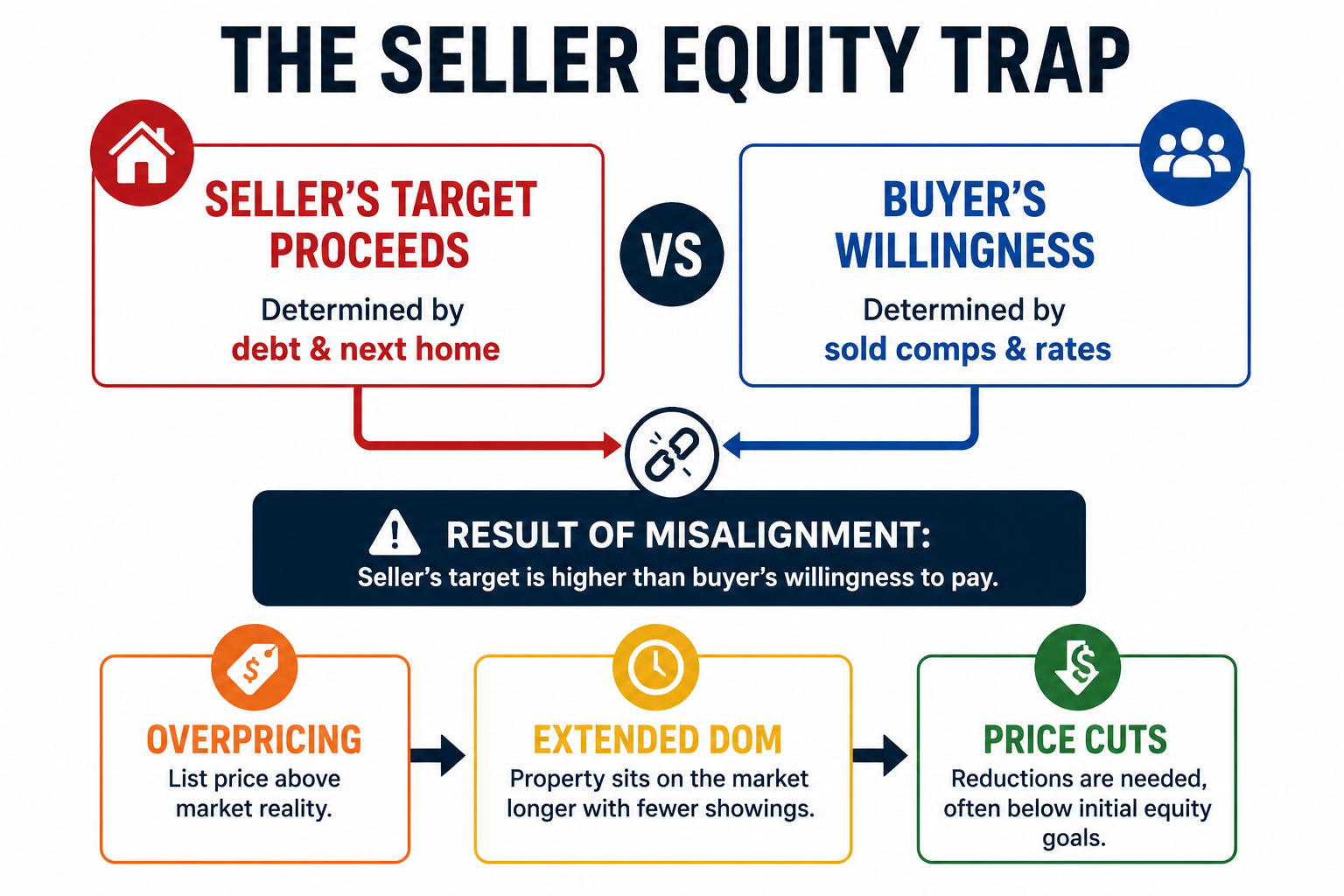
When a property is listed at $385,000 in a submarket where comparable homes consistently close between $340,000 and $350,000, buyer engagement drops off immediately. Today's buyers are well-informed regarding recent local comps and interest rates; when they recognize a property is priced above the surrounding market, they simply filter it out of their search.
The Fix
Focus exclusively on closed sales—properties that have settled within the past 90 to 180 days within your immediate subdivision or school district. Active listing prices represent what neighboring sellers hope to get, whereas closed sales indicate what buyers actually paid. Aligning your asking price with verified sales data prevents initial stagnation.
2. Ignoring the Widening Gap Between List Price and Sold Price
A notable trend in recent market data is the divergence between initial listing prices and final closing figures.
This divergence does not mean buyers are paying over asking across the board. Rather, it highlights a split market: properties that are turnkey and priced accurately sell quickly at or above list price, while properties listed at unrealistic figures sit until significant price cuts are made.
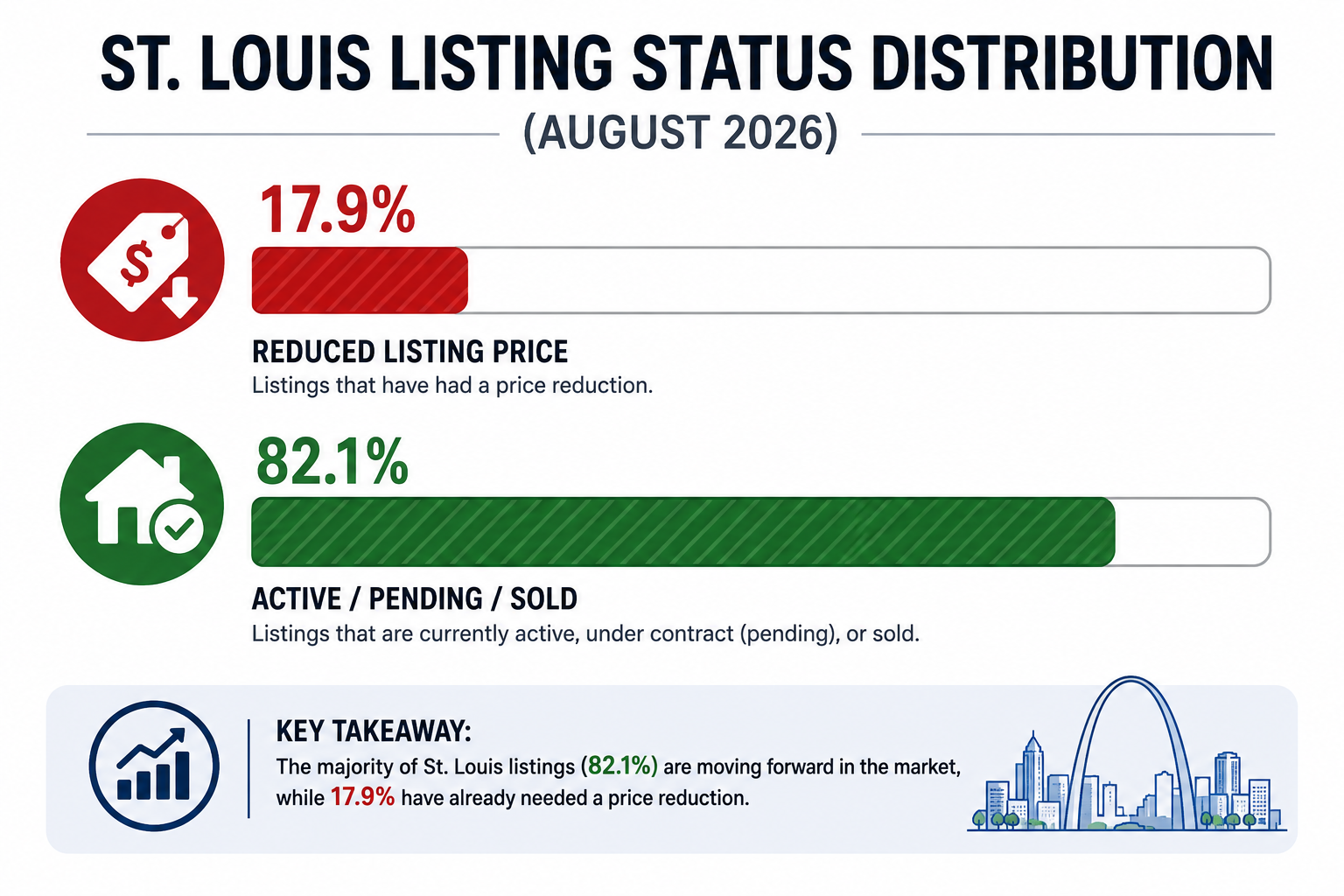
In fact,
| Market Indicator | August 2025 | August 2026 | Year-Over-Year Change |
|---|---|---|---|
|
Active Listings |
5,688 |
+10.3% |
|
|
Median Days on Market |
22 days |
+100.0% |
|
|
Listings with Price Cuts |
12.1% |
+5.8 pts |
|
|
Median List Price |
$299,900 |
-3.3% |
|
|
Median Closed Sale Price |
$334,900 |
+4.5% |
The Fix
Positioning your price correctly from day one avoids the "stale listing" label. When a property sits past the average market threshold, buyers often assume latent defects exist or anticipate seller urgency, leading to below-market offers.
3. Relying Solely on Automated Valuation Models (AVMs)
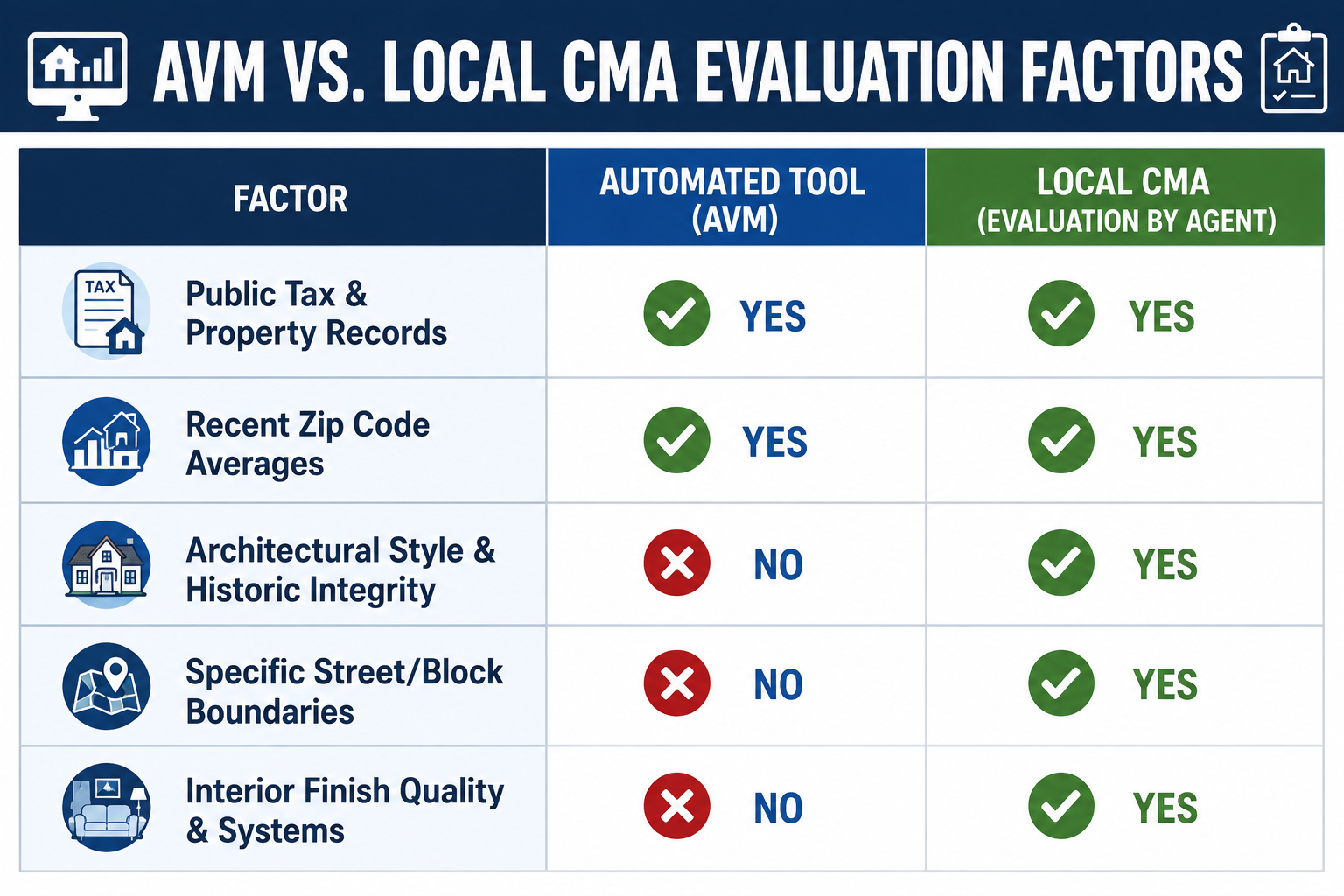
Automated valuation tools like Zillow’s Zestimate or Redfin’s estimate rely on algorithms that pull public record data, tax assessments, and regional sales trends. While useful for broad estimations, these algorithms frequently struggle in hyper-local markets like St. Louis City and St. Louis County, where values shift dramatically across small distances.
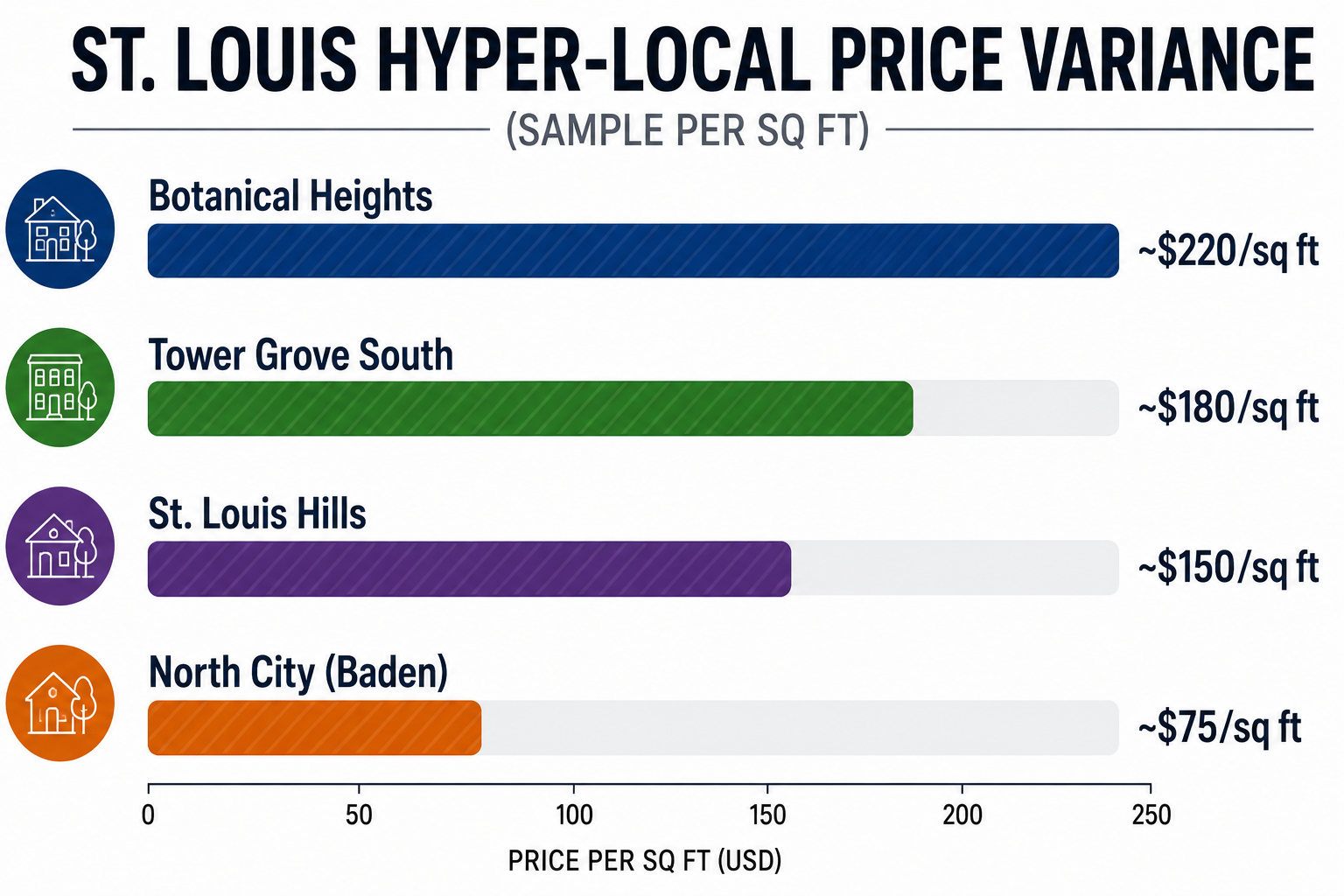
For instance, two brick homes of identical square footage built in 1920 can command entirely different values depending on specific location and updates:
-
A fully renovated historic home in Botanical Heights or Tower Grove South may fetch top dollar due to updated mechanical systems, historic tax incentives, and walkable neighborhood amenities.
-
A property of similar footprint in an adjacent area without recent capital updates may appraise at a completely different valuation tier.
Algorithmic models often miss details like high-end kitchen updates, historic architectural details, basement drain-tile systems, or unpermitted finishes.
The Fix
Rely on a Comparative Market Analysis (CMA) prepared by a local professional who physically inspects the property. A comprehensive CMA evaluates:
-
Closed Sales: Similar properties sold within the past 3 to 6 months.
-
Pending Sales: Homes currently under contract, reflecting active buyer demand.
-
Active Competitors: Listings currently competing for the same pool of buyers.
-
Expired/Withdrawn Listings: Properties that failed to sell, offering clear data on where the market drew the line.
4. Testing the Market with an Intentional Overprice
A common strategy among sellers is listing above market value with the intention of testing buyer appetite. The reasoning is usually: "We can always lower the price later if we don't get any takers."
While this strategy occasionally worked during periods of historic inventory shortages, it is counterproductive in today's market.
| Timeline | Listing Stage | What Happens |
|---|---|---|
|
Week 1–2 |
Listing Launch |
High price deters showings |
|
Week 3–4 |
Market Silence |
Buyers move on to better-value comps |
|
Week 5–6 |
First Price Cut |
Property gets labeled “stale” by buyers |
|
Week 7–8+ |
Second Cut |
Property sells below the original market value |
When a property is overpriced at launch, it misses its primary window of visibility:
-
Initial Launch (Days 1–14): Serious, pre-approved buyers receive instant alerts for new listings matching their criteria. If a home is priced out of its actual value bracket, these buyers won't view it.
-
The Stagnation Phase (Days 15–30): Showings taper off, and feedback consistently notes that the price is too high for the condition.
-
The Reactive Reduction (Days 30+): The seller eventually drops the price, but the initial excitement has passed. Buyers now question why the home sat and often submit lower offers than they would have initially.
The Fix
Price the property at or slightly below current market value from the start. A competitively priced home generates early momentum, higher open-house attendance, and strong offer terms.
5. Ignoring Days on Market (DOM) Realities
During the height of the recent housing boom, St. Louis homes routinely went under contract in under three weeks. Sellers grew accustomed to immediate offers and minimal contingencies. However, that timeline has shifted significantly.
When a property does not sell in the first ten days, sellers often panic or, conversely, dig in and refuse to adjust. Expecting a 48-hour turnaround in today's environment leads to premature frustration and reactive decision-making.
The Fix
Establish a structured timeline with your listing agent before going live:
| Timeline | Action |
|---|---|
|
Days 1–10 |
Launch listing, host open houses, and evaluate showing volume |
|
Days 11–20 |
Gather buyer feedback on price vs. property condition |
|
Day 21 |
If there are zero offers or low activity, implement a price adjustment |
|
Days 22–30 |
Re-engage active buyers with updated pricing and positioning |
Planning a price review date ahead of time takes the emotion out of adjustments if initial traffic is lower than expected.
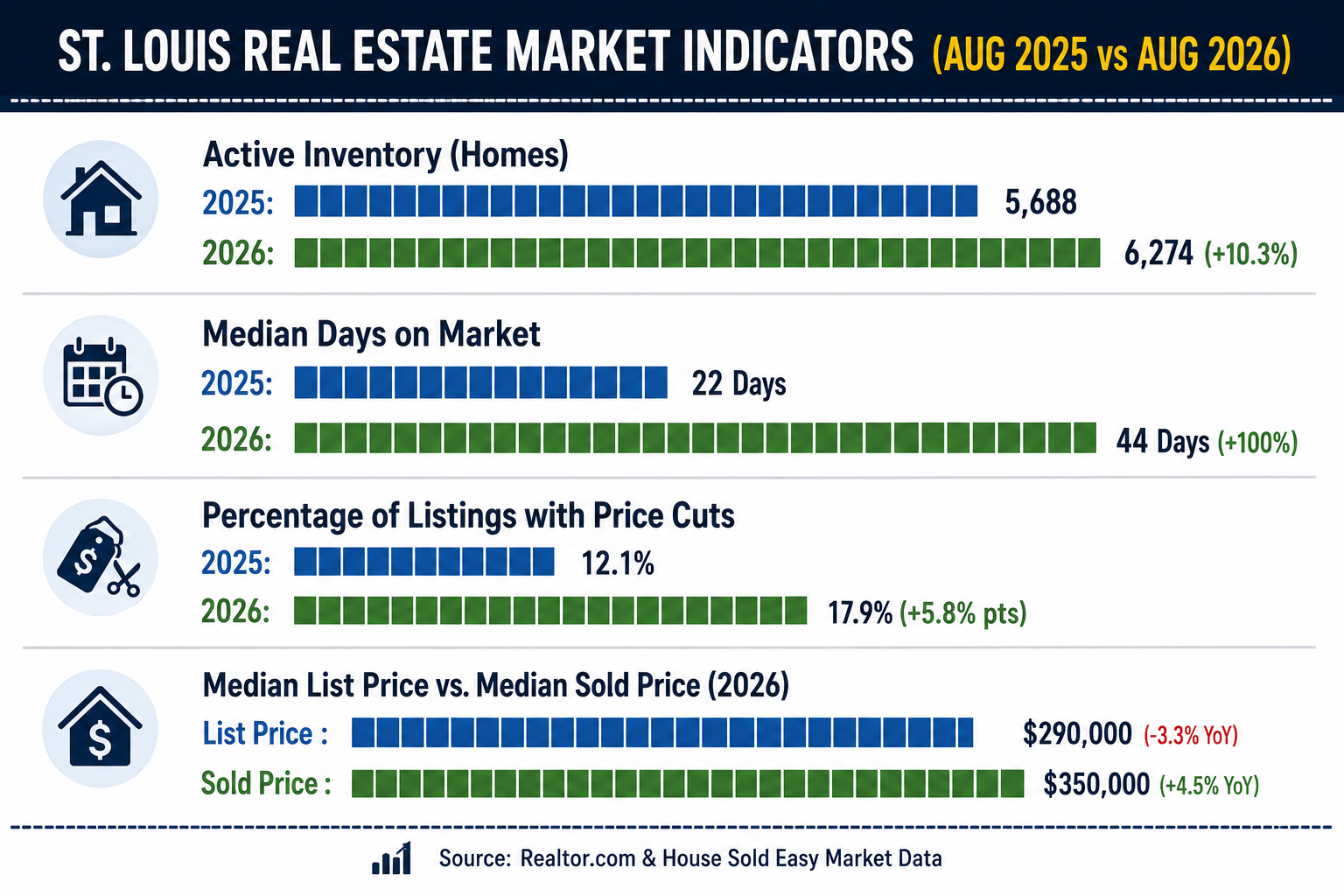
Static Market Visual: Listing vs. Sales Metrics
The visual below summarizes the shift in key St. Louis real estate performance indicators between August 2025 and August 2026:
Neighborhood Pricing Realities
Because St. Louis is a patchwork of distinct submarkets, pricing strategy varies depending on your specific zip code and property type.
|
Neighborhood |
Typical Range |
Strategic Focus |
|---|---|---|
|
Botanical Heights |
$350,000–$400,000+ |
Premium pricing for historic renovations; realistic pricing for un-renovated homes. |
|
Central West End |
$320,000–$380,000 |
Anchored by major employers; price to match condo vs. single-family demand. |
|
St. Louis Hills (63139) |
$210,000–$240,000 |
Stable demand; competitive pricing brings strong buyer interest. |
|
Tower Grove South |
$260,000–$320,000 |
Demand for updated historic homes; price based strictly on finish level. |
|
North City (The Ville, Baden) |
$120,000–$180,000 |
Active investor market; price to move cash transactions efficiently. |
Conclusion
The August 2026 market rewards sellers who prioritize strategy over sentiment. While the era of automatic bidding wars has faded, the St. Louis market remains active for properties that align with current buyer expectations. By moving away from "testing" prices and instead anchoring your strategy to verified sold comparables, you position your home to compete effectively in an environment where buyers have more options than they have seen in years. Success in this market isn’t about chasing the highest possible list price; it is about securing the highest possible net proceeds in a reasonable timeframe. When you price accurately from day one, maintain flexibility regarding market feedback, and acknowledge that a 45-day sales cycle is the new normal, you avoid the "stale listing" trap that forces costly, reactive price cuts. If you are preparing to sell, view your home through the eyes of a data-conscious buyer: price it to generate momentum, not just hope. Connect with a local real estate professional who can provide a neighborhood-specific Comparative Market Analysis (CMA), and remember that in a shifting market, your first offer is often your best offer. The St. Louis market hasn't stopped moving—it has simply become more discerning. Make sure your listing is the one that stands out for the right reasons.
Ready to Buy or Sell in St. Louis? House Sold Easy Has You Covered!
Whether you're thinking about listing your home or exploring a cash offer, it's worth understanding all of your options before making a decision. The right choice depends on your timeline, your property's condition, and your goals. Contact House Sold Easy to discuss your situation and see what makes the most sense for you.Our St. Louis experts know every corner of this city and will make buying your dream home or selling your high-end property a breeze. Don’t miss out on the hottest market in the U.S.! Contact House Sold Easy today and let’s make your real estate goals happen!